CRAWLER MOUNTED CRANE
CONSTRUCTION TECHNOLOGY & EQUIPMENTS
(PRESENTATION)
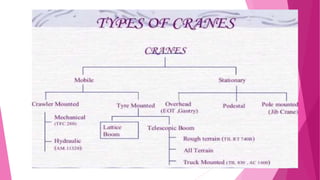
CRANE
• A crane is a type of machine, generally equipped with a hoist rope, wire
ropes or chains, and sheaves, that can be used both to lift and lower materials and
to move them horizontally.
• It is mainly used for lifting heavy things and transporting them to other places.
• The device uses one or more simple machines to create mechanical advantage and
thus move loads beyond the normal capability of a human.
• Cranes are commonly employed in the transport industry for the loading and
unloading of freight, in the construction industry for the movement of materials,
and in the manufacturing industry for the assembling of heavy equipment.
CRAWLER MOUNTED CRANE-INTRODUCTION
. The crawler crane is basically a tracked vehicle that has a crane mechanism
attached to it.
2. This crane has the capability to work on every type of ground surface, even on
the softest grounds, thanks to its specially designed track properties. The metal
tracks make the crawler crane very stable on the ground and also provide increased
maneuverability on the ground.
3. The lifting capacity of the crawler crane ranges from 30 to 3000 tons depending
on the model.
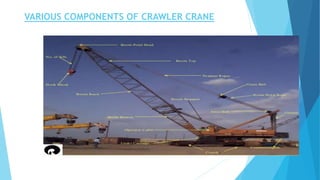
VARIOUS COMPONENTS OF CRAWLER CRANE
COMPONENTS
 1. CRANE: consists of a rotating structure for lifting and lowering horizontally on crawler treads
 2. HOIST: used to lift and lower load
 3. BOOM: an inclined spar, strut, or other long member supporting the hoisting tackle
 4. JIB: extension attached to the boom point to provide added boom length for lifting specified
loads
 5. COUNTER WEIGHT: weights used for balancing loads and the weight of the crane in providing
stability
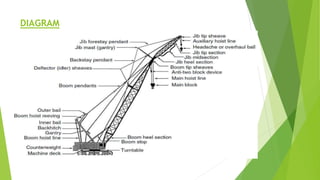
DIAGRAM
1. All crawler cranes consist of several parts. The propulsion system and the tracks
are the main parts of the crane.
2. A long boom is attached to the cabin and can be raised high above the control
cabin. Cables move through the boom and a hook is attached at the end of the boom
for catching, lifting and moving various kinds of items and loads from one place to
another.
3. Some crawler crane models come with additional part known as a jib which is
attached at the end of the boom. The jib allows the crawler crane to move items
even further from its position on the ground. The crawler crane moves like a crawler
tractor, but because of its weight it moves very slowly on the ground.
4.One main feature which allows the crawler crane to lift and move heavy loads
without losing control is the counterweight. The counterweight are usually placed at
the back of the crane and can weight up to several tons. The crawler crane is
versatile machine , capable of performing and completing various lifting tasks on all
types of groung surfaces and weather conditions.
ADVANTAGES AND DISADVANTAGES
 The MAIN ADVANTAGE of the crawler crane is the ability to move and lift items
and other heavy loads around the construction site very easily. In addition,
the tracks of the crawler crane provide support and increased stability.
 • The BIGGEST DISADVANTAGE of the crawler crane is the big size and weight.
The crawler crane is not transported fully assembled. They are just too big
for the roads. That's why they are delivered in manageable pieces and
assemble on site. This can be a project on its own and will involve a team of
professional heavy lifting technicians such as riggers and operators. The
configuration of the crane is predetermined in advance by the lift engineer
based on the customer's project requirement.
EXAMPLE
GIVEN DATA:ACE 750 –MODEL
PURCHASE COST:175 LAKHS
USEFUL LIFE:10 YEARS(2000Hr/Yr)
ENGINE:230 Hp
Assumed data :operating factor-0.65
Salvage value-10%purchase cost
Maintainance & repair-85%of depreciation
Investment cost-12% of AAI
Lubricating oil-20% of fuel cost
Labour cost -15000 rupees per month
1)Avg annual investment-
P(n+1)+S(n-1)
2n
Here, S=10% of P
P=purchase value
S=salvage value
n=useful life
=175*10^5(10+1)+175*10^4(10-1)
2*10
=10412500rupees=104.125 lakhs
a)Investment cost per year=12% avg annual investment
=0.12*104.125 lakhs
=12.495lakh rs / yr
ICP hr=12.495lakh rs/2000
=624.75 rs/hr
b)Depreciation cost per year=P-S
n
=175lakh-17.5lakh
10
=15.75lakh/yr
DCP per hour=787.5rs/hr
c)Maintainance & repair cost/year-
85%of depreciation=0.85*15.75lakh/yr=13.3875lakh/year
per hour =669.37rs/hr
d)Fuel cost-Assume the rate of fuel :60rs/lt
Operating fuel consumption/hr(Q)=op. factor *Hp*fuel factor
Fuel fac.=0.04gal/Hp=0.04*3.785L/hp=0.1514L/hp
Opearting fuel consumption=230*0.6*0.1514=20.893L
Fuel cost=20.893*60=125.6rs/hr
e)Lubricating oil cost=20%of fuel cost=0.20*1253.6=250.716rs
f) Labour cost=15000*12
2000
=90rs/hr
Total owning & operating cost=3425.22rs/hr
MAJOR CAUSES OF CRANE ACCIDENTS
the major causes or crane accidents to include :
 1. Crane buckling or collapsing: All cranes have weight limits to ensure that
the crane will not tip over. To counter balance the weight, cranes use
counterweight and out-rigging systems. If the maximum weight is exceeded,
the crane will be in danger of either buckling or the boom may collapse.
 2. Improper crane assembly: One of the biggest reasons that a boom collapses
is improper assembly. Specifically if the crane does not have the proper
blocking (wood or metal supports) to stabilize the load, the unbalanced load
will move and may lead to the crane collapsing.
 3. Improper employee training: Operators who do not have the proper
training in crane operation and safety procedures may lead to crane
accidents.
4.Mechanical failures: Routine crane maintenance should be followed to prevent
accidents due to mechanical failure. Crane components with excessive wear
should be repaired and replaced right away.
5. Contact with overhead power lines: Electrocution from contact with overhead
power lines is leading cause of crane related accidents. Both the crane operator
and workers in the crane basket should be aware of the placement of power lines
surrounding the worksite. Before work commences the current to active power
lines should be shut off to prevent electrocution from accidental contact with
live wires.
6. Flawed or infrequent inspections: Timely, consistent inspections by
experienced and well trained inspectors can wholly prevent tragic accidents.
PLANNING BEFORE START-UP
1.Level the crane and ensure support surface is firm and able to support the load.
2.Know the basic crane capacities , limitations, and job site restrictions ,such as the location of
power lines ,unstable soil or high winds.
3.Contact power line owners and determine precautions . Know the location and voltage of
overhead power lines.
4.At the beginning ,walk-around your crane checking for mechanical , electrical , structural , and
hydraulic issues (MESH).
5.Make other personnel aware of hoisting activities.
6.Barricade areas within swing radius.
7.Ensure proper maintenance and inspections.
8.Determine safe areas to store materials and place machinery.
APPLICATIONS
1.Used in lifting operations on different ground surfaces, including soft ground .
2. Used in demolition.
3. Used in bridge/road construction.
4.Used in Cargo loading.
5.Used in removal of debris.
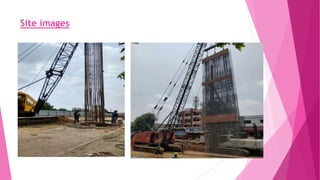
Site images
MADE BY: ANUBHAV SUHALKA(16BCL005)
ANUSHKA SUROLIA(16BCL007)
AXAY SHARMA(16BCL008)

Crawler Mounted crane

  • 1.
    CRAWLER MOUNTED CRANE CONSTRUCTIONTECHNOLOGY & EQUIPMENTS (PRESENTATION)
  • 2.
    CRANE • A craneis a type of machine, generally equipped with a hoist rope, wire ropes or chains, and sheaves, that can be used both to lift and lower materials and to move them horizontally. • It is mainly used for lifting heavy things and transporting them to other places. • The device uses one or more simple machines to create mechanical advantage and thus move loads beyond the normal capability of a human. • Cranes are commonly employed in the transport industry for the loading and unloading of freight, in the construction industry for the movement of materials, and in the manufacturing industry for the assembling of heavy equipment.
  • 4.
    CRAWLER MOUNTED CRANE-INTRODUCTION .The crawler crane is basically a tracked vehicle that has a crane mechanism attached to it. 2. This crane has the capability to work on every type of ground surface, even on the softest grounds, thanks to its specially designed track properties. The metal tracks make the crawler crane very stable on the ground and also provide increased maneuverability on the ground. 3. The lifting capacity of the crawler crane ranges from 30 to 3000 tons depending on the model.
  • 5.
    VARIOUS COMPONENTS OFCRAWLER CRANE
  • 6.
    COMPONENTS  1. CRANE:consists of a rotating structure for lifting and lowering horizontally on crawler treads  2. HOIST: used to lift and lower load  3. BOOM: an inclined spar, strut, or other long member supporting the hoisting tackle  4. JIB: extension attached to the boom point to provide added boom length for lifting specified loads  5. COUNTER WEIGHT: weights used for balancing loads and the weight of the crane in providing stability
  • 7.
  • 8.
    1. All crawlercranes consist of several parts. The propulsion system and the tracks are the main parts of the crane. 2. A long boom is attached to the cabin and can be raised high above the control cabin. Cables move through the boom and a hook is attached at the end of the boom for catching, lifting and moving various kinds of items and loads from one place to another. 3. Some crawler crane models come with additional part known as a jib which is attached at the end of the boom. The jib allows the crawler crane to move items even further from its position on the ground. The crawler crane moves like a crawler tractor, but because of its weight it moves very slowly on the ground. 4.One main feature which allows the crawler crane to lift and move heavy loads without losing control is the counterweight. The counterweight are usually placed at the back of the crane and can weight up to several tons. The crawler crane is versatile machine , capable of performing and completing various lifting tasks on all types of groung surfaces and weather conditions.
  • 9.
    ADVANTAGES AND DISADVANTAGES The MAIN ADVANTAGE of the crawler crane is the ability to move and lift items and other heavy loads around the construction site very easily. In addition, the tracks of the crawler crane provide support and increased stability.  • The BIGGEST DISADVANTAGE of the crawler crane is the big size and weight. The crawler crane is not transported fully assembled. They are just too big for the roads. That's why they are delivered in manageable pieces and assemble on site. This can be a project on its own and will involve a team of professional heavy lifting technicians such as riggers and operators. The configuration of the crane is predetermined in advance by the lift engineer based on the customer's project requirement.
  • 10.
    EXAMPLE GIVEN DATA:ACE 750–MODEL PURCHASE COST:175 LAKHS USEFUL LIFE:10 YEARS(2000Hr/Yr) ENGINE:230 Hp Assumed data :operating factor-0.65 Salvage value-10%purchase cost Maintainance & repair-85%of depreciation Investment cost-12% of AAI Lubricating oil-20% of fuel cost Labour cost -15000 rupees per month 1)Avg annual investment-
  • 11.
    P(n+1)+S(n-1) 2n Here, S=10% ofP P=purchase value S=salvage value n=useful life =175*10^5(10+1)+175*10^4(10-1) 2*10 =10412500rupees=104.125 lakhs a)Investment cost per year=12% avg annual investment =0.12*104.125 lakhs =12.495lakh rs / yr
  • 12.
    ICP hr=12.495lakh rs/2000 =624.75rs/hr b)Depreciation cost per year=P-S n =175lakh-17.5lakh 10 =15.75lakh/yr DCP per hour=787.5rs/hr c)Maintainance & repair cost/year- 85%of depreciation=0.85*15.75lakh/yr=13.3875lakh/year per hour =669.37rs/hr d)Fuel cost-Assume the rate of fuel :60rs/lt Operating fuel consumption/hr(Q)=op. factor *Hp*fuel factor Fuel fac.=0.04gal/Hp=0.04*3.785L/hp=0.1514L/hp
  • 13.
    Opearting fuel consumption=230*0.6*0.1514=20.893L Fuelcost=20.893*60=125.6rs/hr e)Lubricating oil cost=20%of fuel cost=0.20*1253.6=250.716rs f) Labour cost=15000*12 2000 =90rs/hr Total owning & operating cost=3425.22rs/hr
  • 14.
    MAJOR CAUSES OFCRANE ACCIDENTS the major causes or crane accidents to include :  1. Crane buckling or collapsing: All cranes have weight limits to ensure that the crane will not tip over. To counter balance the weight, cranes use counterweight and out-rigging systems. If the maximum weight is exceeded, the crane will be in danger of either buckling or the boom may collapse.  2. Improper crane assembly: One of the biggest reasons that a boom collapses is improper assembly. Specifically if the crane does not have the proper blocking (wood or metal supports) to stabilize the load, the unbalanced load will move and may lead to the crane collapsing.  3. Improper employee training: Operators who do not have the proper training in crane operation and safety procedures may lead to crane accidents.
  • 15.
    4.Mechanical failures: Routinecrane maintenance should be followed to prevent accidents due to mechanical failure. Crane components with excessive wear should be repaired and replaced right away. 5. Contact with overhead power lines: Electrocution from contact with overhead power lines is leading cause of crane related accidents. Both the crane operator and workers in the crane basket should be aware of the placement of power lines surrounding the worksite. Before work commences the current to active power lines should be shut off to prevent electrocution from accidental contact with live wires. 6. Flawed or infrequent inspections: Timely, consistent inspections by experienced and well trained inspectors can wholly prevent tragic accidents.
  • 16.
    PLANNING BEFORE START-UP 1.Levelthe crane and ensure support surface is firm and able to support the load. 2.Know the basic crane capacities , limitations, and job site restrictions ,such as the location of power lines ,unstable soil or high winds. 3.Contact power line owners and determine precautions . Know the location and voltage of overhead power lines. 4.At the beginning ,walk-around your crane checking for mechanical , electrical , structural , and hydraulic issues (MESH). 5.Make other personnel aware of hoisting activities. 6.Barricade areas within swing radius. 7.Ensure proper maintenance and inspections. 8.Determine safe areas to store materials and place machinery.
  • 17.
    APPLICATIONS 1.Used in liftingoperations on different ground surfaces, including soft ground . 2. Used in demolition. 3. Used in bridge/road construction. 4.Used in Cargo loading. 5.Used in removal of debris.
  • 18.
  • 19.
    MADE BY: ANUBHAVSUHALKA(16BCL005) ANUSHKA SUROLIA(16BCL007) AXAY SHARMA(16BCL008)