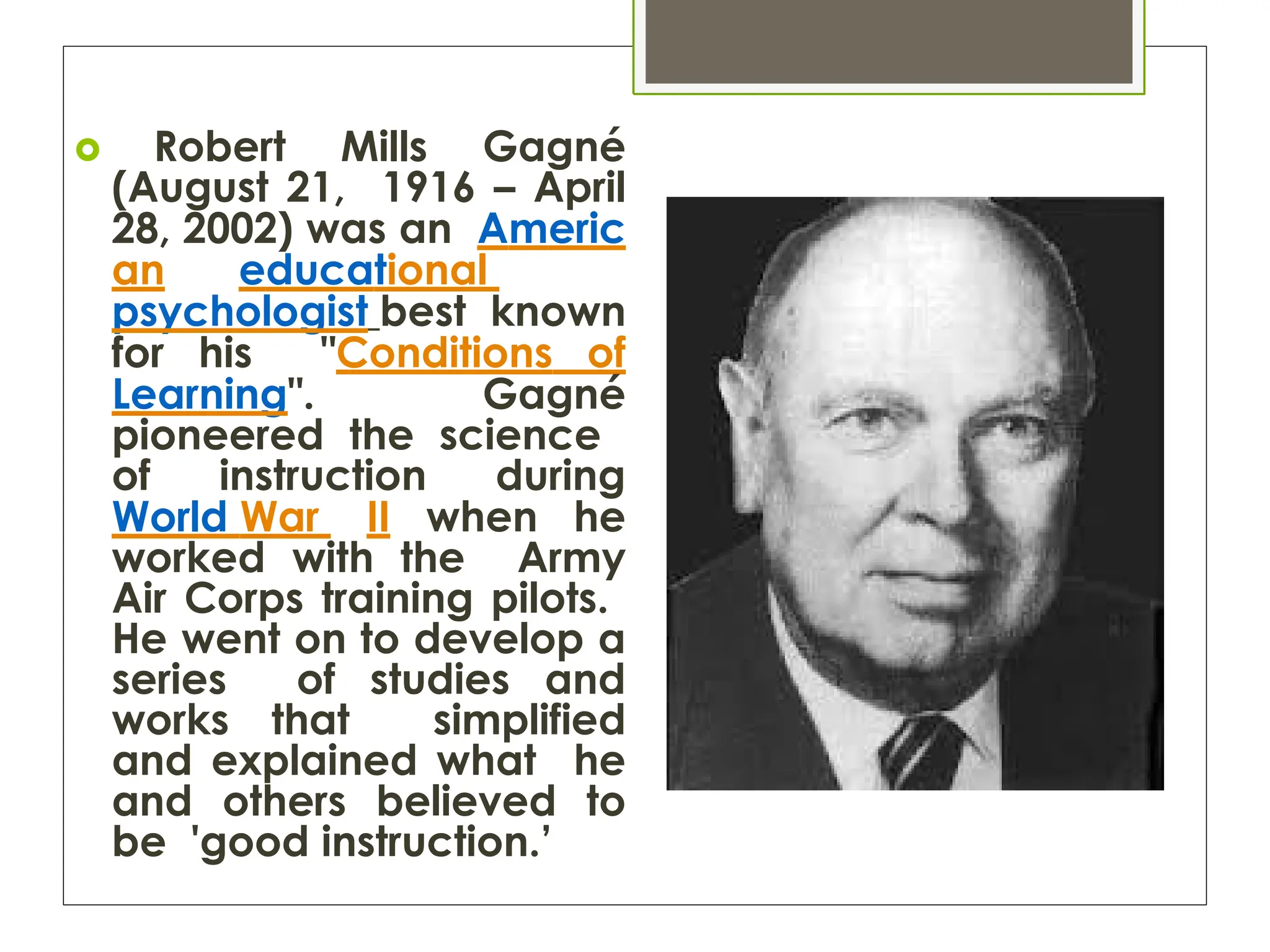
Robert MillsGagné
(August 21, 1916 – April
28, 2002) was an Americ
an educational
psychologist best known
for his "Conditions of
Learning". Gagné
pioneered the science
of instruction during
World War II when he
worked with the Army
Air Corps training pilots.
He went on to develop a
series of studies and
works that simplified
and explained what he
and others believed to
be 'good instruction.’
3.
In 1965 RobertGagne published his book
entitled The Conditions of Learning. In his
book, Gagne (1965) described the analysis
of learning objectives, and how these
different classes of learning objectives relate
to the appropriate instructional designs.
6.
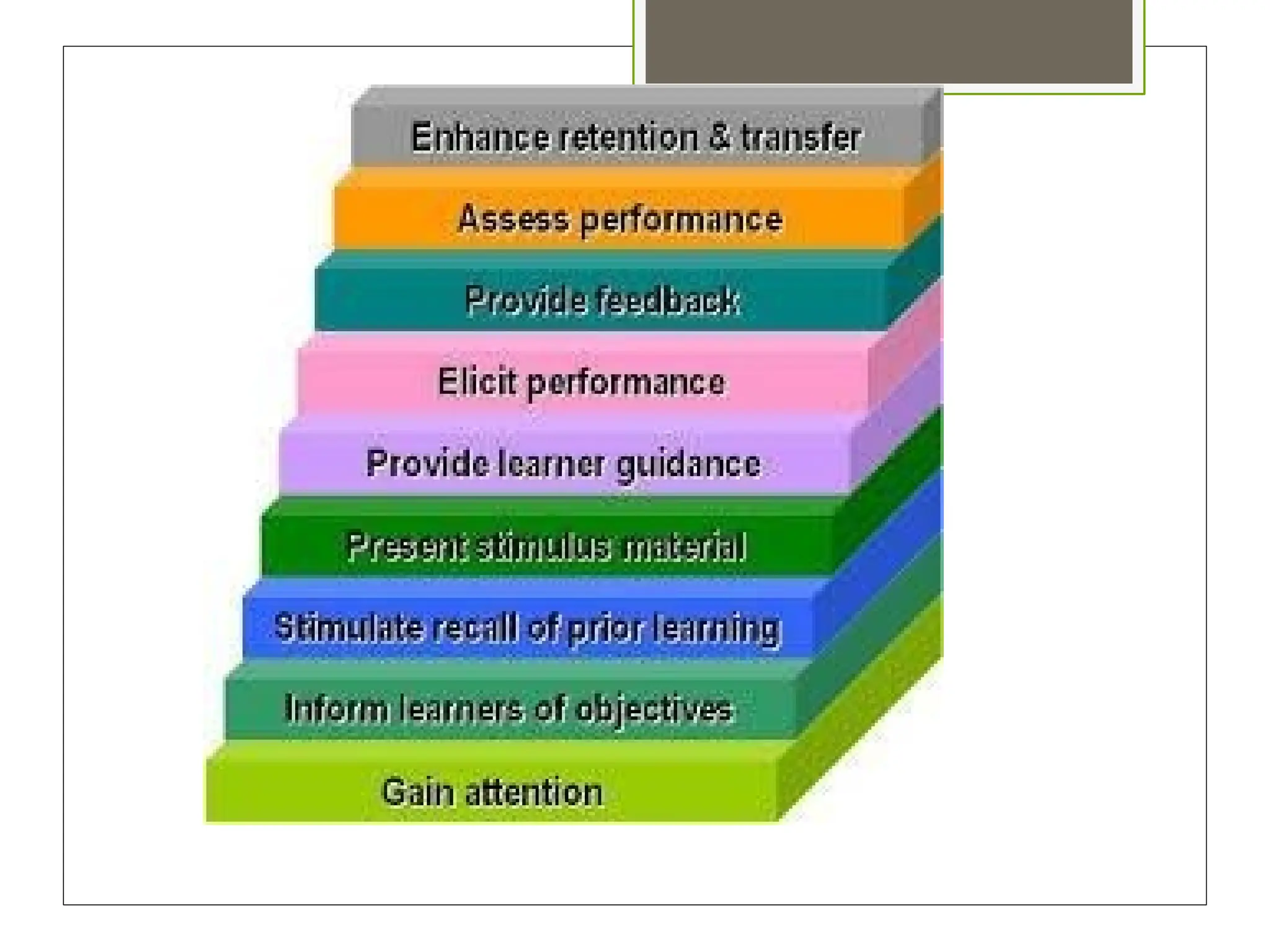
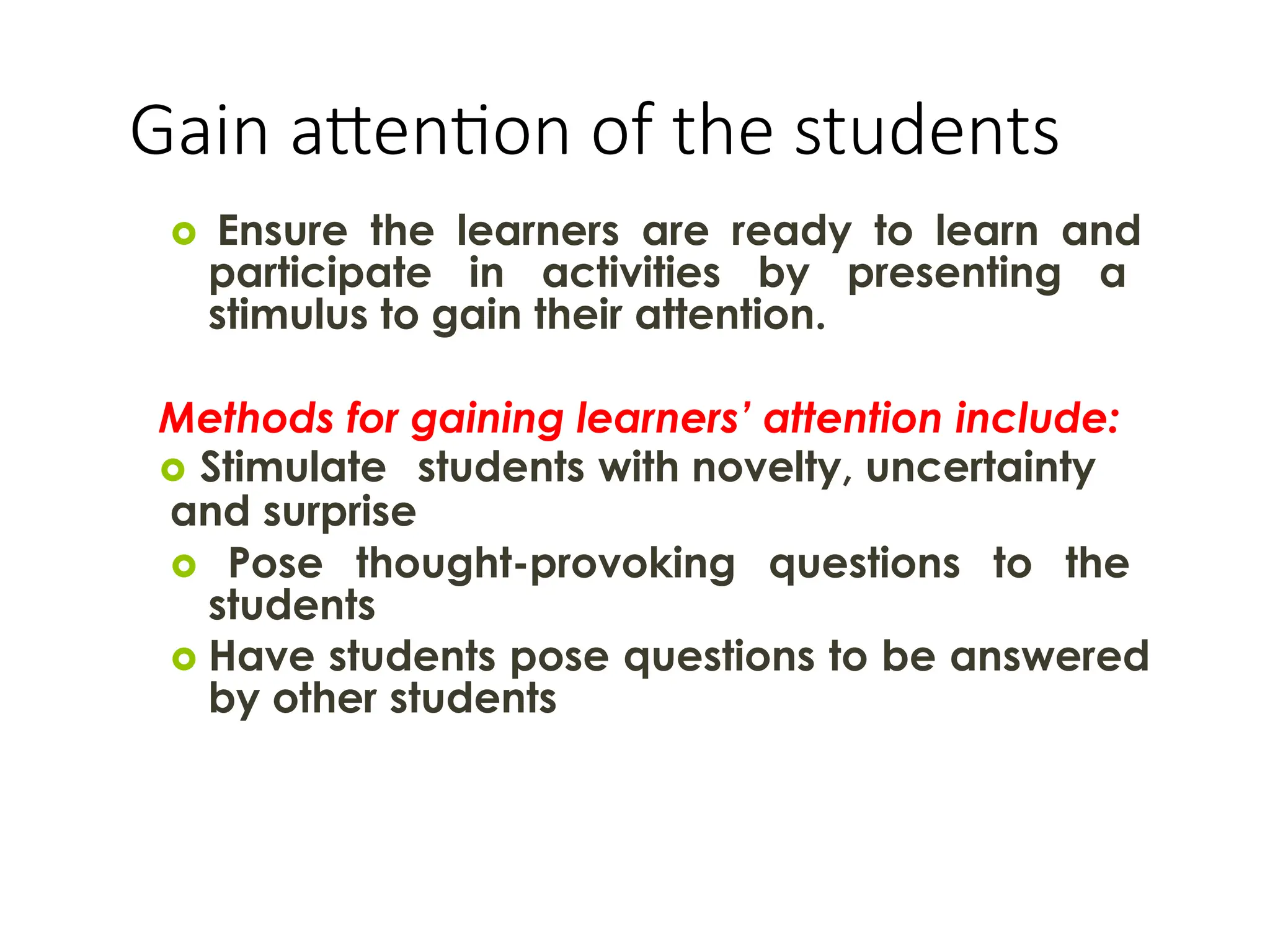
Gain attention ofthe students
Ensure the learners are ready to learn and
participate in activities by presenting a
stimulus to gain their attention.
Methods for gaining learners’ attention include:
Stimulate students with novelty, uncertainty
and surprise
Pose thought-provoking questions to the
students
Have students pose questions to be answered
by other students
7.
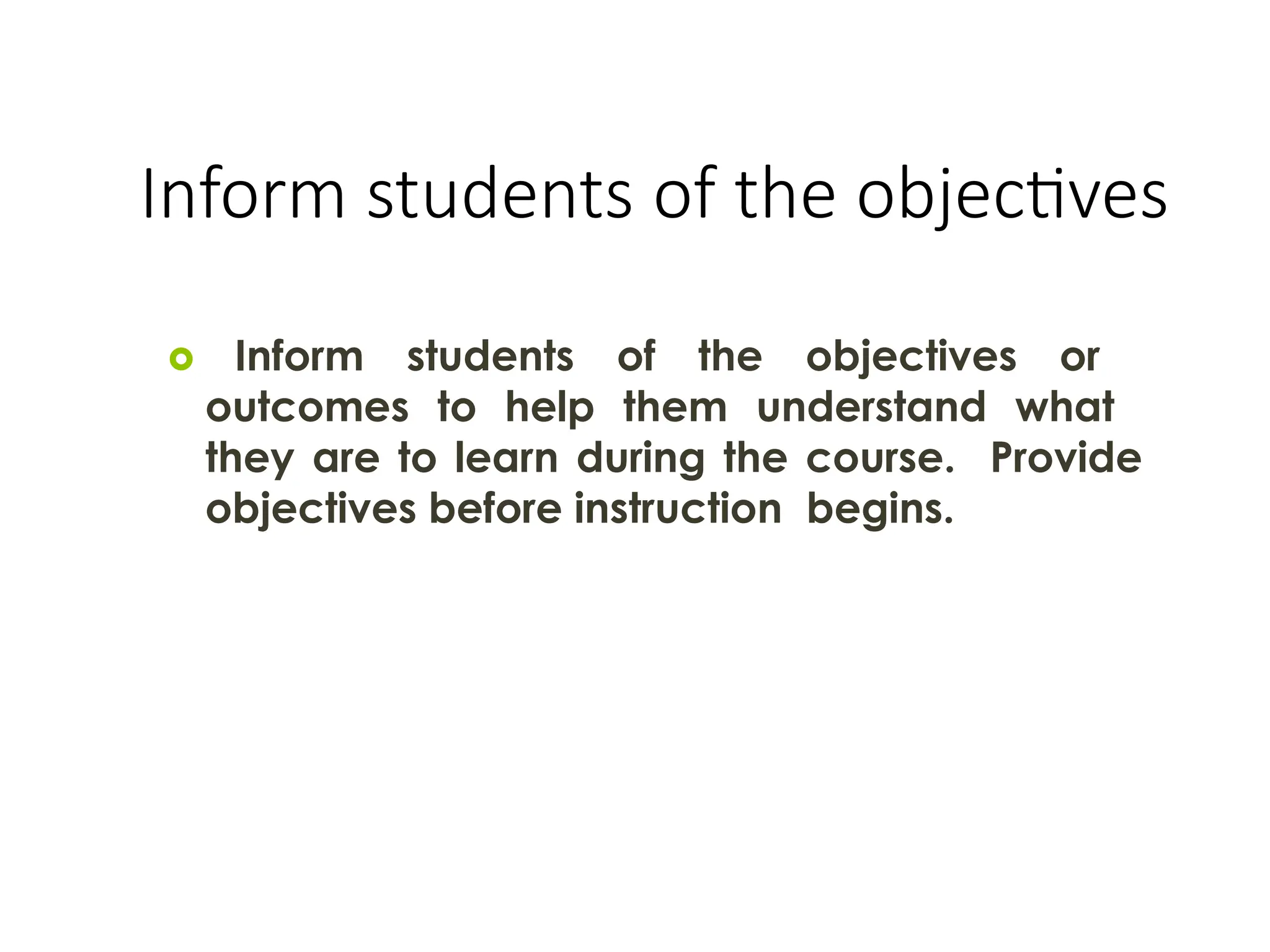
Inform students ofthe objectives
Inform students of the objectives or
outcomes to help them understand what
they are to learn during the course. Provide
objectives before instruction begins.
8.
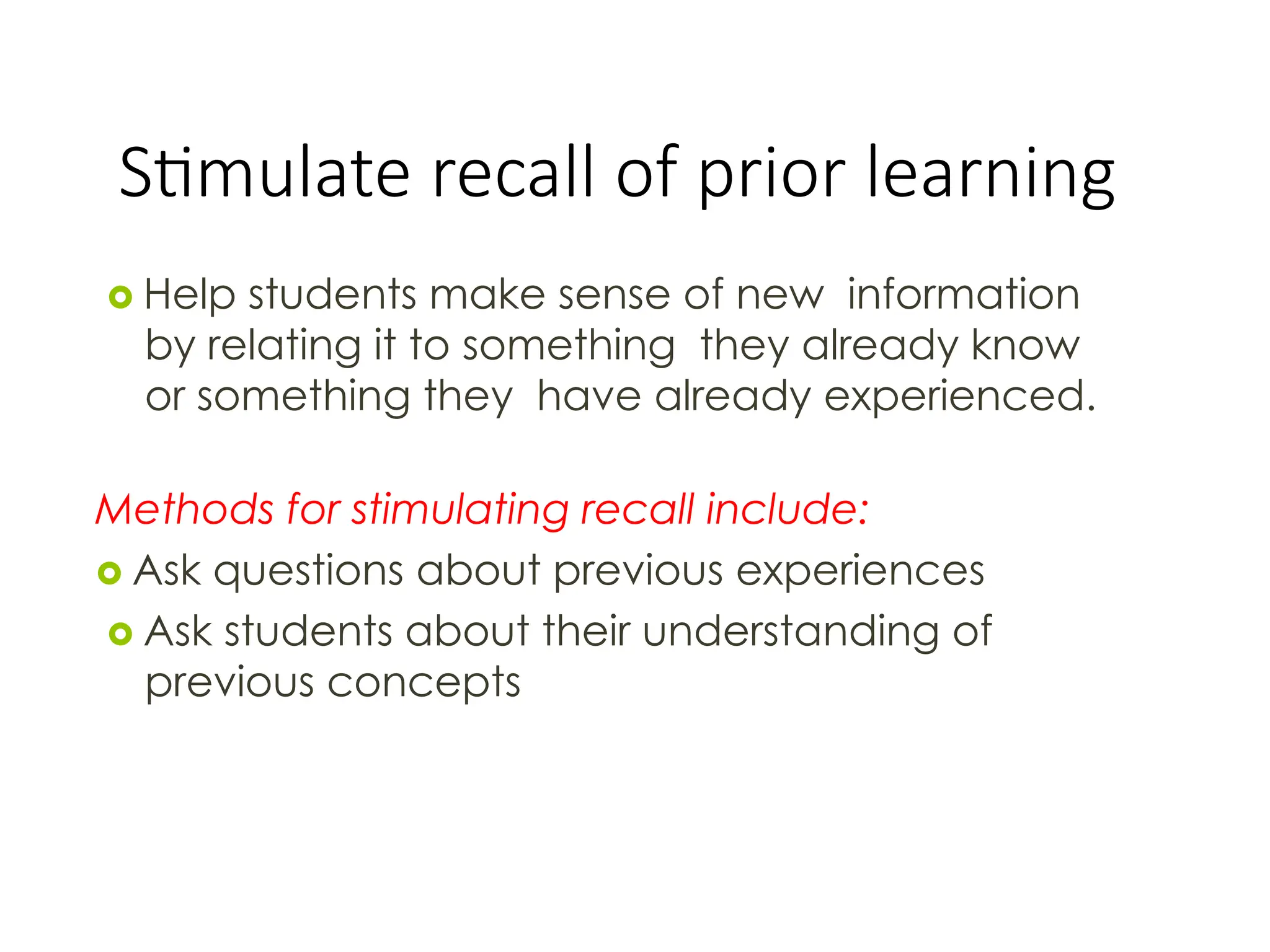
Stimulate recall ofprior learning
Help students make sense of new information
by relating it to something they already know
or something they have already experienced.
Methods for stimulating recall include:
Ask questions about previous experiences
Ask students about their understanding of
previous concepts
9.
Present the content
Usestrategies to present and cue lesson content to provide
more effective, efficient instruction. Organize and chunk
content in a meaningful way. Provide explanations after
demonstrations.
Ways to present and cue lesson content include:
Provide examples
Present multiple versions of the same content, e.g., video,
demonstration, lecture, group work
Provide instructional support as needed – as scaffolds
(cues, hints, prompts) which can be removed after the
student learns the task or content.
Ask deep-learning questions, making reference to what
students already know.
Help students integrate new knowledge by providing real-
world examples.
10.
Provide learning guidance
Advisestudents of strategies to aid them in learning
content and of resources available.
Methods to provide learning guidance include:
Provide instructional support as needed – as
scaffolds (cues, hints, prompts) which can be
removed after the student learns the task or content
Model varied learning strategies –concept mapping,
role playing, visualizing
Use examples and non-examples – in addition to
providing examples, use non-examples to help students
see what not to do or the opposite of examples
Provide case studies, analogies, visual images and
metaphors – case studies for real world application,
analogies for knowledge construction, visual images
to make visual associations, metaphors to support
learning
11.
Elicit performance (practice)
Activatestudent processing to help them internalize new skills and
knowledge and to confirm correct understanding of these concepts.
Ways to activate learner processing include:
Elicit student activities – ask deep-learning questions, make
reference to what students already know or have students
collaborate with their peers
Elicit recall strategies – ask students to recite, revisit, or
reiterate information they have learned
Facilitate student elaborations – ask students to elaborate or
explain details and provide more complexity to their responses
Help students integrate new knowledge – provide content in a
context-rich way (use real-world examples)
12.
Provide feedback
•Types offeedback include:
Confirmatory feedback – Informs the student what did he or she
were supposed to do
Corrective and remedial feedback – informs the student the
accuracy of their performance or response
Informative feedback – Provides information (new, different,
additions, suggestions) to a student and confirms that you have
been actively listening – this information allows sharing between
two people
Analytical feedback – Provides the student with suggestions,
recommendations, and information for them to correct their
performance
Provide immediate feedback to the students performance
to assess and facilitate learning.
13.
Assess performance
In orderto evaluate the effectiveness of the instructional
events, you must test to see if the expected learning outcomes
have been achieved. Performance should be based on
previously stated objectives.
Methods for testing learning include:
Pretest for mastery of prerequisites
Conduct a post-test to check for mastery of content or
skills
Embed questions throughout instruction through oral
questioning and/or quizzes
Include objective or criterion-referenced
performances which measure how well a student has
learned a topic
Identify normative-referenced performances
which compares one student to another student
14.
Enhance retention andtransfer
to the job
To help learners develop expertise, they must
internalize new knowledge.
Methods for helping learners internalize new
knowledge include:
Generating examples
Create concept maps or outlines