Dr. Mahipal Singh
• Introduction
• Definitions Of Growth and Development
• Evolution of human jaw
• Concepts of Growth and Development
• Growth movements
• Theories of growth
• Prenatal development with reference to Craniofacial Region
• Postnatal growth of face and craniofacial region
• Conclusion
 STEWART (1982)
Growth may be defined as a developmental increase in mass. In other words, it is a process that
leads to an increase in the physical size of cells, tissues, organs or the organism as a whole.
 PROFFIT (1986)
Growth refers to an increase in size or number.
 MOYERS (1988)
Growth may be defined as the normal changes in the amount of a living substance.
 STEDMAN (1990)
Growth is an increase in the size of a living being or any of its parts, occurring in the
process of development.
 PINKHAM (1994)
Growth signifies an increase, expansion or extension of a given tissue.
 J.S.HUXLEY
Self multiplication of living substance.
KROGMAN
Increase in size, change in proportion and progressive complexity.
 TODD
An increase in size.
 MOSS
Change in any morphologic parameter which is measurable.
 The jaw and teeth of homosapiens have evolved, from the last common ancestor of
chimpanzee.
 Many factors such as the food eaten and processing of food by fire and tools have affected
the evolution course.
Yusuf emns(2011)on evolution of human jaws and teeth
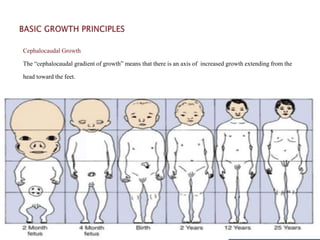
Cephalocaudal Growth
The “cephalocaudal gradient of growth” means that there is an axis of increased growth extending from the
head toward the feet.
 The second month of intrauterine development, the
head takes up almost 50%of the total body length. The cranium is large relative to the face a
nd represents more than half the total head.
 The limbs are still rudimentary and the trunk is underdeveloped.
 The time of birth, the trunk and limbs have grown faster than the head and face, so that the p
roportion of the entire body devoted to the head has decreased to about 30%.
 At birth the cranium is enlarged relative to the face
with the jaws and face relatively underdeveloped.
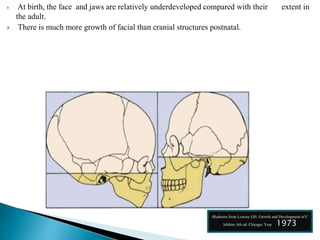
 At birth, the face and jaws are relatively underdeveloped compared with their extent in
the adult.
 There is much more growth of facial than cranial structures postnatal.
(Redrawn from Lowery GH. Growth and Development of C
hildren. 6th ed. Chicago: Year 1973
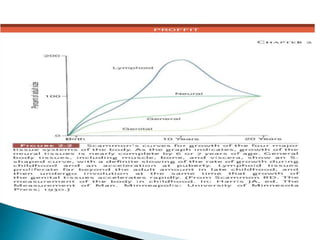
 The human body is comprised of different tissues, of
 which there are four main groups:
1. Lymphoid,
2. Neural,
3. Reproductive and
4. Somatic tissue (e.g. muscles and bone).
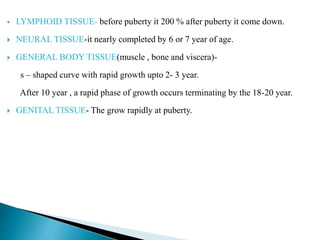
 LYMPHOID TISSUE- before puberty it 200 % after puberty it come down.
 NEURAL TISSUE-it nearly completed by 6 or 7 year of age.
 GENERAL BODY TISSUE(muscle , bone and viscera)-
s – shaped curve with rapid growth upto 2- 3 year.
After 10 year , a rapid phase of growth occurs terminating by the 18-20 year.
 GENITAL TISSUE- The grow rapidly at puberty.
Bjork
“In the case of the brain case, the rate of growth of the inner structure is governed by
the growth of the brain. After the age of 10 or 12 years the increase in size is slight
, whereas the facial skeleton, comprising the bones of the upper facial structure and
the mandible, continues its growth up to the age of 20 and beyond. The cranial base
, which from a functional point of view may be regarded as the border between
brain and facial structure, is obliged, therefore, to develop in conformity with the
different growth patterns of the brain ease and facial structure and consequently
, must follow two different growth rates, one along its internal surface and another
along its external surface.”(Björk 1955)
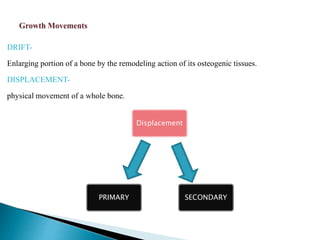
DRIFT-
Enlarging portion of a bone by the remodeling action of its osteogenic tissues.
DISPLACEMENT-
physical movement of a whole bone.
Displacement
SECONDARYPRIMARY
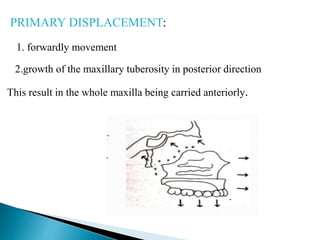
PRIMARY DISPLACEMENT:
1. forwardly movement
2.growth of the maxillary tuberosity in posterior direction
This result in the whole maxilla being carried anteriorly.
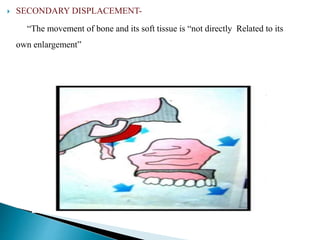
 SECONDARY DISPLACEMENT-
“The movement of bone and its soft tissue is “not directly Related to its
own enlargement”
 GROWTH SPURTS- “sudden acceleration of growth”
 Concept of normality-”cranio-facial growth is that normality changes
with age”
 Rhythm of growth- according to hoaton “ human growth is not a
steady and uniform process wherein all parts of the body enlarge at
the same rate and the increments of one year are equal to that of the
preceding year”
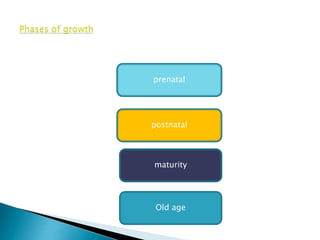
prenatal
postnatal
maturity
Old age
 Genetic theory- Brodie 1955-This theories mainly based on
observation.
 Cartilaginous theory-scott
 Sutural dominance theory-sicher
 Functional matrix theory-melvin moss
 Given by sicher in 1955
 “the primary event in sutural growth is the proliferation of the connective tissue
between two bone. If sutural tissue proliferates, it creates the space for appositional
growth at the border of bone”
Function of suture-
1. Unite the bone
2. absorb the force
3.act as a joint
 Given by james scott-1956
ACCORDING THE SCOTT
- Speno occiptial synchondrosis cartilage- this cartilage responsible for the cranial
base.
- Nasal septal cartilage- responsible for maxilla growth
- condyle cartilage responsible for mandible growth.
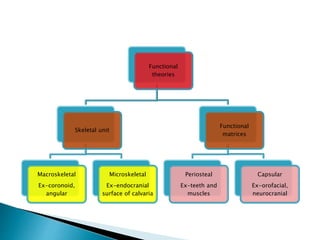
 Given by melvin moss
“ the origin , growth and maintenance of all skeletal tissue and origin are
secondary and compensatory response to event and processes, occuring in
related non skeletal tissue ,organs and functioning space”
O.P kharbanda textbook page 114
Functional
theories
Skeletal unit
Macroskeletal
Ex-coronoid,
angular
Microskeletal
Ex-endocranial
surface of calvaria
Functional
matrices
Periosteal
Ex-teeth and
muscles
Capsular
Ex-orofacial,
neurocranial
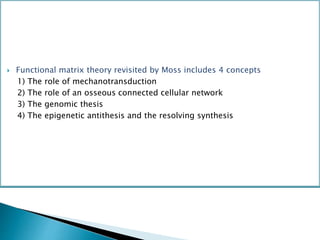
 Functional matrix theory revisited by Moss includes 4 concepts
1) The role of mechanotransduction
2) The role of an osseous connected cellular network
3) The genomic thesis
4) The epigenetic antithesis and the resolving synthesis
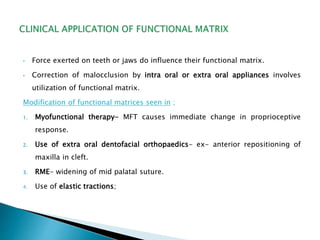
• Force exerted on teeth or jaws do influence their functional matrix.
• Correction of malocclusion by intra oral or extra oral appliances involves
utilization of functional matrix.
Modification of functional matrices seen in ;
1. Myofunctional therapy- MFT causes immediate change in proprioceptive
response.
2. Use of extra oral dentofacial orthopaedics- ex- anterior repositioning of
maxilla in cleft.
3. RME- widening of mid palatal suture.
4. Use of elastic tractions;
Growth
data
observations
Rating and
ranking
quantitatve
opinion
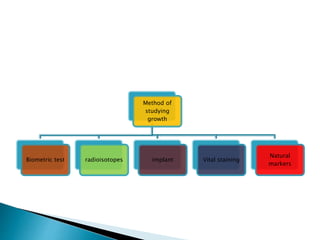
Method of
studying
growth
Biometric test radioisotopes implant Vital staining
Natural
markers
 TODD (1931)
Development in an increase in complexity.
 LOWREY (1951)
Development is used to indicate an increase in skill and complexity
of functions.
 PROFFIT (1986)
Development is in complexity.
 MOYER (1988)
 Development refers to all the naturally occurring
unidirectional events in the life of an individual from its existence as a single
cell to its elaboration as a multifunctional unit terminating in death.
STEDMAN (1990)
The act or process of natural progression from a previous, lower or embryonic
stage to a later more complex, or adult stage.
 PINKHAM (1994)
Development addresses the progressive evolution of a tissue.
 Prenatal : occurring or existing before birth.
 Postnatal : related to denoting the period after child
birth.
Stages of prenatal growth:
1. The period of the ovum from fertilization to the end of
the 14th day.
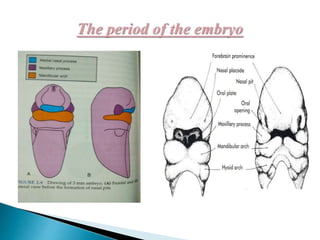
2. The period of the embryo from the 14th day to about
56th day.
3. The period of the fetus, from about 56th day until the
270th day – birth.
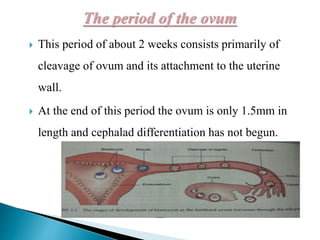
 This period of about 2 weeks consists primarily of
cleavage of ovum and its attachment to the uterine
wall.
 At the end of this period the ovum is only 1.5mm in
length and cephalad differentiation has not begun.
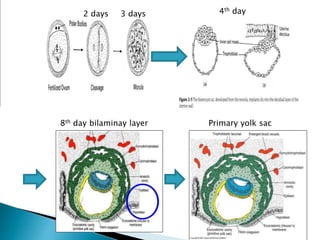
2 days 3 days 4th day
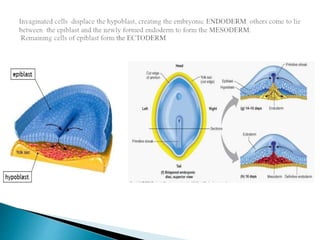
8th day bilaminay layer Primary yolk sac
 No arch cartilage/primary cartilage exists in the
maxillary process, but the center of ossification is
associated closely with nasal capsule.
 Centre of ossification appears where the anterosuperior
nerve is given off from the infraorbital nerve.
 From this centre bone formation spreads post below the
orbit towards the developing zygoma, ant towards the
future incisor region, superiorly to form the frontal
process and into the palatine process to form the hard
palate.
 The maxillary sinus forms during the 16th weekas a
shallow groove on the nasal aspect of developing
maxilla.
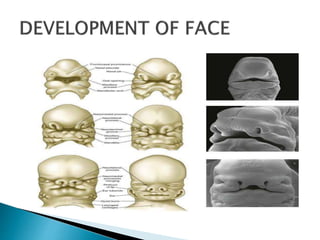
 About 4th week of intrauterine life the developing brain and pericardium form 2
prominent bulge on ventral aspect of embryo.
 These bulges are separated by primitive oral cavity called stomodeum.
 The floor of the stomodeum is formed by bucco-pharyngeal membrane, which
separates it from foregut .
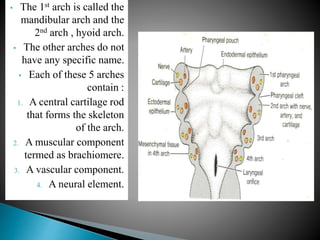
 The pharyngeal arches are laid down on the lateral and ventral aspect of the cranial
most part of the foregut that lies in close approximation with the stomodeum.
 Initially there are six pharyngeal arches, but 5th one usually disappears as soon as it
is formed leaving only five.
 They are separated by four branchial grooves.
• The 1st arch is called the
mandibular arch and the
2nd arch , hyoid arch.
• The other arches do not
have any specific name.
• Each of these 5 arches
contain :
1. A central cartilage rod
that forms the skeleton
of the arch.
2. A muscular component
termed as brachiomere.
3. A vascular component.
4. A neural element.
 The mandibular arch forms the lateral wall of the
stomodeum.
 It gives off a bud from its dorsal end, these bud is called as
the maxillary process.
 It grows ventro-medially, cranial to the main part of the
arch, which is now called the mandibular process.
 The mandibular processes of both sides grow towards each
other and fuse in the mid-line.
 They now form lower of the stomodeum i.e. the lower lip
and lower jaw.
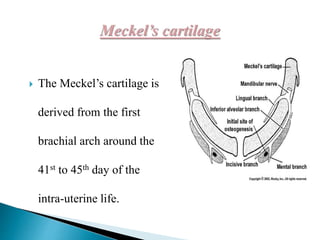
 The Meckel’s cartilage is
derived from the first
brachial arch around the
41st to 45th day of the
intra-uterine life.
 It extends from the cartilaginous otic capsue to the
midline or symphysis and provides a template for
guiding the growth of mandible.
 A major portion of Meckel’s cartilage disappears during
growth and remaining part develops into the following
structures.
1. Mental ossicles
2. Incus and malleus
3. Spine of sphenoid bone
4. Anterior ligament of malleus
5. Spheno-mandibular ligament
 A single ossification center for each half of the mandible
arises in the 6th week of the intrauterine life in the region of
the bifurcation of inferior alvelolar nerve into mental and
incisive branches.
 The ossifying membrane is located lateral to the Meckel’s
cartilage and its accompanying neuro-vascular bundle.
 From these primary center, ossification spreads below and
around the inferior alveolar nerve and its incisive branch and
upward to form a trough for accommodating the developing
tooth buds.
 Spread of the intramembranous ossification dorsally and
ventrally forms the body and ramus of the mandible.
 As the ossification continues, the Meckel’s cartilage
becomes surrounded and invaded by bone.
 Ossification stops at the site that will later become
the mandibular lingula from where the Meckel’s
cartilage continue into the middle ear and develops
into the auditory ossicles i.e. malleus and incus.
 The sphenomandibular ligament that extends from
the lingual of mandible to the sphenoid bone forms
the remnant of Meckel’s cartilage.
 Endochondral bone formation is seen only in 3 areas of
the mandible:
1. The condylar process
2. The coronoid process
3. The Mental region
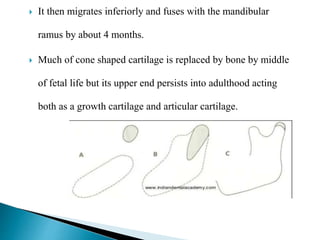
 At about the 5th week of intrauterine life an area of
mesenchymal condensation can be seen above the
ventral part of the developing mandible.
 This develops into a cone shaped cartilage by about
10th week and starts ossification by 14th week.
 It then migrates inferiorly and fuses with the mandibular
ramus by about 4 months.
 Much of cone shaped cartilage is replaced by bone by middle
of fetal life but its upper end persists into adulthood acting
both as a growth cartilage and articular cartilage.
 Secondary accessory cartilages appear in the region of the
coronoid process by about 10 to 14 week of intrauterine
life.
 The coronoid accessory cartilage becomes incorporated into
the expanding intramembranous bone of the ramus and
disappears before birth.
 In the mental region, on either side of the symphysis,
on one or two small cartilages appear and ossify in the
7th month of intrauterine life to form variable numbers
of mental ossicles in the fibrous tissues of symphysis.
 These ossicles become incorporated into the
intramembranous bone when the symphysis ossifies
completely during the 1st year of postnatal life.
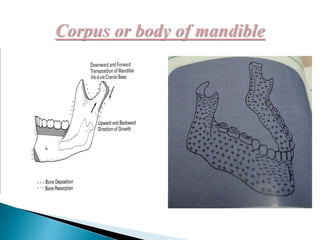
 Of the facial bones, the mandible undergoes the largest amount of
growth postnatally and also exhibits the largest variability in
morphology.
 While the mandible appears in the adult as a single bone, it is developed
mentally and functionally visible into several skeletal subunits.
 The basal bone or the body of the mandible forms 1 unit, to which is
attached the alveolar process, the coronoid process, condylar process,
angular process, the ramus, the lingual tuberosity and the chin.
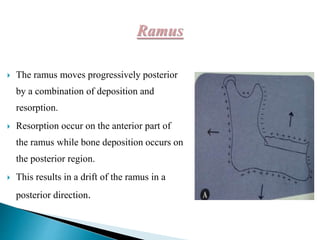
 The ramus moves progressively posterior
by a combination of deposition and
resorption.
 Resorption occur on the anterior part of
the ramus while bone deposition occurs on
the posterior region.
 This results in a drift of the ramus in a
posterior direction.
 The functions of the remodeling of the ramus are:
1. To accommodate the increasing mass of masticatory
muscles inserted into it.
2. To accommodate the enlarged breadth of the
pharyngeal space.
3. To facilitate the lengthening of the mandibular
body, which in turn accommodates the erupting
molars.
 On the lingual side of the angle of mandible, resorption
takes place on the posterio-inferior aspect while deposition
occur on the anterio-superior aspect.
 On buccal side, resorption occur on the anterio-superior
part while depostition takes place on the posterior-superior
part.
 This result in flaring of angle of mandible as age advances.
 The lingual tuberosity is a direct equivalent of the maxillary
tuberosity, which forms a major site of growth for mandibular arch.
 It forms the boundary between the ramus and the body.
 The lingual tuberosity moves posteriorly by deposition on its
posteriorly facing surface.
 It can be noticed that the lingual tuberosity protrudes noticeably in a
lingual direction and that it lies well towards the midline of the
ramus.
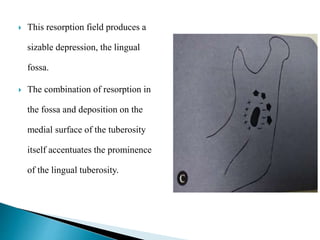
 Prominence of the tuberosity is increased by the presence of large
resorption field just below it.
 This resorption field produces a
sizable depression, the lingual
fossa.
 The combination of resorption in
the fossa and deposition on the
medial surface of the tuberosity
itself accentuates the prominence
of the lingual tuberosity.
 The mandibular condyle has been recognized as an important growth
site.
 The head of the condyle is covered by a thin layer of cartilage called the
condylar cartilage.
 The presence of the condylar cartilage is an adaption to withstand the
compression that occurs at the joint.
 The role of condyle in growth of mandible has remained a controversy.
 The condylar growth rate increases at puberty reaching a peak between
12.5 to 14 years.
 The growth ceases around the age of 20.
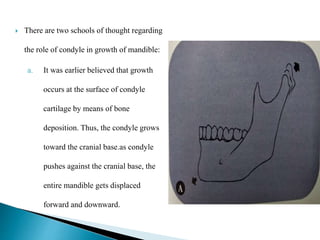
 There are two schools of thought regarding
the role of condyle in growth of mandible:
a. It was earlier believed that growth
occurs at the surface of condyle
cartilage by means of bone
deposition. Thus, the condyle grows
toward the cranial base.as condyle
pushes against the cranial base, the
entire mandible gets displaced
forward and downward.
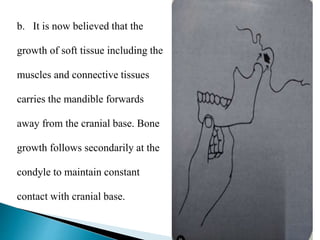
b. It is now believed that the
growth of soft tissue including the
muscles and connective tissues
carries the mandible forwards
away from the cranial base. Bone
growth follows secondarily at the
condyle to maintain constant
contact with cranial base.
 The growth of coronoid process follows the enlarging
‘V’ principle.
 Viewing the longitudinal section of the coronoid
process from the posterior aspect it can be seen that
deposition occur on the lingual (medial) surfaces of the
left and right coronoid process.
 Although addition takes place on the lingual side, the
vertical dimension of coronoid process also increases.
 This follows the ‘V’ principle.
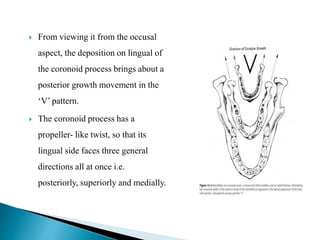
 From viewing it from the occusal
aspect, the deposition on lingual of
the coronoid process brings about a
posterior growth movement in the
‘V’ pattern.
 The coronoid process has a
propeller- like twist, so that its
lingual side faces three general
directions all at once i.e.
posteriorly, superiorly and medially.
 Congenital diseases : is one which is present at
or before birth but is not necessarily inherited
i.e. transmitted through the genes.
 Developmental anomalies : unusual sequel of
development, a deviation from shape or size
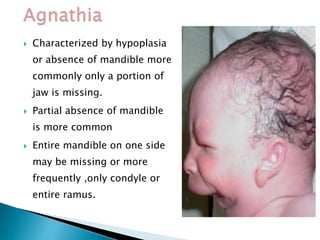
 Characterized by hypoplasia
or absence of mandible more
commonly only a portion of
jaw is missing.
 Partial absence of mandible
is more common
 Entire mandible on one side
may be missing or more
frequently ,only condyle or
entire ramus.
 In case of unilateral absence of mandibular ramus,
ears may be deformed or absent.
 This is believed to be due to failure of migration of
neural crest mesenchyme into maxillary
prominence at fourth to fifth week of gestation
 Bilateral agenesis of condyles and ramus have also
been reported.
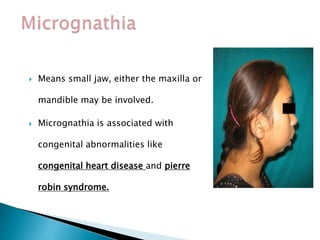
 Means small jaw, either the maxilla or
mandible may be involved.
 Micrognathia is associated with
congenital abnormalities like
congenital heart disease and pierre
robin syndrome.
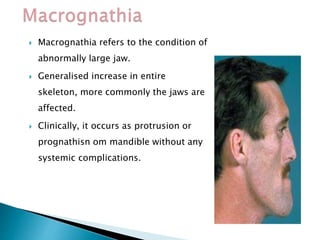
 Macrognathia refers to the condition of
abnormally large jaw.
 Generalised increase in entire
skeleton, more commonly the jaws are
affected.
 Clinically, it occurs as protrusion or
prognathisn om mandible without any
systemic complications.
 It is often associated with other conditions
like:
◦ Paget’s disease
◦ Acromegaly
◦ Leontiasis ossea
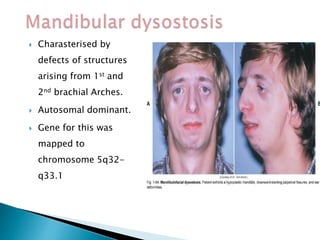
 Charasterised by
defects of structures
arising from 1st and
2nd brachial Arches.
 Autosomal dominant.
 Gene for this was
mapped to
chromosome 5q32-
q33.1
 A notch appears on the outer portion of the lower
eye lid.
 There is deficiency of eye lids.
 Ears may be deformed.
 Mandible is under developed with retruded chin.
 Cleft palate > 1/3 of cases.
 Parotid may be hypoplastic or totally absent.
 Respiratory and feeding difficulties in infants due to
hypoplasia of nasopharynx, oropharynx,
hypopharynx.
 Characteristic facial feature is bird like or fish like.
 It starts its development as two separate surfaces condylar and
temporal
 the primary joint in the embryonic period is the joint between
malleus and incus but as development proceeds, they loose
contact with meckel’s cartilage.
 Before the condylar cartilage forms a broad band of
undifferentiated mesenchyme exists between the developing
ramus and the developing squamous tympanic bone.
 With the proliferation of the condylar cartilage
towards temporal bone, the mesenchyme b/w the two
bones differentiates into fibrous tissue.
 By 12th week of IUL 2 joint cavities are delineated by
intervening articular disc.
 At birth mandibular fossa is flat and articular
eminence is not developed –helps in ant-post
movement during suckling.
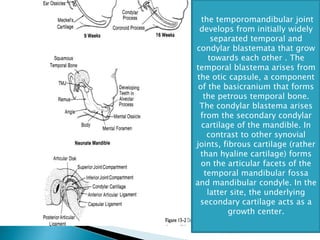
the temporomandibular joint
develops from initially widely
separated temporal and
condylar blastemata that grow
towards each other . The
temporal blastema arises from
the otic capsule, a component
of the basicranium that forms
the petrous temporal bone.
The condylar blastema arises
from the secondary condylar
cartilage of the mandible. In
contrast to other synovial
joints, fibrous cartilage (rather
than hyaline cartilage) forms

on the articular facets of the
temporal mandibular fossa
and mandibular condyle. In the
latter site, the underlying
secondary cartilage acts as a
growth center.
 Aplasia of mandibular condyle.
 Coronoid hyperplasia.
 Condylar hyperplasia.
 Bifid condyle.
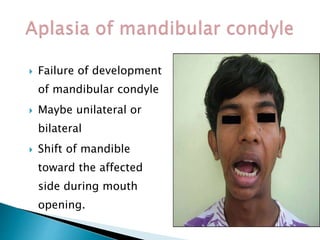
 Failure of development
of mandibular condyle
 Maybe unilateral or
bilateral
 Shift of mandible
toward the affected
side during mouth
opening.
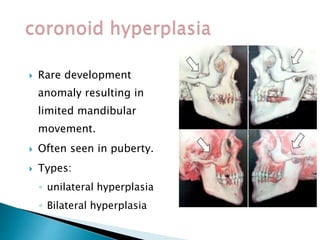
 Rare development
anomaly resulting in
limited mandibular
movement.
 Often seen in puberty.
 Types:
◦ unilateral hyperplasia
◦ Bilateral hyperplasia
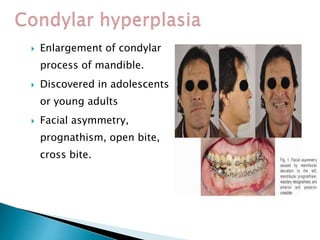
 Enlargement of condylar
process of mandible.
 Discovered in adolescents
or young adults
 Facial asymmetry,
prognathism, open bite,
cross bite.
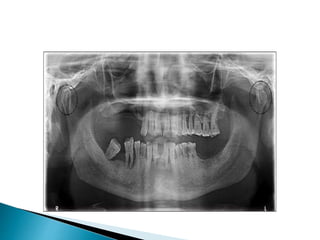
 Rare developmental anomaly characterized by
double-headed mandibular condyle.
 Some may have medial and lateral heads divided
by anterioposterior grooves.
 Some may have anterior and posterior head.
 Discovered in routine radiographs.
 Shows bilobed appearance of the condylar head.
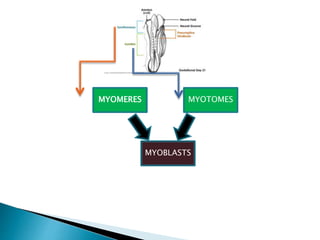
 The myomeres of the somitomeres and the myotomes of the
somites form primitive muscle cells termed myoblasts.
 Myoblasts divide and fuse to form multinucleated myotubes
that cease further mitosis and thus become myocytes (muscle
fibers).
MYOMERES MYOTOMES
MYOBLASTS
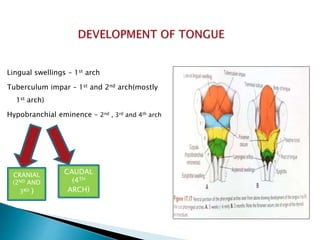
Lingual swellings – 1st arch
Tuberculum impar – 1st and 2nd arch(mostly
1st arch)
Hypobranchial eminence – 2nd , 3rd and 4th arch
CRANIAL
(2ND AND
3RD )
CAUDAL
(4TH
ARCH)
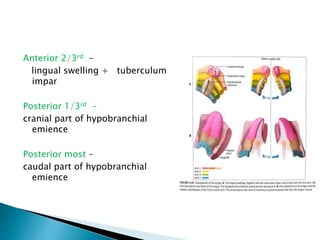
Anterior 2/3rd -
lingual swelling + tuberculum
impar
Posterior 1/3rd -
cranial part of hypobranchial
emience
Posterior most –
caudal part of hypobranchial
emience
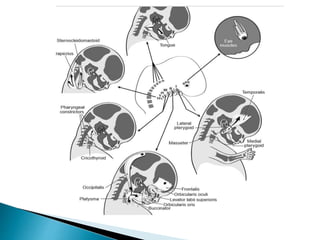
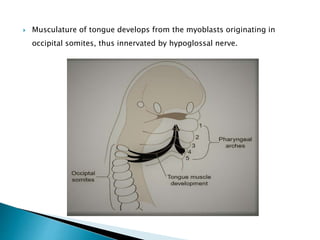
 Musculature of tongue develops from the myoblasts originating in
occipital somites, thus innervated by hypoglossal nerve.
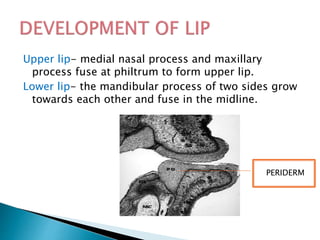
Upper lip- medial nasal process and maxillary
process fuse at philtrum to form upper lip.
Lower lip- the mandibular process of two sides grow
towards each other and fuse in the midline.
PERIDERM
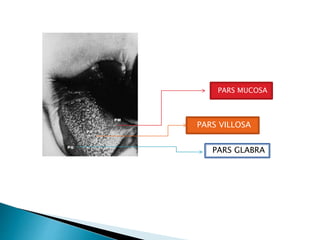
PARS MUCOSA
PARS VILLOSA
PARS GLABRA
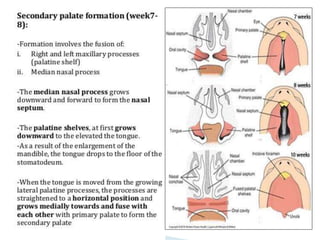
 The main part of definitive palate is formed by 2 shelf like growths
from the maxillary prominences.
 The palatine shelves appear in 6th week of development and are
directed obliquely downwards from each side of the tongue.
 7th week palatine shelves ascend to attain a horizontal position
above the tongue and fuse forming the secondary palate.
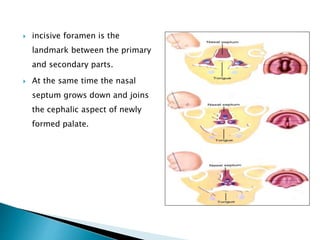
 incisive foramen is the
landmark between the primary
and secondary parts.
 At the same time the nasal
septum grows down and joins
the cephalic aspect of newly
formed palate.
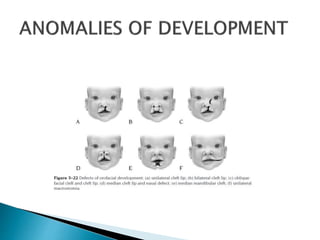
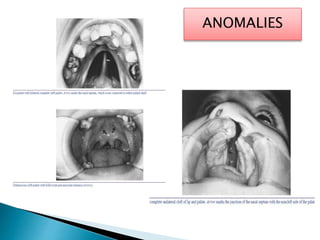
ANOMALIES
 Knowing the basic growth and development of the Cranial Base and Calvaria is of
great importance for the clinical purposes.
 By knowing the interactions of the various bones and structures that make up the
craniofacial complex he can better come to a diagnosis and treatment plan for
each patient, as well as know the underlying cause for the abnormality seen.
 Using the knowledge gained from studying the growth changes of the
craniofacial region at different ages , the clinician can know what patterns of
development to expect at certain timeframes during treatment,thereby providing
a more predictable treatment outcome.
 Sperber GH. First year of life: prenatal craniofacial development. Cleft Palate Craniofac J
1992;29:109–11.
 Sperber GH. Current concepts in embryonic craniofacial development. Crit Rev Oral Biol Med
1992;4:67–72.
 Sperber GH, Machin GA. The enigma of cephalogenesis. Cleft Palate Craniofac J 1994;31:91–6.
 Garcia-Castro M, Bronner-Fraser M. Induction and differentiation of the neural crest. Curr Opin
Cell Biol 1999;11:695–8.
 Johnson MC, Bronsky PT. Embryonic craniofacial development. Prog Clin Biol Res
1991;373:99–115.
 Om prakash kharbanda textbook : diagnosis and management of malocclusion and dental
deformities,third edition,pp.55-69.
 Björk, A., 1955. Cranial base development. American Journal of Orthodontics, 41(3), pp.198–
225.
 Premkumar, S., 2011. Textbook of Craniofacial Growth,pp.2-89.
 Proffit, W.R., Fields, H.W. & Sarver, D.M., 2013. Contemporary orthodontics
 Baume, L.J., 1961. Principles of cephalofacial development revealed by experimental biology. A
merican Journal of Orthodontics, 47(12), pp.881901. Dhopatkar, A., Bhatia, S. & Rock, P., 2002
 An Investigation Into the Relationship Between theCranial Base Angle and Malocclusion. The
Angle Orthodontist, 72(5), pp.456–463
Growth and development

Growth and development

  • 1.
  • 2.
    • Introduction • DefinitionsOf Growth and Development • Evolution of human jaw • Concepts of Growth and Development • Growth movements • Theories of growth • Prenatal development with reference to Craniofacial Region • Postnatal growth of face and craniofacial region • Conclusion
  • 4.
     STEWART (1982) Growthmay be defined as a developmental increase in mass. In other words, it is a process that leads to an increase in the physical size of cells, tissues, organs or the organism as a whole.  PROFFIT (1986) Growth refers to an increase in size or number.  MOYERS (1988) Growth may be defined as the normal changes in the amount of a living substance.
  • 5.
     STEDMAN (1990) Growthis an increase in the size of a living being or any of its parts, occurring in the process of development.  PINKHAM (1994) Growth signifies an increase, expansion or extension of a given tissue.  J.S.HUXLEY Self multiplication of living substance.
  • 6.
    KROGMAN Increase in size,change in proportion and progressive complexity.  TODD An increase in size.  MOSS Change in any morphologic parameter which is measurable.
  • 7.
     The jawand teeth of homosapiens have evolved, from the last common ancestor of chimpanzee.  Many factors such as the food eaten and processing of food by fire and tools have affected the evolution course. Yusuf emns(2011)on evolution of human jaws and teeth
  • 8.
    Cephalocaudal Growth The “cephalocaudalgradient of growth” means that there is an axis of increased growth extending from the head toward the feet.
  • 9.
     The secondmonth of intrauterine development, the head takes up almost 50%of the total body length. The cranium is large relative to the face a nd represents more than half the total head.  The limbs are still rudimentary and the trunk is underdeveloped.  The time of birth, the trunk and limbs have grown faster than the head and face, so that the p roportion of the entire body devoted to the head has decreased to about 30%.  At birth the cranium is enlarged relative to the face with the jaws and face relatively underdeveloped.
  • 10.
     At birth,the face and jaws are relatively underdeveloped compared with their extent in the adult.  There is much more growth of facial than cranial structures postnatal. (Redrawn from Lowery GH. Growth and Development of C hildren. 6th ed. Chicago: Year 1973
  • 11.
     The humanbody is comprised of different tissues, of  which there are four main groups: 1. Lymphoid, 2. Neural, 3. Reproductive and 4. Somatic tissue (e.g. muscles and bone).
  • 13.
     LYMPHOID TISSUE-before puberty it 200 % after puberty it come down.  NEURAL TISSUE-it nearly completed by 6 or 7 year of age.  GENERAL BODY TISSUE(muscle , bone and viscera)- s – shaped curve with rapid growth upto 2- 3 year. After 10 year , a rapid phase of growth occurs terminating by the 18-20 year.  GENITAL TISSUE- The grow rapidly at puberty.
  • 14.
    Bjork “In the caseof the brain case, the rate of growth of the inner structure is governed by the growth of the brain. After the age of 10 or 12 years the increase in size is slight , whereas the facial skeleton, comprising the bones of the upper facial structure and the mandible, continues its growth up to the age of 20 and beyond. The cranial base , which from a functional point of view may be regarded as the border between brain and facial structure, is obliged, therefore, to develop in conformity with the different growth patterns of the brain ease and facial structure and consequently , must follow two different growth rates, one along its internal surface and another along its external surface.”(Björk 1955)
  • 15.
    DRIFT- Enlarging portion ofa bone by the remodeling action of its osteogenic tissues. DISPLACEMENT- physical movement of a whole bone. Displacement SECONDARYPRIMARY
  • 16.
    PRIMARY DISPLACEMENT: 1. forwardlymovement 2.growth of the maxillary tuberosity in posterior direction This result in the whole maxilla being carried anteriorly.
  • 17.
     SECONDARY DISPLACEMENT- “Themovement of bone and its soft tissue is “not directly Related to its own enlargement”
  • 18.
     GROWTH SPURTS-“sudden acceleration of growth”  Concept of normality-”cranio-facial growth is that normality changes with age”  Rhythm of growth- according to hoaton “ human growth is not a steady and uniform process wherein all parts of the body enlarge at the same rate and the increments of one year are equal to that of the preceding year”
  • 19.
  • 20.
     Genetic theory-Brodie 1955-This theories mainly based on observation.  Cartilaginous theory-scott  Sutural dominance theory-sicher  Functional matrix theory-melvin moss
  • 21.
     Given bysicher in 1955  “the primary event in sutural growth is the proliferation of the connective tissue between two bone. If sutural tissue proliferates, it creates the space for appositional growth at the border of bone” Function of suture- 1. Unite the bone 2. absorb the force 3.act as a joint
  • 22.
     Given byjames scott-1956 ACCORDING THE SCOTT - Speno occiptial synchondrosis cartilage- this cartilage responsible for the cranial base. - Nasal septal cartilage- responsible for maxilla growth - condyle cartilage responsible for mandible growth.
  • 23.
     Given bymelvin moss “ the origin , growth and maintenance of all skeletal tissue and origin are secondary and compensatory response to event and processes, occuring in related non skeletal tissue ,organs and functioning space” O.P kharbanda textbook page 114
  • 24.
    Functional theories Skeletal unit Macroskeletal Ex-coronoid, angular Microskeletal Ex-endocranial surface ofcalvaria Functional matrices Periosteal Ex-teeth and muscles Capsular Ex-orofacial, neurocranial
  • 25.
     Functional matrixtheory revisited by Moss includes 4 concepts 1) The role of mechanotransduction 2) The role of an osseous connected cellular network 3) The genomic thesis 4) The epigenetic antithesis and the resolving synthesis
  • 26.
    • Force exertedon teeth or jaws do influence their functional matrix. • Correction of malocclusion by intra oral or extra oral appliances involves utilization of functional matrix. Modification of functional matrices seen in ; 1. Myofunctional therapy- MFT causes immediate change in proprioceptive response. 2. Use of extra oral dentofacial orthopaedics- ex- anterior repositioning of maxilla in cleft. 3. RME- widening of mid palatal suture. 4. Use of elastic tractions;
  • 27.
  • 28.
    Method of studying growth Biometric testradioisotopes implant Vital staining Natural markers
  • 30.
     TODD (1931) Developmentin an increase in complexity.  LOWREY (1951) Development is used to indicate an increase in skill and complexity of functions.  PROFFIT (1986) Development is in complexity.
  • 31.
     MOYER (1988) Development refers to all the naturally occurring unidirectional events in the life of an individual from its existence as a single cell to its elaboration as a multifunctional unit terminating in death. STEDMAN (1990) The act or process of natural progression from a previous, lower or embryonic stage to a later more complex, or adult stage.  PINKHAM (1994) Development addresses the progressive evolution of a tissue.
  • 32.
     Prenatal :occurring or existing before birth.  Postnatal : related to denoting the period after child birth.
  • 33.
    Stages of prenatalgrowth: 1. The period of the ovum from fertilization to the end of the 14th day. 2. The period of the embryo from the 14th day to about 56th day. 3. The period of the fetus, from about 56th day until the 270th day – birth.
  • 34.
     This periodof about 2 weeks consists primarily of cleavage of ovum and its attachment to the uterine wall.  At the end of this period the ovum is only 1.5mm in length and cephalad differentiation has not begun.
  • 35.
    2 days 3days 4th day 8th day bilaminay layer Primary yolk sac
  • 40.
     No archcartilage/primary cartilage exists in the maxillary process, but the center of ossification is associated closely with nasal capsule.  Centre of ossification appears where the anterosuperior nerve is given off from the infraorbital nerve.  From this centre bone formation spreads post below the orbit towards the developing zygoma, ant towards the future incisor region, superiorly to form the frontal process and into the palatine process to form the hard palate.  The maxillary sinus forms during the 16th weekas a shallow groove on the nasal aspect of developing maxilla.
  • 41.
     About 4thweek of intrauterine life the developing brain and pericardium form 2 prominent bulge on ventral aspect of embryo.  These bulges are separated by primitive oral cavity called stomodeum.  The floor of the stomodeum is formed by bucco-pharyngeal membrane, which separates it from foregut .  The pharyngeal arches are laid down on the lateral and ventral aspect of the cranial most part of the foregut that lies in close approximation with the stomodeum.  Initially there are six pharyngeal arches, but 5th one usually disappears as soon as it is formed leaving only five.  They are separated by four branchial grooves.
  • 42.
    • The 1starch is called the mandibular arch and the 2nd arch , hyoid arch. • The other arches do not have any specific name. • Each of these 5 arches contain : 1. A central cartilage rod that forms the skeleton of the arch. 2. A muscular component termed as brachiomere. 3. A vascular component. 4. A neural element.
  • 43.
     The mandibulararch forms the lateral wall of the stomodeum.  It gives off a bud from its dorsal end, these bud is called as the maxillary process.  It grows ventro-medially, cranial to the main part of the arch, which is now called the mandibular process.  The mandibular processes of both sides grow towards each other and fuse in the mid-line.  They now form lower of the stomodeum i.e. the lower lip and lower jaw.
  • 44.
     The Meckel’scartilage is derived from the first brachial arch around the 41st to 45th day of the intra-uterine life.
  • 45.
     It extendsfrom the cartilaginous otic capsue to the midline or symphysis and provides a template for guiding the growth of mandible.  A major portion of Meckel’s cartilage disappears during growth and remaining part develops into the following structures. 1. Mental ossicles 2. Incus and malleus 3. Spine of sphenoid bone 4. Anterior ligament of malleus 5. Spheno-mandibular ligament
  • 46.
     A singleossification center for each half of the mandible arises in the 6th week of the intrauterine life in the region of the bifurcation of inferior alvelolar nerve into mental and incisive branches.  The ossifying membrane is located lateral to the Meckel’s cartilage and its accompanying neuro-vascular bundle.  From these primary center, ossification spreads below and around the inferior alveolar nerve and its incisive branch and upward to form a trough for accommodating the developing tooth buds.  Spread of the intramembranous ossification dorsally and ventrally forms the body and ramus of the mandible.
  • 47.
     As theossification continues, the Meckel’s cartilage becomes surrounded and invaded by bone.  Ossification stops at the site that will later become the mandibular lingula from where the Meckel’s cartilage continue into the middle ear and develops into the auditory ossicles i.e. malleus and incus.  The sphenomandibular ligament that extends from the lingual of mandible to the sphenoid bone forms the remnant of Meckel’s cartilage.
  • 48.
     Endochondral boneformation is seen only in 3 areas of the mandible: 1. The condylar process 2. The coronoid process 3. The Mental region
  • 49.
     At aboutthe 5th week of intrauterine life an area of mesenchymal condensation can be seen above the ventral part of the developing mandible.  This develops into a cone shaped cartilage by about 10th week and starts ossification by 14th week.
  • 50.
     It thenmigrates inferiorly and fuses with the mandibular ramus by about 4 months.  Much of cone shaped cartilage is replaced by bone by middle of fetal life but its upper end persists into adulthood acting both as a growth cartilage and articular cartilage.
  • 51.
     Secondary accessorycartilages appear in the region of the coronoid process by about 10 to 14 week of intrauterine life.  The coronoid accessory cartilage becomes incorporated into the expanding intramembranous bone of the ramus and disappears before birth.
  • 52.
     In themental region, on either side of the symphysis, on one or two small cartilages appear and ossify in the 7th month of intrauterine life to form variable numbers of mental ossicles in the fibrous tissues of symphysis.  These ossicles become incorporated into the intramembranous bone when the symphysis ossifies completely during the 1st year of postnatal life.
  • 53.
     Of thefacial bones, the mandible undergoes the largest amount of growth postnatally and also exhibits the largest variability in morphology.  While the mandible appears in the adult as a single bone, it is developed mentally and functionally visible into several skeletal subunits.  The basal bone or the body of the mandible forms 1 unit, to which is attached the alveolar process, the coronoid process, condylar process, angular process, the ramus, the lingual tuberosity and the chin.
  • 54.
     The ramusmoves progressively posterior by a combination of deposition and resorption.  Resorption occur on the anterior part of the ramus while bone deposition occurs on the posterior region.  This results in a drift of the ramus in a posterior direction.
  • 55.
     The functionsof the remodeling of the ramus are: 1. To accommodate the increasing mass of masticatory muscles inserted into it. 2. To accommodate the enlarged breadth of the pharyngeal space. 3. To facilitate the lengthening of the mandibular body, which in turn accommodates the erupting molars.
  • 57.
     On thelingual side of the angle of mandible, resorption takes place on the posterio-inferior aspect while deposition occur on the anterio-superior aspect.  On buccal side, resorption occur on the anterio-superior part while depostition takes place on the posterior-superior part.  This result in flaring of angle of mandible as age advances.
  • 58.
     The lingualtuberosity is a direct equivalent of the maxillary tuberosity, which forms a major site of growth for mandibular arch.  It forms the boundary between the ramus and the body.  The lingual tuberosity moves posteriorly by deposition on its posteriorly facing surface.  It can be noticed that the lingual tuberosity protrudes noticeably in a lingual direction and that it lies well towards the midline of the ramus.  Prominence of the tuberosity is increased by the presence of large resorption field just below it.
  • 59.
     This resorptionfield produces a sizable depression, the lingual fossa.  The combination of resorption in the fossa and deposition on the medial surface of the tuberosity itself accentuates the prominence of the lingual tuberosity.
  • 60.
     The mandibularcondyle has been recognized as an important growth site.  The head of the condyle is covered by a thin layer of cartilage called the condylar cartilage.  The presence of the condylar cartilage is an adaption to withstand the compression that occurs at the joint.  The role of condyle in growth of mandible has remained a controversy.  The condylar growth rate increases at puberty reaching a peak between 12.5 to 14 years.  The growth ceases around the age of 20.
  • 61.
     There aretwo schools of thought regarding the role of condyle in growth of mandible: a. It was earlier believed that growth occurs at the surface of condyle cartilage by means of bone deposition. Thus, the condyle grows toward the cranial base.as condyle pushes against the cranial base, the entire mandible gets displaced forward and downward.
  • 62.
    b. It isnow believed that the growth of soft tissue including the muscles and connective tissues carries the mandible forwards away from the cranial base. Bone growth follows secondarily at the condyle to maintain constant contact with cranial base.
  • 63.
     The growthof coronoid process follows the enlarging ‘V’ principle.  Viewing the longitudinal section of the coronoid process from the posterior aspect it can be seen that deposition occur on the lingual (medial) surfaces of the left and right coronoid process.  Although addition takes place on the lingual side, the vertical dimension of coronoid process also increases.  This follows the ‘V’ principle.
  • 64.
     From viewingit from the occusal aspect, the deposition on lingual of the coronoid process brings about a posterior growth movement in the ‘V’ pattern.  The coronoid process has a propeller- like twist, so that its lingual side faces three general directions all at once i.e. posteriorly, superiorly and medially.
  • 65.
     Congenital diseases: is one which is present at or before birth but is not necessarily inherited i.e. transmitted through the genes.  Developmental anomalies : unusual sequel of development, a deviation from shape or size
  • 66.
     Characterized byhypoplasia or absence of mandible more commonly only a portion of jaw is missing.  Partial absence of mandible is more common  Entire mandible on one side may be missing or more frequently ,only condyle or entire ramus.
  • 67.
     In caseof unilateral absence of mandibular ramus, ears may be deformed or absent.  This is believed to be due to failure of migration of neural crest mesenchyme into maxillary prominence at fourth to fifth week of gestation  Bilateral agenesis of condyles and ramus have also been reported.
  • 68.
     Means smalljaw, either the maxilla or mandible may be involved.  Micrognathia is associated with congenital abnormalities like congenital heart disease and pierre robin syndrome.
  • 69.
     Macrognathia refersto the condition of abnormally large jaw.  Generalised increase in entire skeleton, more commonly the jaws are affected.  Clinically, it occurs as protrusion or prognathisn om mandible without any systemic complications.
  • 70.
     It isoften associated with other conditions like: ◦ Paget’s disease ◦ Acromegaly ◦ Leontiasis ossea
  • 71.
     Charasterised by defectsof structures arising from 1st and 2nd brachial Arches.  Autosomal dominant.  Gene for this was mapped to chromosome 5q32- q33.1
  • 72.
     A notchappears on the outer portion of the lower eye lid.  There is deficiency of eye lids.  Ears may be deformed.  Mandible is under developed with retruded chin.  Cleft palate > 1/3 of cases.  Parotid may be hypoplastic or totally absent.  Respiratory and feeding difficulties in infants due to hypoplasia of nasopharynx, oropharynx, hypopharynx.  Characteristic facial feature is bird like or fish like.
  • 73.
     It startsits development as two separate surfaces condylar and temporal  the primary joint in the embryonic period is the joint between malleus and incus but as development proceeds, they loose contact with meckel’s cartilage.  Before the condylar cartilage forms a broad band of undifferentiated mesenchyme exists between the developing ramus and the developing squamous tympanic bone.
  • 74.
     With theproliferation of the condylar cartilage towards temporal bone, the mesenchyme b/w the two bones differentiates into fibrous tissue.  By 12th week of IUL 2 joint cavities are delineated by intervening articular disc.  At birth mandibular fossa is flat and articular eminence is not developed –helps in ant-post movement during suckling.
  • 75.
    the temporomandibular joint developsfrom initially widely separated temporal and condylar blastemata that grow towards each other . The temporal blastema arises from the otic capsule, a component of the basicranium that forms the petrous temporal bone. The condylar blastema arises from the secondary condylar cartilage of the mandible. In contrast to other synovial joints, fibrous cartilage (rather than hyaline cartilage) forms on the articular facets of the temporal mandibular fossa and mandibular condyle. In the latter site, the underlying secondary cartilage acts as a growth center.
  • 76.
     Aplasia ofmandibular condyle.  Coronoid hyperplasia.  Condylar hyperplasia.  Bifid condyle.
  • 77.
     Failure ofdevelopment of mandibular condyle  Maybe unilateral or bilateral  Shift of mandible toward the affected side during mouth opening.
  • 78.
     Rare development anomalyresulting in limited mandibular movement.  Often seen in puberty.  Types: ◦ unilateral hyperplasia ◦ Bilateral hyperplasia
  • 79.
     Enlargement ofcondylar process of mandible.  Discovered in adolescents or young adults  Facial asymmetry, prognathism, open bite, cross bite.
  • 80.
     Rare developmentalanomaly characterized by double-headed mandibular condyle.  Some may have medial and lateral heads divided by anterioposterior grooves.  Some may have anterior and posterior head.  Discovered in routine radiographs.  Shows bilobed appearance of the condylar head.
  • 82.
     The myomeresof the somitomeres and the myotomes of the somites form primitive muscle cells termed myoblasts.  Myoblasts divide and fuse to form multinucleated myotubes that cease further mitosis and thus become myocytes (muscle fibers).
  • 83.
  • 85.
    Lingual swellings –1st arch Tuberculum impar – 1st and 2nd arch(mostly 1st arch) Hypobranchial eminence – 2nd , 3rd and 4th arch CRANIAL (2ND AND 3RD ) CAUDAL (4TH ARCH)
  • 86.
    Anterior 2/3rd - lingualswelling + tuberculum impar Posterior 1/3rd - cranial part of hypobranchial emience Posterior most – caudal part of hypobranchial emience
  • 87.
     Musculature oftongue develops from the myoblasts originating in occipital somites, thus innervated by hypoglossal nerve.
  • 88.
    Upper lip- medialnasal process and maxillary process fuse at philtrum to form upper lip. Lower lip- the mandibular process of two sides grow towards each other and fuse in the midline. PERIDERM
  • 89.
  • 91.
     The mainpart of definitive palate is formed by 2 shelf like growths from the maxillary prominences.  The palatine shelves appear in 6th week of development and are directed obliquely downwards from each side of the tongue.  7th week palatine shelves ascend to attain a horizontal position above the tongue and fuse forming the secondary palate.
  • 93.
     incisive foramenis the landmark between the primary and secondary parts.  At the same time the nasal septum grows down and joins the cephalic aspect of newly formed palate.
  • 94.
  • 95.
     Knowing thebasic growth and development of the Cranial Base and Calvaria is of great importance for the clinical purposes.  By knowing the interactions of the various bones and structures that make up the craniofacial complex he can better come to a diagnosis and treatment plan for each patient, as well as know the underlying cause for the abnormality seen.  Using the knowledge gained from studying the growth changes of the craniofacial region at different ages , the clinician can know what patterns of development to expect at certain timeframes during treatment,thereby providing a more predictable treatment outcome.
  • 96.
     Sperber GH.First year of life: prenatal craniofacial development. Cleft Palate Craniofac J 1992;29:109–11.  Sperber GH. Current concepts in embryonic craniofacial development. Crit Rev Oral Biol Med 1992;4:67–72.  Sperber GH, Machin GA. The enigma of cephalogenesis. Cleft Palate Craniofac J 1994;31:91–6.  Garcia-Castro M, Bronner-Fraser M. Induction and differentiation of the neural crest. Curr Opin Cell Biol 1999;11:695–8.  Johnson MC, Bronsky PT. Embryonic craniofacial development. Prog Clin Biol Res 1991;373:99–115.  Om prakash kharbanda textbook : diagnosis and management of malocclusion and dental deformities,third edition,pp.55-69.  Björk, A., 1955. Cranial base development. American Journal of Orthodontics, 41(3), pp.198– 225.  Premkumar, S., 2011. Textbook of Craniofacial Growth,pp.2-89.  Proffit, W.R., Fields, H.W. & Sarver, D.M., 2013. Contemporary orthodontics  Baume, L.J., 1961. Principles of cephalofacial development revealed by experimental biology. A merican Journal of Orthodontics, 47(12), pp.881901. Dhopatkar, A., Bhatia, S. & Rock, P., 2002  An Investigation Into the Relationship Between theCranial Base Angle and Malocclusion. The Angle Orthodontist, 72(5), pp.456–463