OSHAOffice of Training & Education 1
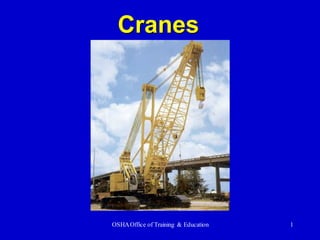
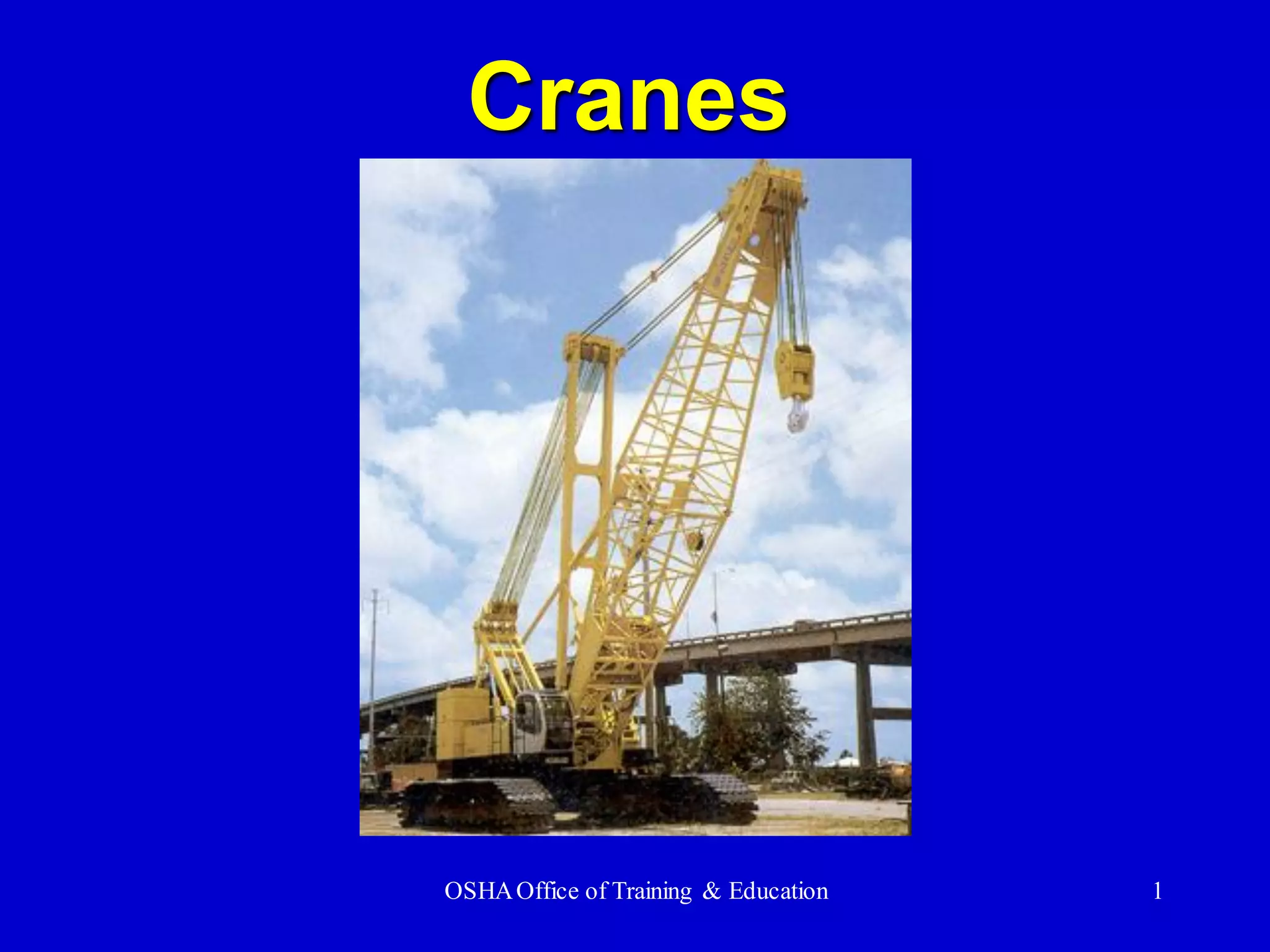
Cranes
OSHAOffice of Training & Education 2
Major Causes of Crane Accidents
• Contact with power lines
• Overturns
• Falls
• Mechanical failures
OSHAOffice of Training & Education 3
•Instability – unsecured load, load
capacity exceeded, or ground not level
or too soft
•Lack of communication - the point of
operation is a distance from the crane
operator or not in full view of the
operator
•Lack of training
•Inadequate maintenance or inspection
How Do Accidents Occur?
OSHAOffice of Training & Education 4
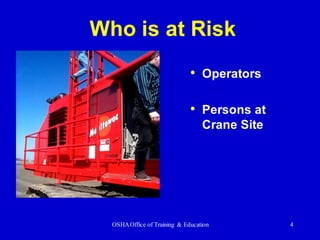
Who is at Risk
• Operators
• Persons at
Crane Site
OSHAOffice of Training & Education 5
Definitions
• Crane – Consists of a rotating structure for lifting and
lowering horizontally on rubber tires or crawler treads
• Hoist - Used to lift and lower load.
• Boom – An inclined spar, strut, or other long member
supporting the hoisting tackle
• Boom stops – A device used to limit the angle of the
boom at its highest position
• Brake – To slow or stop motion by friction or power
• Block – Sheaves or grooved pulleys in a frame with
hook, eye and strap
• Jib – Extension attached to the boom point to provide
added boom length for lifting specified loads.
OSHAOffice of Training & Education 6
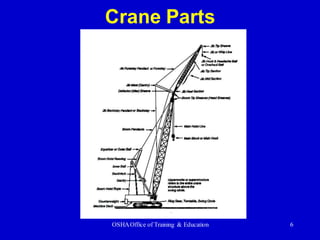
Crane Parts
OSHAOffice of Training & Education 7
Types of Cranes
• Mobile
• Hydraulic
• Overhead
• Gantry
• Tower
OSHAOffice of Training & Education 8
• Improper load
rating
• Excessive speeds
• No hand signals
• Inadequate
inspection and
maintenance
• Unguarded parts
• Unguarded swing
radius
Crane Hazards
• Working too close to
power lines
• Improper exhaust
system
• Shattered windows
• No steps/guardrails
walkways
• No boom angle
indicator
• Not using outriggers
OSHAOffice of Training & Education 9
Planning Before Start-Up
• Level the crane and ensure support surface is firm
and able to support the load
• Contact power line owners and determine
precautions. Know the location and voltage of
overhead power lines.
• Know the basic crane capacities, limitations, and
job site restrictions, such as the location of power
lines, unstable soil, or high winds.
• Make other personnel aware of hoisting activities.
• Barricade areas within swing radius.
• Ensure proper maintenance and inspections.
• Determine safe areas to store materials and place
machinery.
OSHAOffice of Training & Education 10
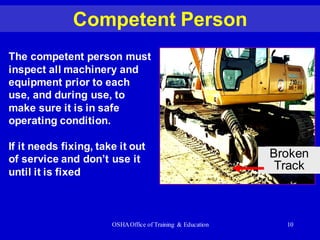
Competent Person
The competent person must
inspect all machinery and
equipment prior to each
use, and during use, to
make sure it is in safe
operating condition.
If it needs fixing, take it out
of service and don’t use it
until it is fixed
Broken
Track
OSHAOffice of Training & Education 11
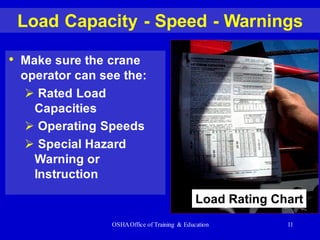
Load Capacity - Speed - Warnings
• Make sure the crane
operator can see the:
➢ Rated Load
Capacities
➢ Operating Speeds
➢ Special Hazard
Warning or
Instruction
Load Rating Chart
OSHAOffice of Training & Education 12
Know the Weight of the Load
• Refer to shipping ticket or other
documentation
• Ensure lift calculations are correct
• Ensure load is within load chart rating for
boom length and load radius of crane
• Crane is rated by the maximum weight it
will lift at a minimum radius and minimum
boom length – the further from its
centerpoint, the less it will lift
OSHAOffice of Training & Education 13
Load Limiting Factors
• Not level
• Wind
• Side loads
• On its wheels
• Lifting over the side
• Use of extensions, jibs and other
attachments
• Limits of wire rope, slings and lifting devices
OSHAOffice of Training & Education 14
Mobile Cranes –
Lifting Principles
• Center of Gravity
• Leverage
• Stability
• Structural Integrity
OSHAOffice of Training & Education 15
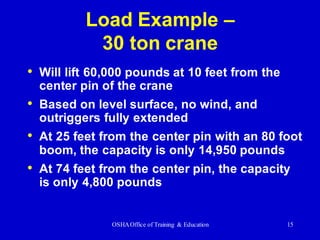
Load Example –
30 ton crane
• Will lift 60,000 pounds at 10 feet from the
center pin of the crane
• Based on level surface, no wind, and
outriggers fully extended
• At 25 feet from the center pin with an 80 foot
boom, the capacity is only 14,950 pounds
• At 74 feet from the center pin, the capacity
is only 4,800 pounds
OSHAOffice of Training & Education 16
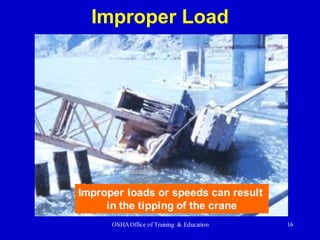
Improper Load
Improper loads or speeds can result
in the tipping of the crane
OSHAOffice of Training & Education 17
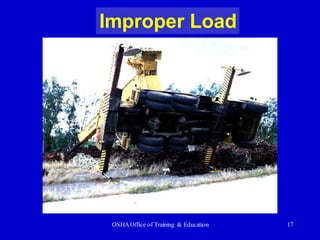
Improper Load
OSHAOffice of Training & Education 18
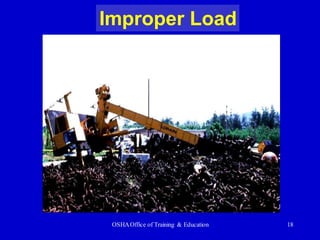
Improper Load
OSHAOffice of Training & Education 19
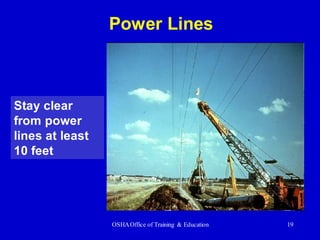
Stay clear
from power
lines at least
10 feet
Power Lines
OSHAOffice of Training & Education 20
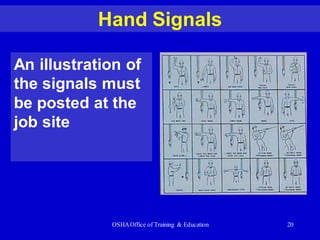
An illustration of
the signals must
be posted at the
job site
Hand Signals
OSHAOffice of Training & Education 21
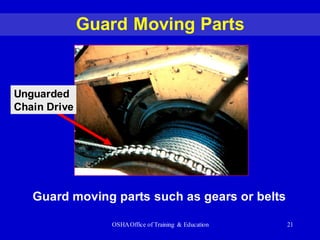
Guard Moving Parts
Unguarded
Chain Drive
Guard moving parts such as gears or belts
OSHAOffice of Training & Education 22
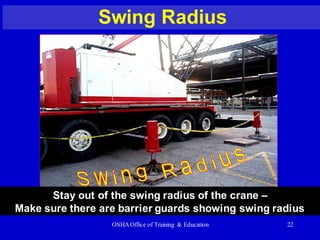
Swing Radius
Stay out of the swing radius of the crane –
Make sure there are barrier guards showing swing radius
OSHAOffice of Training & Education 23
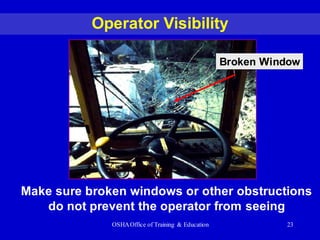
Operator Visibility
Broken Window
Make sure broken windows or other obstructions
do not prevent the operator from seeing
OSHAOffice of Training & Education 24
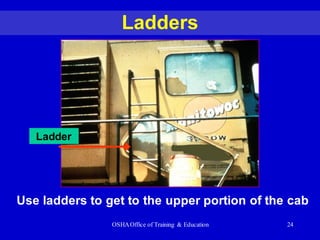
Ladders
Ladder
Use ladders to get to the upper portion of the cab
OSHAOffice of Training & Education 25
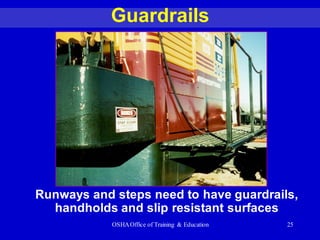
Guardrails
Runways and steps need to have guardrails,
handholds and slip resistant surfaces
OSHAOffice of Training & Education 26
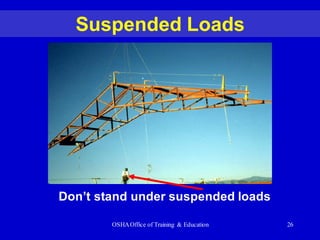
Suspended Loads
Don’t stand under suspended loads
OSHAOffice of Training & Education 27
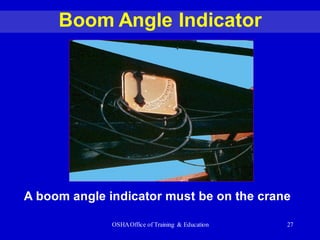
Boom Angle Indicator
A boom angle indicator must be on the crane
OSHAOffice of Training & Education 28
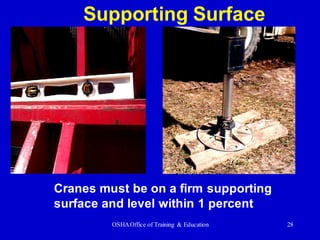
Supporting Surface
Cranes must be on a firm supporting
surface and level within 1 percent
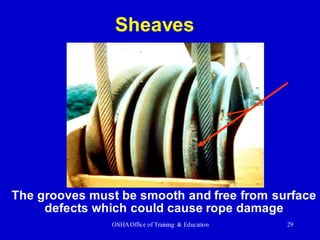
OSHAOffice of Training & Education 29
The grooves must be smooth and free from surface
defects which could cause rope damage
Sheaves
OSHAOffice of Training & Education 30
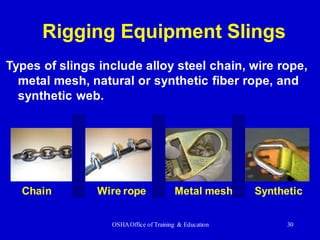
Rigging Equipment Slings
Types of slings include alloy steel chain, wire rope,
metal mesh, natural or synthetic fiber rope, and
synthetic web.
Chain Wire rope Metal mesh Synthetic
OSHAOffice of Training & Education 31
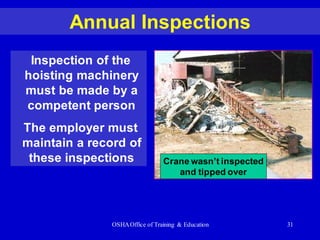
Annual Inspections
Inspection of the
hoisting machinery
must be made by a
competent person
The employer must
maintain a record of
these inspections Crane wasn’t inspected
and tipped over
OSHAOffice of Training & Education 32
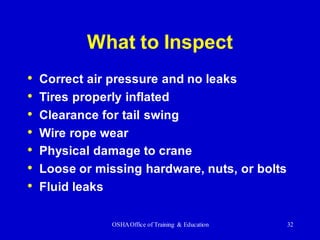
What to Inspect
• Correct air pressure and no leaks
• Tires properly inflated
• Clearance for tail swing
• Wire rope wear
• Physical damage to crane
• Loose or missing hardware, nuts, or bolts
• Fluid leaks
OSHAOffice of Training & Education 33
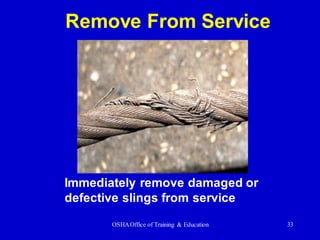
Remove From Service
Immediately remove damaged or
defective slings from service
OSHAOffice of Training & Education 34
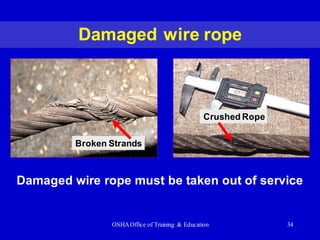
Damaged wire rope
Broken Strands
Damaged wire rope must be taken out of service
Crushed Rope
OSHAOffice of Training & Education 35
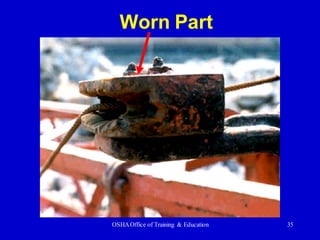
Worn Part
OSHAOffice of Training & Education 36
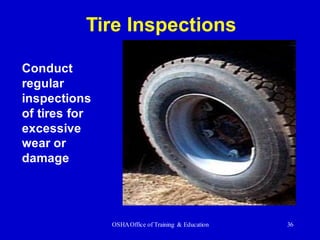
Conduct
regular
inspections
of tires for
excessive
wear or
damage
Tire Inspections
OSHAOffice of Training & Education 37
Training
• Operators:
➢must qualify on specific crane type
➢Must include on-the-job training
• Supervisor / competent person
OSHAOffice of Training & Education 38
Summary
• An unstable load, lack of communication, lack of
training, and inadequate maintenance or inspection are
major contributors to crane accidents.
• Operators or others working in the area can be
victims to “struck by" and "caught in" injuries.
• Contact with power lines causes many accidents.
• A competent person must inspect a crane regularly
to insure it is in proper order.
• Planning and training reduces accidents.

Crane Safety

  • 1.
    OSHAOffice of Training& Education 1 Cranes
  • 2.
    OSHAOffice of Training& Education 2 Major Causes of Crane Accidents • Contact with power lines • Overturns • Falls • Mechanical failures
  • 3.
    OSHAOffice of Training& Education 3 •Instability – unsecured load, load capacity exceeded, or ground not level or too soft •Lack of communication - the point of operation is a distance from the crane operator or not in full view of the operator •Lack of training •Inadequate maintenance or inspection How Do Accidents Occur?
  • 4.
    OSHAOffice of Training& Education 4 Who is at Risk • Operators • Persons at Crane Site
  • 5.
    OSHAOffice of Training& Education 5 Definitions • Crane – Consists of a rotating structure for lifting and lowering horizontally on rubber tires or crawler treads • Hoist - Used to lift and lower load. • Boom – An inclined spar, strut, or other long member supporting the hoisting tackle • Boom stops – A device used to limit the angle of the boom at its highest position • Brake – To slow or stop motion by friction or power • Block – Sheaves or grooved pulleys in a frame with hook, eye and strap • Jib – Extension attached to the boom point to provide added boom length for lifting specified loads.
  • 6.
    OSHAOffice of Training& Education 6 Crane Parts
  • 7.
    OSHAOffice of Training& Education 7 Types of Cranes • Mobile • Hydraulic • Overhead • Gantry • Tower
  • 8.
    OSHAOffice of Training& Education 8 • Improper load rating • Excessive speeds • No hand signals • Inadequate inspection and maintenance • Unguarded parts • Unguarded swing radius Crane Hazards • Working too close to power lines • Improper exhaust system • Shattered windows • No steps/guardrails walkways • No boom angle indicator • Not using outriggers
  • 9.
    OSHAOffice of Training& Education 9 Planning Before Start-Up • Level the crane and ensure support surface is firm and able to support the load • Contact power line owners and determine precautions. Know the location and voltage of overhead power lines. • Know the basic crane capacities, limitations, and job site restrictions, such as the location of power lines, unstable soil, or high winds. • Make other personnel aware of hoisting activities. • Barricade areas within swing radius. • Ensure proper maintenance and inspections. • Determine safe areas to store materials and place machinery.
  • 10.
    OSHAOffice of Training& Education 10 Competent Person The competent person must inspect all machinery and equipment prior to each use, and during use, to make sure it is in safe operating condition. If it needs fixing, take it out of service and don’t use it until it is fixed Broken Track
  • 11.
    OSHAOffice of Training& Education 11 Load Capacity - Speed - Warnings • Make sure the crane operator can see the: ➢ Rated Load Capacities ➢ Operating Speeds ➢ Special Hazard Warning or Instruction Load Rating Chart
  • 12.
    OSHAOffice of Training& Education 12 Know the Weight of the Load • Refer to shipping ticket or other documentation • Ensure lift calculations are correct • Ensure load is within load chart rating for boom length and load radius of crane • Crane is rated by the maximum weight it will lift at a minimum radius and minimum boom length – the further from its centerpoint, the less it will lift
  • 13.
    OSHAOffice of Training& Education 13 Load Limiting Factors • Not level • Wind • Side loads • On its wheels • Lifting over the side • Use of extensions, jibs and other attachments • Limits of wire rope, slings and lifting devices
  • 14.
    OSHAOffice of Training& Education 14 Mobile Cranes – Lifting Principles • Center of Gravity • Leverage • Stability • Structural Integrity
  • 15.
    OSHAOffice of Training& Education 15 Load Example – 30 ton crane • Will lift 60,000 pounds at 10 feet from the center pin of the crane • Based on level surface, no wind, and outriggers fully extended • At 25 feet from the center pin with an 80 foot boom, the capacity is only 14,950 pounds • At 74 feet from the center pin, the capacity is only 4,800 pounds
  • 16.
    OSHAOffice of Training& Education 16 Improper Load Improper loads or speeds can result in the tipping of the crane
  • 17.
    OSHAOffice of Training& Education 17 Improper Load
  • 18.
    OSHAOffice of Training& Education 18 Improper Load
  • 19.
    OSHAOffice of Training& Education 19 Stay clear from power lines at least 10 feet Power Lines
  • 20.
    OSHAOffice of Training& Education 20 An illustration of the signals must be posted at the job site Hand Signals
  • 21.
    OSHAOffice of Training& Education 21 Guard Moving Parts Unguarded Chain Drive Guard moving parts such as gears or belts
  • 22.
    OSHAOffice of Training& Education 22 Swing Radius Stay out of the swing radius of the crane – Make sure there are barrier guards showing swing radius
  • 23.
    OSHAOffice of Training& Education 23 Operator Visibility Broken Window Make sure broken windows or other obstructions do not prevent the operator from seeing
  • 24.
    OSHAOffice of Training& Education 24 Ladders Ladder Use ladders to get to the upper portion of the cab
  • 25.
    OSHAOffice of Training& Education 25 Guardrails Runways and steps need to have guardrails, handholds and slip resistant surfaces
  • 26.
    OSHAOffice of Training& Education 26 Suspended Loads Don’t stand under suspended loads
  • 27.
    OSHAOffice of Training& Education 27 Boom Angle Indicator A boom angle indicator must be on the crane
  • 28.
    OSHAOffice of Training& Education 28 Supporting Surface Cranes must be on a firm supporting surface and level within 1 percent
  • 29.
    OSHAOffice of Training& Education 29 The grooves must be smooth and free from surface defects which could cause rope damage Sheaves
  • 30.
    OSHAOffice of Training& Education 30 Rigging Equipment Slings Types of slings include alloy steel chain, wire rope, metal mesh, natural or synthetic fiber rope, and synthetic web. Chain Wire rope Metal mesh Synthetic
  • 31.
    OSHAOffice of Training& Education 31 Annual Inspections Inspection of the hoisting machinery must be made by a competent person The employer must maintain a record of these inspections Crane wasn’t inspected and tipped over
  • 32.
    OSHAOffice of Training& Education 32 What to Inspect • Correct air pressure and no leaks • Tires properly inflated • Clearance for tail swing • Wire rope wear • Physical damage to crane • Loose or missing hardware, nuts, or bolts • Fluid leaks
  • 33.
    OSHAOffice of Training& Education 33 Remove From Service Immediately remove damaged or defective slings from service
  • 34.
    OSHAOffice of Training& Education 34 Damaged wire rope Broken Strands Damaged wire rope must be taken out of service Crushed Rope
  • 35.
    OSHAOffice of Training& Education 35 Worn Part
  • 36.
    OSHAOffice of Training& Education 36 Conduct regular inspections of tires for excessive wear or damage Tire Inspections
  • 37.
    OSHAOffice of Training& Education 37 Training • Operators: ➢must qualify on specific crane type ➢Must include on-the-job training • Supervisor / competent person
  • 38.
    OSHAOffice of Training& Education 38 Summary • An unstable load, lack of communication, lack of training, and inadequate maintenance or inspection are major contributors to crane accidents. • Operators or others working in the area can be victims to “struck by" and "caught in" injuries. • Contact with power lines causes many accidents. • A competent person must inspect a crane regularly to insure it is in proper order. • Planning and training reduces accidents.