SHAHID ALI
CLASS No 53
TOPIC OF PRESENTATION:
INTRODUCTION: CRACKS
Cracks can be:
o Structural Cracks
o Non Structural Cracks
STRUCTURAL CRACKS:
refers to crack that developed at the core or
frame that form the foundation of the building
itself. Normally, any types of crack occurred
in this case is very dangerous and must be
dealt immediately.
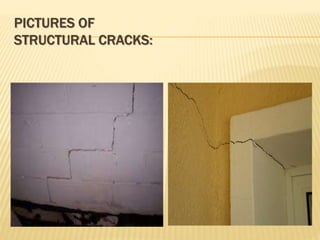
PICTURES OF
STRUCTURAL CRACKS:
NON STRUCTURAL CRACKS:
as the name itself implies, refers to any parts
of the building that doesn’t belong to the
core or frame of the building for example
wall (except load bearing wall),driveway,
patio, and walkway. Cracks occurred in this
case are not that threatening if compared to
structural crack.
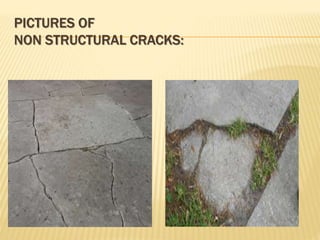
PICTURES OF
NON STRUCTURAL CRACKS:
CAUSES:
 Structural cracks
 due to incorrect design
 faulty construction
 Overloading
 Non Structural cracks
 Moisture changes
 Thermal movement
 Elastic deformation
 Creep
 Chemical reaction
 Foundation movement and settlement of soil
 Vegetation
NON STRUCTURAL CRACKS:
MOISTURE CHANGES:
Building materials expand on absorbing
moisture and shrink on drying. Shrinkage in
concrete or mortar depends on a number of
factors
 Cement concrete: Richer the mix , greater is
the drying shrinkage.
 Water content: More water in mix induces the
more it is to reduce, so greater is the shrinkage.
 Aggregates : Large aggregates with good
grading has less shrinkage for same workability
as less water is used
 Curing: If proper curing starts as soon as
initial set has taken place and continued
for 7 to 10 days shrinkage is comparatively
less
 Excessive fines: More fines in aggregate
requires more water for same workability
and hence more shrinkage.
 Temperature: Concrete made in hot
weather needs more water for same
workability hence results in more
shrinkage
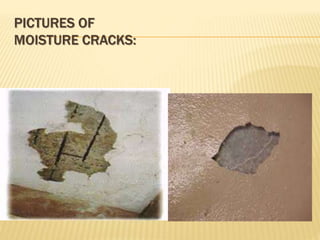
PICTURES OF
MOISTURE CRACKS:
SOME MEASURES FOR CONTROLLING
SHRINKAGE
 Shrinkage cracks in masonry can be
minimized by avoiding use of rich cement
mortar and by delaying plastering till
masonry has dried after proper curing and
has undergone most of its initial shrinkage.
TEMPRATURE EXPENSION AND CONTRACTION:
Materials expand or contract when subjected
to changes in temperature. Most materials
expand when they are heated, and contract
when they are cooled. When free to deform,
concrete will expand or contract due to
fluctuations in temperature. The size of the
concrete structure whether it is a bridge, a
highway, or a building does not make it
immune to the effects of temperature.
PICTURE OF THERMAL VARIATION:
CONTROLLING OF THERMAL VARIATION:
Joints are the most effective way to control
cracking. If a sizable section of concrete is
not provided with properly spaced joints to
accommodate temperature movement, the
concrete will crack in a regular pattern
related to the temperature.
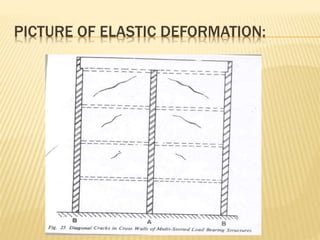
ELASTIC DEFORMATION:
When the walls are unevenly loaded, due to
variation in stresses in different parts of wall
the cracks are formed in walls. When two
materials having wide different elastic
properties are built together under the effect
of load, different shear stresses in these
materials create cracks at the junction
PICTURE OF ELASTIC DEFORMATION:
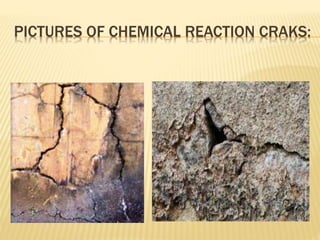
CHEMICAL REACTION:
 Chemical reactions in building materials
increase their volume and internal stress ,
causes cracks. The components of structure
also weaken due to chemical reactions. Some
common instances of chemical reactions are
following.
 Sulphates attack on cement products
 Carbonation in cement based materials
 Corrosion of reinforcement in concrete
 Alkali aggregate reaction
PICTURES OF CHEMICAL REACTION CRAKS:
CONTROLLING OF
CHEMICAL REATION CRACKS:
 If sulphates content in soil is more that 0.2 %
or in ground water more than 300 ppm use
rich mix of concrete and mortar has to be
adopted.
 Avoid bricks containing too much soluble
sulphates (more than 5 %) and use rich
mortar in such cases.
 Use expansion and control joint at closure
intervals
CREEP:
 deformation of structure under sustained
load. Basically, long term pressure or stress
on concrete can make it change shape. This
deformation usually occurs in the direction
the force is being applied. Like a concrete
column getting more compressed, or a beam
bending
PICTURES OF CREEP:
CONTROLLING OF
CREEP CRACKS:
 By using aggrigates having high modulus of
elasticity because It can be easily imagined that
the higher the modulus of elasticity the less is
the creep. Light weight aggregate shows
substantially higher creep than normal weight
aggregate.
 it can also be said that creep is inversely
proportional to the strength of concrete, so we
can reduce creep cracks by keeping
water/cement low.
VEGETATION:

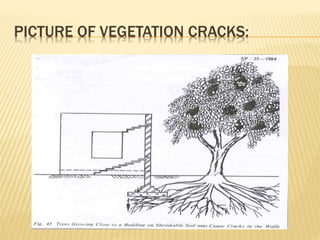
The roots of trees located in the vicinity of a
wall can create cracks in walls due to growth
of roots under foundation. The cracks occur
in clay soil due to moisture contained by
roots.
PICTURE OF VEGETATION CRACKS:
CONTROLLING OF
VEGETATION CRACKS:
 Do not let trees grow too close to the
buildings, compound walls etc. Remove any
saplings of trees as soon as possible if they
start growing in or near of walls etc.
STRUCTURAL CRACKS:
Structural cracks mainly occur due to:
a) Defective design and defective load assumptions
and perception of behavior of the structure.
b) In correct assessment of bearing capacity of
foundation soil and soil properly.
c) Defective detailing of joints of components like
roof with brick wall corner joints of walls
d) Defective detailing of structural detailing of steel
reinforcement.
e) Lack of quality control during construction.
END OF THE PRESENTATION:
THANK YOU

Cracks in cOncrete

  • 1.
  • 2.
  • 3.
    INTRODUCTION: CRACKS Cracks canbe: o Structural Cracks o Non Structural Cracks
  • 4.
    STRUCTURAL CRACKS: refers tocrack that developed at the core or frame that form the foundation of the building itself. Normally, any types of crack occurred in this case is very dangerous and must be dealt immediately.
  • 5.
  • 6.
    NON STRUCTURAL CRACKS: asthe name itself implies, refers to any parts of the building that doesn’t belong to the core or frame of the building for example wall (except load bearing wall),driveway, patio, and walkway. Cracks occurred in this case are not that threatening if compared to structural crack.
  • 7.
  • 8.
    CAUSES:  Structural cracks due to incorrect design  faulty construction  Overloading  Non Structural cracks  Moisture changes  Thermal movement  Elastic deformation  Creep  Chemical reaction  Foundation movement and settlement of soil  Vegetation
  • 9.
    NON STRUCTURAL CRACKS: MOISTURECHANGES: Building materials expand on absorbing moisture and shrink on drying. Shrinkage in concrete or mortar depends on a number of factors  Cement concrete: Richer the mix , greater is the drying shrinkage.  Water content: More water in mix induces the more it is to reduce, so greater is the shrinkage.  Aggregates : Large aggregates with good grading has less shrinkage for same workability as less water is used
  • 10.
     Curing: Ifproper curing starts as soon as initial set has taken place and continued for 7 to 10 days shrinkage is comparatively less  Excessive fines: More fines in aggregate requires more water for same workability and hence more shrinkage.  Temperature: Concrete made in hot weather needs more water for same workability hence results in more shrinkage
  • 11.
  • 12.
    SOME MEASURES FORCONTROLLING SHRINKAGE  Shrinkage cracks in masonry can be minimized by avoiding use of rich cement mortar and by delaying plastering till masonry has dried after proper curing and has undergone most of its initial shrinkage.
  • 13.
    TEMPRATURE EXPENSION ANDCONTRACTION: Materials expand or contract when subjected to changes in temperature. Most materials expand when they are heated, and contract when they are cooled. When free to deform, concrete will expand or contract due to fluctuations in temperature. The size of the concrete structure whether it is a bridge, a highway, or a building does not make it immune to the effects of temperature.
  • 14.
  • 15.
    CONTROLLING OF THERMALVARIATION: Joints are the most effective way to control cracking. If a sizable section of concrete is not provided with properly spaced joints to accommodate temperature movement, the concrete will crack in a regular pattern related to the temperature.
  • 16.
    ELASTIC DEFORMATION: When thewalls are unevenly loaded, due to variation in stresses in different parts of wall the cracks are formed in walls. When two materials having wide different elastic properties are built together under the effect of load, different shear stresses in these materials create cracks at the junction
  • 17.
    PICTURE OF ELASTICDEFORMATION:
  • 18.
    CHEMICAL REACTION:  Chemicalreactions in building materials increase their volume and internal stress , causes cracks. The components of structure also weaken due to chemical reactions. Some common instances of chemical reactions are following.  Sulphates attack on cement products  Carbonation in cement based materials  Corrosion of reinforcement in concrete  Alkali aggregate reaction
  • 19.
    PICTURES OF CHEMICALREACTION CRAKS:
  • 20.
    CONTROLLING OF CHEMICAL REATIONCRACKS:  If sulphates content in soil is more that 0.2 % or in ground water more than 300 ppm use rich mix of concrete and mortar has to be adopted.  Avoid bricks containing too much soluble sulphates (more than 5 %) and use rich mortar in such cases.  Use expansion and control joint at closure intervals
  • 21.
    CREEP:  deformation ofstructure under sustained load. Basically, long term pressure or stress on concrete can make it change shape. This deformation usually occurs in the direction the force is being applied. Like a concrete column getting more compressed, or a beam bending
  • 22.
  • 23.
    CONTROLLING OF CREEP CRACKS: By using aggrigates having high modulus of elasticity because It can be easily imagined that the higher the modulus of elasticity the less is the creep. Light weight aggregate shows substantially higher creep than normal weight aggregate.  it can also be said that creep is inversely proportional to the strength of concrete, so we can reduce creep cracks by keeping water/cement low.
  • 24.
    VEGETATION:  The roots oftrees located in the vicinity of a wall can create cracks in walls due to growth of roots under foundation. The cracks occur in clay soil due to moisture contained by roots.
  • 25.
  • 26.
    CONTROLLING OF VEGETATION CRACKS: Do not let trees grow too close to the buildings, compound walls etc. Remove any saplings of trees as soon as possible if they start growing in or near of walls etc.
  • 27.
    STRUCTURAL CRACKS: Structural cracksmainly occur due to: a) Defective design and defective load assumptions and perception of behavior of the structure. b) In correct assessment of bearing capacity of foundation soil and soil properly. c) Defective detailing of joints of components like roof with brick wall corner joints of walls d) Defective detailing of structural detailing of steel reinforcement. e) Lack of quality control during construction.
  • 28.
    END OF THEPRESENTATION: THANK YOU