CREATIVE RESEARCH
ENVIRONMENTS
An Australian Perspective on
Managing a Paradox
Summary
• Who are creative people?
• What are Creative Research Environments?
• Where are we now?
• Why do we need to strive to improve?
Who Are They?
Maslow’s Insight
Conscious

HOT BUTTON ZONE
Unconscious
THE HOT BUTTONS?
•
•
•
•
•
•

Crave Autonomy
Ambitious & Striving for purpose
Risk taking – Almost Cavelier!
Strong analytical-factual thinks
Hunger for Information/Knowledge
Typical Gen X / Y-type profile
How are they Motivated?
•
•
•
•
•

Effective leadership
Recognition of higher purpose
Fun at Work
Constant challenge & stimulation
Accountability for outcomes
Cultural Contrast
Motivator

USA

Leadership

“Field of
Dreams”

Recognition

Very Obvious

Fun @ Work

Australia
Simple, Safe Steps
Quite Achiever

Formal/Respect Informal/Irreverent

Stimulation

Capitalist Profit

Socialist –
Public Good

Accountability

Shoot For Stars

Cassandra
Complex
What Do They Do?
R&D Team Culture Types
Club Culture

Role Culture

• Extended Personality • Management focus
• Nepotistic Feel
• Flexible/Informal

Task Culture
• Problem solving
• Team-based
• Responsive

• Comfortable/safe

Person Culture
• Star Cluster
• Talent is king
• Anti-management
Cultural Fit in CREs is Crucial
But there is no right answer!
The 4P’s in Paradox
PEOPLE
PROJECTS
(Innovation Capability) (Innovation Strategy)

PASSION
(Innovation Adoption)

PROCESS
(Innovation Process)
PEOPLE - Capability
•
•
•
•
•

Behavioural Profile
Knowledgement Services
Gap Analysis Diagnostics
Creative Thinking Processes
Creative Stimulation
PASSION - Adoption
•
•
•
•
•
•

Alignment with Sector/Company Prospectus
Economic Impact of Outcomes
Sociotechnical Change Processes
Commercialisation Services
Sector/Company Opportunity Profiling
Critical Mass Diffusion Processes
PROJECTS - Strategy
•
•
•
•
•
•
•

Scenario Visioning
Futurism
Scanning Techniques
Leading Edge Planning Techniques
Collaborative Partnerships
R&D Clustering
IP FTO Scanning
PROCESS – Systems
•
•
•
•
•
•
•

Performance Measurement
Business Planning
Outcomes & KPIs
Project Selection Models
Project Management Systems
Stage-gate Decision Making
Project Termination Processes
Where Are We Now?
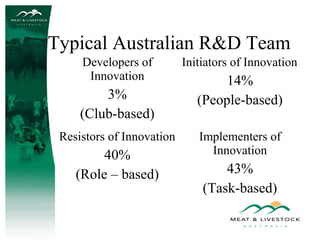
Typical Australian R&D Team
Developers of
Innovation

3%
(Club-based)
Resistors of Innovation

40%
(Role – based)

Initiators of Innovation

14%
(People-based)
Implementers of
Innovation

43%
(Task-based)
Using the 4P’s in Paradox
• PEOPLE – Recruiting the right profile to get > 80%
initiators/implementors
• PASSION – Improving alignment of R&D programs
with real issues
• PROJECT – Select on ROI
• PROCESS – Implement systems & measures to
deliver on ROI
Why do we need to perform
better?
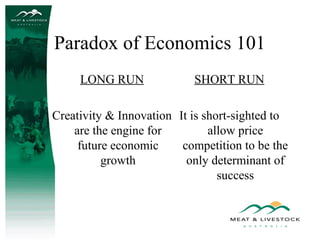
Paradox of Economics 101
LONG RUN

SHORT RUN

Creativity & Innovation It is short-sighted to
are the engine for
allow price
future economic
competition to be the
growth
only determinant of
success
Closing Comment
R&D is an Investment
Like any area of investment Science
& Technology must offer appropriate
levels of return to attract the attention
of investors
Summary - CREs
WHO
WHAT
WHERE
WHY

Creative Research Environments