Creativity is the ability to bring something new into being.ppt
1.
Slides 5 –Innovation, creativity and option generation
Today’s topics
Creativity and innovation
Different creativity methods
Thinking barriers
Brainstorming and other creativity meetings
CP option generation
Information sources for CP
Evaluation of options
Implementation of CP options
2.
Slides 5 –Innovation, creativity and option generation
Creativity
Creativity is the ability to bring something new into
being, something that did not exist before.
Creativity comprises the development of entirely
new systems, the combination of already known
information as well as the transfer of known
relations to completely new situations.
A creative action has to be intentional and must
have a purpose.
3.
Slides 5 –Innovation, creativity and option generation
Creativity and the
thought process
Convergent thinking is a fixed, structured and logical
way of thinking divided into systematic steps.
Divergent thinking is a free, disordered and imaginative
way of thinking which cannot be followed logically.
Productive creativity is controlled divergence. Creative
thinking is a type of divergent thinking which is adapted
to reality.
4.
Slides 5 –Innovation, creativity and option generation
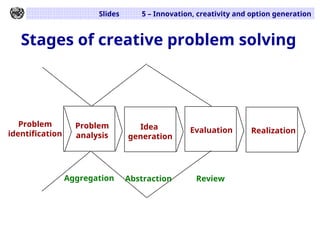
Stages of creative problem solving
Problem
identification
Problem
analysis
Idea
generation
Evaluation Realization
Aggregation Abstraction Review
5.
Slides 5 –Innovation, creativity and option generation
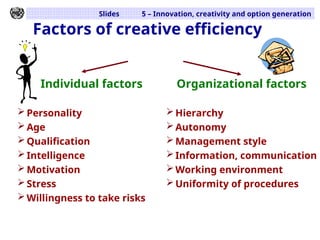
Factors of creative efficiency
Individual factors
Personality
Age
Qualification
Intelligence
Motivation
Stress
Willingness to take risks
Organizational factors
Hierarchy
Autonomy
Management style
Information, communication
Working environment
Uniformity of procedures
6.
Slides 5 –Innovation, creativity and option generation
Innovation – 1
Only the economic implementation of an idea can be
called innovation. The innovation process comprises
the generation of an idea, its acceptance (decision)
and realization (implementation). Creative thinking
is required particularly during the first stage of this
process.
A new idea is not inevitably the result of creative
thinking but can be based on modification or
imitation. What is more, not every creative process is
followed by the implementation of an idea.
7.
Slides 5 –Innovation, creativity and option generation
Innovation – 2
Innovation includes any type of change performed
on a process. At the beginning it is irrelevant,
whether this change is new per se or if it is
introduced in a particular company for the first
time. Consequently the successful transfer of
previously known solutions to new applications has
to be considered an innovation.
8.
Slides 5 –Innovation, creativity and option generation
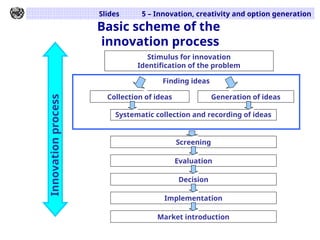
Basic scheme of the
innovation process
Finding ideas
Stimulus for innovation
Identification of the problem
Collection of ideas Generation of ideas
Systematic collection and recording of ideas
Screening
Evaluation
Decision
Implementation
Market introduction
Innovation
process
9.
Slides 5 –Innovation, creativity and option generation
Methods of idea generation
Splitting up:
Morphological analysis
Progressive abstraction
Linking:
Brainstorming
different methods such as classical, imaginative, destructive-
constructive, stop-and-go, discussion 66
Brainwriting
Method 635
Analogy:
Synectics, Bionics
10.
Slides 5 –Innovation, creativity and option generation
Thinking barriers
Routines and habits
It simply is like that; it is right; ...
Wrong categories
Generalizations, wrong presumptions
Premature evaluation
Too early criticism, typical idea killers
Emotional insecurity
Fear of exposing oneself
Pressure of conformity
Cultural barriers
Culture of logical and conclusive thinking, no intuition
Working environment
Intellectual barriers
11.
Slides 5 –Innovation, creativity and option generation
Brainstorming
Four principles
Any kind of criticism is strictly forbidden!
There are no limits to imagination.
Quantity comes before quality.
Take up the ideas of others and develop them.
12.
Slides 5 –Innovation, creativity and option generation
Working group –
your tasks
Form groups of 3 – 5 persons.
Describe your problem in the company.
Use the W-questions.
Use brainstorming techniques and
consider the tips for moderation,
visualization, etc.
Evaluate the ideas using Worksheet 5-1.
13.
Slides 5 –Innovation, creativity and option generation
Possible tasks – 1
1. A lighting manufacturer wants to develop a new
work light, especially in view of a new target
group of environmentally conscious customers
(material, light sources).
2. A car repair shop wants to extend its services
and is looking for new opportunities in the field
of “mobility”.
3. A big shopping centre has problems with traffic
congestions, especially at the weekends. Parking
spaces are rare and cost a lot. The company
looks for a solution which is not too expensive.
14.
Slides 5 –Innovation, creativity and option generation
Possible tasks – 2
4. An interest group would like to introduce an
environmental model administration.
5. A company responsible for waste disposal at an
airport would like to discuss with the airlines how
to separate waste in the aircraft. Which
possibilities can you think of?
15.
Slides 5 –Innovation, creativity and option generation
Successful idea generation group
3 – 8 members from different areas
Social homogeneity of the group
Coordinator (not necessarily the manager)
Informal and pleasant atmosphere
Mixed group (men and women)
Meetings should not be too long or too frequent
Clear tasks with clear definitions of roles
Discussion: always objective, open
Criticism should be open and objective
16.
Slides 5 –Innovation, creativity and option generation
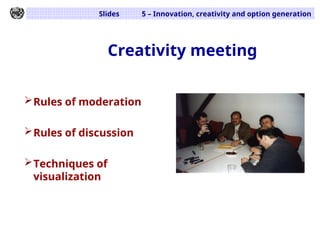
Creativity meeting
Rules of moderation
Rules of discussion
Techniques of
visualization
17.
Slides 5 –Innovation, creativity and option generation
Creativity meeting
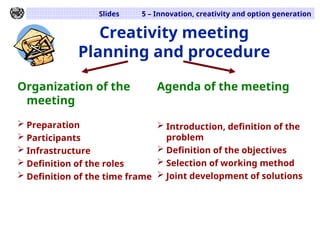
Planning and procedure
Organization of the
meeting
Preparation
Participants
Infrastructure
Definition of the roles
Definition of the time frame
Agenda of the meeting
Introduction, definition of the
problem
Definition of the objectives
Selection of working method
Joint development of solutions
18.
Slides 5 –Innovation, creativity and option generation
Creativity meeting
Evaluation and continuation
Check the results
Discussion of the results
Evaluation
Definition of remaining
aspects
Discussion of possible new
approaches
Definition of the next
meeting
Take the minutes
Sum up all possible solutions
Take note of everything
Point out the most interesting
possible solutions
19.
Slides 5 –Innovation, creativity and option generation
New, creative CP options
Apply the CP methodology consistently
Ask questions
Brainstorming with staff in a team
Adapt CP options from other sectors
(i.e. cooling, compressed air,
motivation of employees, etc.)
...
20.
Slides 5 –Innovation, creativity and option generation
CP option generation
Standard options
New, creative options
Evaluation of CP options
Technical
Environmental
Economic
21.
Slides 5 –Innovation, creativity and option generation
Standard CP options
and information sources
General checklists from manuals
Sector-specific manuals and studies,
other information sources
Information from suppliers
...
22.
Slides 5 –Innovation, creativity and option generation
CP information
sources
Manuals, sectoral
information
UNIDO/UNEP/other
NCPCs
Suppliers
Internet/homepages
Universities, research
centres
Databases
Seminars, roundtables,
congresses
Own experience
Counterparts
Chamber of Industry and
Commerce
Government, ministries
Other companies
Company staff
23.
Slides 5 –Innovation, creativity and option generation
Useful internet addresses
Cleaner production
www.unep.org
www.unido.org/cp
www.epa.gov/p2
www.es.epa.gov
Technical information
www.es.epa.gov/techinfo
www.ecodesign.at
www.acfcp.org.au/case-studies
Companies
www3.volvo.com/environment
www.sulzer.com/environment
www.nokia.com/environment
24.
Slides 5 –Innovation, creativity and option generation
Useful addresses
CP case studies
Training course www.epa.gov/oia/itc/cpnote/index.htm
(how to search on the Internet for CP)
www.unido.org/cp
www.unep.org
www.emcentre.com/unepweb/tec_case/index.htm
www.unido.org/ssites/env/sectors
www.cleanerproduction.com/industries
www.es.epa.gov/techinfo/case/case.html
www.es.epa.gov/studies
25.
Slides 5 –Innovation, creativity and option generation
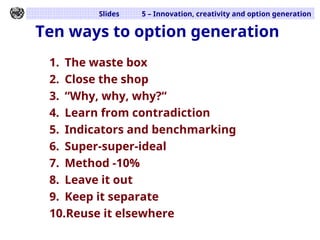
Ten ways to option generation
1. The waste box
2. Close the shop
3. “Why, why, why?“
4. Learn from contradiction
5. Indicators and benchmarking
6. Super-super-ideal
7. Method -10%
8. Leave it out
9. Keep it separate
10.Reuse it elsewhere
26.
Slides 5 –Innovation, creativity and option generation
When to carry out CP option
generation and evaluation?
Within a full CP assessment project
First company visit: convince the company to participate in a
project with the NCPC
EMS initial review
Enquiries to the NCPC from other companies, consultants,
associations
Within a cost reduction audit
Within continuous improvement
...
27.
Slides 5 –Innovation, creativity and option generation
Technical evaluation
Influence on product quality
Influence on productivity
Material consumption
Energy consumption
Influence on maintenance
Safety
Flexibility
...
28.
Slides 5 –Innovation, creativity and option generation
Environmental evaluation
Material consumption
Energy consumption
Emissions to air, water, soil
Shift of environmental problems
to other media
Replacement of substances
Health and safety
...
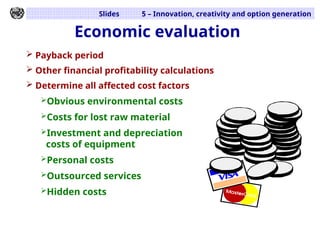
29.
Slides 5 –Innovation, creativity and option generation
Payback period
Other financial profitability calculations
Determine all affected cost factors
Obvious environmental costs
Costs for lost raw material
Investment and depreciation
costs of equipment
Personal costs
Outsourced services
Hidden costs
Economic evaluation
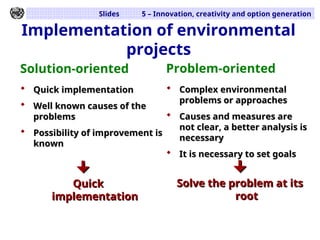
30.
Slides 5 –Innovation, creativity and option generation
Implementation of environmental
projects
Solution-oriented
Quick implementation
Quick implementation
Well known causes of the
Well known causes of the
problems
problems
Possibility of improvement is
Possibility of improvement is
known
known
Problem-oriented
Complex environmental
Complex environmental
problems or approaches
problems or approaches
Causes and measures are
Causes and measures are
not clear, a better analysis is
not clear, a better analysis is
necessary
necessary
It is necessary to set goals
It is necessary to set goals
Quick
Quick
implementation
implementation
Solve the problem at its
Solve the problem at its
root
root
31.
Slides 5 –Innovation, creativity and option generation
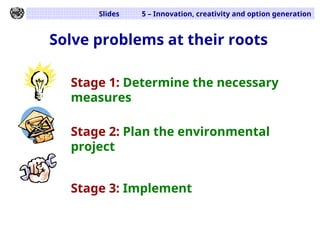
Solve problems at their roots
Stage 1: Determine the necessary
measures
Stage 2: Plan the environmental
project
Stage 3: Implement
32.
Slides 5 –Innovation, creativity and option generation
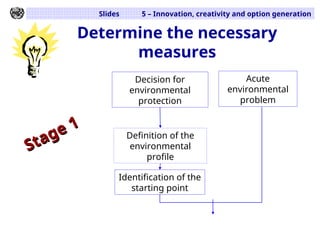
Determine the necessary
measures
Stage 1
Stage 1
Decision for
environmental
protection
Definition of the
environmental
profile
Identification of the
starting point
Acute
environmental
problem
33.
Slides 5 –Innovation, creativity and option generation
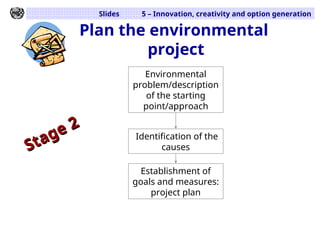
Plan the environmental
project
Stage 2
Stage 2
Environmental
problem/description
of the starting
point/approach
Identification of the
causes
Establishment of
goals and measures:
project plan
34.
Slides 5 –Innovation, creativity and option generation
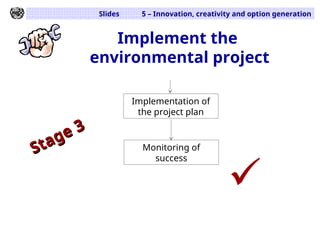
Implement the
environmental project
Stage 3
Stage 3
Implementation of
the project plan
Monitoring of
success
Editor's Notes
#2 Falsche Vorurteile gegenüber dem Begriff Kreativität:
Kreativität ist die Fähigkeit einer Minderheit von zu bewundernden "Spinnern", die manchmal brauchbare Ideen, Gags und spontan auftretende "Aha-Erlebnisse" haben. Diese wenigen "Begnadeten" nehmen eine Sonderstellung ein.
Die eigentliche Domäne der Kreativität ist der künstlerisch-ästhetische Bereich.
Intuition, Originalität und schöpferische Phantasie sind nicht methodisch erfaßbare Attribute, nicht systematisier- oder planbar.
Daher:
Jeder Mensch besitzt kreative Fähigkeiten. Kreativität ist jedoch nur zum Teil eine rein persönliche Eigenschaft und hängt auch nicht direkt mit Intelligenz zusammen. Sie ist eine fertigkeit, die durch Ausbildung und Übung gefördert werden kann. Kreativität bedeutet sowohl die Anwendung bestimmter Techniken als auch eine Geisteshaltung. Eine der wichtigsten Voraussetzungen für die Kreativität ist die Bereitschaft, immer von neuem zu beginnen und nichts als definitiv oder als einen abgeschlossenen Prozeß zu sehen.
#3 Konvergente und divergente Denkoperationen sind kein Gegensatz, sondern stehen für eine kreative Persönlichkeit durchaus in notwendiger Ergänzung zueinander.
Kreative Problemlösung bedeutet das Zusammenführen, das Umstrukturieren von an sich nicht logisch zusammenpassenden Teilsystemen.
Die Vorstellung z.B., daß der Fortschritt in den Wissenschaften durch die alleinige Anwendung der strengen Logik geschieht, wird heute allgemein als überholt anerkannt (Einsteins Relativitätstheorie wäre so nie zustande gekommen).
#4 Die obige Grafik zeigt den chematischen Ablauf eines kreativen Denkprozesses. Für die Problemanalyse findet zunächst mal eine Verdichtung der Gedanken auf das konkrete Problem statt. Hier liegt i.d.R. logisches systematisches (konvergentes) Denken vor. Der dann kreative Ideenfindungsprozess entfernt sich wieder vom Problem (divergentes Denken). Alle Ideen werden anschließend kritisch überprüft (streng konvergentes Denken).
Diese Vorgangsweise wird auch Divergenz mit kontrollierter Konvergenz genannt und gewährleistet die Verbindung der Ungebundenheit der Phantasie mit der Strenge der logischen Schlußfolgerung. Fehlt der letzte Schritt, ist der Weg vom "Genie zum Wahnsinn" leicht möglich.
Wichtig ist die Unterscheidung in die verschiedenen Phasen und das Sich-Bewußt-Werden, in welcher Phase man sich gerade befindet, da der Mensch nicht divergent und konvergent zugleich denken kann.
Der abgebildete Ablauf gilt für nahezu jeden kreativen Denkprozeß, unabhängig davon, ob er allein oder in der Gruppe durchlaufen wird.
Für größere Probleme oder in größeren Firmen kann es sinnvoll sein, für jede Phase eine eigene Gruppe zu haben (Analysegruppe, Ideengruppe, Bewertungsgruppe, Realisierungsgruppe).
#5 Individuelle Faktoren:
Persönlichkeitsmerkmale - Problemsensibilität, Gedankengeläufigkeit, Flexibilität und Anpassungsfähigkeit, Originalität, Spontaneität, Frustrationstoleranz, Risikobereitschaft, Durchsetzungsvermögen
(all diese Merkmale sind entwickelbar)
Alter - in der Tendenz entfällt die Phase höchster Kreativität auf die ersten 10 Berufsjahren.
Wissen und Intelligenz - vielseitiges Wissen und ein fundierter Erfahrungs- und Wortschatz und eine am oberen Durchschnitt liegende Intelligenz fördern die schöpferische Leistungsfähigkeit. Erfahrung kann aber auch alternative Lösungen blockieren.
Motivation, Leistungsdruck - innere, echte Motivation statt von außen gesetzte Zwänge; persönliche Identifikation mit den Zielen; Zeitdruck, finanzielle Verantwortung und Qualitätsanspruche werden dann postiv verarbeitet, wenn Bedürfnisse wie Sicherheit, Ansehen, Selbstständigkeit ... gewährleistet sind.
Organisatorische Faktoren:
Hierarchie - notwendigerweise innovationsfeindlich, geringe formale Statusunterschiede schaffen
Autonomie - Delegation von Verantwortung und Autorität bringt hohe Experimentierfreude, Innovation und Kreativität. Ideenfindung erfordert zeitweilige Dezentralisierung und Gruppenarbeit.
Führungsstil - Autortäre Führung unterbindet freie Denkansätze, fördert unproduktive und passive Haltung der Mitarbeiter. Demokratischer, mitarbeiterorientierter und kooperativer Führungsstil ist von höchster Bedeutung.
Sicherheit, Offenheit - Jeder Mitarebeiter muß Lösungsbeiträge liefern können, ohne befürchten zu müssen, daß ihm mangelnde Qualität dieser Vorschläge nachteilig angelastet wird. Klima schaffen, in dem sich Mitarbeiter untereinander als gegenseitige Hilfsquellen betrachten und nicht als Konkurrenten.
Standardisierung - Hohe Standardiesierung, Routineregelungen und generell gehaltene Arbeitsanweisungen sind zwar rationell aber nachteilig für Innovation und Kreativität.
Hilfreich: - mehr Teamarbeit in die tägliche Praxis einbauen, - Beförderungsrichtlinien, die sich auch an sozialen Fähigkeiten und Kooperationsbereitschaft orientieren, einführen.
#6 Während die traditionellen Innovationsanlässe eher im Bereich der zufälligen Chance zu suchen waren, gehen heute immer mehr Unterrnehmen dazu über, ihre Innovationsfähigkeit unter Einsatz von Kreativitätstechniken und Innovationsteams systematisch zu forcieren. damit ist in verstärktem Maße eine Hinwendung zu den kreativen Phasen des Innovationsprozesses erforderlich.
#9 Zerkleinerung:
konvergenter Denkansatz, systematische Problemspezifizierung und Systematisierung
Morphologische Analyse - Aufteilung des Problems in Teilkomplexe; Lösung der Teilprobleme und Zusammenfügung zu einer Gesamtlösung
Progressive Abstraktion - Worauf kommt es eigentlich an? Aufdecken der Kernfragedurch systematisches und hierarchisch strukturiertes Vorgehen.
Anknüpfung:
divergentes Denken mit freien und spontanen Assoziationen
Brainstorming - ungehemmte Diskussion, in der keine Kritik geäußert werden darf
ananym - anonymes Aufschreiben vor der Problemlösungssitzung
destrukiv-konstruktiv - alle denkbaren Schwächen einer Lösung werden ausgearbeitet und dann weiter
verbessert
stop and go - schöpferische Phasen (go) und solche der kritischen Bewertung (stop)
discussion 66 - ein großes Gremium wird in Gruppen zu 6 Personen eingeteilt, die 6 Minuten Zeit
bekommen, unabhängig voneinander einlösung zu finden. Anschließend findet die Diskussion im
großen Rahmen statt.
Brainwriting - spontanes Wiederschreiben von Ideen auf Formulare oder Zettel; Umlauf von Formularen
Ideen-Delphi - wiederkehrende Befragung, bei der der Befragte mit der Auswertung der Ergebnisse der
Gruppe erneut konfrontiert wird.
Methode 635 - 6 Personen haben 5 Minuaten Zeit, um drei Ideen in eine Tabelle einzutragen. Diese
Tabelle reicht nun jeder an den Nachbarn weiter und ergänzt die an ihn gereichte Tabelle, indem er auf
die Ideen des Vorgängers eingehen kann.
Analogie:
Synektik - Stimulieung der Lösungsfindung durch Auseinandersetzung mit Bedeutungsinhalten, die scheinbar nicht mit dem Problem zusammenhängen.
Bionik - Befolgung bestimmter, der Natur abgeschauter Prinzipien bei der Lösungssuche
#10 Gewohnte "Sets":
Hat sich eine bestimmte Gewohnheit eingestellt, so pflegen wird das Denken abzustellen und mechanisch immer wieder das Gelernte zu praktizieren (Zu einem Theaterbesuch gehören ....).
Falsche Kategorien:
Verallgemeinerungen, falsche Voraussetzungen oder die frühere Erfahrung machen es schwierig, das Problem aus unterschiedlichen Blickwinkeln zu betrachten.
Vorzeitige Beurteilung:
Sie sollte unbedingt verhindert werden. Zu frühe Kritik kann Anregungen eliminieren, anstatt sie weiter zu entwickeln.
Emotionale Unsicherheit:
Aus Furcht vor Blamage wird kein Risiko eingegangen , das kreative Denken wird unterdrückt.
Konformitätsdruck:
Jede Gruppe entwickelt eigene Normen und beeinflußt die Denkkategorien ihrer Mitglieder. Einzelne Menschen wenden sich, wenn sie vor Entscheidungen gestellt werden und Meinungen in unklaren Situationen bilden sollen, i.d.R. an andere.
Kulturbedingte Blockaden:
Das kreative Denken, das mehr von der Intuition abhängt, wird durch das hohe Maß an Bedeutung, das unsere Kultur der Logik und dem schlußfolgernden Denken zuerkennt, blockiert.
Umweltbedingte Blockaden:
Die unmittelbare Umgebung kann die Kreativität blockieren (Ablenkung, persönliche Spannungen).
Blockaden des Intellekts
#12 Stellen Sie Ihr betriebliches Problem der Kreativitätsgruppe dar. Verwenden Sie hierfür die W-Fragen. Berücksichtigen Sie beim Abhalten der Kreativitätssitzung die bereits angeführten Grundregeln.
Werten Sie die Ideen mit den beiliegenden Arbeitsblättern aus und ordnen Sie sie nach Grad der Unsetzbarkeit und Art der Cleaner Production Maßnahme.
Idealerweise sollte je Betrieb, zumindest aber für zwei, eine Brainstormingsitzung abgehalten werden. Teilen Sie sich die Abfolge, pausen etc. selber ein.
Sollten Sie keine konkreten betrieblichen Probleme vorliegen haben, so wählen Sie bitte aus den folgenden Vorschlägen:
1. Eine neue Arbeitsleuchte soll insbesondere im Hinblick auf die neue Zielgruppe ökologisch orientierter Kunden entwickelt werden (Materialien, Lichtquellen).
2. Ein Kfz-Betrieb möchte weg vom reinen Reparatur-Image und sucht nach neuen Wegen im Dienstleistungsbereich "Mobilität".
3. Ein großes Shopping-Center erleidet insbesondere am Wochenende den Auto-Infarkt. Parkraum ist knapp und neuer teuer. Gesucht wird nach neuen und finanzierbaren Wegen.
4. Eine Interessensvertretung möchte in der eigenen Großverwaltung Vorreiter sein und ökologisch ein Vorbild geben. Was könnte sie wie tun?
5. Eine metallverarbeitende Firma, die auf Großbaustellen Rohrleitungen verlegt, möchte mit einem neuen, eigenen ökologischen Abfallogistikkonzept an die Kunden herantreten.
6. Die für die Abfallentsorgung eines Flughafens verantwortliche Gesellschaft möchte mit den Airlines über ein bereits im Flugzeug durchgeführtes Vortrennkonzept diskutieren. Welche Möglichkeiten gäbe es?
#23 When you want to find special informations in the WWW, you have to use some tricks to get them.
Search engines are searching for internet addresses and the informations you want to have.
Therefore you have to feed the search engine with words, keywords, phrases or, in some cases with questions.
The search engine automatically sorts the results so the most relevant Web pages are listed first.
There are two kinds of search engines:......
To limit the documents that the search program finds in index of the Web, you can also include logical expressions, like................
or include commands that limit the search to specific elements of the Web, such as the HTML title.
So now lets go into practice.