Turnover Reduction:
A Complex (But Achievable)
Goal
Presented by:
Ted Kinney, Ph.D.
Tracey Tafero, Ph.D.
Select International, Inc.
2
©2015QUALTRICSLLC.
The recording for today’s presentation will be available on-demand at talentweek.com.
Along with other content and webinars from Talentweek.
Join the conversation on twitter by tweeting @qualtrics using #Talentweek and #HumanCapital.
It’s not too late to register! Make sure your team and network register for Talentweek.
Housekeeping
Introductions
Tracey Tafero, Ph.D. - Director of Consulting
• I/O Psychologist, Clemson University
• Leads a team of consultants developing and
implementing talent solutions, spanning all industries and
levels within organizations
Ted Kinney, Ph.D. - Director of R&D
• I/O Psychologist, Pennsylvania State University
• Extensive Turnover Consultation experience
• 15+ years implementing talent solutions in organizations
Topics for our time together today
• The presenters’ unique perspectives
• Why do we care about turnover?
– The consequences of turnover
• What are your turnover drivers?
– The antecedents of turnover
– Some solutions for your consideration
• A few case studies from our experience
• Conclusion and Discussion
Our Unique Perspective
• We have a unique position on which to view what is
happening in our labor markets
• Turnover has become a more important pain point than
ever before
• Ted’s and Tracey’s unique experiences have led us to the
same conclusion . . .
Why do we care about turnover?
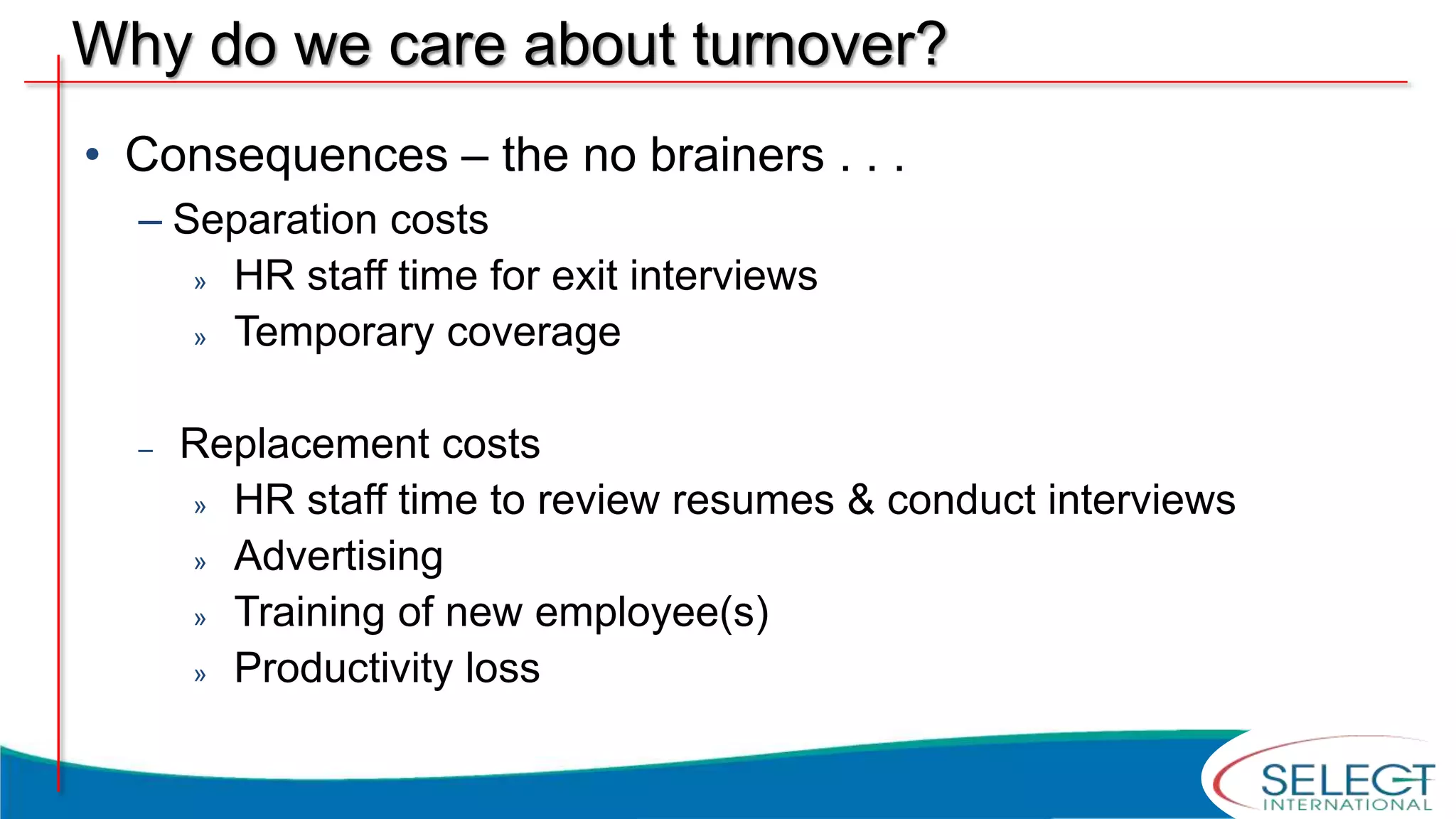
• Consequences – the no brainers . . .
– Separation costs
» HR staff time for exit interviews
» Temporary coverage
– Replacement costs
» HR staff time to review resumes & conduct interviews
» Advertising
» Training of new employee(s)
» Productivity loss
Why do we care about turnover?
• Consequences – the not so obvious . . .
– Well being of workforce
– Stress
– Safety
– Teamwork
– Cultural impact
– Client loss
– Snowball effect
• SO what is the real cost? 1.5x to 2.5x total comp!
– . . . AT LEAST!!
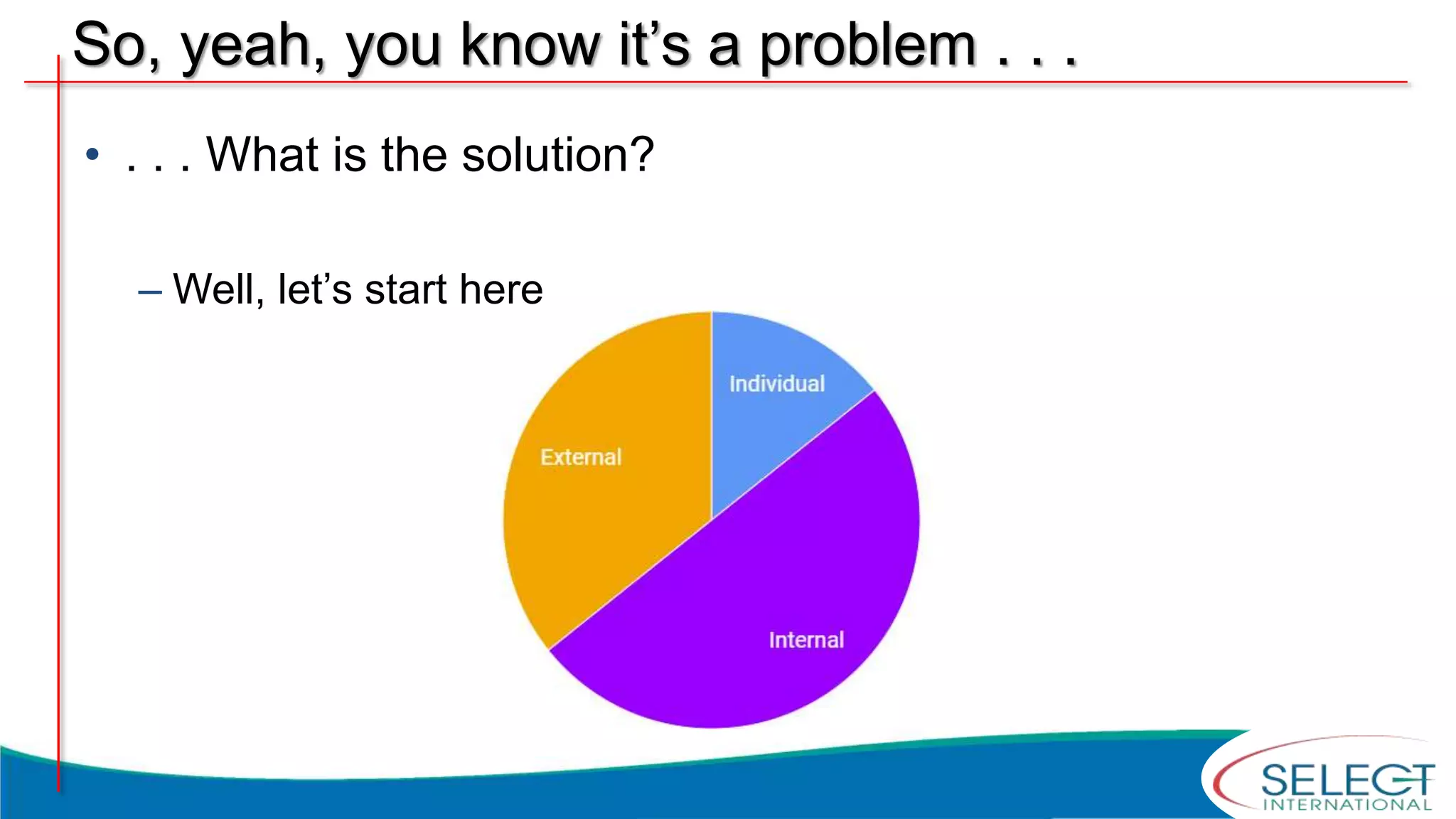
So, yeah, you know it’s a problem . . .
• . . . What is the solution?
– Well, let’s start here
Individual Difference Drivers
Causes of turnover due to
the person
• Impulsivity
• Locus of Control
• Adaptability
• Self Esteem
• Integrity
• Growth Need Strength
• Fit
Strategies to combat
these challenges
• Implement an
assessment
• Collect biographical
information
• Provide an accurate RJP
• Alternative recruitment
strategies
Internal Drivers
Causes of turnover internal
to the organization
• Culture
• Pay & benefits
• Job design
• Workload
• Autonomy
• Growth opportunities
• Training opportunities
• Leadership
• Communication
• Job related shocks
• Relationships
Strategies to combat
these challenges
• Socialization practices
• Training & development
• Justice & fairness
• Tie rewards to retention
• Train leaders
• Remove abusive
supervisors
• Set challenging, but
achievable goals
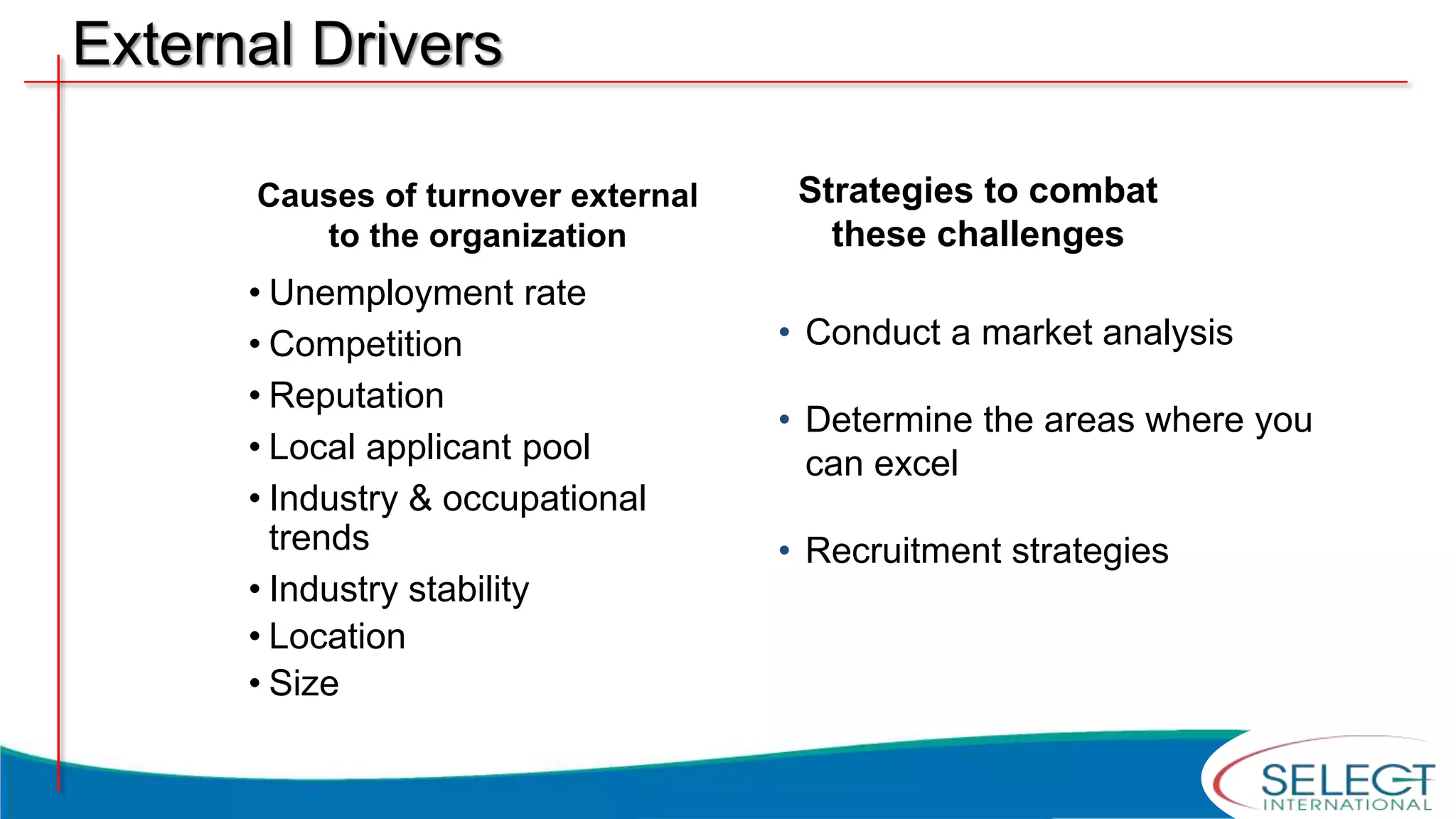
External Drivers
Causes of turnover external
to the organization
• Unemployment rate
• Competition
• Reputation
• Local applicant pool
• Industry & occupational
trends
• Industry stability
• Location
• Size
Strategies to combat
these challenges
• Conduct a market analysis
• Determine the areas where you
can excel
• Recruitment strategies
Individual Intervention Case Studies
• Most of our research outcomes focus on individual
interventions . . .
– An illustrative series of Healthcare Individual Differences
Interventions in different situations
• CASE 1 - Focusing only on the assessment
• CASE 2 - Focusing on everything
• CASE 3 - Plugging in an assessment at a strong EOC
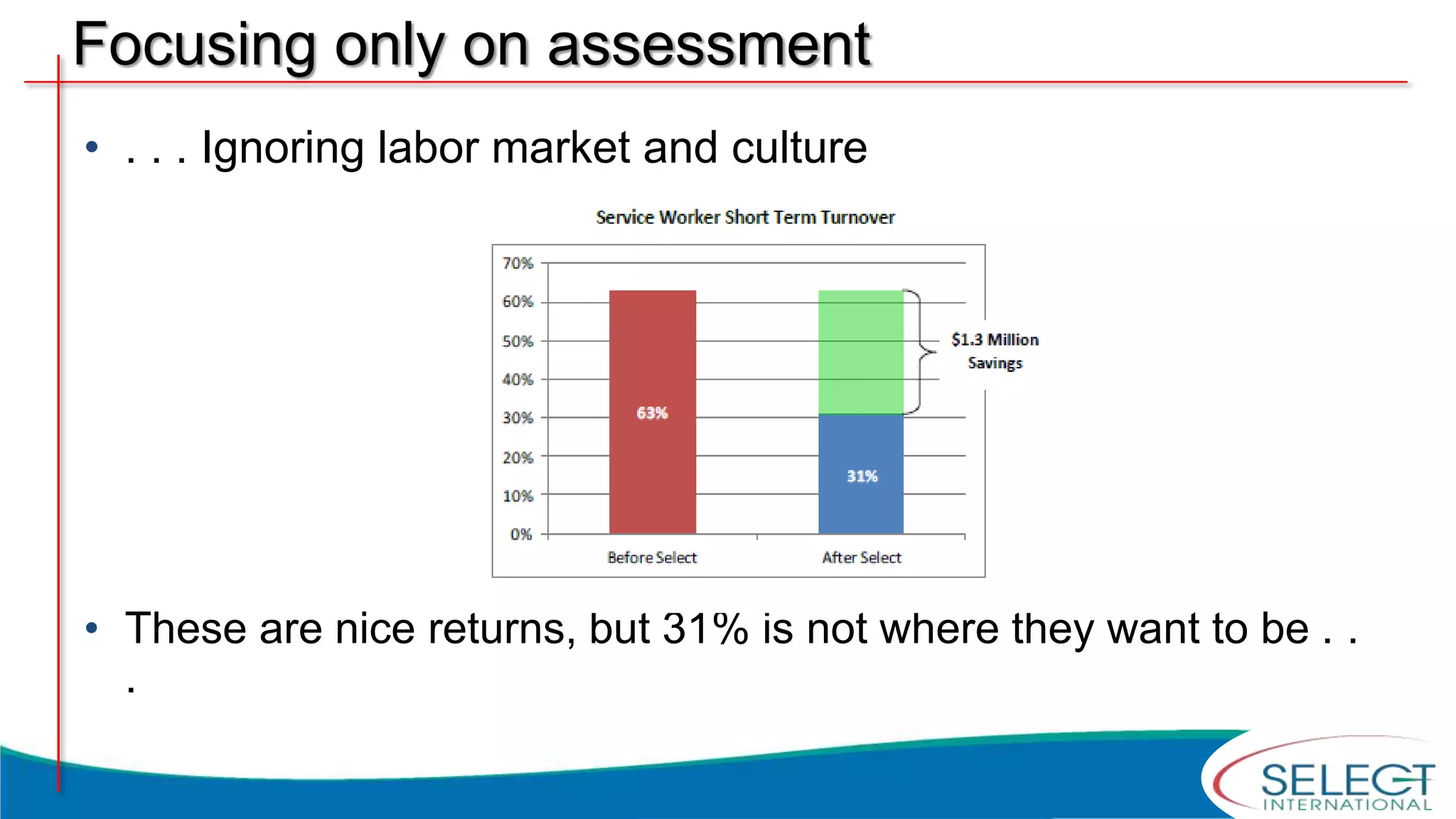
Focusing only on assessment
• . . . Ignoring labor market and culture
• These are nice returns, but 31% is not where they want to be . .
.
Focusing on everything
• Taking seriously the journey to become EOC with best-in-class talent systems
• Original overall turnover was 24%
– Post implementation
• Along with other critical outcomes . . .
– 16 percentile point improvement in patient satisfaction
– Reduced time to fill by 44%
– Improved staff perception of focus on safety by 10%
– Improved staff perception of involvement in patient experience initiatives by 18%
3 months or less <1%
6 months 4.0%
1 year 6.3%
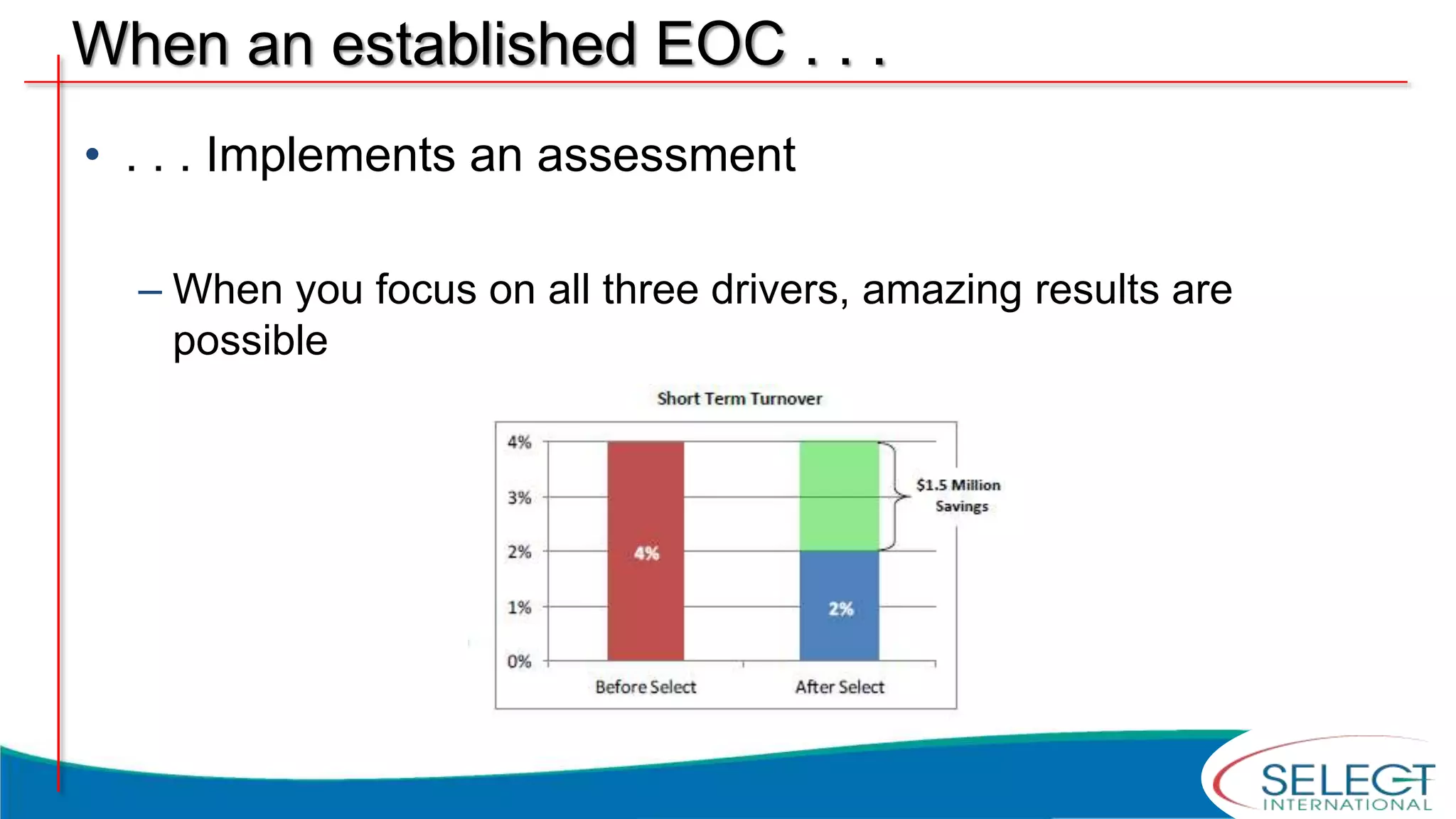
When an established EOC . . .
• . . . Implements an assessment
– When you focus on all three drivers, amazing results are
possible
Summary
• Achieving Turnover Goals is possible, but . . .
– It is complex
– Requires serious investigation into all drivers
– Unless you are lucky, focusing on one driver won’t get you
there
• If you focus on all three sources through detailed
investigation . . .
– SINGLE DIGIT TURNOVER IS POSSIBLE!
Select can help you understand your turnover
• We have developed a process to help organizations
understand turnover
– Multifaceted approach to investigate all three drivers
– Tools to collect data on key turnover antecedents
– Provide detailed insight on turnover reduction strategies
– Provide recommendations and likely returns from suggested interventions
• This process can be deployed at varying levels of
resource expenditure
– Feel free to contact us to discuss our approach to turnover diagnosis
Questions from you
THANK YOU!

Turnover Reduction: A Complex (but Achievable) Goal

  • 1.
    Turnover Reduction: A Complex(But Achievable) Goal Presented by: Ted Kinney, Ph.D. Tracey Tafero, Ph.D. Select International, Inc.
  • 2.
    2 ©2015QUALTRICSLLC. The recording fortoday’s presentation will be available on-demand at talentweek.com. Along with other content and webinars from Talentweek. Join the conversation on twitter by tweeting @qualtrics using #Talentweek and #HumanCapital. It’s not too late to register! Make sure your team and network register for Talentweek. Housekeeping
  • 3.
    Introductions Tracey Tafero, Ph.D.- Director of Consulting • I/O Psychologist, Clemson University • Leads a team of consultants developing and implementing talent solutions, spanning all industries and levels within organizations Ted Kinney, Ph.D. - Director of R&D • I/O Psychologist, Pennsylvania State University • Extensive Turnover Consultation experience • 15+ years implementing talent solutions in organizations
  • 4.
    Topics for ourtime together today • The presenters’ unique perspectives • Why do we care about turnover? – The consequences of turnover • What are your turnover drivers? – The antecedents of turnover – Some solutions for your consideration • A few case studies from our experience • Conclusion and Discussion
  • 5.
    Our Unique Perspective •We have a unique position on which to view what is happening in our labor markets • Turnover has become a more important pain point than ever before • Ted’s and Tracey’s unique experiences have led us to the same conclusion . . .
  • 6.
    Why do wecare about turnover? • Consequences – the no brainers . . . – Separation costs » HR staff time for exit interviews » Temporary coverage – Replacement costs » HR staff time to review resumes & conduct interviews » Advertising » Training of new employee(s) » Productivity loss
  • 7.
    Why do wecare about turnover? • Consequences – the not so obvious . . . – Well being of workforce – Stress – Safety – Teamwork – Cultural impact – Client loss – Snowball effect • SO what is the real cost? 1.5x to 2.5x total comp! – . . . AT LEAST!!
  • 8.
    So, yeah, youknow it’s a problem . . . • . . . What is the solution? – Well, let’s start here
  • 9.
    Individual Difference Drivers Causesof turnover due to the person • Impulsivity • Locus of Control • Adaptability • Self Esteem • Integrity • Growth Need Strength • Fit Strategies to combat these challenges • Implement an assessment • Collect biographical information • Provide an accurate RJP • Alternative recruitment strategies
  • 10.
    Internal Drivers Causes ofturnover internal to the organization • Culture • Pay & benefits • Job design • Workload • Autonomy • Growth opportunities • Training opportunities • Leadership • Communication • Job related shocks • Relationships Strategies to combat these challenges • Socialization practices • Training & development • Justice & fairness • Tie rewards to retention • Train leaders • Remove abusive supervisors • Set challenging, but achievable goals
  • 11.
    External Drivers Causes ofturnover external to the organization • Unemployment rate • Competition • Reputation • Local applicant pool • Industry & occupational trends • Industry stability • Location • Size Strategies to combat these challenges • Conduct a market analysis • Determine the areas where you can excel • Recruitment strategies
  • 12.
    Individual Intervention CaseStudies • Most of our research outcomes focus on individual interventions . . . – An illustrative series of Healthcare Individual Differences Interventions in different situations • CASE 1 - Focusing only on the assessment • CASE 2 - Focusing on everything • CASE 3 - Plugging in an assessment at a strong EOC
  • 13.
    Focusing only onassessment • . . . Ignoring labor market and culture • These are nice returns, but 31% is not where they want to be . . .
  • 14.
    Focusing on everything •Taking seriously the journey to become EOC with best-in-class talent systems • Original overall turnover was 24% – Post implementation • Along with other critical outcomes . . . – 16 percentile point improvement in patient satisfaction – Reduced time to fill by 44% – Improved staff perception of focus on safety by 10% – Improved staff perception of involvement in patient experience initiatives by 18% 3 months or less <1% 6 months 4.0% 1 year 6.3%
  • 15.
    When an establishedEOC . . . • . . . Implements an assessment – When you focus on all three drivers, amazing results are possible
  • 16.
    Summary • Achieving TurnoverGoals is possible, but . . . – It is complex – Requires serious investigation into all drivers – Unless you are lucky, focusing on one driver won’t get you there • If you focus on all three sources through detailed investigation . . . – SINGLE DIGIT TURNOVER IS POSSIBLE!
  • 17.
    Select can helpyou understand your turnover • We have developed a process to help organizations understand turnover – Multifaceted approach to investigate all three drivers – Tools to collect data on key turnover antecedents – Provide detailed insight on turnover reduction strategies – Provide recommendations and likely returns from suggested interventions • This process can be deployed at varying levels of resource expenditure – Feel free to contact us to discuss our approach to turnover diagnosis
  • 18.
  • 19.