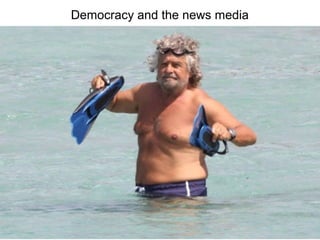
Democracy and the news media
Beppe Grillo and the Five Star Movement
  Italian elections, February 2013

• The movement is based entirely on the internet, it has no
  headquarters and no local offices

• Grillo has more than 1 million followers on Twitter and Facebook

• 5SM candidates for parliament were picked in on-line elections

• It has a strict rule not to appear on television talk shows

• During the election campaign Grillo did not give any television or
  newspaper interviews, because journalists, like politicians, are the
  “enemy”

• The Italian press, both liberal and conservative, is extremely hostile
  to the 5SM. Politicians denounce Grillo as a right-wing demagogue;
  a left-wing anarchist; a personality cult
•   For the past 30 years, Sylvio
    Berlusconi’s Mediaset empire has
    controlled Italy’s top three national
    TV channels

•   He owns a major daily newspaper
    (Il Giornale), a popular news
    magazine (Panorama), and a large
    publishing house

•   As head of government for most of
    the decade from 2001-2011,
    Berlusconi also maintained a tight
    grip on the state broadcaster, Rai,
    appointing its board and sacking
    “hostile” journalists

•   Italy ranks 57th on the Reporters
    without Borders press freedom index,
    behind Hungary, Haiti and Burkina
    Faso
What are the functions of media
       in a democracy?
The liberal model of media in a democracy:


- Watchdog: holding governments to account, guardian of the public
   interest

    - Whistle-blowing, investigative reporting, exposing wrongdoing

         - Informing, educating, mobilising

                - A mirror held up to the world

                        - A public forum for debate

                                - A voice for the voiceless

                                         - Builder of consensus
Market model

Basic principles:

• Society’s needs are best met through
  unregulated supply and demand

• Consumers generate demand

• Media are like all other goods and services

• Private, unregulated ownership is best
“The only reliable, durable, and perpetual guarantee
of independence is profit.”
                                 James Murdoch, 2009
Paul McMullan,
                                              deputy features
                                              editor, News of the
                                              World (1994 to
                                              2001), to the
                                              Leveson Inquiry,
                                              London, 2011


“Circulation defines what is the public interest.
I see no distinction between what the public is
interested in and the public interest. ...
What is of interest to the public is what they put
their hand in their pocket and buy.”
2002   2008
September
2002
“It’s silly to point the finger
 at these programmes for
 puffing up the property
 market, forcing people into
 taking out massive
 mortgages, or into
 negative equity.

 “Blaming such shows and
 their presenters for the
 present uncertain state of
 the property market is like
 blaming TV chefs for the
 great increase in obesity.”


  Kirstie Allsopp, presenter,
“Location Location Location”
      (Channel 4), July 2008
Advantages:
   – Efficiency
   – Responsiveness
   – Competitiveness
   – Flexibility
   – Innovation

Disadvantages:
    – Concentration of ownership
    – Entertainment beats information
    – Reliance on advertising
    – Journalism is expensive!
Rupert Murdoch, Davos, 2011
How democratic are the corporate media?


•   Extremely steep hierarchy
•   Upper levels usually from higher social classes
•   Very white and male
•   Lower levels have very little say over content
•   Content is aimed at a specific audience
•   Comment is limited to a few “star” writers
•   Very narrow range of views broadcast or in print
•   Almost entirely unaccountable to the public
The ‘propaganda model’

       •   Edward Herman and Noam Chomsky,
           “Manufacturing Consent”, 1988

       •   Five filters:
            –   Ownership
            –   Advertising
            –   Sources
            –   ‘Flak’
            –   Anti-communism (now largely replaced by ‘Islamic terror’)
Guardian journalist Nick Davies
commissioned
“The rules of production”
                          Nick Davies (investigative reporter, The Guardian),
                                            author of Flat Earth News (2008)

To make more money:

   1. Run cheap stories

     2. Select safe facts / ideas

       3. ‘Ninja turtle’ syndrome

         4. Avoid the electric fence

            5. Always give both sides of the story

              6. Give them what they want

                 7. Bias against the truth

                    8. Go with the moral panic
Dilemma:
• Mass media are businesses
• But they also are providers of information
  and carriers of culture
• Tension between private profit and public
  interest
How influential are the media?


•   In 2006, 41% of Americans said Iraq in 2003 had weapons of
    mass destruction or a major programme for developing them

•   49% believed Iraq was directly involved in the September 11,
    2001, attacks or gave ‘substantial help’ to al-Qaeda

                (Poll of 851 Americans by WorldPublicOpinion.org, March 1-6, 2006
UK general elections, voting patterns among
readers of The Sun newspaper


                          1992 1997 2001 2005 2010

Conservative              45    30     29     33   43

Labour                    36    52     52     45   28

                                     Source: Ipsos MORI
Does Fox News influence
    voters, or merely reinforce
    their existing opinions?

•   Study of 9,256 towns in the
    US where Fox cable TV was
    introduced after 1996

•   Measured the impact of the
    introduction of Fox on the
    vote share in the presidential
    elections of 2000

•   It found Republicans gained
    just 0.4 to 0.7 percentage
    points in the towns that
    broadcast Fox News

        Quarterly Journal of Economics,
                           August 2007
Fox failed to stop Obama… twice!

• Backing the right-wing Tea Party movement was not an unequivocal
  political success

• It may have damaged the Republican Party by turning people
  against more moderate conservatives

• Not only was Fox unable to prevent Obama’s re-election, but it failed
  to stop his health care plan

• The Democrats did not suffer losses in the 2010 mid-term elections
  primarily because of opposition on Fox; they hesitated on health
  care reform and there was a deep recession

• There were legitimate grounds for criticism of Obama from the left
Other events in recent history that
should not have happened if the
media control our minds…
Recent stories that should not
have happened if the media were
100% dominated by corporate
interests…
UK parliamentary expenses, 2008
Wikileaks Iraq /Afghan diplomatic cables, 2010
Milly Dowler, 2011
‘Public sphere’ model of the media

  • Media are not like other products

  • Society’s needs not met entirely through market
    system

  • Consumer power is not democracy

  • Profitability is not the sole determinant of value

  • Government may have a role to play

Cps 2

  • 1.
  • 2.
    Beppe Grillo andthe Five Star Movement Italian elections, February 2013 • The movement is based entirely on the internet, it has no headquarters and no local offices • Grillo has more than 1 million followers on Twitter and Facebook • 5SM candidates for parliament were picked in on-line elections • It has a strict rule not to appear on television talk shows • During the election campaign Grillo did not give any television or newspaper interviews, because journalists, like politicians, are the “enemy” • The Italian press, both liberal and conservative, is extremely hostile to the 5SM. Politicians denounce Grillo as a right-wing demagogue; a left-wing anarchist; a personality cult
  • 3.
    For the past 30 years, Sylvio Berlusconi’s Mediaset empire has controlled Italy’s top three national TV channels • He owns a major daily newspaper (Il Giornale), a popular news magazine (Panorama), and a large publishing house • As head of government for most of the decade from 2001-2011, Berlusconi also maintained a tight grip on the state broadcaster, Rai, appointing its board and sacking “hostile” journalists • Italy ranks 57th on the Reporters without Borders press freedom index, behind Hungary, Haiti and Burkina Faso
  • 4.
    What are thefunctions of media in a democracy?
  • 5.
    The liberal modelof media in a democracy: - Watchdog: holding governments to account, guardian of the public interest - Whistle-blowing, investigative reporting, exposing wrongdoing - Informing, educating, mobilising - A mirror held up to the world - A public forum for debate - A voice for the voiceless - Builder of consensus
  • 6.
    Market model Basic principles: •Society’s needs are best met through unregulated supply and demand • Consumers generate demand • Media are like all other goods and services • Private, unregulated ownership is best
  • 7.
    “The only reliable,durable, and perpetual guarantee of independence is profit.” James Murdoch, 2009
  • 8.
    Paul McMullan, deputy features editor, News of the World (1994 to 2001), to the Leveson Inquiry, London, 2011 “Circulation defines what is the public interest. I see no distinction between what the public is interested in and the public interest. ... What is of interest to the public is what they put their hand in their pocket and buy.”
  • 9.
    2002 2008
  • 10.
  • 11.
    “It’s silly topoint the finger at these programmes for puffing up the property market, forcing people into taking out massive mortgages, or into negative equity. “Blaming such shows and their presenters for the present uncertain state of the property market is like blaming TV chefs for the great increase in obesity.” Kirstie Allsopp, presenter, “Location Location Location” (Channel 4), July 2008
  • 12.
    Advantages: – Efficiency – Responsiveness – Competitiveness – Flexibility – Innovation Disadvantages: – Concentration of ownership – Entertainment beats information – Reliance on advertising – Journalism is expensive!
  • 13.
  • 14.
    How democratic arethe corporate media? • Extremely steep hierarchy • Upper levels usually from higher social classes • Very white and male • Lower levels have very little say over content • Content is aimed at a specific audience • Comment is limited to a few “star” writers • Very narrow range of views broadcast or in print • Almost entirely unaccountable to the public
  • 15.
    The ‘propaganda model’ • Edward Herman and Noam Chomsky, “Manufacturing Consent”, 1988 • Five filters: – Ownership – Advertising – Sources – ‘Flak’ – Anti-communism (now largely replaced by ‘Islamic terror’)
  • 16.
    Guardian journalist NickDavies commissioned
  • 17.
    “The rules ofproduction” Nick Davies (investigative reporter, The Guardian), author of Flat Earth News (2008) To make more money: 1. Run cheap stories 2. Select safe facts / ideas 3. ‘Ninja turtle’ syndrome 4. Avoid the electric fence 5. Always give both sides of the story 6. Give them what they want 7. Bias against the truth 8. Go with the moral panic
  • 18.
    Dilemma: • Mass mediaare businesses • But they also are providers of information and carriers of culture • Tension between private profit and public interest
  • 19.
    How influential arethe media? • In 2006, 41% of Americans said Iraq in 2003 had weapons of mass destruction or a major programme for developing them • 49% believed Iraq was directly involved in the September 11, 2001, attacks or gave ‘substantial help’ to al-Qaeda (Poll of 851 Americans by WorldPublicOpinion.org, March 1-6, 2006
  • 20.
    UK general elections,voting patterns among readers of The Sun newspaper 1992 1997 2001 2005 2010 Conservative 45 30 29 33 43 Labour 36 52 52 45 28 Source: Ipsos MORI
  • 21.
    Does Fox Newsinfluence voters, or merely reinforce their existing opinions? • Study of 9,256 towns in the US where Fox cable TV was introduced after 1996 • Measured the impact of the introduction of Fox on the vote share in the presidential elections of 2000 • It found Republicans gained just 0.4 to 0.7 percentage points in the towns that broadcast Fox News Quarterly Journal of Economics, August 2007
  • 22.
    Fox failed tostop Obama… twice! • Backing the right-wing Tea Party movement was not an unequivocal political success • It may have damaged the Republican Party by turning people against more moderate conservatives • Not only was Fox unable to prevent Obama’s re-election, but it failed to stop his health care plan • The Democrats did not suffer losses in the 2010 mid-term elections primarily because of opposition on Fox; they hesitated on health care reform and there was a deep recession • There were legitimate grounds for criticism of Obama from the left
  • 23.
    Other events inrecent history that should not have happened if the media control our minds…
  • 28.
    Recent stories thatshould not have happened if the media were 100% dominated by corporate interests…
  • 30.
  • 31.
    Wikileaks Iraq /Afghandiplomatic cables, 2010
  • 32.
  • 33.
    ‘Public sphere’ modelof the media • Media are not like other products • Society’s needs not met entirely through market system • Consumer power is not democracy • Profitability is not the sole determinant of value • Government may have a role to play