Church Planting Movements
A Summary
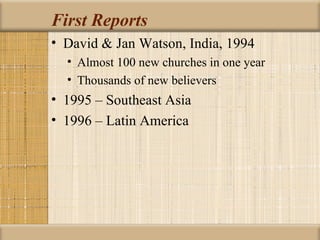
First Reports
• David & Jan Watson, India, 1994
  • Almost 100 new churches in one year
  • Thousands of new believers
• 1995 – Southeast Asia
• 1996 – Latin America
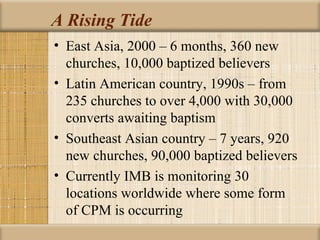
A Rising Tide
• East Asia, 2000 – 6 months, 360 new
  churches, 10,000 baptized believers
• Latin American country, 1990s – from
  235 churches to over 4,000 with 30,000
  converts awaiting baptism
• Southeast Asian country – 7 years, 920
  new churches, 90,000 baptized believers
• Currently IMB is monitoring 30
  locations worldwide where some form
  of CPM is occurring
Definition
• A Church Planting Movement is a rapid
  multiplication of indigenous churches
  planting churches that sweeps through a
  people group or population segment.
Key Concepts
• Rapid Reproduction – outstrips population
  growth
• Multiplication – virtually every church is
  engaged in starting other churches
• Indigenous – Insiders drive the movement
• Churches planting churches – exercising
  autonomy and to rapidly to control
• People groups – naturally within shared
  language and ethnic boundaries, then bridging
  to other people groups
What They Are NOT
• Not just a revival or spiritual awakening
  – the people converting were formerly
  unreached
• Not just mass evangelism – new
  churches start and multiply themselves
• Not just people movements – CPM
  results in new churches
• And finally, NOT the Church Growth
  Movement…
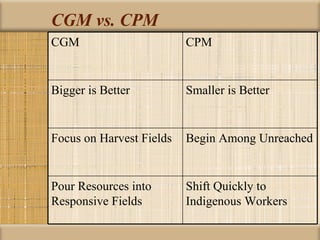
CGM vs. CPM
CGM                       CPM


Bigger is Better          Smaller is Better


Focus on Harvest Fields   Begin Among Unreached


Pour Resources into       Shift Quickly to
Responsive Fields         Indigenous Workers
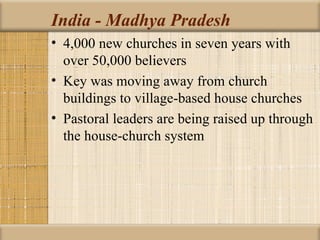
India - Madhya Pradesh
• 4,000 new churches in seven years with
  over 50,000 believers
• Key was moving away from church
  buildings to village-based house churches
• Pastoral leaders are being raised up through
  the house-church system
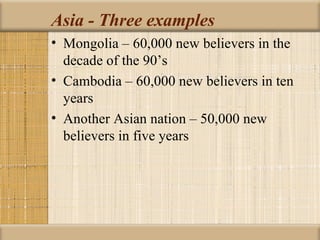
Asia - Three examples
• Mongolia – 60,000 new believers in the
  decade of the 90’s
• Cambodia – 60,000 new believers in ten
  years
• Another Asian nation – 50,000 new
  believers in five years
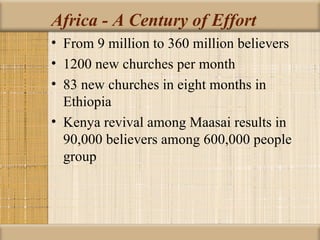
Africa - A Century of Effort
• From 9 million to 360 million believers
• 1200 new churches per month
• 83 new churches in eight months in
  Ethiopia
• Kenya revival among Maasai results in
  90,000 believers among 600,000 people
  group
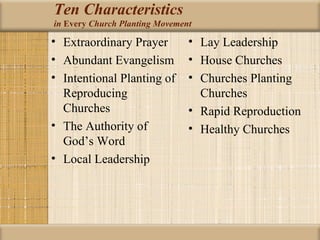
Ten Characteristics
in Every Church Planting Movement

• Extraordinary Prayer          • Lay Leadership
• Abundant Evangelism           • House Churches
• Intentional Planting of       • Churches Planting
  Reproducing                     Churches
  Churches                      • Rapid Reproduction
• The Authority of              • Healthy Churches
  God’s Word
• Local Leadership
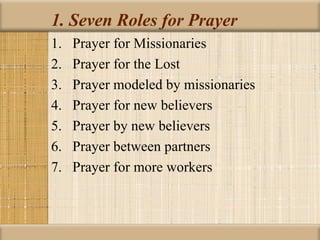
1. Seven Roles for Prayer
1.   Prayer for Missionaries
2.   Prayer for the Lost
3.   Prayer modeled by missionaries
4.   Prayer for new believers
5.   Prayer by new believers
6.   Prayer between partners
7.   Prayer for more workers
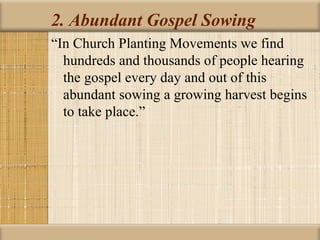
2. Abundant Gospel Sowing
“In Church Planting Movements we find
  hundreds and thousands of people hearing
  the gospel every day and out of this
  abundant sowing a growing harvest begins
  to take place.”
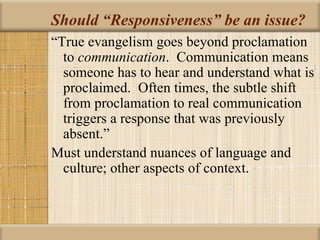
Should “Responsiveness” be an issue?
“True evangelism goes beyond proclamation
  to communication. Communication means
  someone has to hear and understand what is
  proclaimed. Often times, the subtle shift
  from proclamation to real communication
  triggers a response that was previously
  absent.”
Must understand nuances of language and
  culture; other aspects of context.
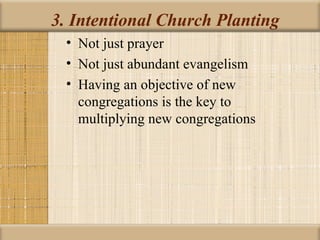
3. Intentional Church Planting
 • Not just prayer
 • Not just abundant evangelism
 • Having an objective of new
   congregations is the key to
   multiplying new congregations
4. An Authoritative Bible
• Teach converts to get doctrine from the
  Bible through guided study
• Don’t rely on your own expertise
• Don’t rely on written material
Communicating God’s Word
Among Illiterate People

1.       Memorization and Recitation
2.       Audio-Visual resources
3.       Bible Storying
4.       Singing Scripture and Theology
     •     EX: The Wesleys working with coal miners
5. Educated Youth
5. Local Leadership
“The resources are in the harvest”

“Never do anything by yourself, always bring
  a brother along with you so you can model
  and mentor as you go.”

“In a CPM you begin with the ‘torch’ in their
  hand” – you don’t pass the torch eventually
6. Lay Leadership
Practically – CPMs produce thousands of churches; well
   beyond the ability of institutions to produce
   professional leaders
Theologically – the priesthood of the believer
From Jesus – his disciples were “unschooled men” who
   had been with him
For Retention – Putting laymen to work assimilates them
   into the church
For Relevance – Laymen connect better with laymen
For Economics – Allows CPMs to expand in
   underdeveloped countries

To work well, laymen must be life-long learners and
  churches must stay small enough for a layman to
  lead
7. House Churches
CPM churches begin as small groups meeting
 in natural settings, such as homes

What they become after rapid reproduction
 begins is not of great concern. The
 movement will take on the shape that is
 appropriate in that culture
8. Churches Planting Churches
Exponential growth only begins to occur
 when churches start planting other churches

Missionaries consciously follow a pattern of
 Model, Assist, Watch, Leave
9. Rapid Reproduction
Rapid is undefined, but in the range of months, not
   years
Rapid Reproduction must be part of the core values
Movement becomes
• Out of control
• Generating internal momentum
• New Christians passionately share their faith
• Fields are confirmed to be ripe for harvest
• Things foreign and hard to reproduce rapidly
   are eliminated
10. Healthy Churches
Exhibiting the Five Purposes of the Church
• Fellowship
• Discipleship
• Ministry
• Evangelism/Missions
• Worship
In a balanced, healthy way
Characteristics of Church Planting
Seen in Scripture
• Vision Driven          • Divine Power evident
• Prayer                   in evangelism
• Abundant Evangelism    • Person of Peace
• Scriptural Authority   • House Church
• Models for               Movement
  Multiplication         • Rapid Conversion
• Preparation for
                         • Multiple Lay Leaders
  Persecution
• Family and Friends     • A Portrait of Multiple
  Evangelism               Movements
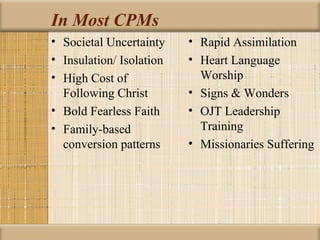
In Most CPMs
• Societal Uncertainty    • Rapid Assimilation
• Insulation/ Isolation   • Heart Language
• High Cost of              Worship
  Following Christ        • Signs & Wonders
• Bold Fearless Faith     • OJT Leadership
• Family-based              Training
  conversion patterns     • Missionaries Suffering
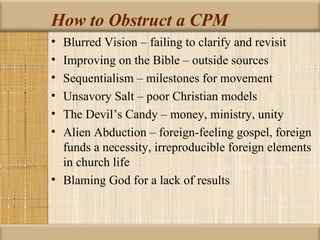
How to Obstruct a CPM
• Blurred Vision – failing to clarify and revisit
• Improving on the Bible – outside sources
• Sequentialism – milestones for movement
• Unsavory Salt – poor Christian models
• The Devil’s Candy – money, ministry, unity
• Alien Abduction – foreign-feeling gospel, foreign
  funds a necessity, irreproducible foreign elements
  in church life
• Blaming God for a lack of results

Cpm a summary of principles and examples

  • 1.
  • 2.
    First Reports • David& Jan Watson, India, 1994 • Almost 100 new churches in one year • Thousands of new believers • 1995 – Southeast Asia • 1996 – Latin America
  • 3.
    A Rising Tide •East Asia, 2000 – 6 months, 360 new churches, 10,000 baptized believers • Latin American country, 1990s – from 235 churches to over 4,000 with 30,000 converts awaiting baptism • Southeast Asian country – 7 years, 920 new churches, 90,000 baptized believers • Currently IMB is monitoring 30 locations worldwide where some form of CPM is occurring
  • 4.
    Definition • A ChurchPlanting Movement is a rapid multiplication of indigenous churches planting churches that sweeps through a people group or population segment.
  • 5.
    Key Concepts • RapidReproduction – outstrips population growth • Multiplication – virtually every church is engaged in starting other churches • Indigenous – Insiders drive the movement • Churches planting churches – exercising autonomy and to rapidly to control • People groups – naturally within shared language and ethnic boundaries, then bridging to other people groups
  • 6.
    What They AreNOT • Not just a revival or spiritual awakening – the people converting were formerly unreached • Not just mass evangelism – new churches start and multiply themselves • Not just people movements – CPM results in new churches • And finally, NOT the Church Growth Movement…
  • 7.
    CGM vs. CPM CGM CPM Bigger is Better Smaller is Better Focus on Harvest Fields Begin Among Unreached Pour Resources into Shift Quickly to Responsive Fields Indigenous Workers
  • 8.
    India - MadhyaPradesh • 4,000 new churches in seven years with over 50,000 believers • Key was moving away from church buildings to village-based house churches • Pastoral leaders are being raised up through the house-church system
  • 9.
    Asia - Threeexamples • Mongolia – 60,000 new believers in the decade of the 90’s • Cambodia – 60,000 new believers in ten years • Another Asian nation – 50,000 new believers in five years
  • 10.
    Africa - ACentury of Effort • From 9 million to 360 million believers • 1200 new churches per month • 83 new churches in eight months in Ethiopia • Kenya revival among Maasai results in 90,000 believers among 600,000 people group
  • 11.
    Ten Characteristics in EveryChurch Planting Movement • Extraordinary Prayer • Lay Leadership • Abundant Evangelism • House Churches • Intentional Planting of • Churches Planting Reproducing Churches Churches • Rapid Reproduction • The Authority of • Healthy Churches God’s Word • Local Leadership
  • 12.
    1. Seven Rolesfor Prayer 1. Prayer for Missionaries 2. Prayer for the Lost 3. Prayer modeled by missionaries 4. Prayer for new believers 5. Prayer by new believers 6. Prayer between partners 7. Prayer for more workers
  • 13.
    2. Abundant GospelSowing “In Church Planting Movements we find hundreds and thousands of people hearing the gospel every day and out of this abundant sowing a growing harvest begins to take place.”
  • 14.
    Should “Responsiveness” bean issue? “True evangelism goes beyond proclamation to communication. Communication means someone has to hear and understand what is proclaimed. Often times, the subtle shift from proclamation to real communication triggers a response that was previously absent.” Must understand nuances of language and culture; other aspects of context.
  • 15.
    3. Intentional ChurchPlanting • Not just prayer • Not just abundant evangelism • Having an objective of new congregations is the key to multiplying new congregations
  • 16.
    4. An AuthoritativeBible • Teach converts to get doctrine from the Bible through guided study • Don’t rely on your own expertise • Don’t rely on written material
  • 17.
    Communicating God’s Word AmongIlliterate People 1. Memorization and Recitation 2. Audio-Visual resources 3. Bible Storying 4. Singing Scripture and Theology • EX: The Wesleys working with coal miners 5. Educated Youth
  • 18.
    5. Local Leadership “Theresources are in the harvest” “Never do anything by yourself, always bring a brother along with you so you can model and mentor as you go.” “In a CPM you begin with the ‘torch’ in their hand” – you don’t pass the torch eventually
  • 19.
    6. Lay Leadership Practically– CPMs produce thousands of churches; well beyond the ability of institutions to produce professional leaders Theologically – the priesthood of the believer From Jesus – his disciples were “unschooled men” who had been with him For Retention – Putting laymen to work assimilates them into the church For Relevance – Laymen connect better with laymen For Economics – Allows CPMs to expand in underdeveloped countries To work well, laymen must be life-long learners and churches must stay small enough for a layman to lead
  • 20.
    7. House Churches CPMchurches begin as small groups meeting in natural settings, such as homes What they become after rapid reproduction begins is not of great concern. The movement will take on the shape that is appropriate in that culture
  • 21.
    8. Churches PlantingChurches Exponential growth only begins to occur when churches start planting other churches Missionaries consciously follow a pattern of Model, Assist, Watch, Leave
  • 22.
    9. Rapid Reproduction Rapidis undefined, but in the range of months, not years Rapid Reproduction must be part of the core values Movement becomes • Out of control • Generating internal momentum • New Christians passionately share their faith • Fields are confirmed to be ripe for harvest • Things foreign and hard to reproduce rapidly are eliminated
  • 23.
    10. Healthy Churches Exhibitingthe Five Purposes of the Church • Fellowship • Discipleship • Ministry • Evangelism/Missions • Worship In a balanced, healthy way
  • 24.
    Characteristics of ChurchPlanting Seen in Scripture • Vision Driven • Divine Power evident • Prayer in evangelism • Abundant Evangelism • Person of Peace • Scriptural Authority • House Church • Models for Movement Multiplication • Rapid Conversion • Preparation for • Multiple Lay Leaders Persecution • Family and Friends • A Portrait of Multiple Evangelism Movements
  • 25.
    In Most CPMs •Societal Uncertainty • Rapid Assimilation • Insulation/ Isolation • Heart Language • High Cost of Worship Following Christ • Signs & Wonders • Bold Fearless Faith • OJT Leadership • Family-based Training conversion patterns • Missionaries Suffering
  • 26.
    How to Obstructa CPM • Blurred Vision – failing to clarify and revisit • Improving on the Bible – outside sources • Sequentialism – milestones for movement • Unsavory Salt – poor Christian models • The Devil’s Candy – money, ministry, unity • Alien Abduction – foreign-feeling gospel, foreign funds a necessity, irreproducible foreign elements in church life • Blaming God for a lack of results