Introduction to Missiology Ch. 19 – Contextualization and the Missionary Endeavor
Definitions Indigenization – developing a church that is self-governing, self-supporting, self-propagating, and that reflects positive aspects of the local culture in its expression of Christian community and ministry. Contextualization – Enabling the Christian message to become alive as it addresses the core issues of a sociocultural context and transforms people’s worldview, values, and goals
Introduction The shift from indigenization to contextualization is the greatest methodological issue facing the Christian mission today – Alan Tippett Contextualization implies a deeper involvement in the social issues of the local setting, especially where there is rapid social change
New Testament Paul contextualized his message to his audience God-fearers Athenians The writers of the gospels contextualized their message to the audience
Contemporary Developments - Africa 1955 – Ghana – rise of syncretistic indigenous churches points to a problem 1965 – Nigeria – Consultation of African Theologians attempted to express historic Christianity in African cultural forms Raised issue of the relationship between the gospel and traditional religions
Contemporary Developments - Latin America 1962 – Brazil – Church and Society Movement – dominated by liberation theologians 1971 – Latin American Theological Fraternity – dialogue among evangelical theologians on issues of contextualization
Contemporary Developments – World Council of Churches 1968 – Upsala – addressed contextualization in world perspective In the struggle for peace and justice the church must bear witness and speak out. 1971 – Bossey, Switzerland Dogmatic theology fails to address ethical-social issues that arise in times of rapid change 1972 – Theological Education Fund Report Issues: social justice, local culture, and universal technological civilization
Contemporary Developments – Lausanne Movement 1974 – Lausanne – a distinction must be made between the gospel and the cultural forms in which it is expressed Latin American Theological Fraternity (FTL) The Willowbank Group – theology & education – sought to place greater emphasis on the influence of cultural factors upon the Scriptures as well as upon the reader
Lausanne (Con’t) 1975 – Detroit – contextualizing in North America Minorities in industrialized countries as participants in the theologizing process Encouraged affinity groups to theologize regarding issues in American society & the world
Evangelical Boundaries The evangelical framework views the task of contextualization in terms of disengaging the supra-cultural message from a cultural context and enculturating it into another Priority is always upon the authority and integrity of the biblical text
Key Issues in Contextualization Nature of the Gospel – supracultural or culture bound? Authority of Scriptures – normative or parallel significance with the sociocultural context? Starting Point – sociocultural context or biblical text? Traditional Religions – total continuity, total discontinuity, or another option?
Key Issues (con’t) Contextualizing participants – Outsiders, insiders, or combination of both? Syncretism – inevitable outcome of pushing contextualization too far? Result OK or non-Christian blend? Tools to use – Marxist focus on conflict, functionalist focus on harmony, or another approach?
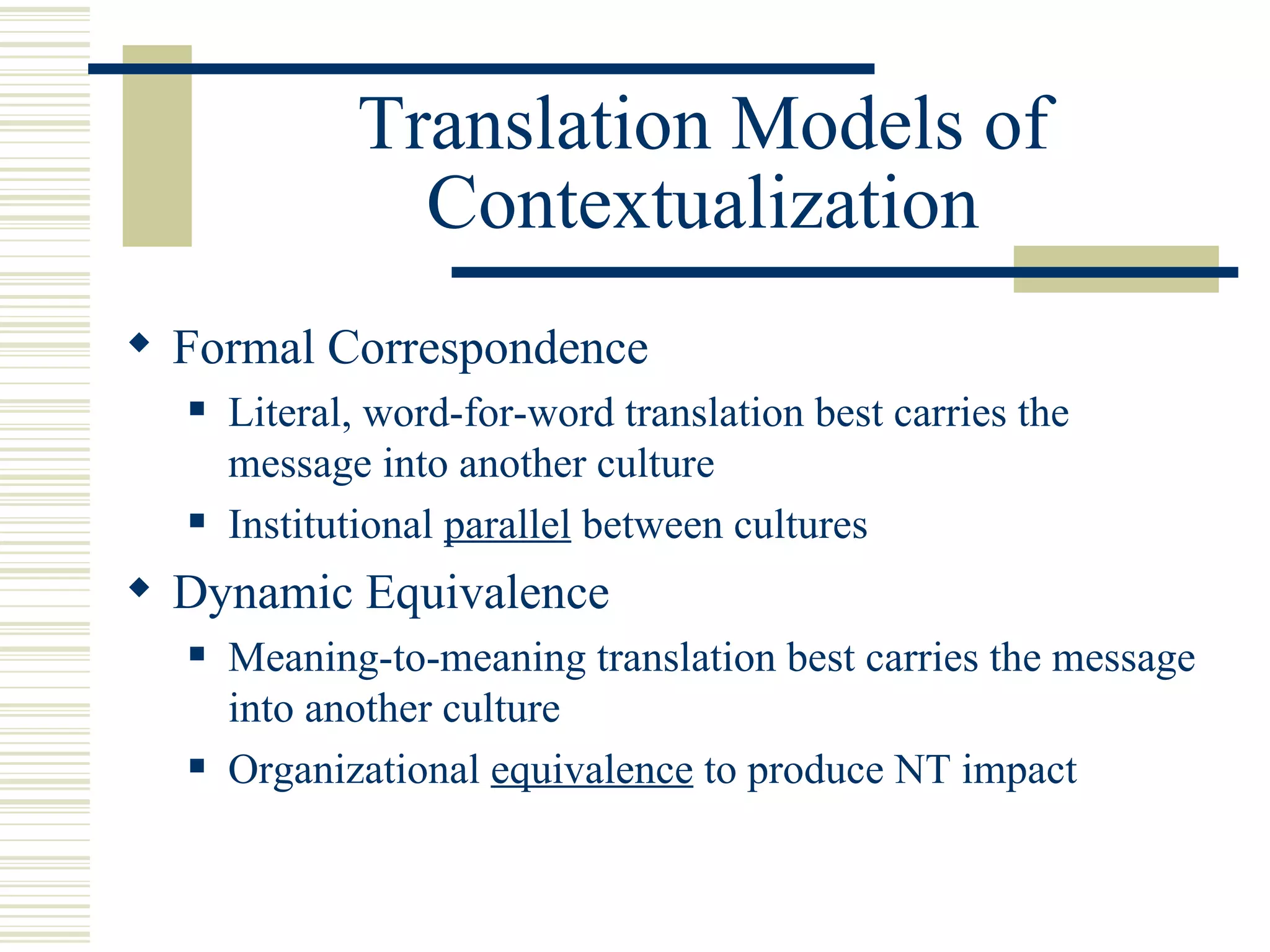
Translation Models of Contextualization Formal Correspondence Literal, word-for-word translation best carries the message into another culture Institutional  parallel  between cultures Dynamic Equivalence Meaning-to-meaning translation best carries the message into another culture Organizational  equivalence  to produce NT impact
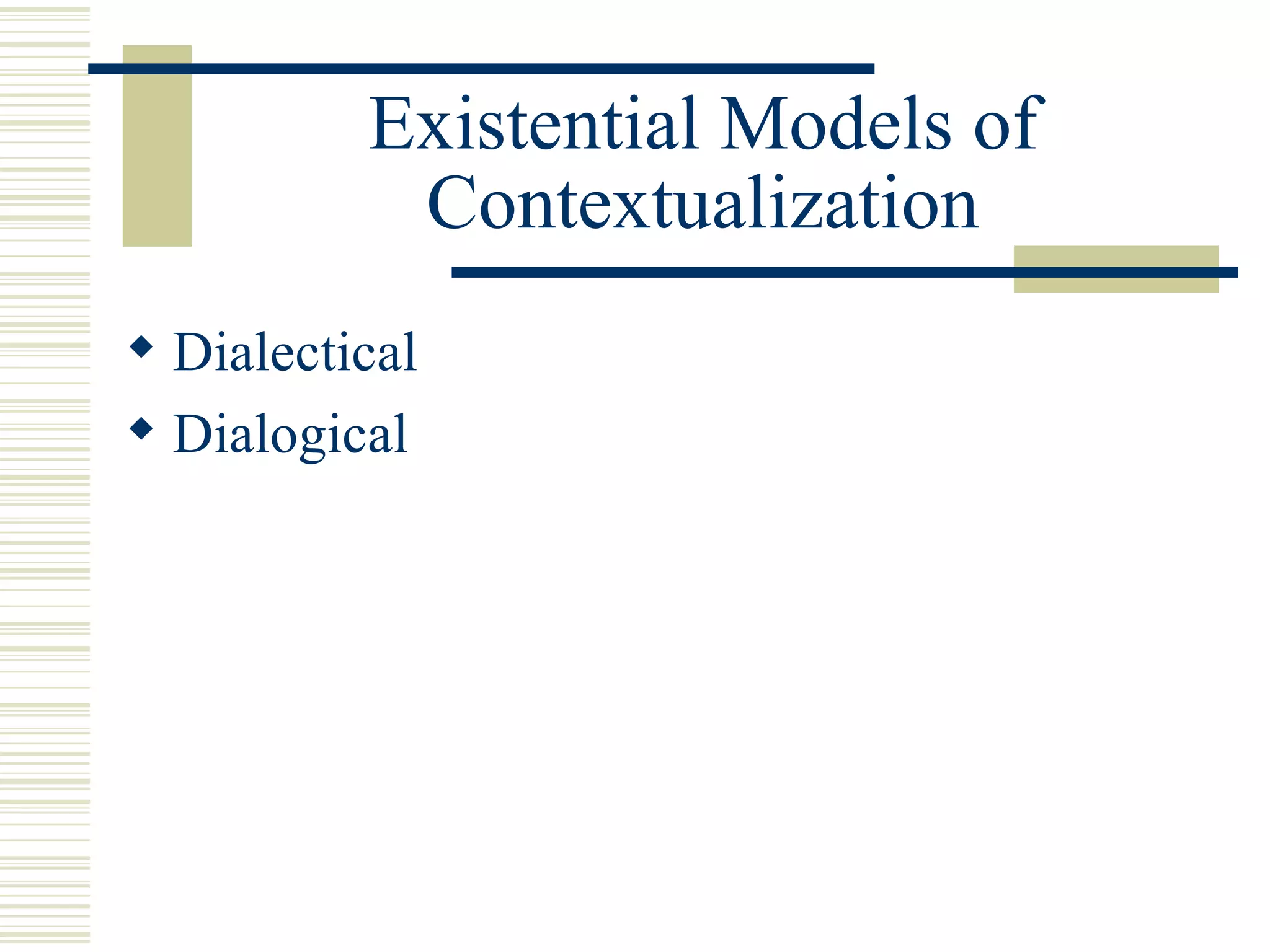
Existential Models of Contextualization Dialectical  Dialogical
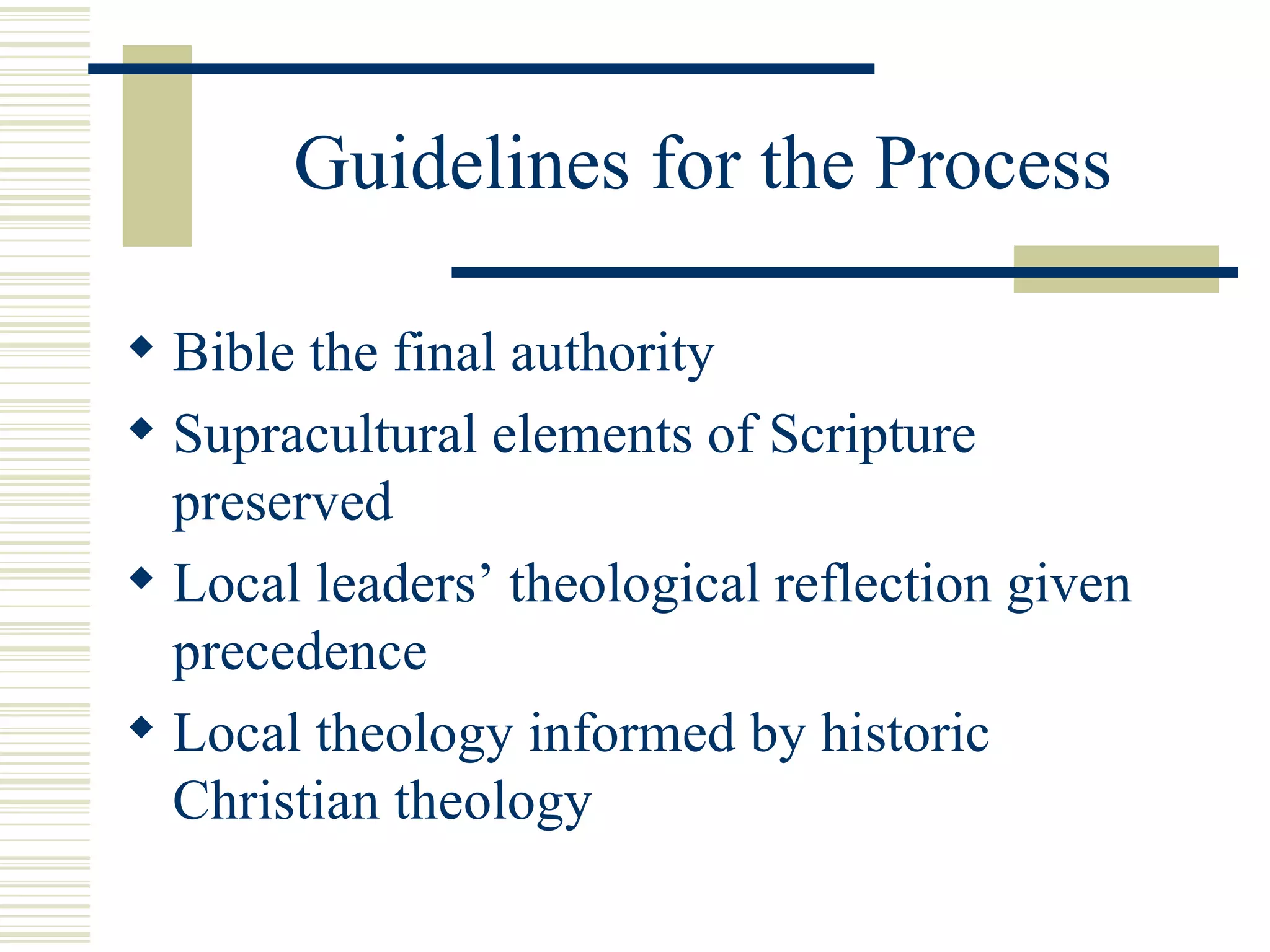
Guidelines for the Process Bible the final authority Supracultural elements of Scripture preserved Local leaders’ theological reflection given precedence Local theology informed by historic Christian theology
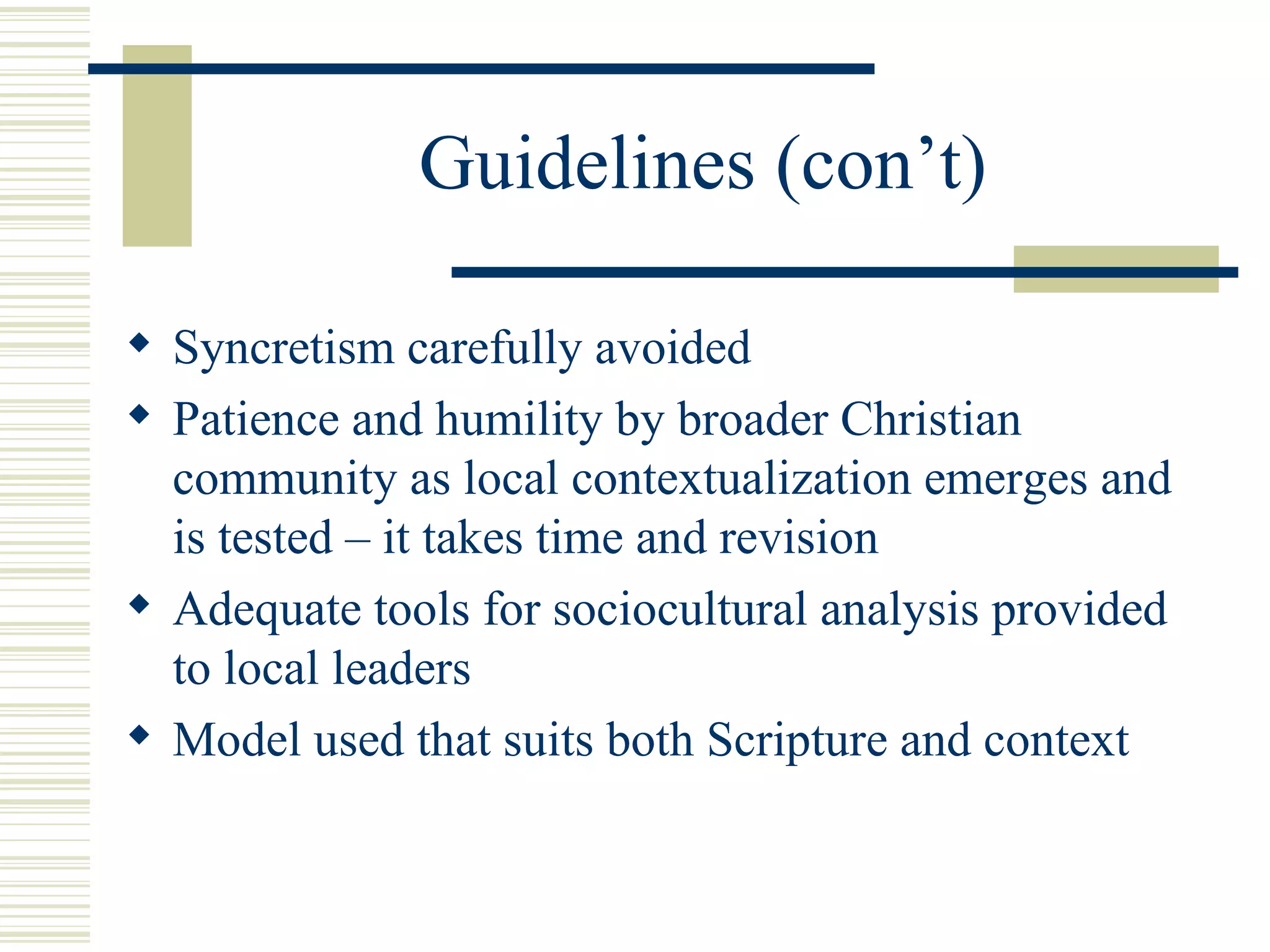
Guidelines (con’t) Syncretism carefully avoided Patience and humility by broader Christian community as local contextualization emerges and is tested – it takes time and revision Adequate tools for sociocultural analysis provided to local leaders Model used that suits both Scripture and context

Ch.19 contextualization

  • 1.
    Introduction to MissiologyCh. 19 – Contextualization and the Missionary Endeavor
  • 2.
    Definitions Indigenization –developing a church that is self-governing, self-supporting, self-propagating, and that reflects positive aspects of the local culture in its expression of Christian community and ministry. Contextualization – Enabling the Christian message to become alive as it addresses the core issues of a sociocultural context and transforms people’s worldview, values, and goals
  • 3.
    Introduction The shiftfrom indigenization to contextualization is the greatest methodological issue facing the Christian mission today – Alan Tippett Contextualization implies a deeper involvement in the social issues of the local setting, especially where there is rapid social change
  • 4.
    New Testament Paulcontextualized his message to his audience God-fearers Athenians The writers of the gospels contextualized their message to the audience
  • 5.
    Contemporary Developments -Africa 1955 – Ghana – rise of syncretistic indigenous churches points to a problem 1965 – Nigeria – Consultation of African Theologians attempted to express historic Christianity in African cultural forms Raised issue of the relationship between the gospel and traditional religions
  • 6.
    Contemporary Developments -Latin America 1962 – Brazil – Church and Society Movement – dominated by liberation theologians 1971 – Latin American Theological Fraternity – dialogue among evangelical theologians on issues of contextualization
  • 7.
    Contemporary Developments –World Council of Churches 1968 – Upsala – addressed contextualization in world perspective In the struggle for peace and justice the church must bear witness and speak out. 1971 – Bossey, Switzerland Dogmatic theology fails to address ethical-social issues that arise in times of rapid change 1972 – Theological Education Fund Report Issues: social justice, local culture, and universal technological civilization
  • 8.
    Contemporary Developments –Lausanne Movement 1974 – Lausanne – a distinction must be made between the gospel and the cultural forms in which it is expressed Latin American Theological Fraternity (FTL) The Willowbank Group – theology & education – sought to place greater emphasis on the influence of cultural factors upon the Scriptures as well as upon the reader
  • 9.
    Lausanne (Con’t) 1975– Detroit – contextualizing in North America Minorities in industrialized countries as participants in the theologizing process Encouraged affinity groups to theologize regarding issues in American society & the world
  • 10.
    Evangelical Boundaries Theevangelical framework views the task of contextualization in terms of disengaging the supra-cultural message from a cultural context and enculturating it into another Priority is always upon the authority and integrity of the biblical text
  • 11.
    Key Issues inContextualization Nature of the Gospel – supracultural or culture bound? Authority of Scriptures – normative or parallel significance with the sociocultural context? Starting Point – sociocultural context or biblical text? Traditional Religions – total continuity, total discontinuity, or another option?
  • 12.
    Key Issues (con’t)Contextualizing participants – Outsiders, insiders, or combination of both? Syncretism – inevitable outcome of pushing contextualization too far? Result OK or non-Christian blend? Tools to use – Marxist focus on conflict, functionalist focus on harmony, or another approach?
  • 13.
    Translation Models ofContextualization Formal Correspondence Literal, word-for-word translation best carries the message into another culture Institutional parallel between cultures Dynamic Equivalence Meaning-to-meaning translation best carries the message into another culture Organizational equivalence to produce NT impact
  • 14.
    Existential Models ofContextualization Dialectical Dialogical
  • 15.
    Guidelines for theProcess Bible the final authority Supracultural elements of Scripture preserved Local leaders’ theological reflection given precedence Local theology informed by historic Christian theology
  • 16.
    Guidelines (con’t) Syncretismcarefully avoided Patience and humility by broader Christian community as local contextualization emerges and is tested – it takes time and revision Adequate tools for sociocultural analysis provided to local leaders Model used that suits both Scripture and context