Introduction to
  Missiology
Ch.26 Introduction to the
Strategy and Methods of
        Missions
Strategy and Methods

    • Strategy – the overall plan,
      principles, or ways by which
      resources and opportunities will
      be utilized in the task
    • Methods – the comprehensive
      and flexible body of tactics or
      actions, the detailed means by
      which God’s people implement
      the mission imperative
Three Basic Questions

• How are we doing in our efforts to
  evangelize the entire world?
• What are our overall plans to
  accomplish world evangelization?
• How can every church and Christian be
  involved?
1. How Are We Doing?
• There was a radical shift in strategy in the last
  quarter century
   – From even emphasis to 10/40 window & UPG
   – From addition to multiplication
   – From Institutional to CPM
• NAMB – increased focus on effective church
  planting
• IMB – increased focus on Church Planting
  Movements (CPM)
Why CPM through house
         churches?
 Radical - True alternative to the
  institutional church as propagated by
  western missionaries
 Trans-cultural – Bible focus and
  simplicity of form minimizes cross-
  cultural dysfunction
 Relational – People are encouraged to
  relate personally rather than
  institutionally
The Key Reason:
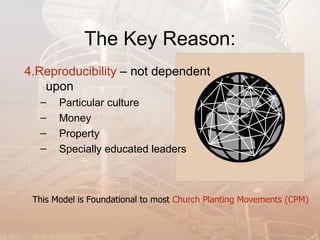
4.Reproducibility – not dependent
   upon
  –    Particular culture
  –    Money
  –    Property
  –    Specially educated leaders


 This Model is Foundational to most Church Planting Movements (CPM)
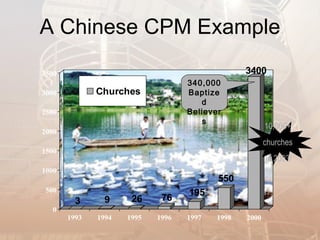
A Chinese CPM Example
3500                                             3400
                                   340,000
3000          Churches             Baptize
                                      d
2500                               Believer
                                       s
                                                        10,000+
2000
                                                        churches
1500
                                                        in 2003!
1000
                                          550
 500                               195
         3      9     26     76
  0
       1993   1994   1995   1996   1997   1998   2000
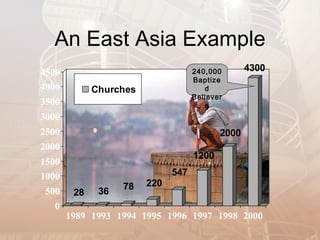
An East Asia Example
4500                                240,000       4300
                                    Baptize
4000         Churches                  d
                                    Believer
3500                                   s
3000
2500                                       2000
2000
                                    1200
1500
1000                          547
                   78   220
500     28    36
   0
       1989 1993 1994 1995 1996 1997 1998 2000
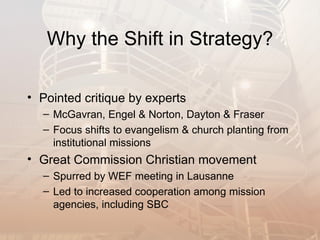
Why the Shift in Strategy?

• Pointed critique by experts
  – McGavran, Engel & Norton, Dayton & Fraser
  – Focus shifts to evangelism & church planting from
    institutional missions
• Great Commission Christian movement
  – Spurred by WEF meeting in Lausanne
  – Led to increased cooperation among mission
    agencies, including SBC
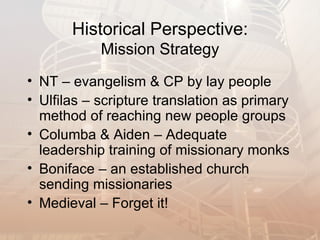
Historical Perspective:
            Mission Strategy
• NT – evangelism & CP by lay people
• Ulfilas – scripture translation as primary
  method of reaching new people groups
• Columba & Aiden – Adequate
  leadership training of missionary monks
• Boniface – an established church
  sending missionaries
• Medieval – Forget it!
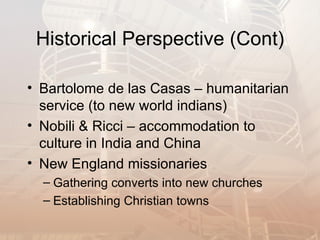
Historical Perspective (Cont)

• Bartolome de las Casas – humanitarian
  service (to new world indians)
• Nobili & Ricci – accommodation to
  culture in India and China
• New England missionaries
  – Gathering converts into new churches
  – Establishing Christian towns
William Carey’s Contribution:
               Five Principles


•   Widespread gospel preaching
•   Bible distribution in heart language
•   Early establishment of new churches
•   Careful study of indigenous culture
•   Training up an indigenous clergy
Venn, Anderson & Nevius

• Bi-vocational leadership
• Methodology appropriate to the local setting
• Full-time leaders called out and supported by
  the local church
• Culturally appropriate church architecture
• Extensive training of leaders
• New churches planted by existing churches
Twentieth Century Trends

• Ecumenical Churches – gradualism
  – Dialogue, presence, seed sowing
  – Dominated by liberal theology
  – Abandoned the notion of conversion
• Evangelical Churches – disciplemaking
  – Evangelism and church planting is key
  – Humanitarian efforts are supplemental
  – Increasing focus on UPGs and CPM
2. What Are Our Plans?

            An Eleven Step Model

•   Decide on the goal     • Project results
•   Study the culture      • Decide team roles
•   Define the workforce   • Develop detailed
•   Choose methods           plans
•   Establish              • Implement plans
    approaches             • Evaluate results
                           • Adjust and continue
Characteristics of Effective
           Strategy

1. Centered on Kingdom growth
2. Holistic – evangelism, discipling, planting,
   church development, leadership training,
   improving the physical aspects of peoples
   lives
3. Research Based – effective strategies are
   discovered – pilot projects
4. Result Oriented – What is the result of
   executing the strategy?
Effective Missionary
           Methodology
1. Relies on the Holy Spirit
  – He leads us to methods
  – He motivates us to use them
  – He grants effectiveness as we work
2. Demonstrates Flexibility
  – Always more than one way to achieve a
    goal
  – Limited to biblically congruent methods
Effective Methodology (con’t)
1. Centers on evangelism and church
   planting
  – Churches accommodated to the needs
    and styles of the people in that region
  – Churches that are “dynamically
    equivalent” to the churches of the NT
2. Culturally Appropriate
  – Recognizing the cultural diversity in the
    world
  – Adjusting without compromising the
    message
Effective Methodology


1. Incorporates the characteristic of
   reproducibility
  – The test for every activity is whether the
    indigenous church can multiply it in their
    setting
Contemporary Methodologies
1. Small Groups play an important part
  – Cell church
  – House church networks
  – Adaptive to particular cultural settings
2. Contextualized Worship to enhance
   evangelism
3. Professional marketing approaches
Contemporary Methodologies
          (Cont)

1. Decentralized approaches to identify,
   train and deploy new leaders
2. Exponential increase in short-term
   mission experiences

Ch.26 introduction to mission strategy

  • 1.
    Introduction to Missiology Ch.26 Introduction to the Strategy and Methods of Missions
  • 2.
    Strategy and Methods • Strategy – the overall plan, principles, or ways by which resources and opportunities will be utilized in the task • Methods – the comprehensive and flexible body of tactics or actions, the detailed means by which God’s people implement the mission imperative
  • 3.
    Three Basic Questions •How are we doing in our efforts to evangelize the entire world? • What are our overall plans to accomplish world evangelization? • How can every church and Christian be involved?
  • 4.
    1. How AreWe Doing? • There was a radical shift in strategy in the last quarter century – From even emphasis to 10/40 window & UPG – From addition to multiplication – From Institutional to CPM • NAMB – increased focus on effective church planting • IMB – increased focus on Church Planting Movements (CPM)
  • 5.
    Why CPM throughhouse churches?  Radical - True alternative to the institutional church as propagated by western missionaries  Trans-cultural – Bible focus and simplicity of form minimizes cross- cultural dysfunction  Relational – People are encouraged to relate personally rather than institutionally
  • 6.
    The Key Reason: 4.Reproducibility– not dependent upon – Particular culture – Money – Property – Specially educated leaders This Model is Foundational to most Church Planting Movements (CPM)
  • 7.
    A Chinese CPMExample 3500 3400 340,000 3000 Churches Baptize d 2500 Believer s 10,000+ 2000 churches 1500 in 2003! 1000 550 500 195 3 9 26 76 0 1993 1994 1995 1996 1997 1998 2000
  • 8.
    An East AsiaExample 4500 240,000 4300 Baptize 4000 Churches d Believer 3500 s 3000 2500 2000 2000 1200 1500 1000 547 78 220 500 28 36 0 1989 1993 1994 1995 1996 1997 1998 2000
  • 9.
    Why the Shiftin Strategy? • Pointed critique by experts – McGavran, Engel & Norton, Dayton & Fraser – Focus shifts to evangelism & church planting from institutional missions • Great Commission Christian movement – Spurred by WEF meeting in Lausanne – Led to increased cooperation among mission agencies, including SBC
  • 10.
    Historical Perspective: Mission Strategy • NT – evangelism & CP by lay people • Ulfilas – scripture translation as primary method of reaching new people groups • Columba & Aiden – Adequate leadership training of missionary monks • Boniface – an established church sending missionaries • Medieval – Forget it!
  • 11.
    Historical Perspective (Cont) •Bartolome de las Casas – humanitarian service (to new world indians) • Nobili & Ricci – accommodation to culture in India and China • New England missionaries – Gathering converts into new churches – Establishing Christian towns
  • 12.
    William Carey’s Contribution: Five Principles • Widespread gospel preaching • Bible distribution in heart language • Early establishment of new churches • Careful study of indigenous culture • Training up an indigenous clergy
  • 13.
    Venn, Anderson &Nevius • Bi-vocational leadership • Methodology appropriate to the local setting • Full-time leaders called out and supported by the local church • Culturally appropriate church architecture • Extensive training of leaders • New churches planted by existing churches
  • 14.
    Twentieth Century Trends •Ecumenical Churches – gradualism – Dialogue, presence, seed sowing – Dominated by liberal theology – Abandoned the notion of conversion • Evangelical Churches – disciplemaking – Evangelism and church planting is key – Humanitarian efforts are supplemental – Increasing focus on UPGs and CPM
  • 15.
    2. What AreOur Plans? An Eleven Step Model • Decide on the goal • Project results • Study the culture • Decide team roles • Define the workforce • Develop detailed • Choose methods plans • Establish • Implement plans approaches • Evaluate results • Adjust and continue
  • 16.
    Characteristics of Effective Strategy 1. Centered on Kingdom growth 2. Holistic – evangelism, discipling, planting, church development, leadership training, improving the physical aspects of peoples lives 3. Research Based – effective strategies are discovered – pilot projects 4. Result Oriented – What is the result of executing the strategy?
  • 17.
    Effective Missionary Methodology 1. Relies on the Holy Spirit – He leads us to methods – He motivates us to use them – He grants effectiveness as we work 2. Demonstrates Flexibility – Always more than one way to achieve a goal – Limited to biblically congruent methods
  • 18.
    Effective Methodology (con’t) 1.Centers on evangelism and church planting – Churches accommodated to the needs and styles of the people in that region – Churches that are “dynamically equivalent” to the churches of the NT 2. Culturally Appropriate – Recognizing the cultural diversity in the world – Adjusting without compromising the message
  • 19.
    Effective Methodology 1. Incorporatesthe characteristic of reproducibility – The test for every activity is whether the indigenous church can multiply it in their setting
  • 20.
    Contemporary Methodologies 1. SmallGroups play an important part – Cell church – House church networks – Adaptive to particular cultural settings 2. Contextualized Worship to enhance evangelism 3. Professional marketing approaches
  • 21.
    Contemporary Methodologies (Cont) 1. Decentralized approaches to identify, train and deploy new leaders 2. Exponential increase in short-term mission experiences

Editor's Notes

  • #6 Radical - Greatest discontinuity with the traditional western church Trans-cultural – Doesn’t really address forms in a way that is culture specific
  • #8 Church Planting Movements are rapidly reproducing indigenous churches planting churches in and through a people group or population segment. Let’s examine a couple of Church Planting Movements to get a better picture of how God is using them to reconcile a lost world to Himself. In 1991, Southern Baptists appointed a Strategy Coordinator to an unreached people group in East Asia. After language study, the SC began relating to 3 underground house churches with about 85 members. The churches were struggling to survive under considerable persecution. The Strategy Coordinator marshaled prayer support, evangelism and church planting training and cast a vision for a Church Planting Movement that would reach the entire area with the gospel. A year later, the three churches had multiplied into nine. In the following years they increased to 26, 76, 195 and 550. By this time, the Strategy Coordinator recognized that the movement was growing exponentially without his direct involvement. When researchers returned to survey the work two years later, they found an estimated 3,400 churches and approximately 340,000 baptized believers. In eight years, God used a Church Planting Movement to transform the area from 3 struggling churches into a vast movement of born again believers.
  • #9 Let’s view another Church Planting Movement. This one occurred in Northern India. When the International Mission Board assigned a Strategy Coordinator to the Bhojpuri People in 1989, he found 28 churches among a people group of nearly 90 million. The Strategy Coordinator set about training national evangelists and church planters to start reproducing churches that would evangelize, disciple and multiply believers across the country. By 1993, the 28 Bhojpuri churches had increased to 36. In the years that followed, their numbers climbed to 78, 220, 547, 1200 and 2000 churches in 1999. By autumn of the year 2000, the Strategy Coordinator could only guess how many churches and believers had emerged from the Bhojpuri Church Planting Movement. In October 2000, a research team visited the area and conservatively estimated the number of churches at 4,300 and the number of believers to be at least 240,000. These spontaneous explosions of multiplying churches are changing the face of lostness wherever they occur. Their almost exponential increase in believers vastly outstrips population growth rates and transforms the religious landscape.