Introduction to Missiology Ch.18 – The Indigenous Church
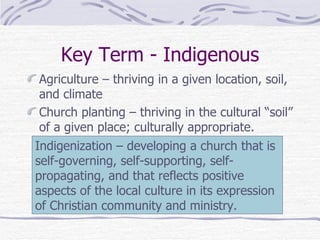
Key Term - Indigenous Agriculture – thriving in a given location, soil, and climate Church planting – thriving in the cultural “soil” of a given place; culturally appropriate. Indigenization – developing a church that is self-governing, self-supporting, self-propagating, and that reflects positive aspects of the local culture in its expression of Christian community and ministry.
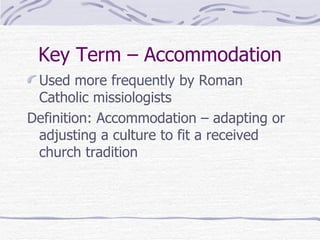
Key Term – Accommodation Used more frequently by Roman Catholic missiologists Definition: Accommodation – adapting or adjusting a culture to fit a received church tradition
Historic Indigenization Historically driven by outside advocates Developing a church native to its culture by external control is problematic Proper approach is to guide cultural insiders as they wrestle with issues of indigenization When insiders seek to integrate biblical faith and local culture, they sense the need for  enculturation  or  contextualization
Key Term – Enculturation More Catholic in origin Def: the creative and dynamic relationship between the Christian message and a culture or cultures. More specifically, it is the church practices which emerge as a result of this interaction
Key Term – Contextualization Ecumenical Protestant in origin Emphasis is on addressing the social issues in a particular context Contextualization – Enabling the Christian message to become alive as it addresses the core issues of a sociocultural context and transforms people’s worldview, values, and goals.
Three-self Formula Originated by Rufus Anderson (1841) and Henry Venn (1855) Formula: Self-supporting, Self-governing, Self-Propagating. First thoroughly applied in Korea among Presbyterians upon counsel of John L. Nevius
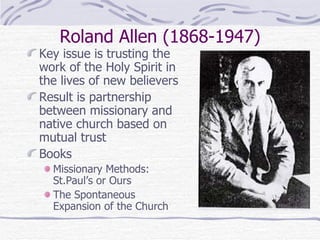
Roland Allen (1868-1947) Key issue is trusting the work of the Holy Spirit in the lives of new believers Result is partnership between missionary and native church based on mutual trust Books Missionary Methods: St.Paul’s or Ours The Spontaneous Expansion of the Church
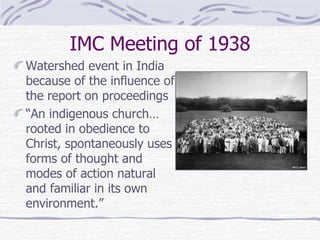
IMC Meeting of 1938 Watershed event in India because of the influence of the report on proceedings “ An indigenous church…rooted in obedience to Christ, spontaneously uses forms of thought and modes of action natural and familiar in its own environment.”
Self-theologizing A requirement for the “three-self” formula to be realized Two-thirds world theologians began to introduce socio-cultural elements from their own context into the world theological dialogue
Models of Church-Mission Relationships Mission directs the indigenous churches Mission directs the indigenous church convention by controlling key leaders Mission directs the indigenous church convention by controlling funding Mission and indigenous church develop and implement a shared vision Indigenous church divests itself of all connection to the mission agency
Missionary Obligation Acknowledge the dynamic role change as the national church develops Foster the early emergence of local leaders Proactively shift roles to enable healthy autonomy of the indigenous church

Ch.18 the indigenous church

  • 1.
    Introduction to MissiologyCh.18 – The Indigenous Church
  • 2.
    Key Term -Indigenous Agriculture – thriving in a given location, soil, and climate Church planting – thriving in the cultural “soil” of a given place; culturally appropriate. Indigenization – developing a church that is self-governing, self-supporting, self-propagating, and that reflects positive aspects of the local culture in its expression of Christian community and ministry.
  • 3.
    Key Term –Accommodation Used more frequently by Roman Catholic missiologists Definition: Accommodation – adapting or adjusting a culture to fit a received church tradition
  • 4.
    Historic Indigenization Historicallydriven by outside advocates Developing a church native to its culture by external control is problematic Proper approach is to guide cultural insiders as they wrestle with issues of indigenization When insiders seek to integrate biblical faith and local culture, they sense the need for enculturation or contextualization
  • 5.
    Key Term –Enculturation More Catholic in origin Def: the creative and dynamic relationship between the Christian message and a culture or cultures. More specifically, it is the church practices which emerge as a result of this interaction
  • 6.
    Key Term –Contextualization Ecumenical Protestant in origin Emphasis is on addressing the social issues in a particular context Contextualization – Enabling the Christian message to become alive as it addresses the core issues of a sociocultural context and transforms people’s worldview, values, and goals.
  • 7.
    Three-self Formula Originatedby Rufus Anderson (1841) and Henry Venn (1855) Formula: Self-supporting, Self-governing, Self-Propagating. First thoroughly applied in Korea among Presbyterians upon counsel of John L. Nevius
  • 8.
    Roland Allen (1868-1947)Key issue is trusting the work of the Holy Spirit in the lives of new believers Result is partnership between missionary and native church based on mutual trust Books Missionary Methods: St.Paul’s or Ours The Spontaneous Expansion of the Church
  • 9.
    IMC Meeting of1938 Watershed event in India because of the influence of the report on proceedings “ An indigenous church…rooted in obedience to Christ, spontaneously uses forms of thought and modes of action natural and familiar in its own environment.”
  • 10.
    Self-theologizing A requirementfor the “three-self” formula to be realized Two-thirds world theologians began to introduce socio-cultural elements from their own context into the world theological dialogue
  • 11.
    Models of Church-MissionRelationships Mission directs the indigenous churches Mission directs the indigenous church convention by controlling key leaders Mission directs the indigenous church convention by controlling funding Mission and indigenous church develop and implement a shared vision Indigenous church divests itself of all connection to the mission agency
  • 12.
    Missionary Obligation Acknowledgethe dynamic role change as the national church develops Foster the early emergence of local leaders Proactively shift roles to enable healthy autonomy of the indigenous church