WHAT IS LAW?

Social Institution
Particular type of rule or
prescription
Propositions of law

Law is an aspect of what Peter
Berger calls “nomization”. It is
cosmos – an orderly world that
allows man to be human, not
chaos. Man imposes order, and
orders his relations with others to
resolve conflict, tames the world,
What makes a proposition of law is
harnesses its energies organic laws,
that it is found in the and interacts
with others in supportive relations.
statutes, administrative
But there has toprocedural rules, of
regulations, or be order and law is
an institution of social order.
the appropriate branches,
instrumentalities, or agencies of
government.
PROCESS OF NOMIZATION

EXTERNALIZATION
Man projects his concept of order into the world and structures it accordingly

OBJECTIFICATION
The object projected becomes part of either the personal, social, or physical worlds.

INTERNALIZATION
The objective scheme of things structures our thinking about things, and the thinking of
society.
FOUR THEORIES OF TRUTH

CORRESPONDENCE THEORY
Maintains that p is true if and only if p, i.e., “The moon is full” is true only if the moon is
in fact full—a correspondence between the proposition and the way things are.

COHERENCE THEORY
Holds that it is the compatibility of the proposition with other accepted propositions that
allows it to be counted as true. So that q is true when one accepts first that p  q and
then p.
“It is sunny today” is true if I can also accept that true that “It is bright outside.”
FOUR THEORIES OF TRUTH

PRAGMATIC THEORY
Was designed to face the issue of how “ethical” or “value” judgments could be said true.
Under this theory, such judgments are true if the consequences to which they lead are
desirable or acceptable.
RATIONAL BELIEF THEORY
Maintains that the statement is true when there is a justification for it. This is the theory
of truth that brings one to the very difficult questions of evidence or verification.
“There is no logically necessary connection between law and
coercion or between law and morality”

Herbert Lionel
Adolphus Hart

Explains that to classify all laws as coercive orders or as moral
commands is to oversimplify the relation between law, coercion,
and morality.

To conceptualize all laws as coercive orders or as moral commands is to impose a
misleading appearance of uniformity on different kinds of laws and on different kinds of
social functions which laws may perform.

Argues that to describe all laws as coercive orders is to mischaracterize the purpose and
function of some laws and is to misunderstand their content, mode of origin, and range
of application.
laws may differ from the
commands of a
sovereign, because they
may apply to those
individuals who enact
them and not merely to
other individuals.

All laws are
commands of a
legally unlimited
sovereign

Laws may also differ from
coercive orders in that
they may not necessarily
impose duties or
obligations but may
instead confer powers or
privileges.

claims that all laws are
coercive orders that
impose duties or
obligations on
individuals.
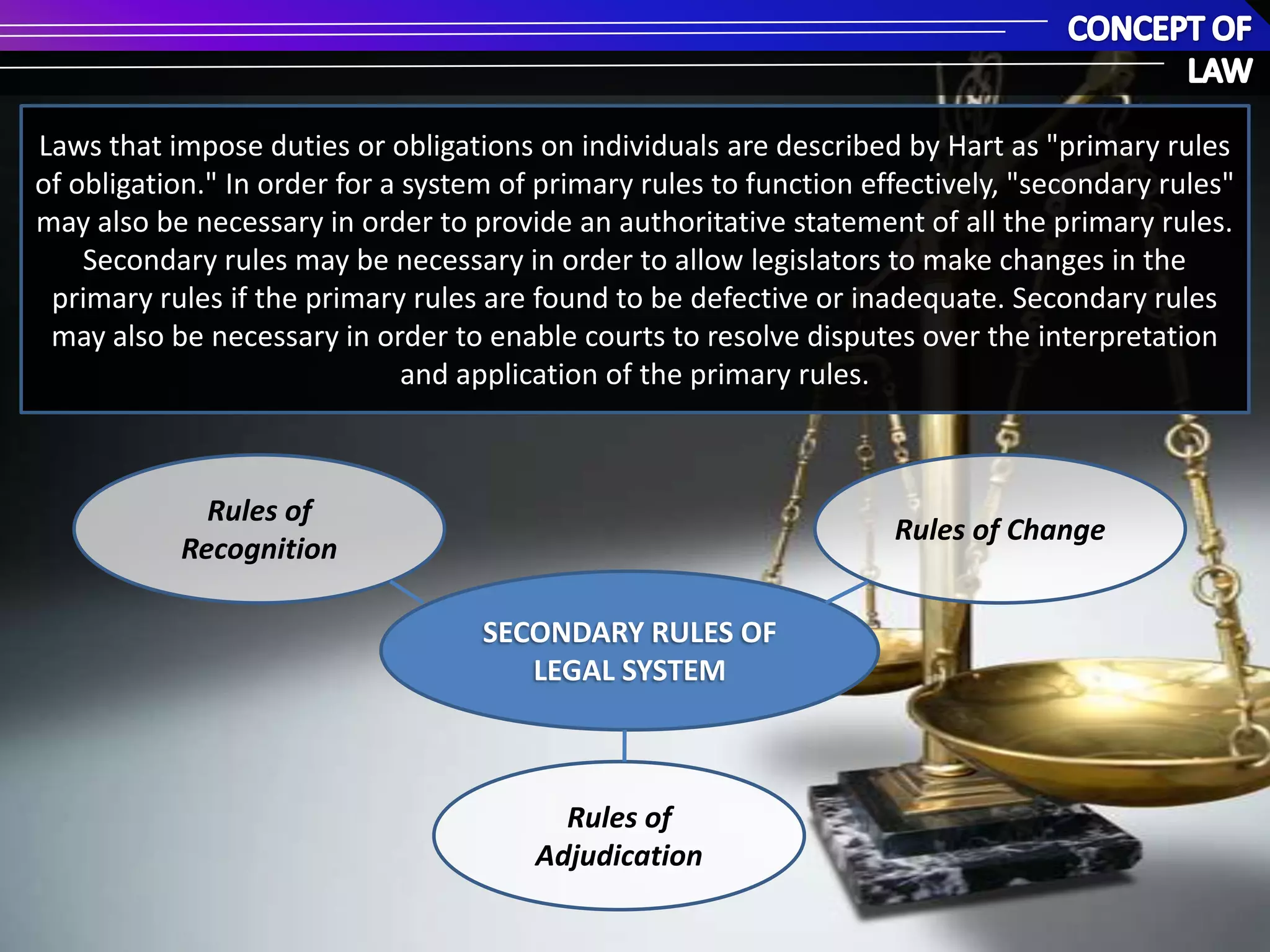
Laws that impose duties or obligations on individuals are described by Hart as "primary rules
of obligation." In order for a system of primary rules to function effectively, "secondary rules"
may also be necessary in order to provide an authoritative statement of all the primary rules.
Secondary rules may be necessary in order to allow legislators to make changes in the
primary rules if the primary rules are found to be defective or inadequate. Secondary rules
may also be necessary in order to enable courts to resolve disputes over the interpretation
and application of the primary rules.

Rules of
Recognition

Rules of Change
SECONDARY RULES OF
LEGAL SYSTEM

Rules of
Adjudication
Primary rules of obligation are not in themselves
sufficient to establish a system of laws that can be
formally recognized, changed, or adjudicated.

Primary rule

Primary rule

Secondary rule

Pre-legal

advancement

LEGAL
DETERMINATION
VIEWPOINT OF LEGAL SYSTEM

EXTERNAL

The external point of view is that of an observer who does not necessarily have to accept
the rules of the legal system. The external observer may be able to evaluate the extent to
which the rules of the legal system produce a regular pattern of conduct on the part of
individuals to whom the rules apply.
The "external" aspect of rules may be evident in the regular pattern of conduct which
may occur among a group of individuals.
INTERNAL
Individuals who are governed by the rules of the legal system and who accept these rules
as standards of conduct. The "internal" aspect of rules distinguishes rules from habits, in
that habits may be viewed as regular patterns of conduct but are not usually viewed as
standards of conduct.
MORAL

may overlap

LEGAL

Moral and legal obligation may be similar in some situations. However, moral and legal
obligation may also differ in some situations. Moral and legal rules may apply to similar
aspects of conduct, such as the obligation to be honest and truthful or the obligation to
respect the rights of other individuals. However, moral rules cannot always be changed in
the same way that legal rules can be changed.

According to Hart, there is no necessary logical connection between the content of law
and morality, and that the existence of legal rights and duties may be devoid of any moral
justification.

Law: Concepts and Viewpoints

  • 2.
    WHAT IS LAW? SocialInstitution Particular type of rule or prescription Propositions of law Law is an aspect of what Peter Berger calls “nomization”. It is cosmos – an orderly world that allows man to be human, not chaos. Man imposes order, and orders his relations with others to resolve conflict, tames the world, What makes a proposition of law is harnesses its energies organic laws, that it is found in the and interacts with others in supportive relations. statutes, administrative But there has toprocedural rules, of regulations, or be order and law is an institution of social order. the appropriate branches, instrumentalities, or agencies of government.
  • 3.
    PROCESS OF NOMIZATION EXTERNALIZATION Manprojects his concept of order into the world and structures it accordingly OBJECTIFICATION The object projected becomes part of either the personal, social, or physical worlds. INTERNALIZATION The objective scheme of things structures our thinking about things, and the thinking of society.
  • 4.
    FOUR THEORIES OFTRUTH CORRESPONDENCE THEORY Maintains that p is true if and only if p, i.e., “The moon is full” is true only if the moon is in fact full—a correspondence between the proposition and the way things are. COHERENCE THEORY Holds that it is the compatibility of the proposition with other accepted propositions that allows it to be counted as true. So that q is true when one accepts first that p  q and then p. “It is sunny today” is true if I can also accept that true that “It is bright outside.”
  • 5.
    FOUR THEORIES OFTRUTH PRAGMATIC THEORY Was designed to face the issue of how “ethical” or “value” judgments could be said true. Under this theory, such judgments are true if the consequences to which they lead are desirable or acceptable. RATIONAL BELIEF THEORY Maintains that the statement is true when there is a justification for it. This is the theory of truth that brings one to the very difficult questions of evidence or verification.
  • 6.
    “There is nologically necessary connection between law and coercion or between law and morality” Herbert Lionel Adolphus Hart Explains that to classify all laws as coercive orders or as moral commands is to oversimplify the relation between law, coercion, and morality. To conceptualize all laws as coercive orders or as moral commands is to impose a misleading appearance of uniformity on different kinds of laws and on different kinds of social functions which laws may perform. Argues that to describe all laws as coercive orders is to mischaracterize the purpose and function of some laws and is to misunderstand their content, mode of origin, and range of application.
  • 7.
    laws may differfrom the commands of a sovereign, because they may apply to those individuals who enact them and not merely to other individuals. All laws are commands of a legally unlimited sovereign Laws may also differ from coercive orders in that they may not necessarily impose duties or obligations but may instead confer powers or privileges. claims that all laws are coercive orders that impose duties or obligations on individuals.
  • 8.
    Laws that imposeduties or obligations on individuals are described by Hart as "primary rules of obligation." In order for a system of primary rules to function effectively, "secondary rules" may also be necessary in order to provide an authoritative statement of all the primary rules. Secondary rules may be necessary in order to allow legislators to make changes in the primary rules if the primary rules are found to be defective or inadequate. Secondary rules may also be necessary in order to enable courts to resolve disputes over the interpretation and application of the primary rules. Rules of Recognition Rules of Change SECONDARY RULES OF LEGAL SYSTEM Rules of Adjudication
  • 9.
    Primary rules ofobligation are not in themselves sufficient to establish a system of laws that can be formally recognized, changed, or adjudicated. Primary rule Primary rule Secondary rule Pre-legal advancement LEGAL DETERMINATION
  • 10.
    VIEWPOINT OF LEGALSYSTEM EXTERNAL The external point of view is that of an observer who does not necessarily have to accept the rules of the legal system. The external observer may be able to evaluate the extent to which the rules of the legal system produce a regular pattern of conduct on the part of individuals to whom the rules apply. The "external" aspect of rules may be evident in the regular pattern of conduct which may occur among a group of individuals. INTERNAL Individuals who are governed by the rules of the legal system and who accept these rules as standards of conduct. The "internal" aspect of rules distinguishes rules from habits, in that habits may be viewed as regular patterns of conduct but are not usually viewed as standards of conduct.
  • 11.
    MORAL may overlap LEGAL Moral andlegal obligation may be similar in some situations. However, moral and legal obligation may also differ in some situations. Moral and legal rules may apply to similar aspects of conduct, such as the obligation to be honest and truthful or the obligation to respect the rights of other individuals. However, moral rules cannot always be changed in the same way that legal rules can be changed. According to Hart, there is no necessary logical connection between the content of law and morality, and that the existence of legal rights and duties may be devoid of any moral justification.