COUNTABLE/
UNCOUNTABLE
NOUNS
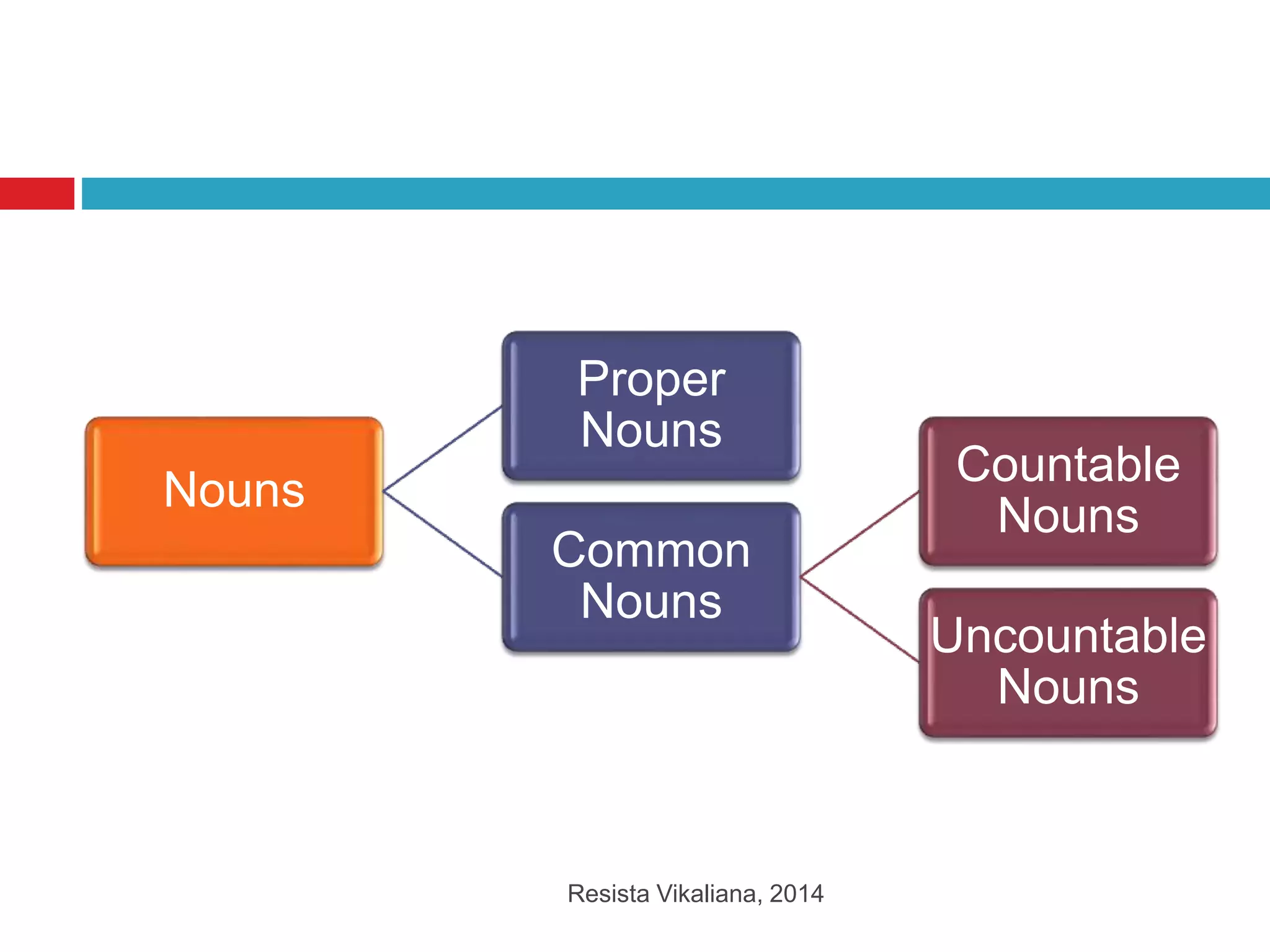
Nouns
Proper
Nouns
Common
Nouns
Countable
Nouns
Uncountable
Nouns
Resista Vikaliana, 2014
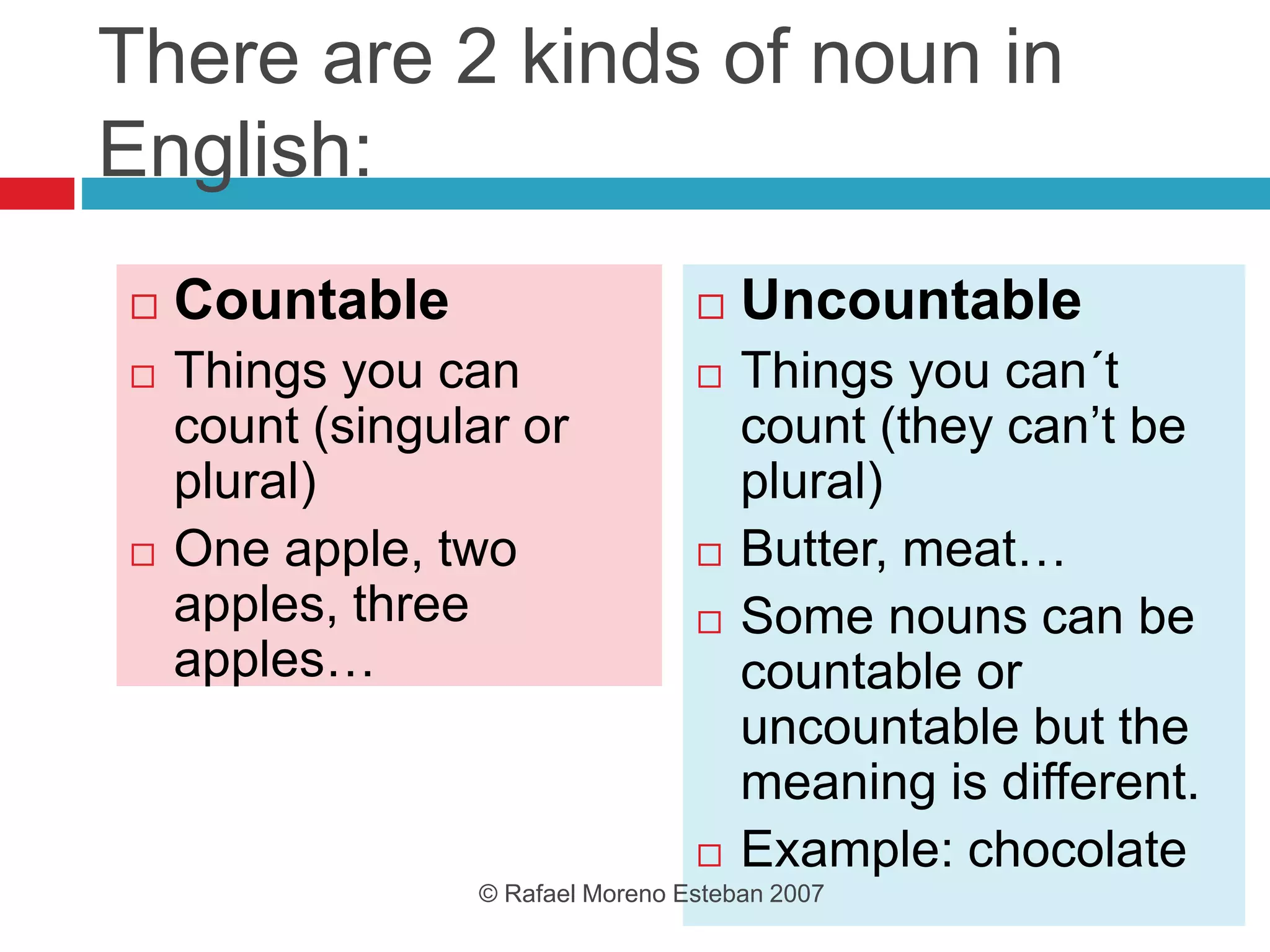
There are 2 kinds of noun in
English:
 Countable
 Things you can
count (singular or
plural)
 One apple, two
apples, three
apples…
 Uncountable
 Things you can´t
count (they can’t be
plural)
 Butter, meat…
 Some nouns can be
countable or
uncountable but the
meaning is different.
 Example: chocolate
© Rafael Moreno Esteban 2007
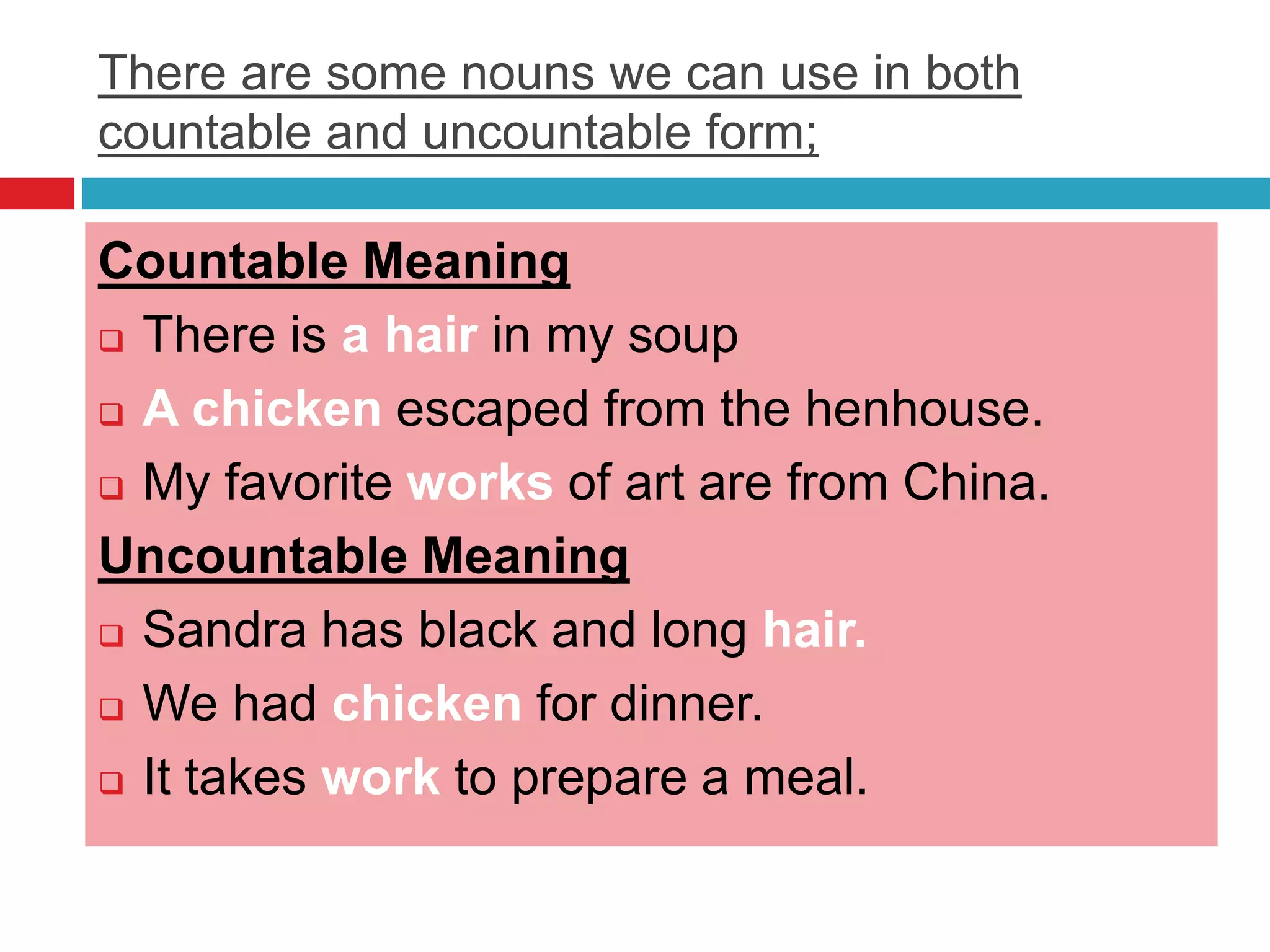
There are some nouns we can use in both
countable and uncountable form;
Countable Meaning
 There is a hair in my soup
 A chicken escaped from the henhouse.
 My favorite works of art are from China.
Uncountable Meaning
 Sandra has black and long hair.
 We had chicken for dinner.
 It takes work to prepare a meal.
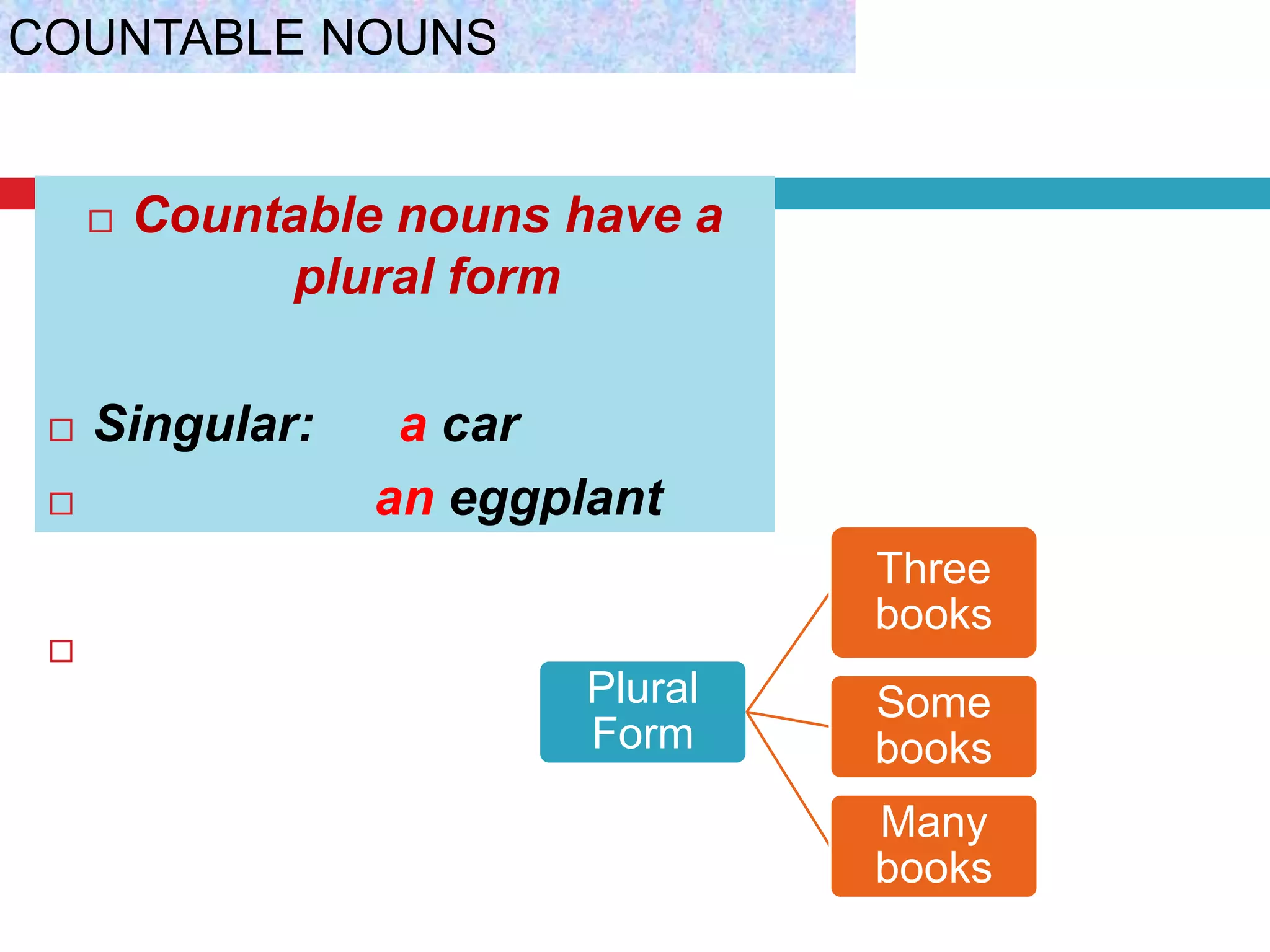
 Countable nouns have a
plural form
 Singular: a car
 an eggplant

Plural
Form
Three
books
Some
books
Many
books
COUNTABLE NOUNS
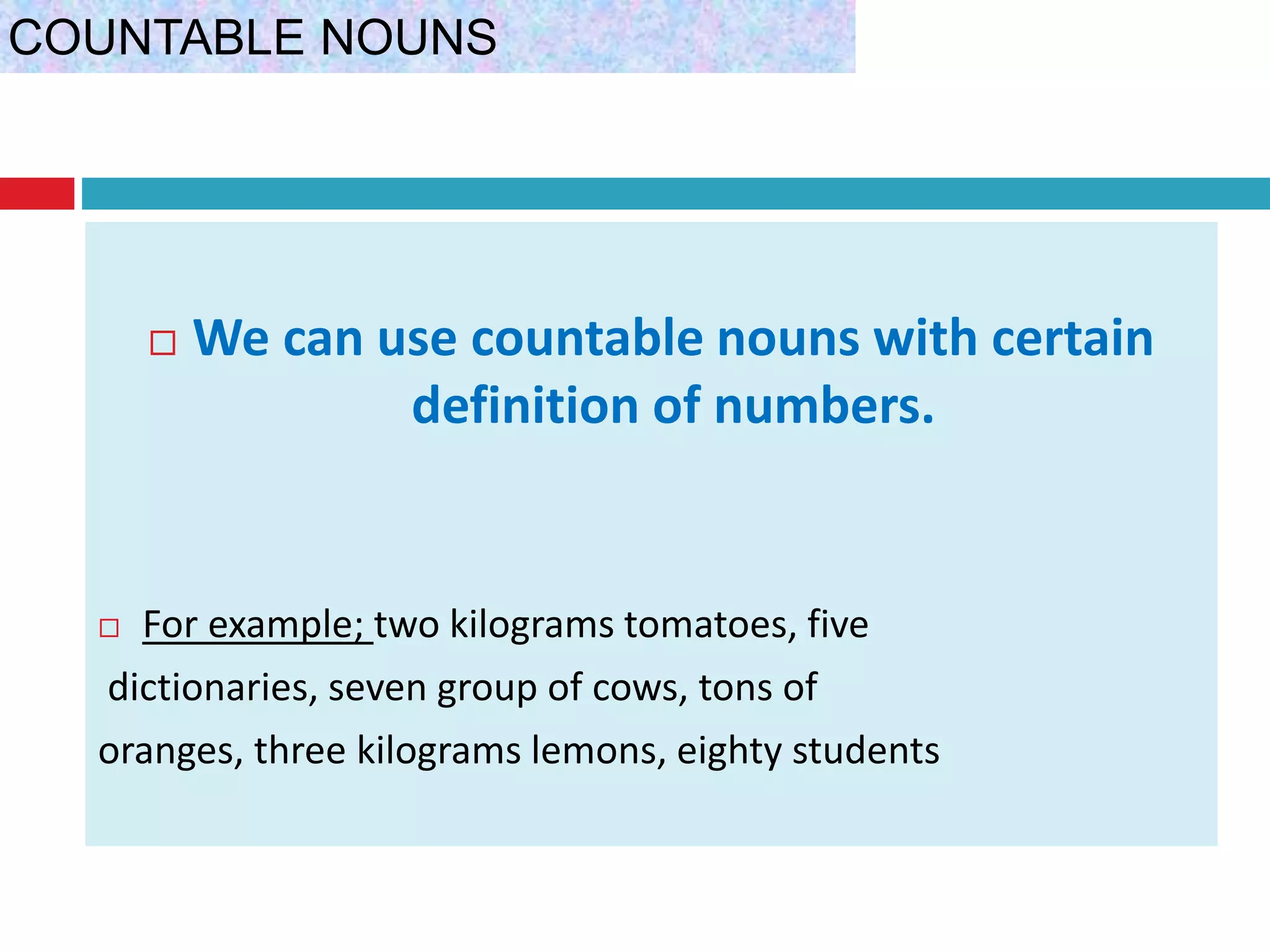
 We can use countable nouns with certain
definition of numbers.
 For example; two kilograms tomatoes, five
dictionaries, seven group of cows, tons of
oranges, three kilograms lemons, eighty students
COUNTABLE NOUNS
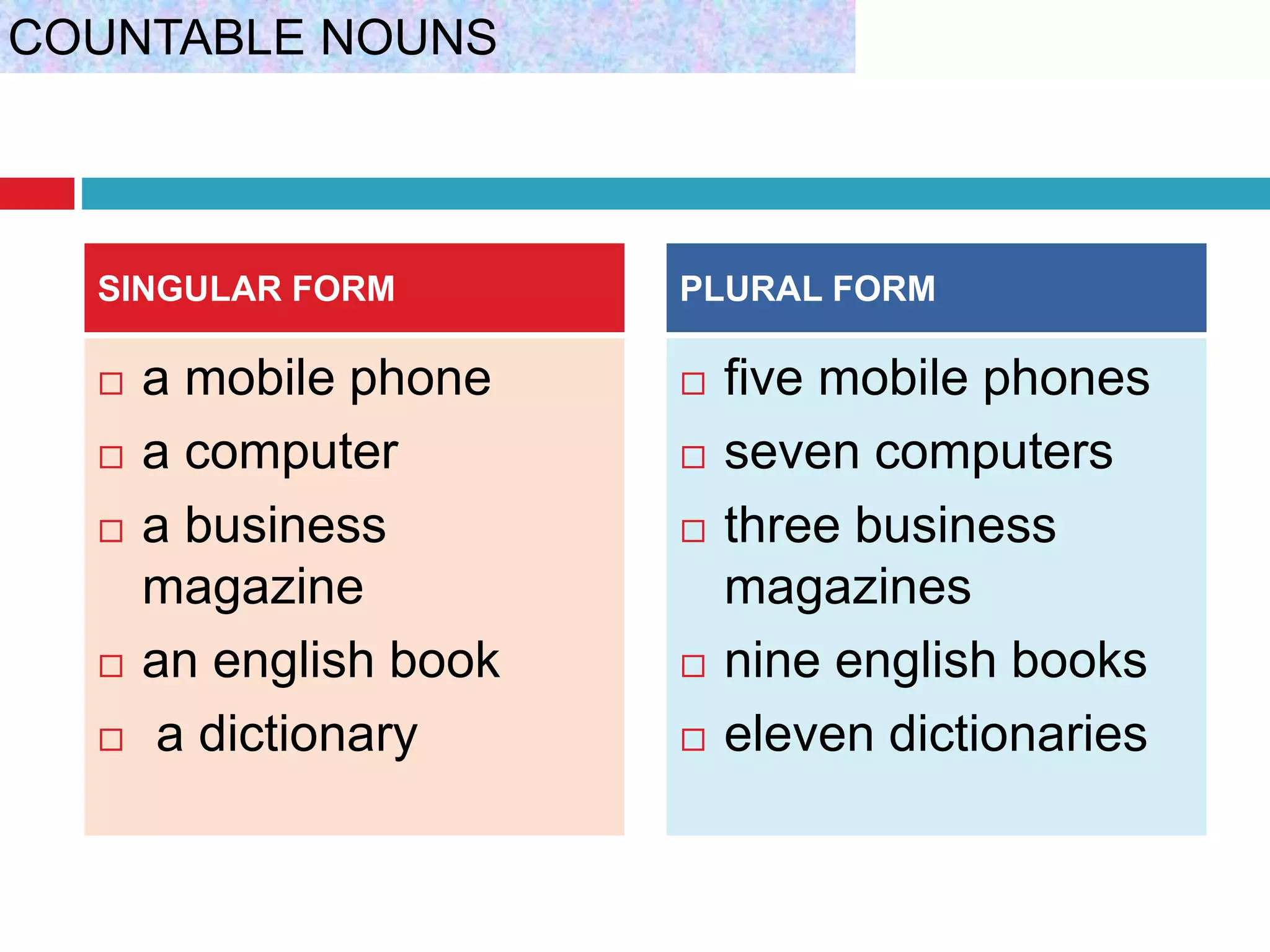
 a mobile phone
 a computer
 a business
magazine
 an english book
 a dictionary
 five mobile phones
 seven computers
 three business
magazines
 nine english books
 eleven dictionaries
SINGULAR FORM PLURAL FORM
COUNTABLE NOUNS
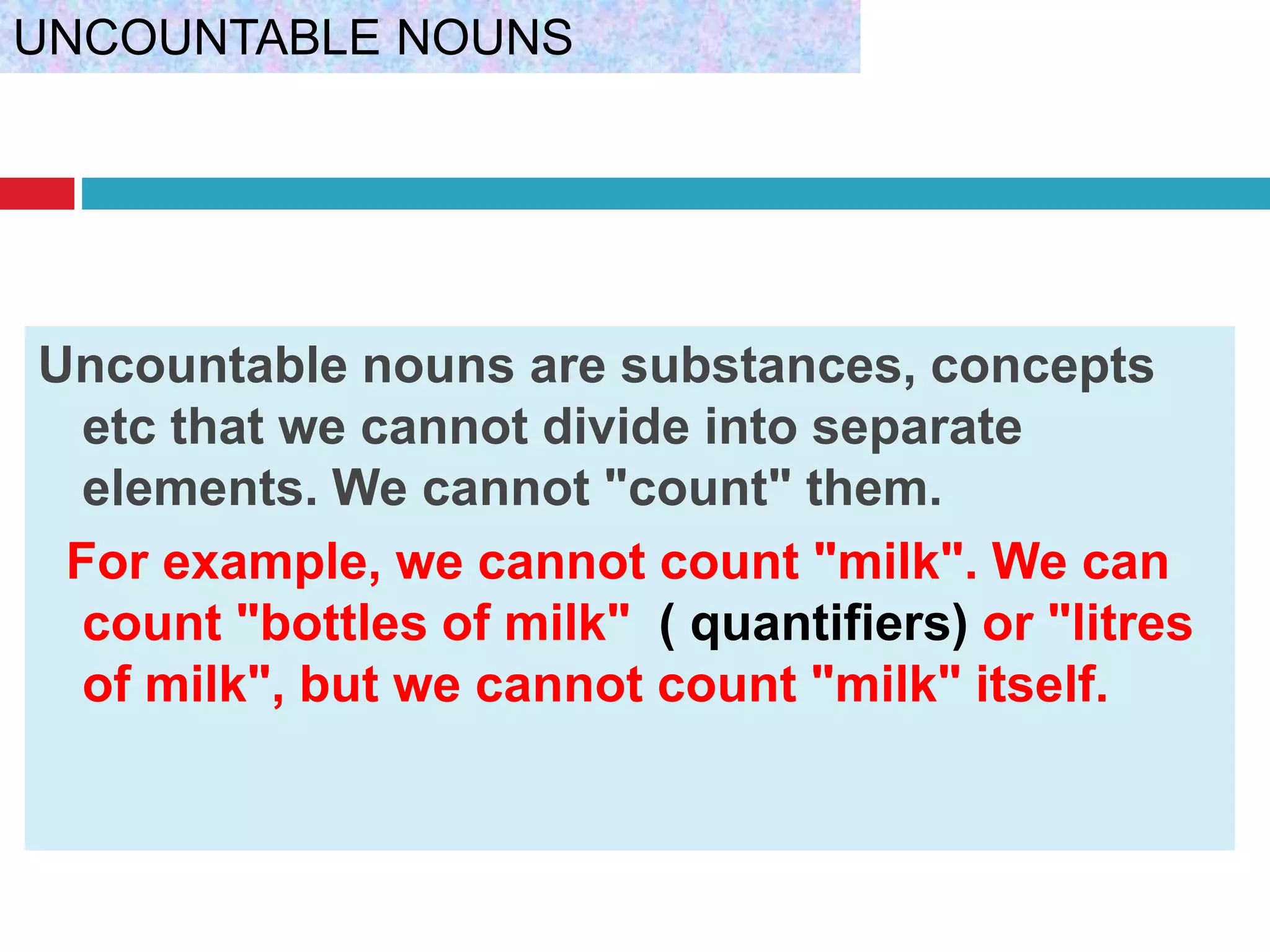
Uncountable nouns are substances, concepts
etc that we cannot divide into separate
elements. We cannot "count" them.
For example, we cannot count "milk". We can
count "bottles of milk" ( quantifiers) or "litres
of milk", but we cannot count "milk" itself.
UNCOUNTABLE NOUNS
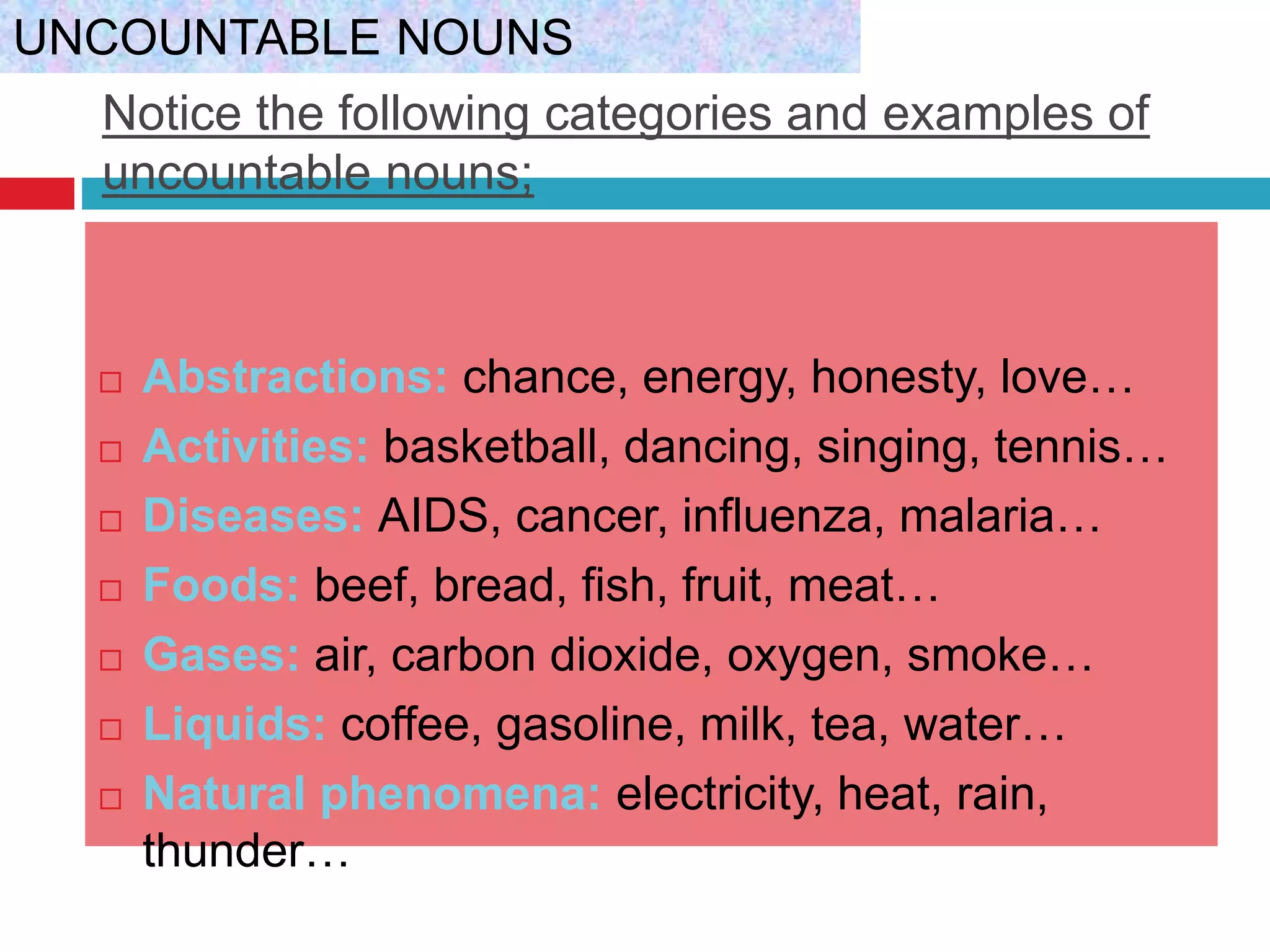
Notice the following categories and examples of
uncountable nouns;
 Abstractions: chance, energy, honesty, love…
 Activities: basketball, dancing, singing, tennis…
 Diseases: AIDS, cancer, influenza, malaria…
 Foods: beef, bread, fish, fruit, meat…
 Gases: air, carbon dioxide, oxygen, smoke…
 Liquids: coffee, gasoline, milk, tea, water…
 Natural phenomena: electricity, heat, rain,
thunder…
UNCOUNTABLE NOUNS
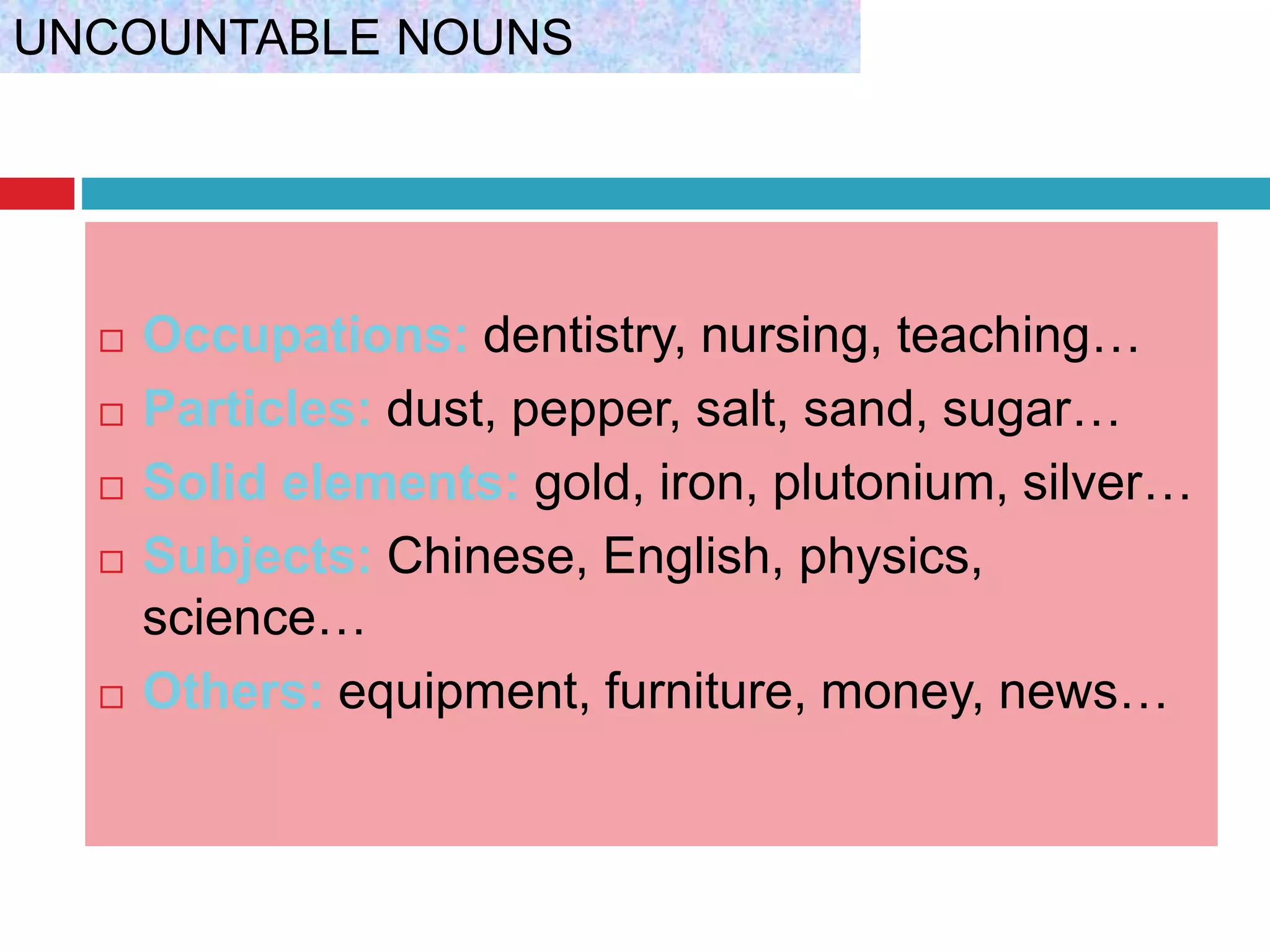
 Occupations: dentistry, nursing, teaching…
 Particles: dust, pepper, salt, sand, sugar…
 Solid elements: gold, iron, plutonium, silver…
 Subjects: Chinese, English, physics,
science…
 Others: equipment, furniture, money, news…
UNCOUNTABLE NOUNS
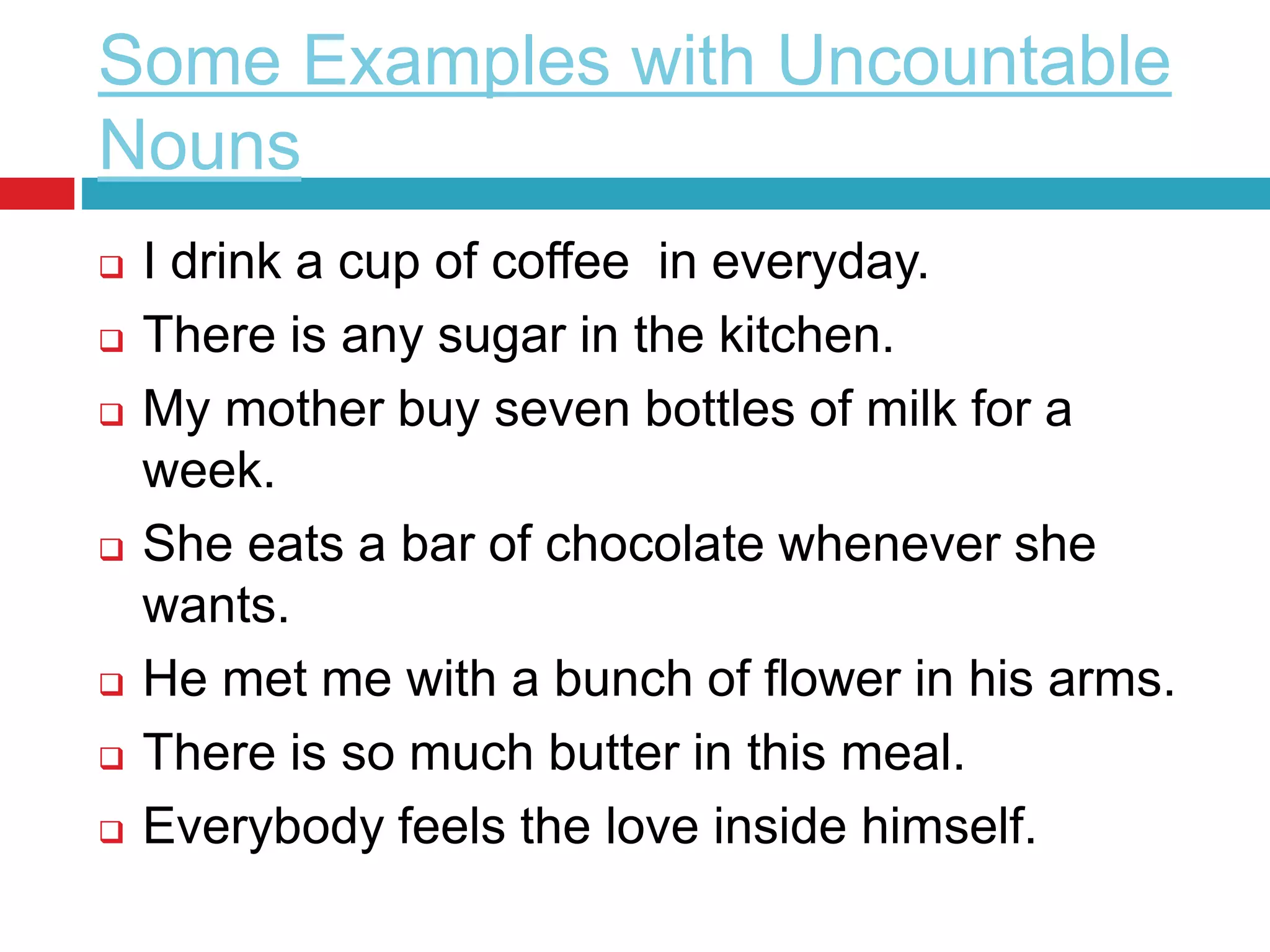
Some Examples with Uncountable
Nouns
 I drink a cup of coffee in everyday.
 There is any sugar in the kitchen.
 My mother buy seven bottles of milk for a
week.
 She eats a bar of chocolate whenever she
wants.
 He met me with a bunch of flower in his arms.
 There is so much butter in this meal.
 Everybody feels the love inside himself.
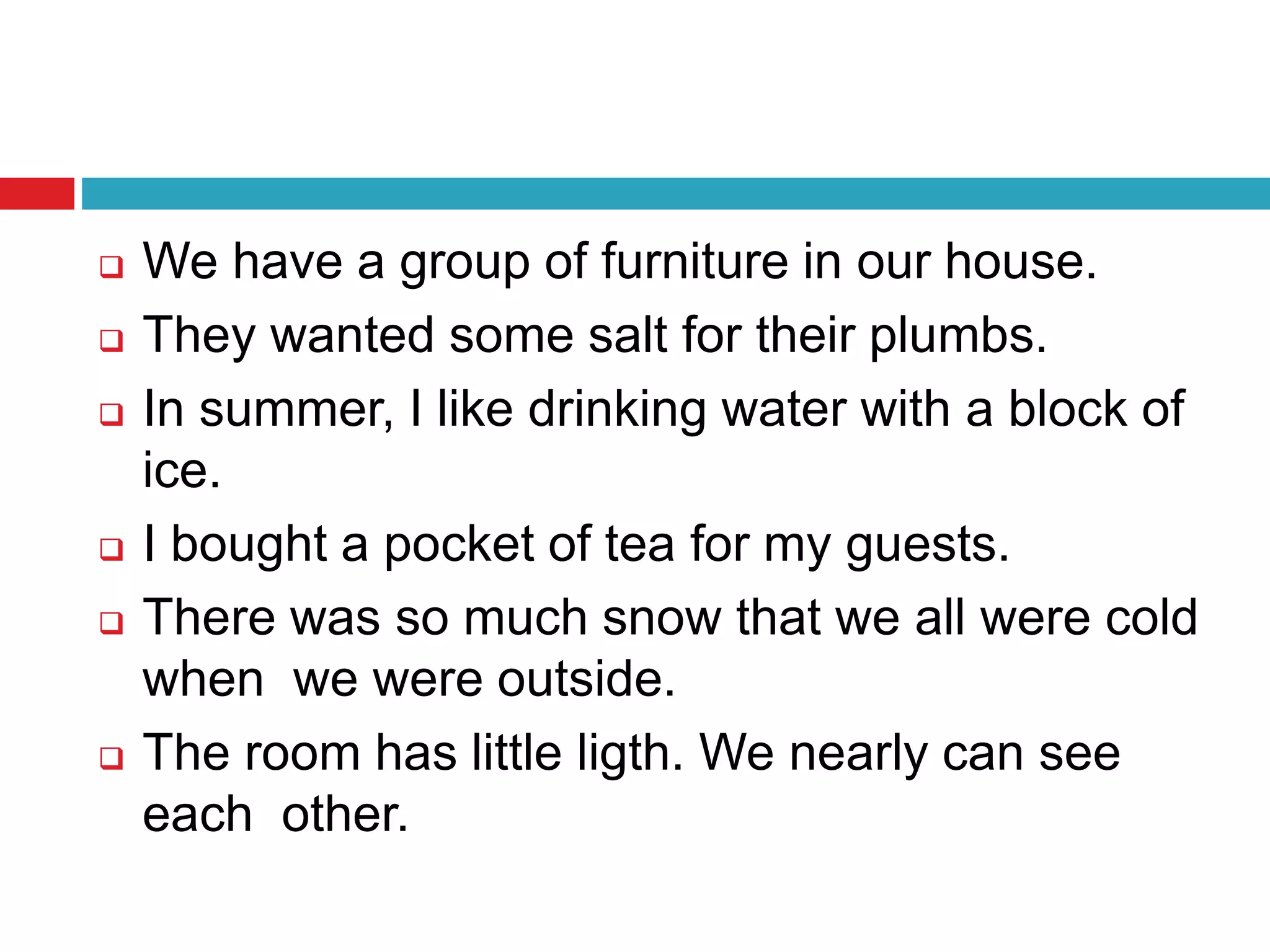
 We have a group of furniture in our house.
 They wanted some salt for their plumbs.
 In summer, I like drinking water with a block of
ice.
 I bought a pocket of tea for my guests.
 There was so much snow that we all were cold
when we were outside.
 The room has little ligth. We nearly can see
each other.
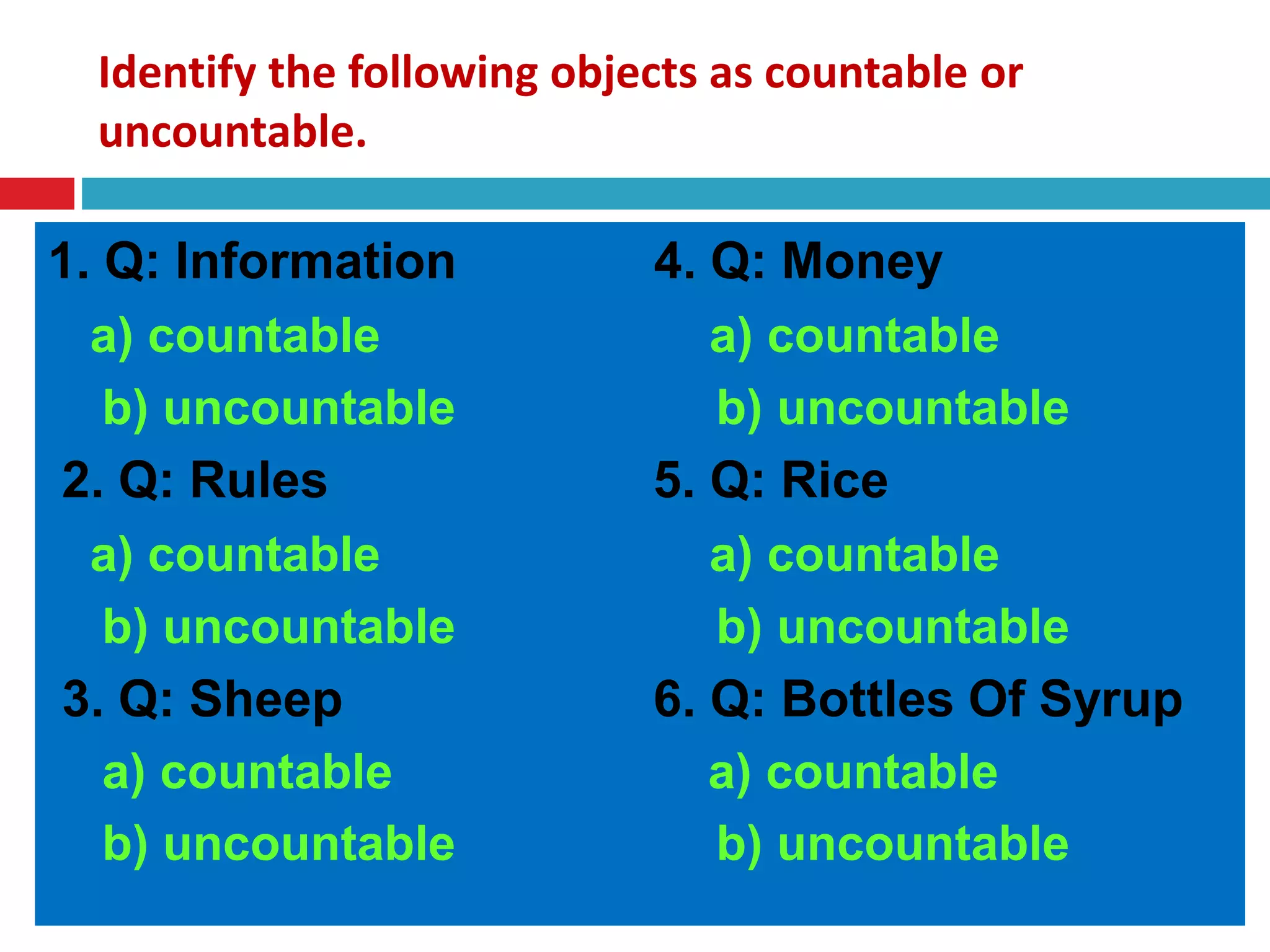
Identify the following objects as countable or
uncountable.
1. Q: Information 4. Q: Money
a) countable a) countable
b) uncountable b) uncountable
2. Q: Rules 5. Q: Rice
a) countable a) countable
b) uncountable b) uncountable
3. Q: Sheep 6. Q: Bottles Of Syrup
a) countable a) countable
b) uncountable b) uncountable
a/an / some/ any
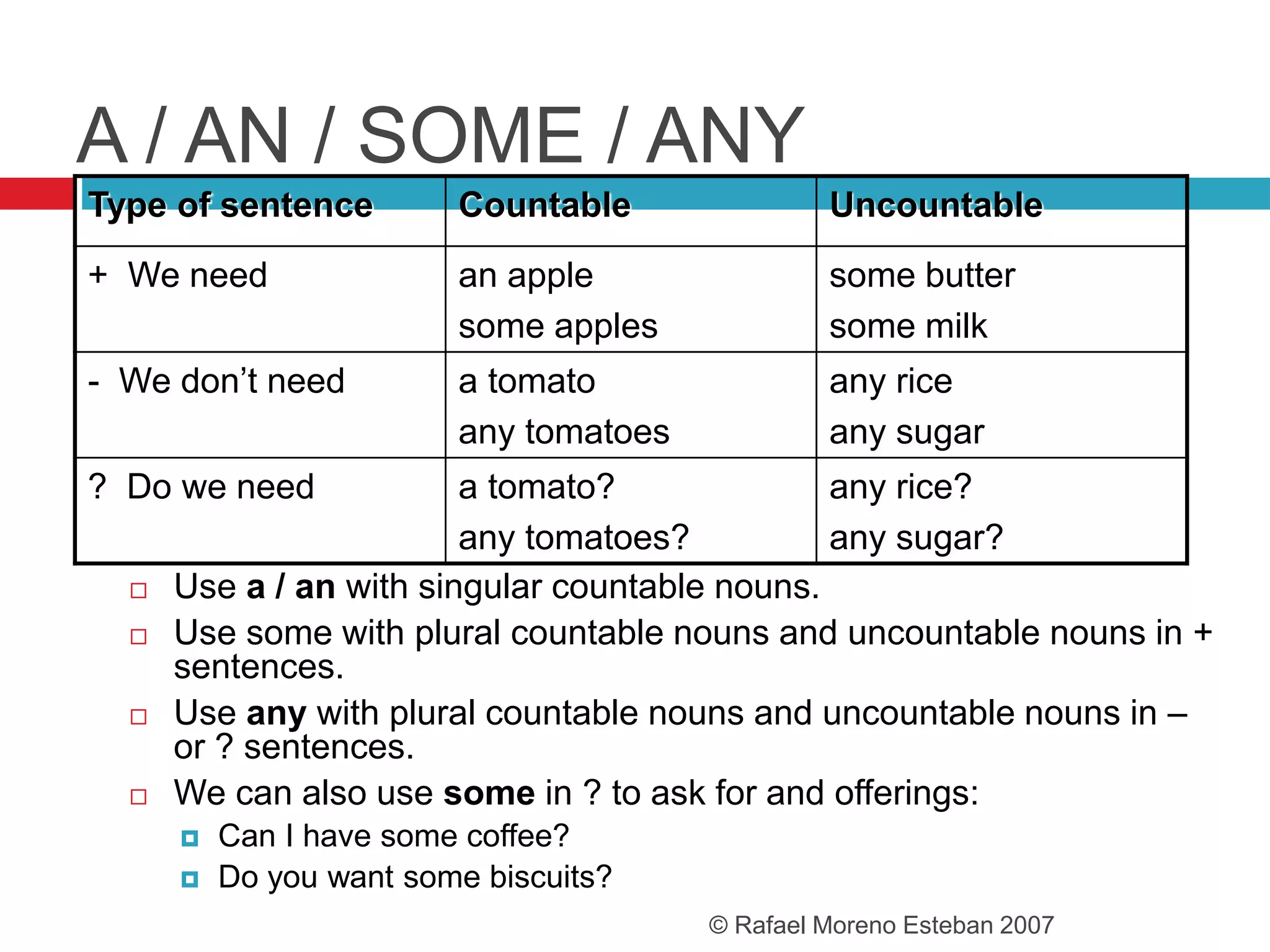
A / AN / SOME / ANY
Type of sentence Countable Uncountable
+ We need an apple
some apples
some butter
some milk
- We don’t need a tomato
any tomatoes
any rice
any sugar
? Do we need a tomato?
any tomatoes?
any rice?
any sugar?
 Use a / an with singular countable nouns.
 Use some with plural countable nouns and uncountable nouns in +
sentences.
 Use any with plural countable nouns and uncountable nouns in –
or ? sentences.
 We can also use some in ? to ask for and offerings:
 Can I have some coffee?
 Do you want some biscuits?
© Rafael Moreno Esteban 2007
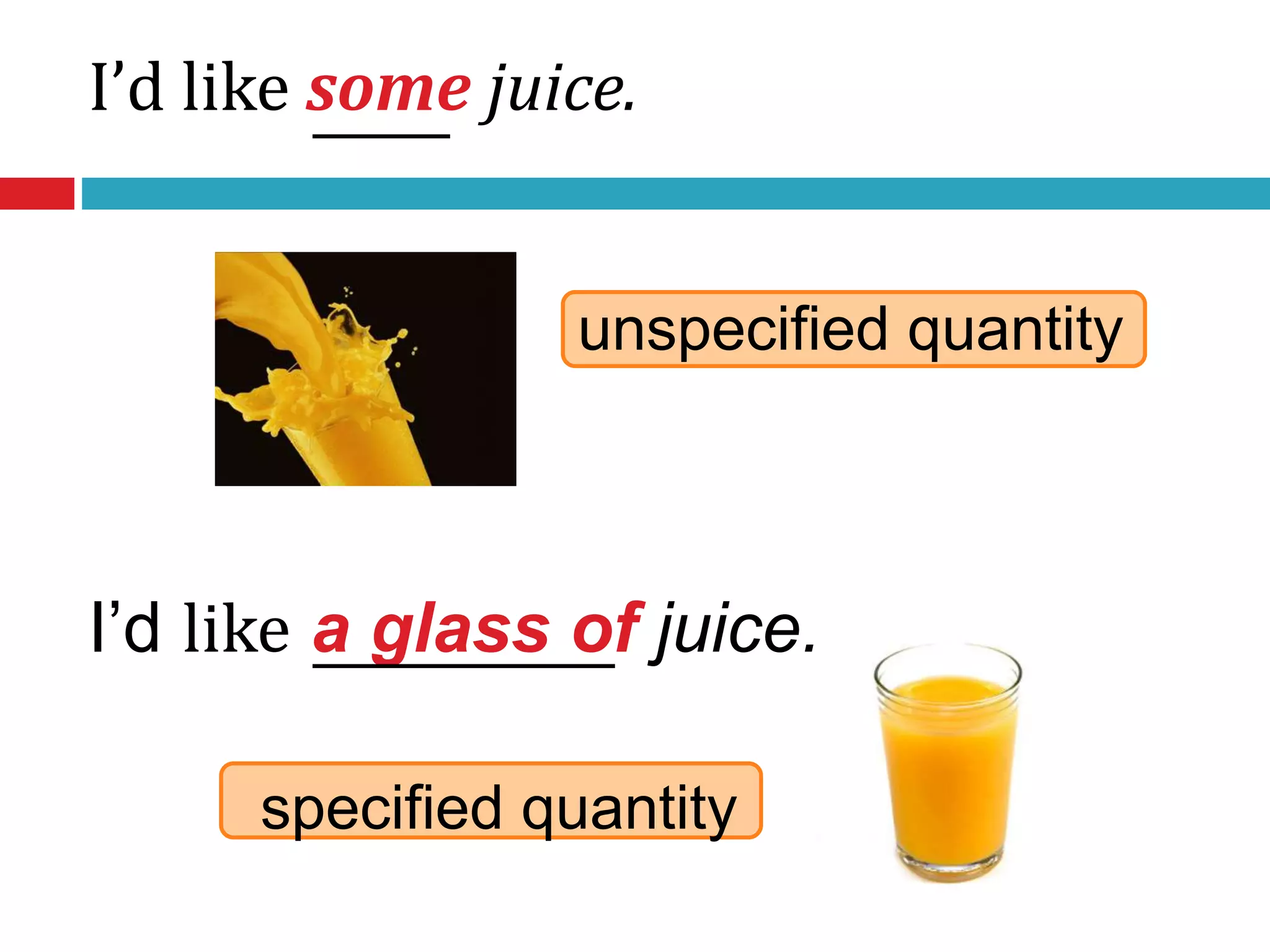
unspecified quantity
specified quantity
I’d like some juice.
I’d like a glass of juice.
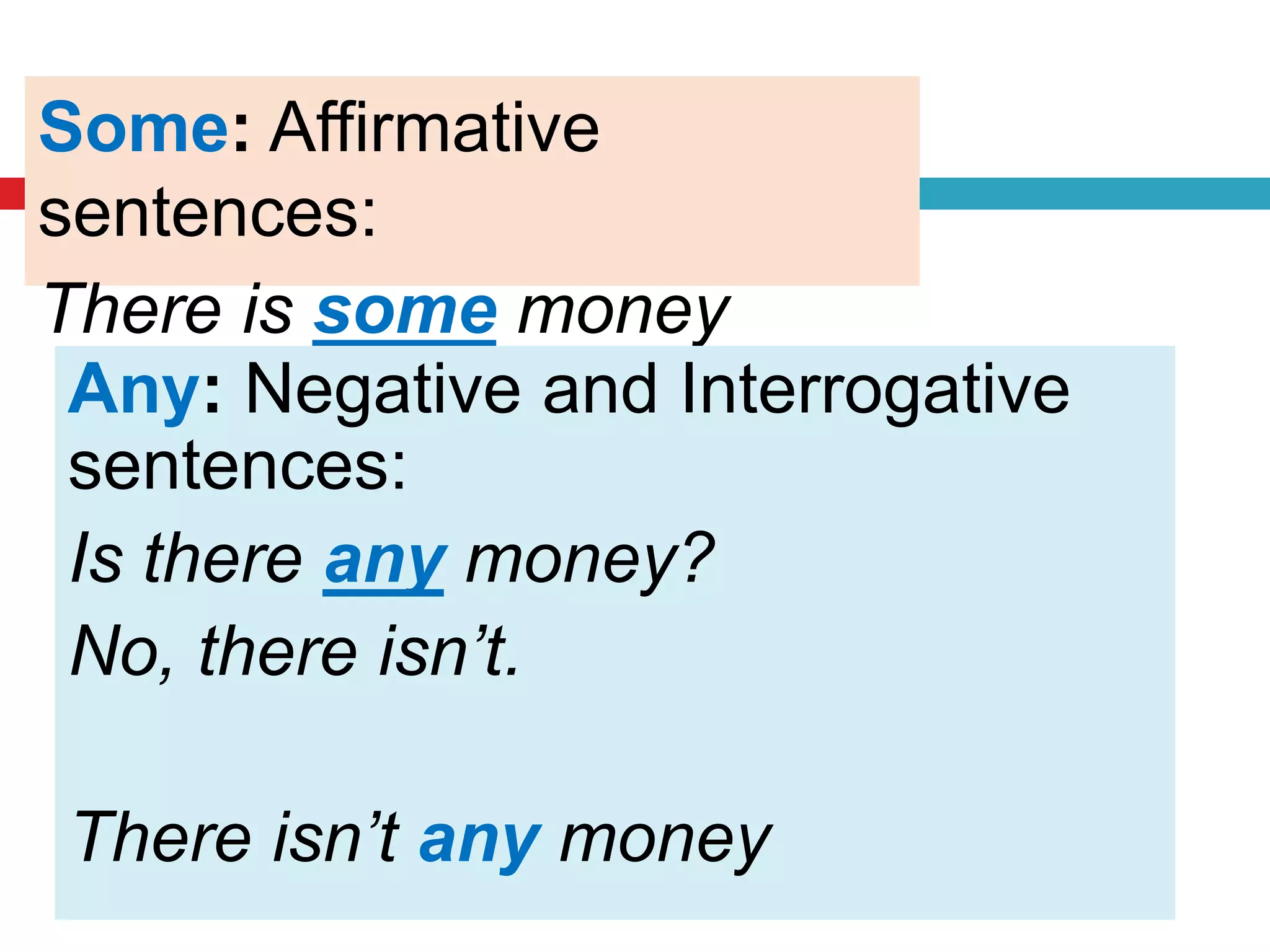
Some: Affirmative
sentences:
There is some money
Any: Negative and Interrogative
sentences:
Is there any money?
No, there isn’t.
There isn’t any money
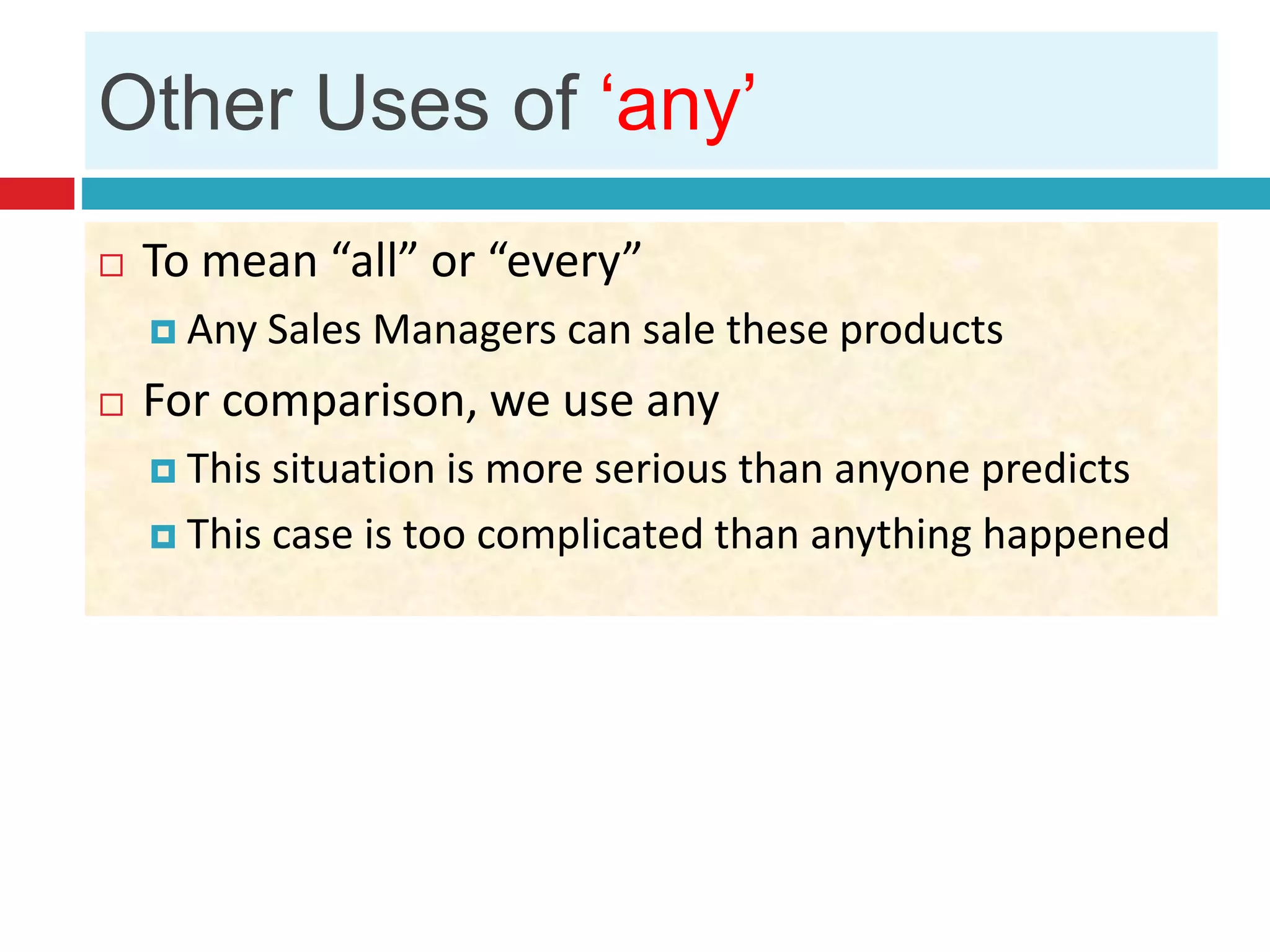
Other Uses of ‘any’
 To mean “all” or “every”
 Any Sales Managers can sale these products
 For comparison, we use any
 This situation is more serious than anyone predicts
 This case is too complicated than anything happened
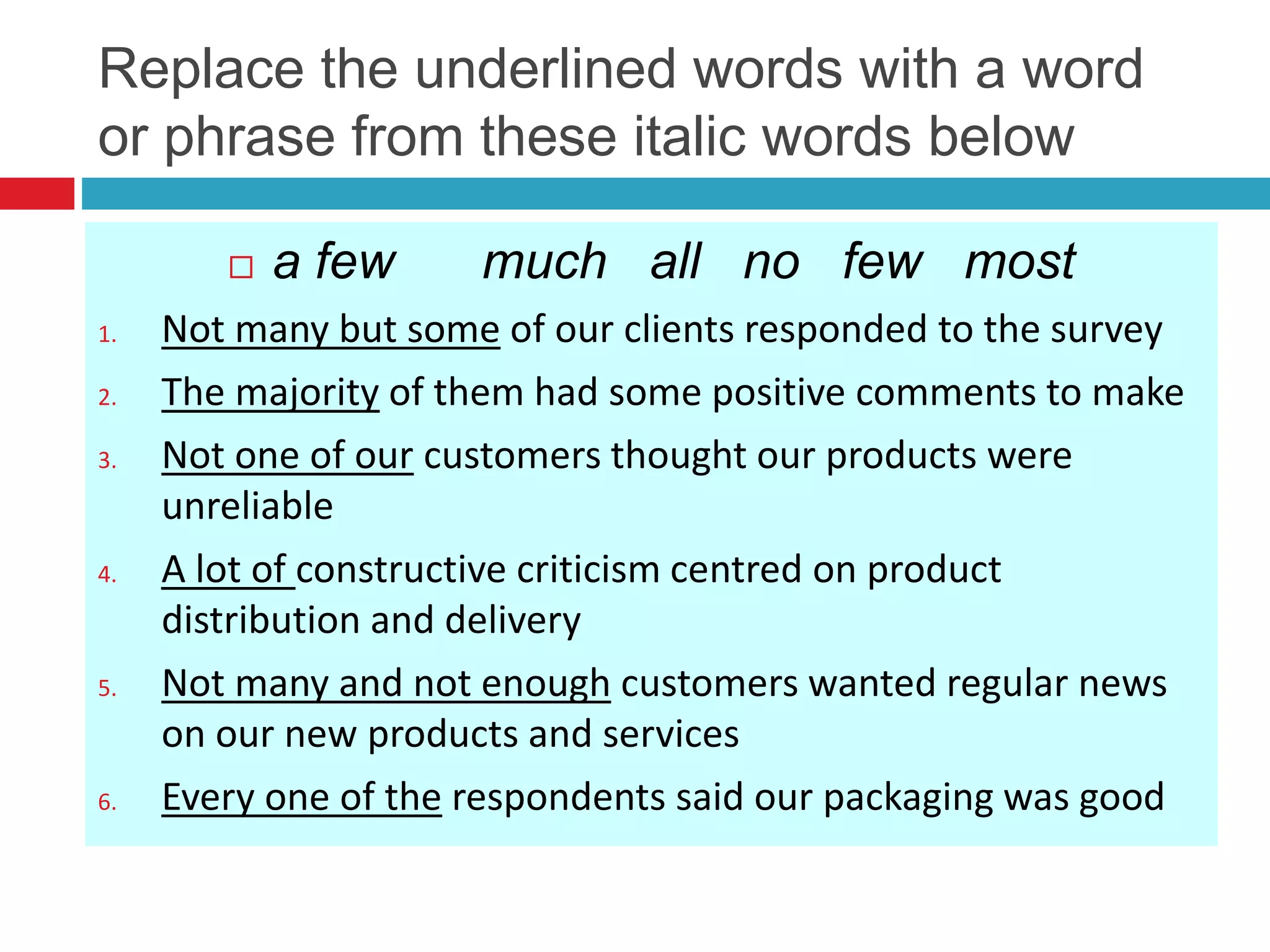
Replace the underlined words with a word
or phrase from these italic words below
 a few much all no few most
1. Not many but some of our clients responded to the survey
2. The majority of them had some positive comments to make
3. Not one of our customers thought our products were
unreliable
4. A lot of constructive criticism centred on product
distribution and delivery
5. Not many and not enough customers wanted regular news
on our new products and services
6. Every one of the respondents said our packaging was good
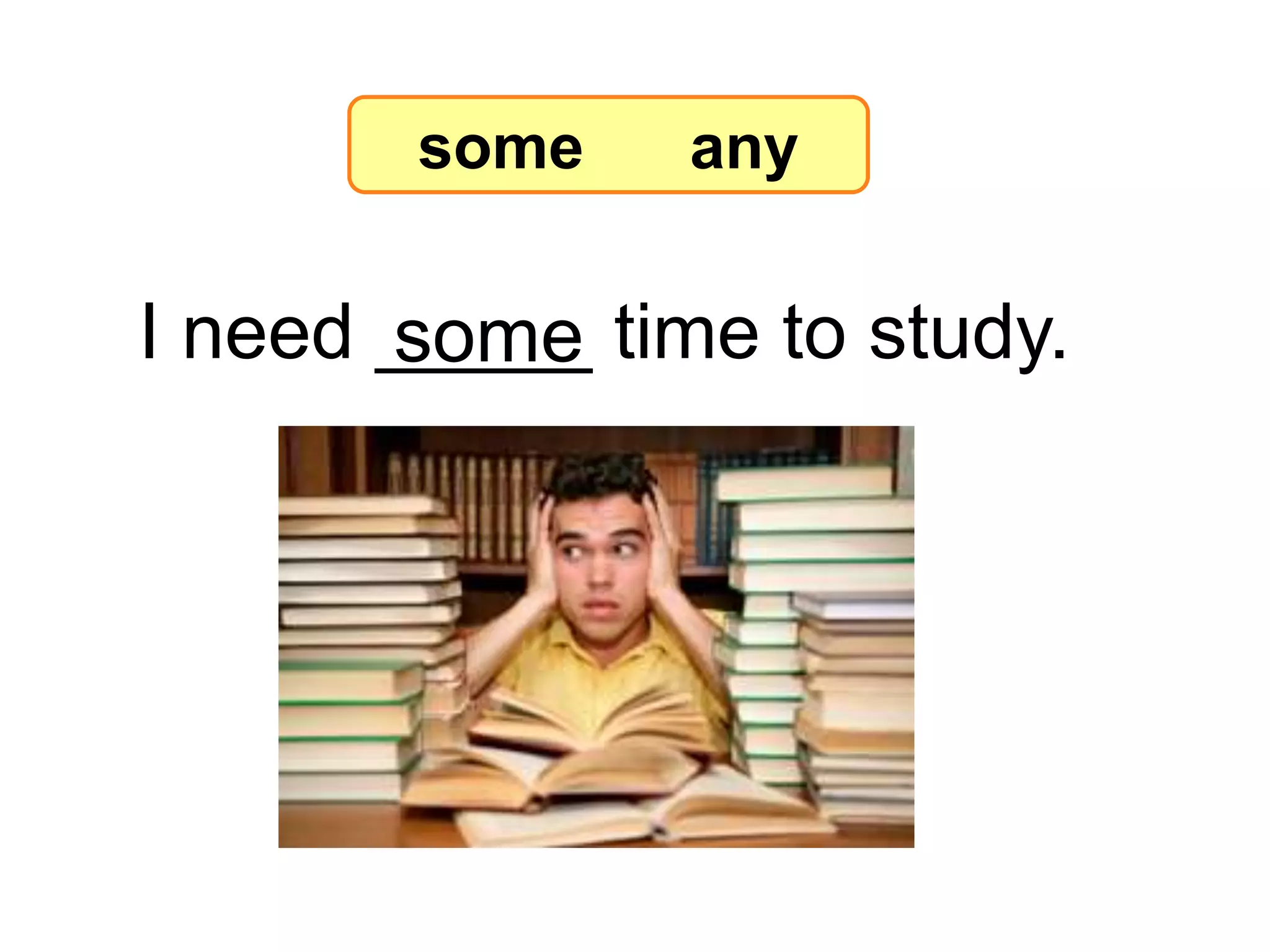
I need _____ time to study.
some
7-8 Let’s Practice
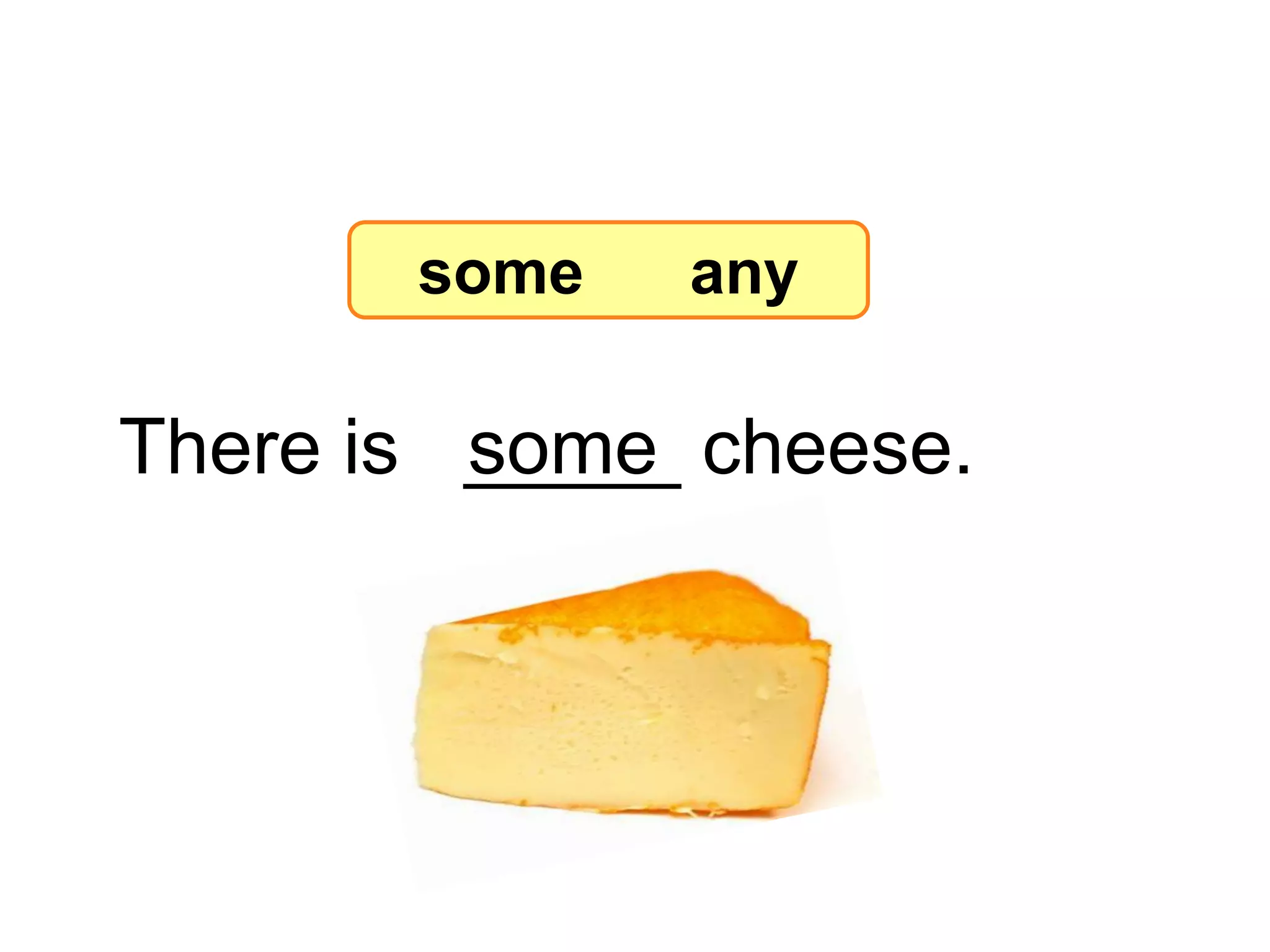
some any
There is _____ cheese.
some
7-8 Let’s Practice
some any
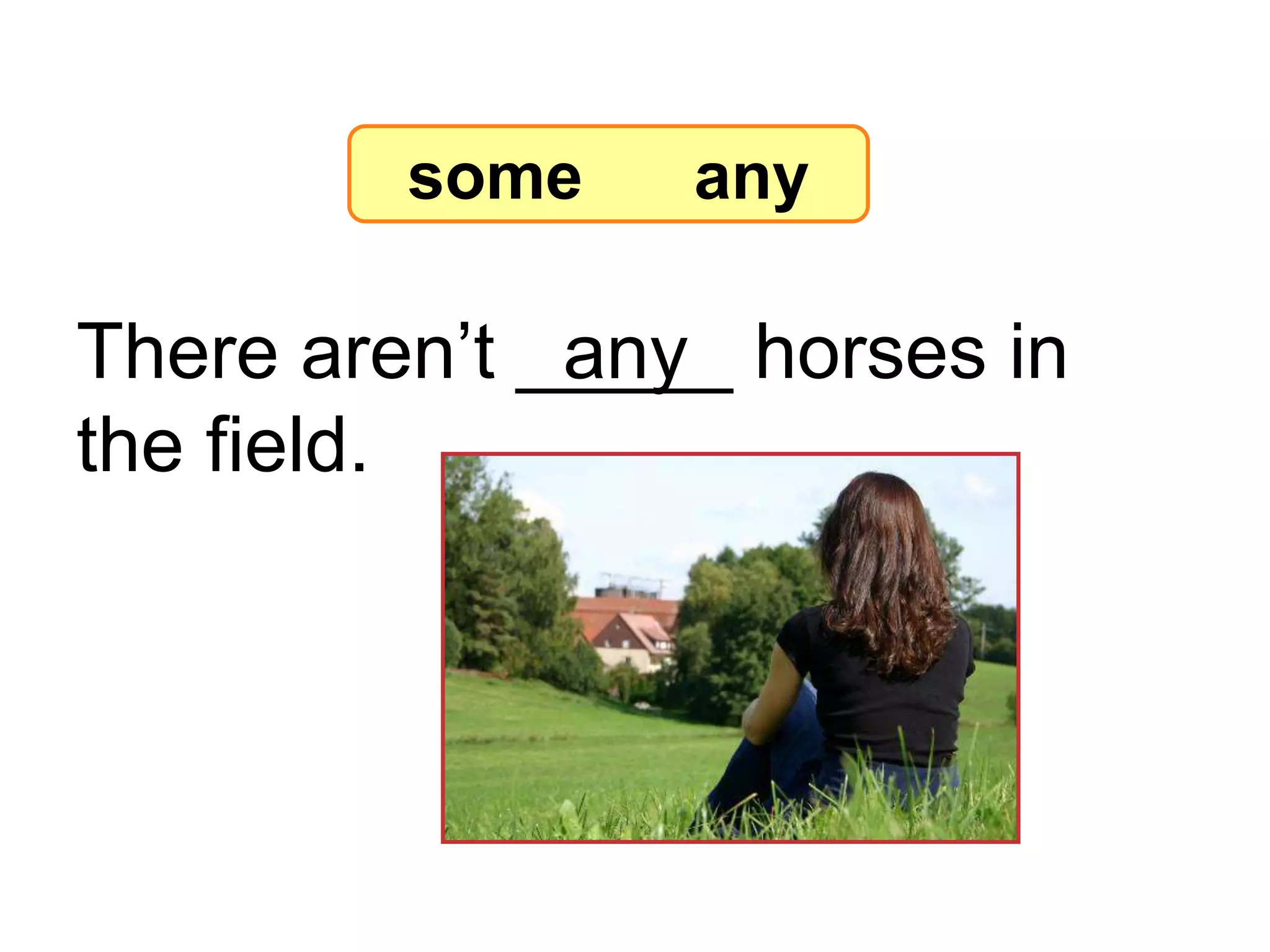
There aren’t _____ horses in
the field.
any
7-8 Let’s Practice
some any
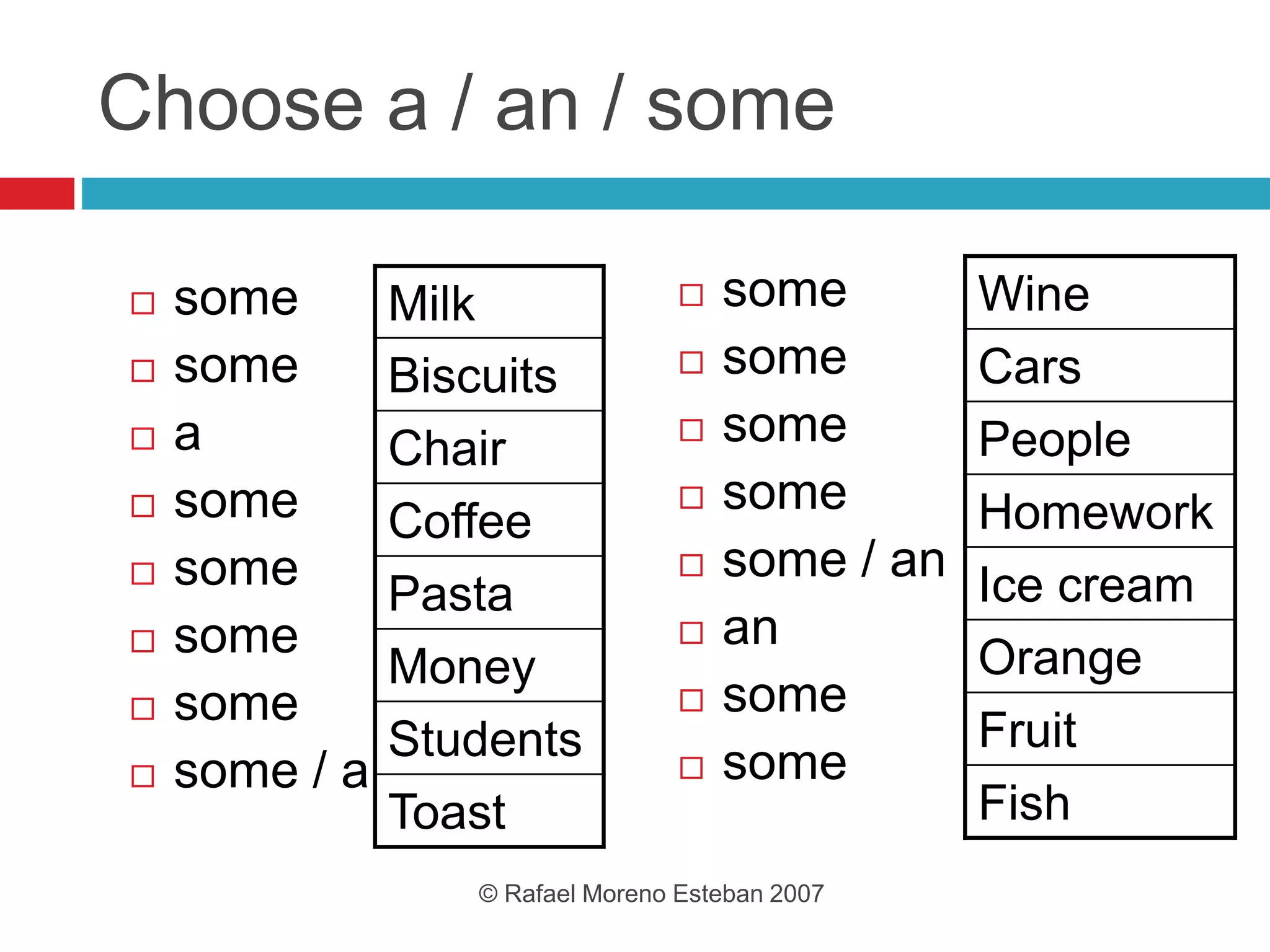
Choose a / an / some
 some
 some
 a
 some
 some
 some
 some
 some / a
 some
 some
 some
 some
 some / an
 an
 some
 some
© Rafael Moreno Esteban 2007
Milk
Biscuits
Chair
Coffee
Pasta
Money
Students
Toast
Wine
Cars
People
Homework
Ice cream
Orange
Fruit
Fish
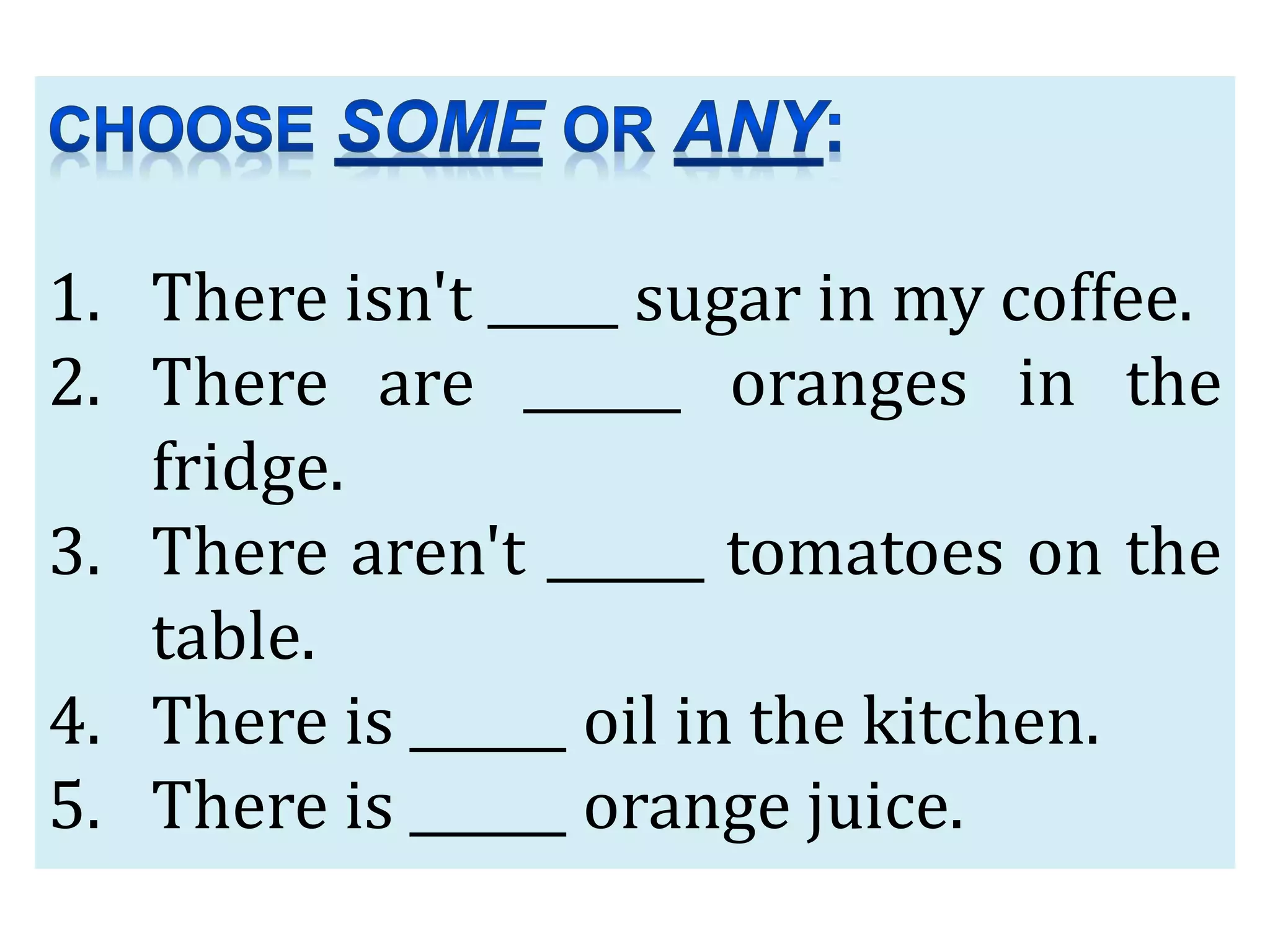
1. There isn't _____ sugar in my coffee.
2. There are ______ oranges in the
fridge.
3. There aren't ______ tomatoes on the
table.
4. There is ______ oil in the kitchen.
5. There is ______ orange juice.
How Much? How Many?
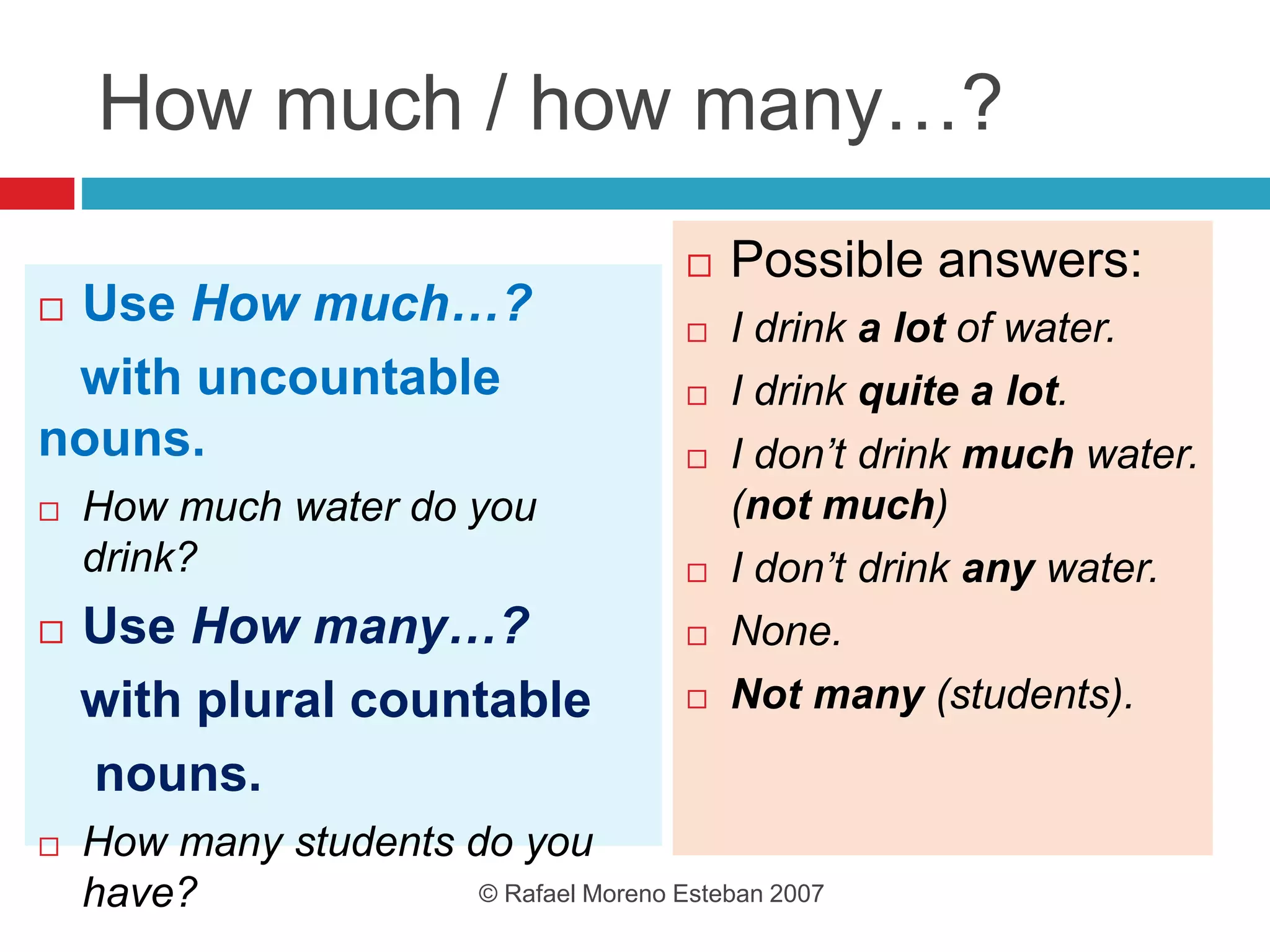
How much / how many…?
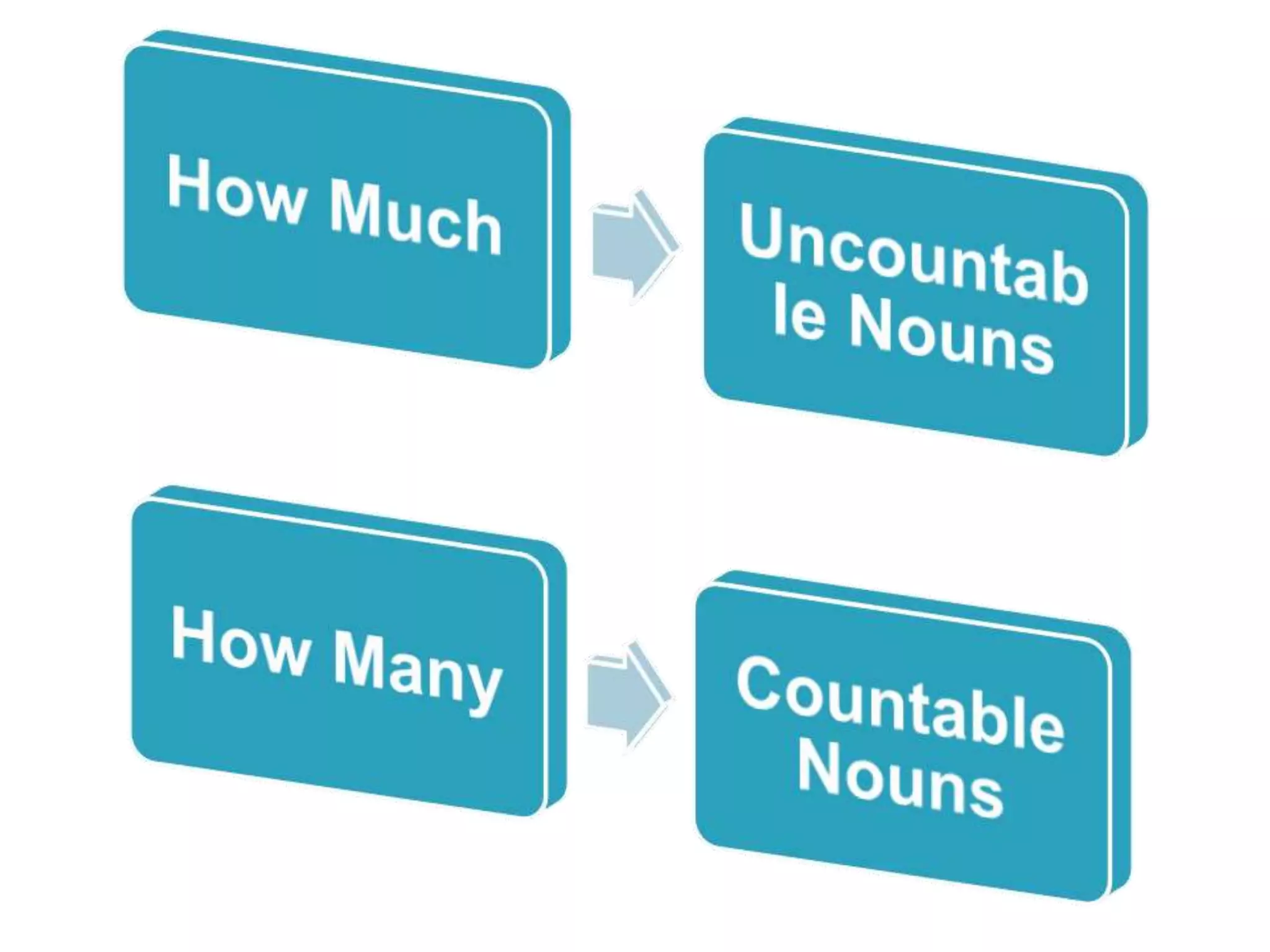
 Use How much…?
with uncountable
nouns.
 How much water do you
drink?
 Use How many…?
with plural countable
nouns.
 How many students do you
have?
 Possible answers:
 I drink a lot of water.
 I drink quite a lot.
 I don’t drink much water.
(not much)
 I don’t drink any water.
 None.
 Not many (students).
© Rafael Moreno Esteban 2007
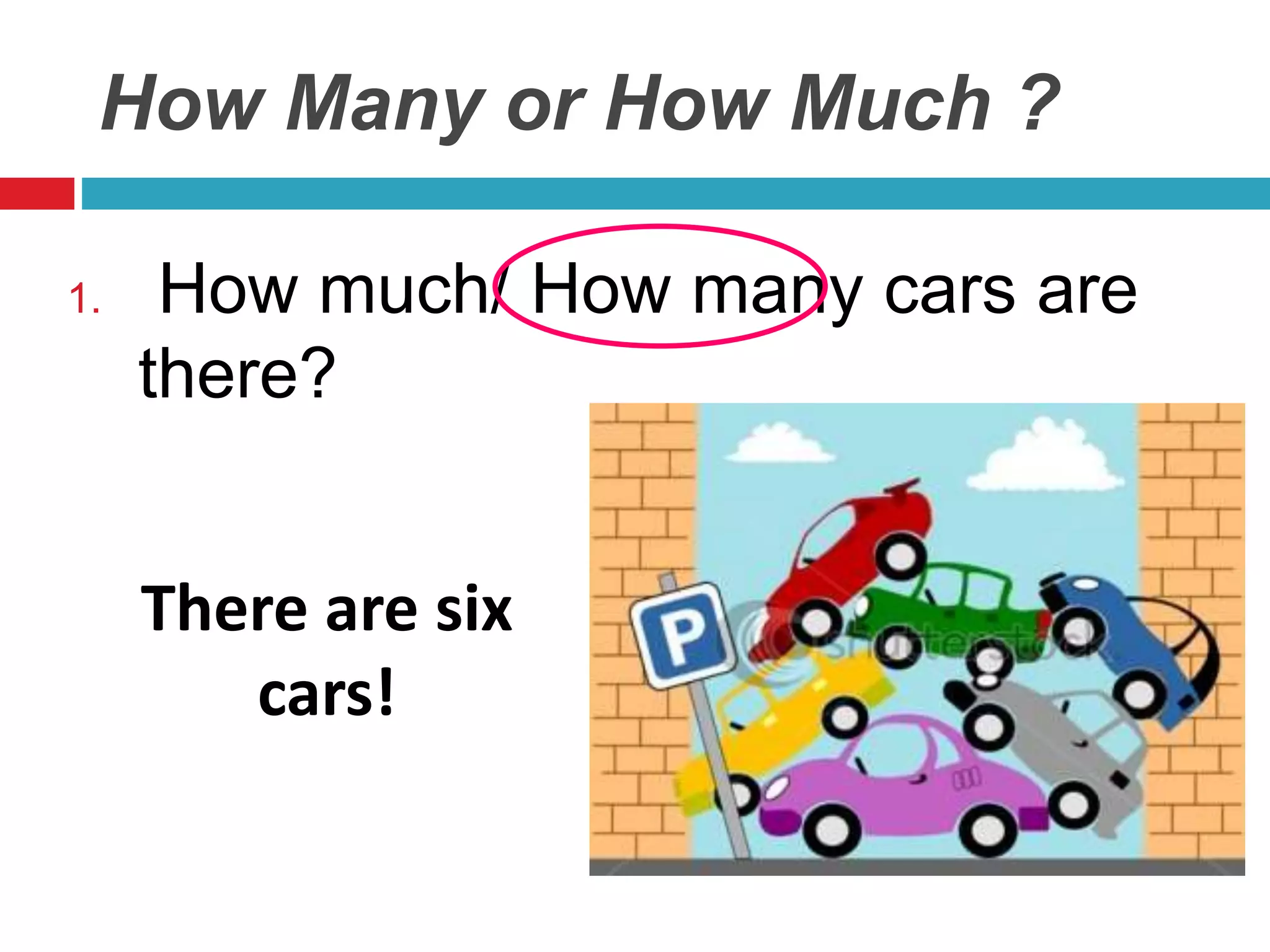
1. How much/ How many cars are
there?
How Many or How Much ?
There are six
cars!
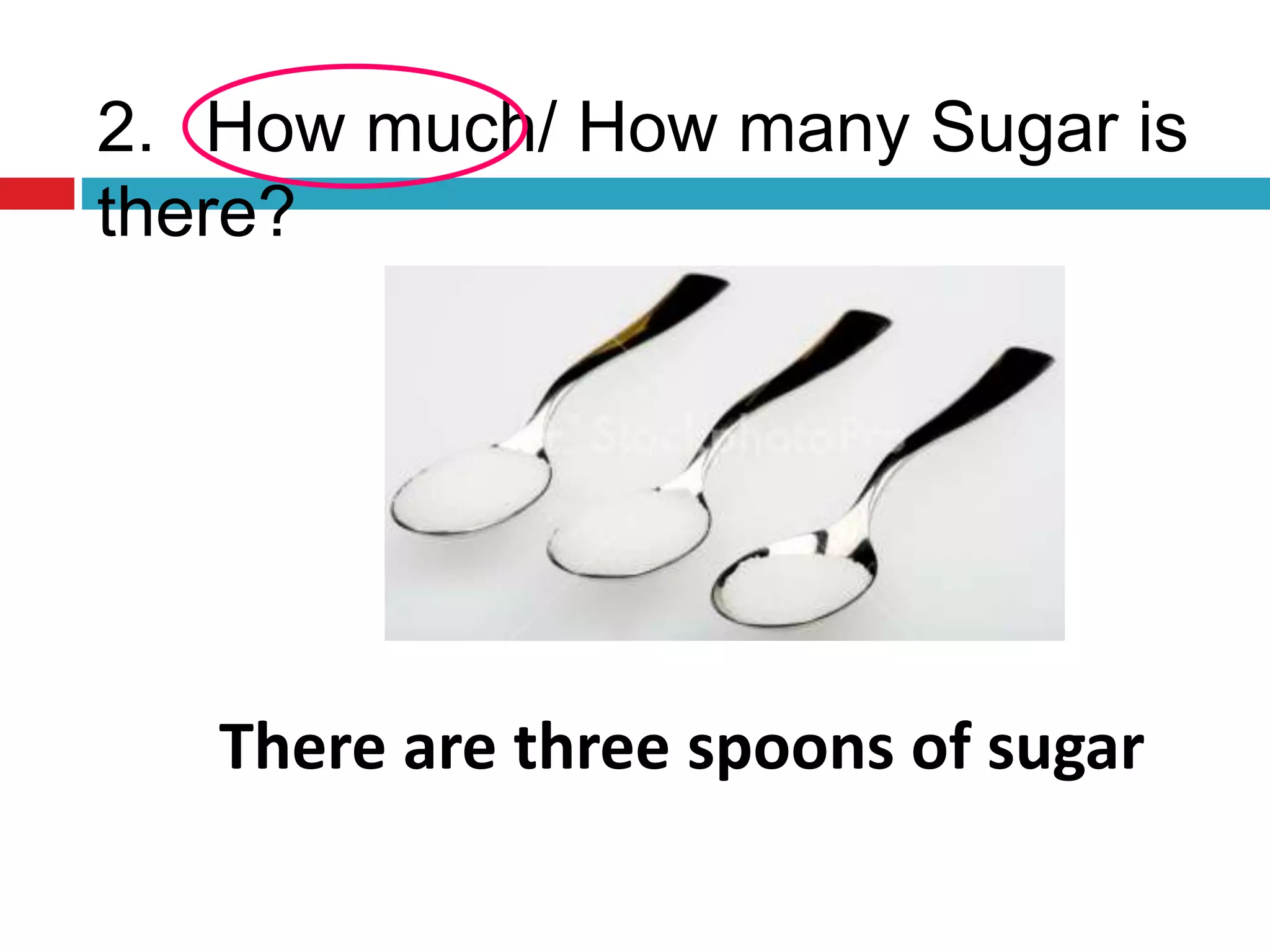
2. How much/ How many Sugar is
there?
There are three spoons of sugar
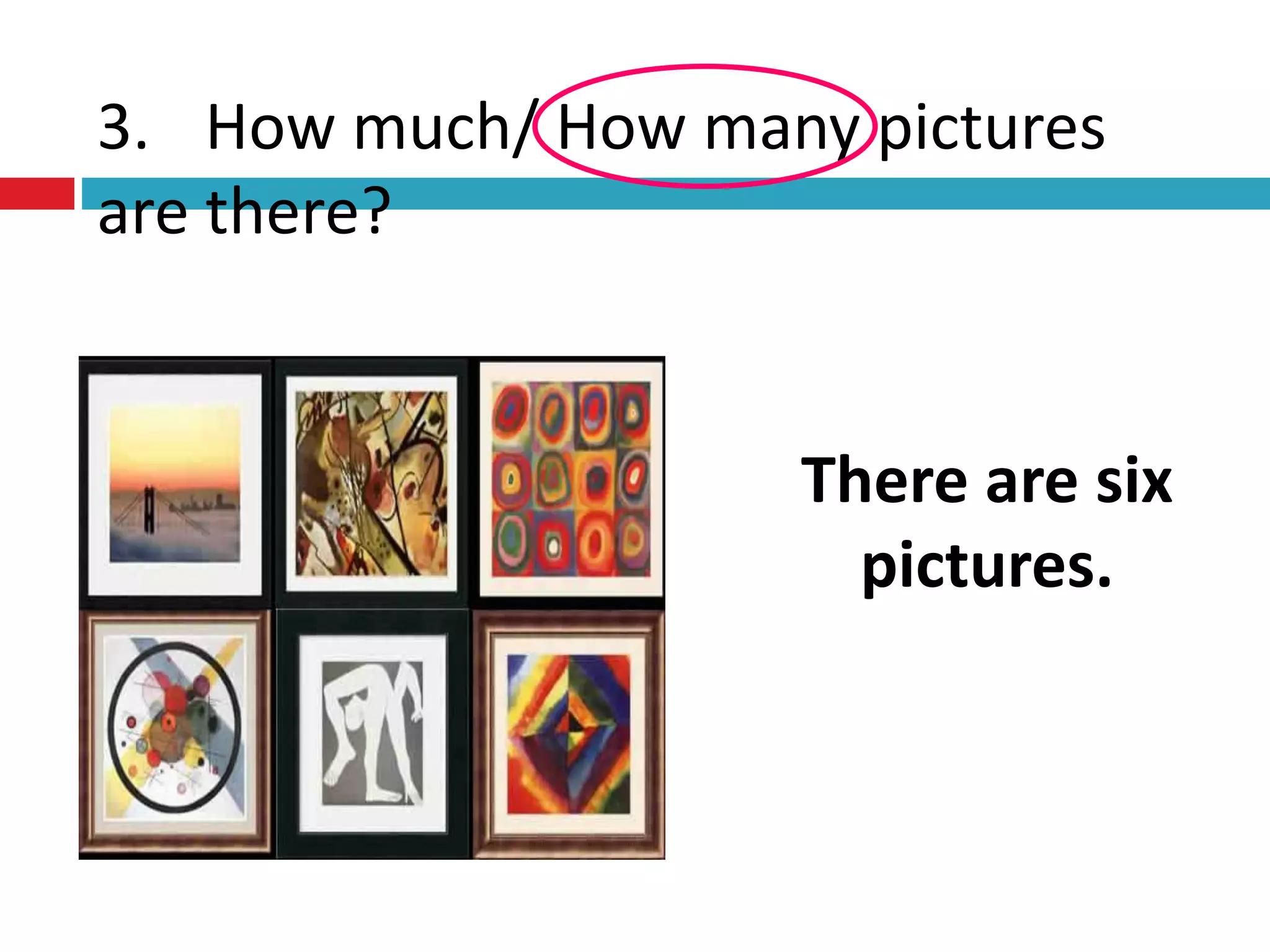
3. How much/ How many pictures
are there?
There are six
pictures.
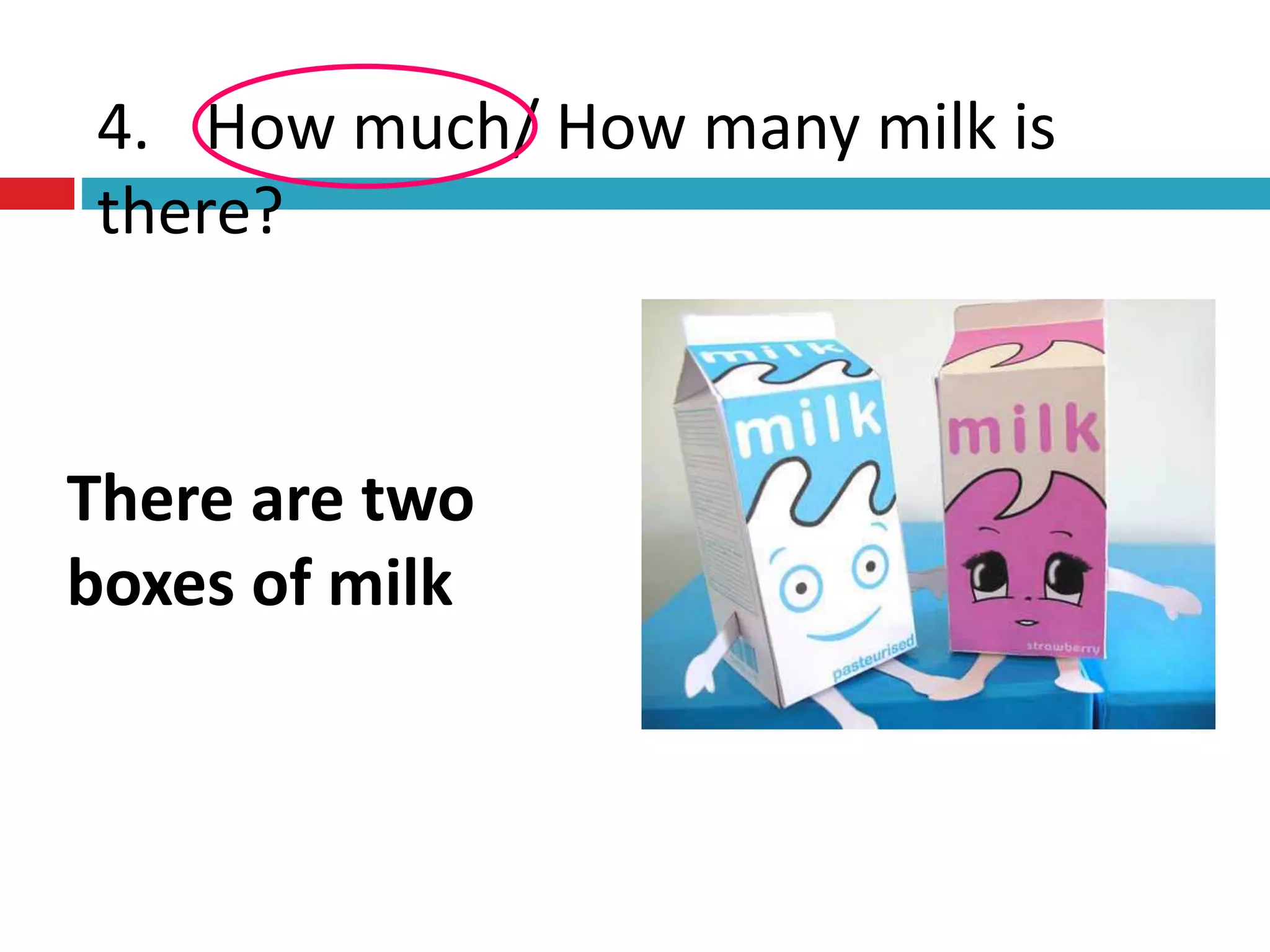
4. How much/ How many milk is
there?
There are two
boxes of milk
Quantifiers
We usually treat uncountable nouns as singular : We
use a singular verb. For example:
 This news is very important.
 Your luggage looks heavy.
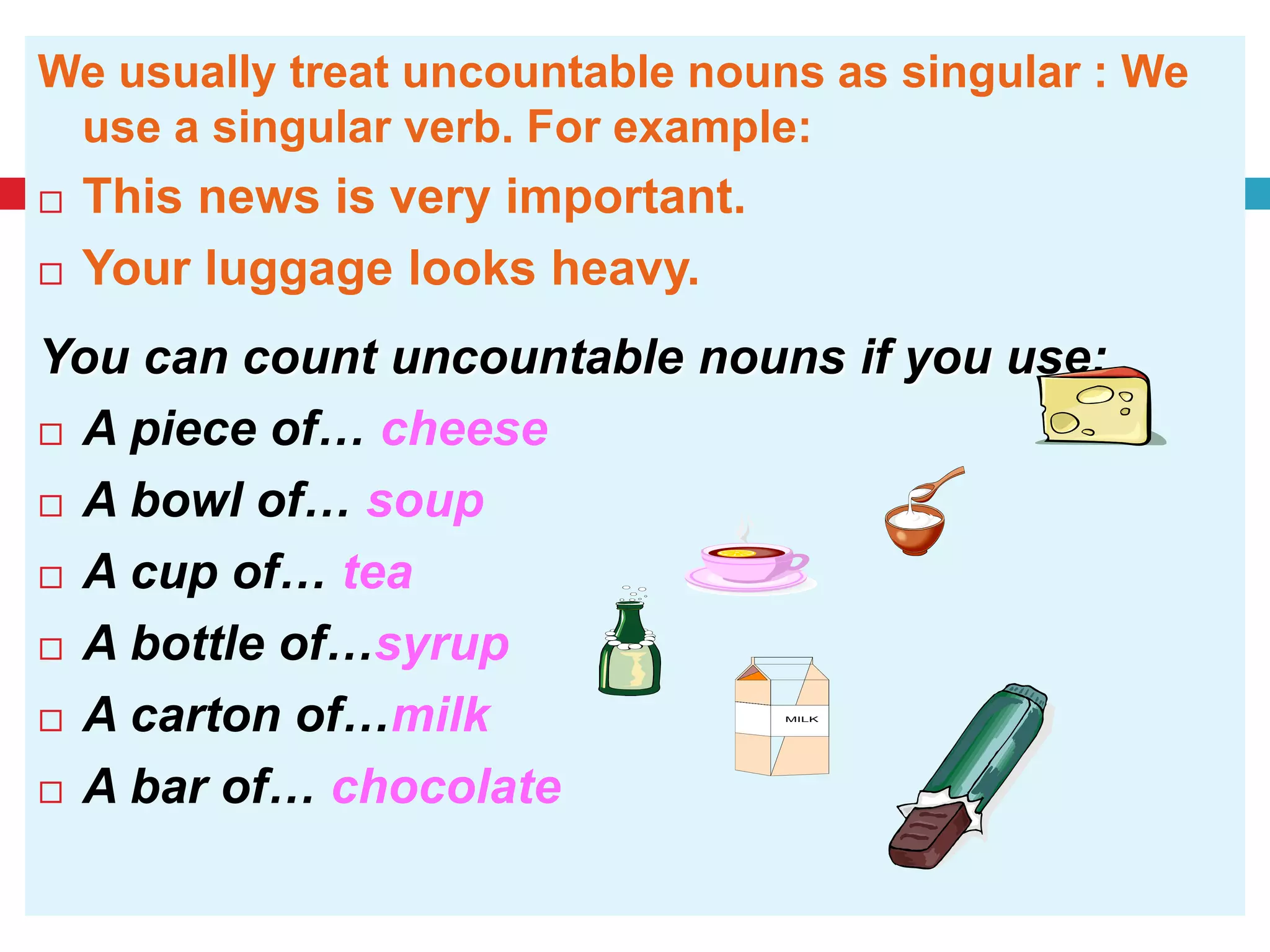
You can count uncountable nouns if you use:
 A piece of… cheese
 A bowl of… soup
 A cup of… tea
 A bottle of…syrup
 A carton of…milk
 A bar of… chocolate
MILK
Here are some of the most common containers /
quantity expressions for these uncountable
nouns:
advice - a piece of advice
baggage - a piece of baggage
bread - a slice of bread, a loaf of bread
equipment - a piece of equipment
furniture - a piece of furniture
garbage - a piece of garbage
information - a piece of information
knowledge - a fact
luggage - a piece of luggage, a bag, a
suitcase
money - a note, a coin
musica – a song, a piece
news - a piece of news
pasta - a plate of pasta, a serving of
pasta
research - a piece of research, a
research project
travel - a journey, a trip
work - a job, a position
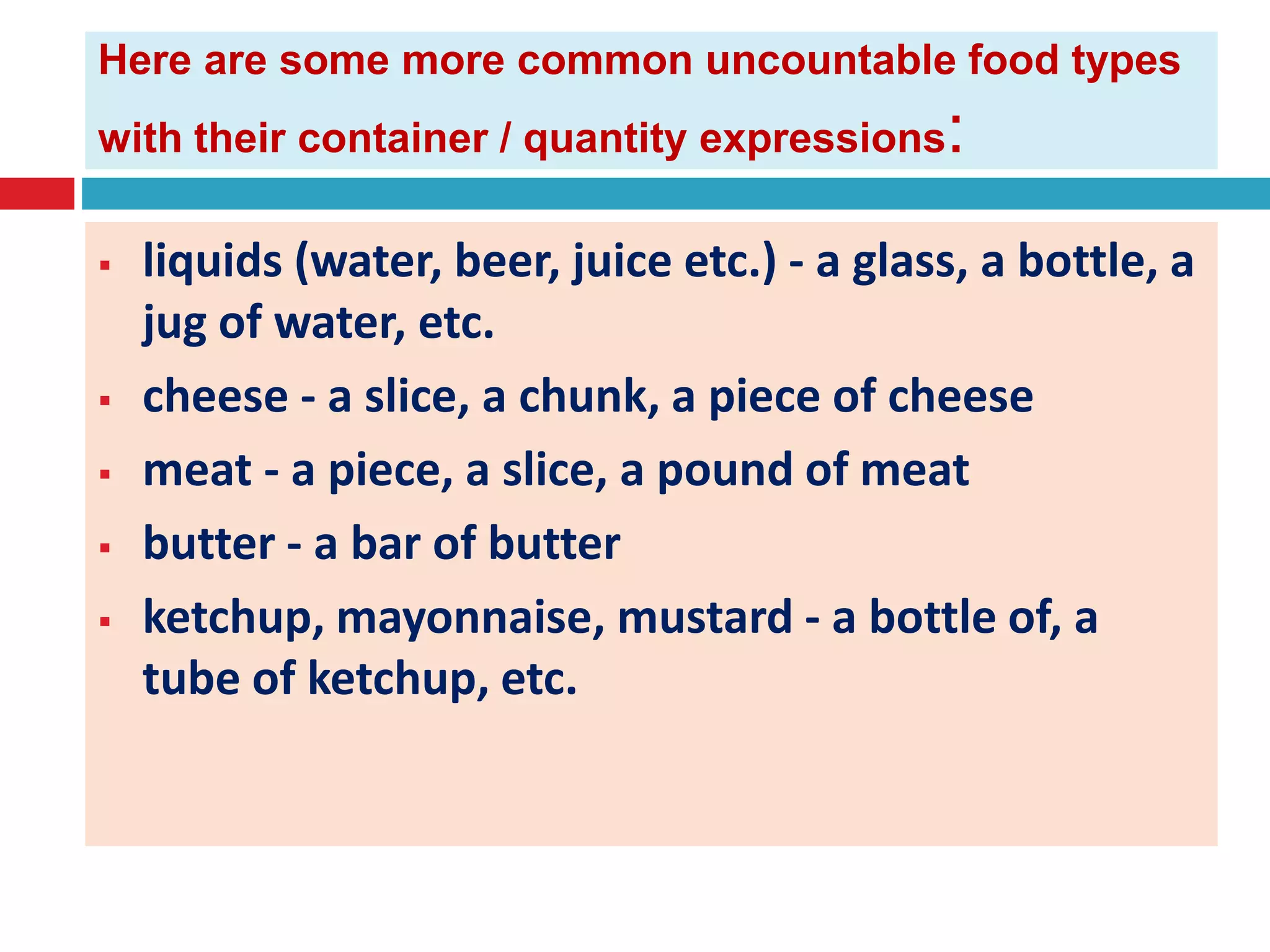
Here are some more common uncountable food types
with their container / quantity expressions:
 liquids (water, beer, juice etc.) - a glass, a bottle, a
jug of water, etc.
 cheese - a slice, a chunk, a piece of cheese
 meat - a piece, a slice, a pound of meat
 butter - a bar of butter
 ketchup, mayonnaise, mustard - a bottle of, a
tube of ketchup, etc.
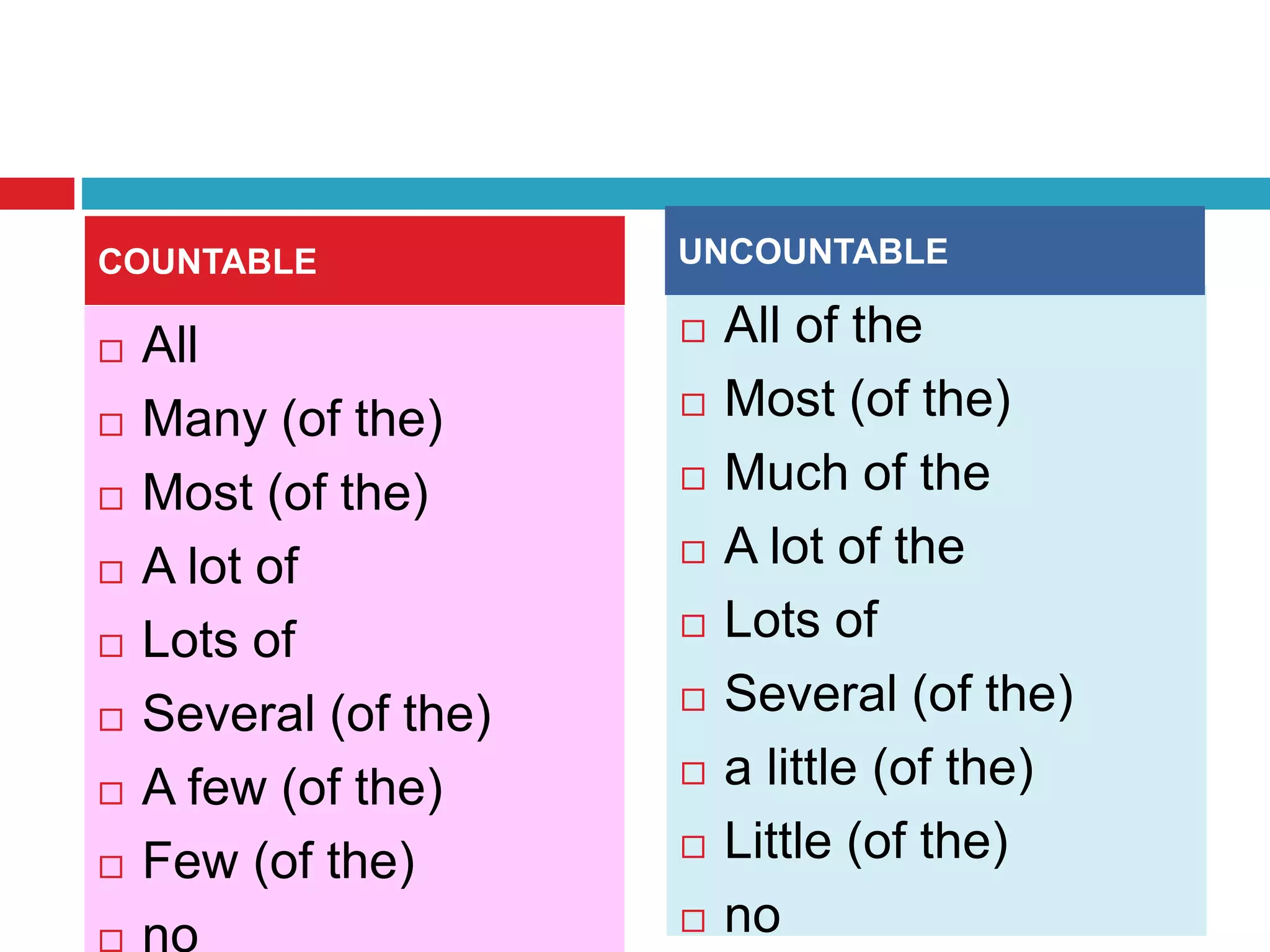
 All
 Many (of the)
 Most (of the)
 A lot of
 Lots of
 Several (of the)
 A few (of the)
 Few (of the)
 no
 All of the
 Most (of the)
 Much of the
 A lot of the
 Lots of
 Several (of the)
 a little (of the)
 Little (of the)
 no
COUNTABLE UNCOUNTABLE
References:
 Basic of English Betty Schrampfer A., New Jersey:
Prentice Hall Regent, 1989
 The Language of Business English (Grammar and
Functions). Prentice Hall International Ltd, London,
1994
 www.taipolst.edu.hk/.../P2CountableNouns_and_Uncou
ntableNouns.ppt (has been downloaded in November
2014)
 egitim.erciyes.edu.tr/.../2.../50Countable-uncount.PPT
(has been downloaded in November 2014)
 www.educacional.com.br/.../countable%20and%20unc
ountable%20noun. (has been downloaded in
November 2014)

b-ing-countable-uncountable-nouns.ppt

  • 1.
  • 2.
  • 3.
    There are 2kinds of noun in English:  Countable  Things you can count (singular or plural)  One apple, two apples, three apples…  Uncountable  Things you can´t count (they can’t be plural)  Butter, meat…  Some nouns can be countable or uncountable but the meaning is different.  Example: chocolate © Rafael Moreno Esteban 2007
  • 4.
    There are somenouns we can use in both countable and uncountable form; Countable Meaning  There is a hair in my soup  A chicken escaped from the henhouse.  My favorite works of art are from China. Uncountable Meaning  Sandra has black and long hair.  We had chicken for dinner.  It takes work to prepare a meal.
  • 5.
     Countable nounshave a plural form  Singular: a car  an eggplant  Plural Form Three books Some books Many books COUNTABLE NOUNS
  • 6.
     We canuse countable nouns with certain definition of numbers.  For example; two kilograms tomatoes, five dictionaries, seven group of cows, tons of oranges, three kilograms lemons, eighty students COUNTABLE NOUNS
  • 7.
     a mobilephone  a computer  a business magazine  an english book  a dictionary  five mobile phones  seven computers  three business magazines  nine english books  eleven dictionaries SINGULAR FORM PLURAL FORM COUNTABLE NOUNS
  • 8.
    Uncountable nouns aresubstances, concepts etc that we cannot divide into separate elements. We cannot "count" them. For example, we cannot count "milk". We can count "bottles of milk" ( quantifiers) or "litres of milk", but we cannot count "milk" itself. UNCOUNTABLE NOUNS
  • 9.
    Notice the followingcategories and examples of uncountable nouns;  Abstractions: chance, energy, honesty, love…  Activities: basketball, dancing, singing, tennis…  Diseases: AIDS, cancer, influenza, malaria…  Foods: beef, bread, fish, fruit, meat…  Gases: air, carbon dioxide, oxygen, smoke…  Liquids: coffee, gasoline, milk, tea, water…  Natural phenomena: electricity, heat, rain, thunder… UNCOUNTABLE NOUNS
  • 10.
     Occupations: dentistry,nursing, teaching…  Particles: dust, pepper, salt, sand, sugar…  Solid elements: gold, iron, plutonium, silver…  Subjects: Chinese, English, physics, science…  Others: equipment, furniture, money, news… UNCOUNTABLE NOUNS
  • 11.
    Some Examples withUncountable Nouns  I drink a cup of coffee in everyday.  There is any sugar in the kitchen.  My mother buy seven bottles of milk for a week.  She eats a bar of chocolate whenever she wants.  He met me with a bunch of flower in his arms.  There is so much butter in this meal.  Everybody feels the love inside himself.
  • 12.
     We havea group of furniture in our house.  They wanted some salt for their plumbs.  In summer, I like drinking water with a block of ice.  I bought a pocket of tea for my guests.  There was so much snow that we all were cold when we were outside.  The room has little ligth. We nearly can see each other.
  • 13.
    Identify the followingobjects as countable or uncountable. 1. Q: Information 4. Q: Money a) countable a) countable b) uncountable b) uncountable 2. Q: Rules 5. Q: Rice a) countable a) countable b) uncountable b) uncountable 3. Q: Sheep 6. Q: Bottles Of Syrup a) countable a) countable b) uncountable b) uncountable
  • 14.
  • 15.
    A / AN/ SOME / ANY Type of sentence Countable Uncountable + We need an apple some apples some butter some milk - We don’t need a tomato any tomatoes any rice any sugar ? Do we need a tomato? any tomatoes? any rice? any sugar?  Use a / an with singular countable nouns.  Use some with plural countable nouns and uncountable nouns in + sentences.  Use any with plural countable nouns and uncountable nouns in – or ? sentences.  We can also use some in ? to ask for and offerings:  Can I have some coffee?  Do you want some biscuits? © Rafael Moreno Esteban 2007
  • 16.
    unspecified quantity specified quantity I’dlike some juice. I’d like a glass of juice.
  • 17.
    Some: Affirmative sentences: There issome money Any: Negative and Interrogative sentences: Is there any money? No, there isn’t. There isn’t any money
  • 18.
    Other Uses of‘any’  To mean “all” or “every”  Any Sales Managers can sale these products  For comparison, we use any  This situation is more serious than anyone predicts  This case is too complicated than anything happened
  • 19.
    Replace the underlinedwords with a word or phrase from these italic words below  a few much all no few most 1. Not many but some of our clients responded to the survey 2. The majority of them had some positive comments to make 3. Not one of our customers thought our products were unreliable 4. A lot of constructive criticism centred on product distribution and delivery 5. Not many and not enough customers wanted regular news on our new products and services 6. Every one of the respondents said our packaging was good
  • 20.
    I need _____time to study. some 7-8 Let’s Practice some any
  • 21.
    There is _____cheese. some 7-8 Let’s Practice some any
  • 22.
    There aren’t _____horses in the field. any 7-8 Let’s Practice some any
  • 23.
    Choose a /an / some  some  some  a  some  some  some  some  some / a  some  some  some  some  some / an  an  some  some © Rafael Moreno Esteban 2007 Milk Biscuits Chair Coffee Pasta Money Students Toast Wine Cars People Homework Ice cream Orange Fruit Fish
  • 24.
    1. There isn't_____ sugar in my coffee. 2. There are ______ oranges in the fridge. 3. There aren't ______ tomatoes on the table. 4. There is ______ oil in the kitchen. 5. There is ______ orange juice.
  • 26.
  • 28.
    How much /how many…?  Use How much…? with uncountable nouns.  How much water do you drink?  Use How many…? with plural countable nouns.  How many students do you have?  Possible answers:  I drink a lot of water.  I drink quite a lot.  I don’t drink much water. (not much)  I don’t drink any water.  None.  Not many (students). © Rafael Moreno Esteban 2007
  • 30.
    1. How much/How many cars are there? How Many or How Much ? There are six cars!
  • 31.
    2. How much/How many Sugar is there? There are three spoons of sugar
  • 32.
    3. How much/How many pictures are there? There are six pictures.
  • 33.
    4. How much/How many milk is there? There are two boxes of milk
  • 34.
  • 35.
    We usually treatuncountable nouns as singular : We use a singular verb. For example:  This news is very important.  Your luggage looks heavy. You can count uncountable nouns if you use:  A piece of… cheese  A bowl of… soup  A cup of… tea  A bottle of…syrup  A carton of…milk  A bar of… chocolate MILK
  • 36.
    Here are someof the most common containers / quantity expressions for these uncountable nouns: advice - a piece of advice baggage - a piece of baggage bread - a slice of bread, a loaf of bread equipment - a piece of equipment furniture - a piece of furniture garbage - a piece of garbage information - a piece of information knowledge - a fact
  • 37.
    luggage - apiece of luggage, a bag, a suitcase money - a note, a coin musica – a song, a piece news - a piece of news pasta - a plate of pasta, a serving of pasta research - a piece of research, a research project travel - a journey, a trip work - a job, a position
  • 38.
    Here are somemore common uncountable food types with their container / quantity expressions:  liquids (water, beer, juice etc.) - a glass, a bottle, a jug of water, etc.  cheese - a slice, a chunk, a piece of cheese  meat - a piece, a slice, a pound of meat  butter - a bar of butter  ketchup, mayonnaise, mustard - a bottle of, a tube of ketchup, etc.
  • 39.
     All  Many(of the)  Most (of the)  A lot of  Lots of  Several (of the)  A few (of the)  Few (of the)  no  All of the  Most (of the)  Much of the  A lot of the  Lots of  Several (of the)  a little (of the)  Little (of the)  no COUNTABLE UNCOUNTABLE
  • 40.
    References:  Basic ofEnglish Betty Schrampfer A., New Jersey: Prentice Hall Regent, 1989  The Language of Business English (Grammar and Functions). Prentice Hall International Ltd, London, 1994  www.taipolst.edu.hk/.../P2CountableNouns_and_Uncou ntableNouns.ppt (has been downloaded in November 2014)  egitim.erciyes.edu.tr/.../2.../50Countable-uncount.PPT (has been downloaded in November 2014)  www.educacional.com.br/.../countable%20and%20unc ountable%20noun. (has been downloaded in November 2014)