Counseling Special
Populations:
Ex-offenders
A Presentation by Sarah Moran
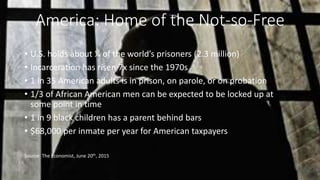
America: Home of the Not-so-Free
• U.S. holds about ¼ of the world’s prisoners (2.3 million)
• Incarceration has risen 7x since the 1970s
• 1 in 35 American adults is in prison, on parole, or on probation
• 1/3 of African American men can be expected to be locked up at
some point in time
• 1 in 9 black children has a parent behind bars
• $68,000 per inmate per year for American taxpayers
Source: The Economist, June 20th, 2015
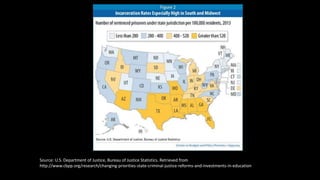
Source: U.S. Department of Justice, Bureau of Justice Statistics. Retrieved from
http://www.cbpp.org/research/changing-priorities-state-criminal-justice-reforms-and-investments-in-education
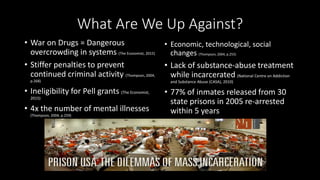
What Are We Up Against?
• War on Drugs = Dangerous
overcrowding in systems (The Economist, 2015)
• Stiffer penalties to prevent
continued criminal activity (Thompson, 2004,
p.268)
• Ineligibility for Pell grants (The Economist,
2015)
• 4x the number of mental illnesses
(Thompson, 2004, p.259)
• Economic, technological, social
changes (Thompson, 2004, p.255)
• Lack of substance-abuse treatment
while incarcerated (National Centre on Addiction
and Substance Abuse (CASA), 2010)
• 77% of inmates released from 30
state prisons in 2005 re-arrested
within 5 years
More Obstacles To Consider…
• Return to poor, geographically- isolated,
inner city neighborhoods (Thompson, 2004, p.267)
• Difficulty keeping connections/maintaining
relationships (Thompson, 2004, p.285)
• Academic and vocational privileges revoked
• Growing number of labor positions moving
overseas (Thompson, 2004, p. 269)
• Typically less educated, less skilled, less
matured (Substance Abuse and Mental Health Services Administration (US), 2000)
https://www.youtube.com/watch?v=GtXyGFMBWBs
Barriers
•Internal
•Societal
Integrating Substance Abuse Treatment and
Vocational Services – Working with the Ex-Offender.
SAMHSA. 2000
How Can Counselors Help?
• Help clients develop sense of autonomy
• Be respectful and consistent with clients
• Celebrate small successes to build/experience achievement
• Present all information and expectations clearly
• Assist in reaching out/developing support unit for client
• Connect client to any available resources within community
• Help obtain proper identification
• Introduction to technology/social media (if necessary)
Source: Integrating Substance Abuse Treatment and Vocational Services – Working with the Ex-Offender. SAMHSA. 2000
Career Guidance
• Assist clients in acquiring any necessary education (GED, job
licensure)
• Create resume (transfer skills)
• Clean up list of offenses, if possible
• Mock interviewing, help clients anticipate employers’ concerns
• Develop statement about positive aspects of client’s background
• Job Training (?)
• Writing referrals for clients to bring to interviews
Source: Integrating Substance Abuse Treatment and Vocational Services – Working with the Ex-Offender. SAMHSA. 2000
References
• CASA Columbia. (2010). New CASA* report finds: 65% of all U.S. inmates meet medical criteria for
substance abuse addiction, only 11% receive any treatment. [Press Release]. Found in:
The right choices. (2015, June 20). The Economist, 415 (8943). Pg.24.
• Chapter 8: Working with the ex-offender. (2000). In Integrating Substance Abuse Treatment and
Vocational Services. Rockville, MD: Substance Abuse and Mental Health Services
Administration (US). Retrieved from http://ncbi.nlm.nih.gov/books/NBK64287/
• Jailhouse nation. (2015, June 20). The Economist, 415 (8943). Pg. 11.
• James R.P., Ogloff et. al. (1994). Mental Health Services in Jails and Prisons: Legal, Clinical, and
Policy Issues. Law and Psychology Review. Pgs 109, 112-115.
• The right choices. (2015, June 20). The Economist, 415 (8943). Pgs. 23-26).
• Thompson, A. (2004). Navigating the Hidden Obstacles to Ex-Offender Reentry. Boston College
Law Review, 45 (2). Pgs. 255- 306. Retrieved from
http://lawdigitalcommons.bc.edu/bclr/vol45/iss2/1

Counseling Special Populations

  • 1.
  • 2.
    America: Home ofthe Not-so-Free • U.S. holds about ¼ of the world’s prisoners (2.3 million) • Incarceration has risen 7x since the 1970s • 1 in 35 American adults is in prison, on parole, or on probation • 1/3 of African American men can be expected to be locked up at some point in time • 1 in 9 black children has a parent behind bars • $68,000 per inmate per year for American taxpayers Source: The Economist, June 20th, 2015
  • 3.
    Source: U.S. Departmentof Justice, Bureau of Justice Statistics. Retrieved from http://www.cbpp.org/research/changing-priorities-state-criminal-justice-reforms-and-investments-in-education
  • 4.
    What Are WeUp Against? • War on Drugs = Dangerous overcrowding in systems (The Economist, 2015) • Stiffer penalties to prevent continued criminal activity (Thompson, 2004, p.268) • Ineligibility for Pell grants (The Economist, 2015) • 4x the number of mental illnesses (Thompson, 2004, p.259) • Economic, technological, social changes (Thompson, 2004, p.255) • Lack of substance-abuse treatment while incarcerated (National Centre on Addiction and Substance Abuse (CASA), 2010) • 77% of inmates released from 30 state prisons in 2005 re-arrested within 5 years
  • 5.
    More Obstacles ToConsider… • Return to poor, geographically- isolated, inner city neighborhoods (Thompson, 2004, p.267) • Difficulty keeping connections/maintaining relationships (Thompson, 2004, p.285) • Academic and vocational privileges revoked • Growing number of labor positions moving overseas (Thompson, 2004, p. 269) • Typically less educated, less skilled, less matured (Substance Abuse and Mental Health Services Administration (US), 2000)
  • 6.
  • 7.
    Barriers •Internal •Societal Integrating Substance AbuseTreatment and Vocational Services – Working with the Ex-Offender. SAMHSA. 2000
  • 8.
    How Can CounselorsHelp? • Help clients develop sense of autonomy • Be respectful and consistent with clients • Celebrate small successes to build/experience achievement • Present all information and expectations clearly • Assist in reaching out/developing support unit for client • Connect client to any available resources within community • Help obtain proper identification • Introduction to technology/social media (if necessary) Source: Integrating Substance Abuse Treatment and Vocational Services – Working with the Ex-Offender. SAMHSA. 2000
  • 9.
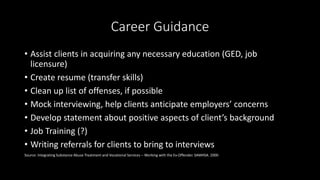
    Career Guidance • Assistclients in acquiring any necessary education (GED, job licensure) • Create resume (transfer skills) • Clean up list of offenses, if possible • Mock interviewing, help clients anticipate employers’ concerns • Develop statement about positive aspects of client’s background • Job Training (?) • Writing referrals for clients to bring to interviews Source: Integrating Substance Abuse Treatment and Vocational Services – Working with the Ex-Offender. SAMHSA. 2000
  • 10.
    References • CASA Columbia.(2010). New CASA* report finds: 65% of all U.S. inmates meet medical criteria for substance abuse addiction, only 11% receive any treatment. [Press Release]. Found in: The right choices. (2015, June 20). The Economist, 415 (8943). Pg.24. • Chapter 8: Working with the ex-offender. (2000). In Integrating Substance Abuse Treatment and Vocational Services. Rockville, MD: Substance Abuse and Mental Health Services Administration (US). Retrieved from http://ncbi.nlm.nih.gov/books/NBK64287/ • Jailhouse nation. (2015, June 20). The Economist, 415 (8943). Pg. 11. • James R.P., Ogloff et. al. (1994). Mental Health Services in Jails and Prisons: Legal, Clinical, and Policy Issues. Law and Psychology Review. Pgs 109, 112-115. • The right choices. (2015, June 20). The Economist, 415 (8943). Pgs. 23-26). • Thompson, A. (2004). Navigating the Hidden Obstacles to Ex-Offender Reentry. Boston College Law Review, 45 (2). Pgs. 255- 306. Retrieved from http://lawdigitalcommons.bc.edu/bclr/vol45/iss2/1