Pretrial supervisionprovides an
alternative for individuals who have
been arrested and charged with a
minor or first-time offense to remain in
the community under supervision.
3.
First pretrialrelease program began in 1961
with the Manhattan Bail Project
Interviewed people to determine community ties
Designed to assist with Release on Recognizance
(ROR)
Pretrial Services Act of 1982 (18 US.C. 3152)
called for the creation of a separate federal
agency designed to oversee the prerelease
and detention of the accused as well as
other pretrial services.
4.
Different ReleaseMechanisms:
Unsecured Bond
ROR
Surety Bond
Deposit/Collateral
Conditional Release
5.
Process wherebysomeone—either
adult or child—is referred to a program
(usually external to the official system)
for counseling or care of some form in
lieu of referral to the official court.
Avoid entrance of person into system
Avoid stigma of the system
What are some stigma of a criminal
arrest/record?
6.
Suspended Sentence:
A court order, entered after A verdict, finding, or
guilty plea, that suspends or postpones the
sentence contingent on the offender’s good
behavior
Revoked or terminated if the offender committed
A new crime
Suspension Of Imposition Of Sentence
Suspension Of Execution Of Sentence
8.
None
Releasewith Services
Phone Checks
Electronic monitoring and “Hot zones” or
exclusion zones
House arrest
Intensive pretrial release
Client Meetings
Drug Treatment Shelters
Drug Testing
9.
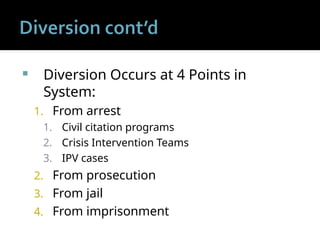
Diversion Occursat 4 Points in
System:
1. From arrest
1. Civil citation programs
2. Crisis Intervention Teams
3. IPV cases
2. From prosecution
3. From jail
4. From imprisonment
12.
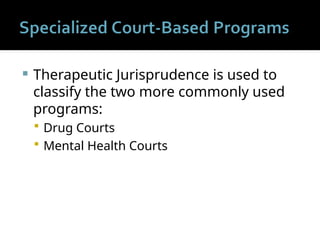
Therapeutic Jurisprudenceis used to
classify the two more commonly used
programs:
Drug Courts
Mental Health Courts
13.
1. Immediate Intervention
2.Non-adversarial adjudication
3. Hands-on judicial involvement
4. Treatment programs with clear rules
and structured goals
5. A team approach that brings together
the judge, prosecutors, defense
counsel, treatment provider, and
correctional staff
14.
Non-adversarial approachto integrating
substance abuse treatment with criminal
case processing
First drug court established in 1989 in
Miami
Established as a result of court and prison
overcrowding.
Required one or more years of drug court
treatment
Successful completion results in case being
dismissed.
15.
1. Drug courtsintegrate alcohol and other drug treatment
services with justice system case processing.
2. Using a non-adversarial approach, prosecution and defense
counsel promote public safety while protecting participants’
due process rights.
3. Eligible participants are identified early and promptly placed
in the drug court program.
4. Drug courts provide access to a continuum of alcohol, drug,
and other related treatment and rehabilitation services.
5. Abstinence is monitored by frequent alcohol and other drug
testing.
6. A coordinated strategy governs drug court responses to
participants’ compliance.
7. Ongoing judicial interaction with each drug court participant
is essential.
8. Monitoring and evaluation measure the achievement of
program goals and gauge effectiveness.
16.
Program lasts9-12 months
Offender placed on probation one year
following completion
Criminal record may be expunged if all
court treatment requirements satisfied
17.
Judges arefree to openly praise or chastise
clients/offenders during hearing
May issue court orders to attend treatment
submit to urinalysis, seek employment, meet
with a probation officer, avoid associations
with drug-abusing friends
Failure to comply may place offender in
contempt of court or in jail
May be transferred to regular criminal court
Judges provide continuous feedback
Drug Courts
Antabuse
Acupuncture
Level Systems
Lower recidivism, works best for drug users and not
OWI
May not cost less (Iowa: Save $16,000-$56,000)
Mental Health Courts
Axis I Disorders - Anxiety Disorders, Mood Disorders,
Eating Disorders, Psychotic Disorders, Dissociative
Disorders, Substance Use Disorders
Transition Planning
Fewer rearrests and higher rate of services
Veterans Courts
Not well evaluated yet
Dual Diagnosis
20.
Designed tokeep nonviolent mentally ill
offenders out of prison
Goal of courts is to ensure that these offenders
are not a nuisance in the community
Mentally ill offenders often commit petty
crimes and are homeless
Work with local agencies to address offender
needs and protect society
Reflective of an integrative casework model of
intervention
21.
Created toaddress the issues of release
for offenders
Provide comprehensive services to
offenders who return from prison to
the community
Offenders are held strictly accountable
Used as a tool to ensure public safety
and ensure offenders receive case
management services
22.
1. Assessment andPlanning
2. Active Oversight
3. Management of Supportive Services
4. Accountability to Community
5. Graduated and Parsimonious
Sanctions
6. Rewards for Success
23.
Specialized courtsprovide for options
other than incarceration
These courts recognize the need for
agency and community partnerships
Provide a range of essential reentry
support services for offenders
Volunteers and other collaborators can fill
the gaps by assisting with transportation
and other informal services
24.
Studies havebeen limited
Most focus on local assessments
Lowenkamp and Whetzel (2009) found:
Static and dynamic factors could predict
success
Static factors include:
▪ criminal history and current offense
Dynamic factors include:
▪ substance use; home ownership; educational
attainment; employment status
25.
Most studiesfocus on effectiveness with
juveniles
Steadman et al. (1999)
Studied diversionary programs for mentally ill
Found no significant difference between
those processed through diversion and those
not processed.
Those not processed through diversion
tended to not get released
26.
Demuth andSteffensmeier (2004) found:
White females most likely to be released on
pretrial
Hispanic males least likely to be released
National Pretrial Service Institute found:
49% serve mixture of rural and urban
communities
Average staff size is 22
50% of programs have less than 5 staff
27.
Program participationdoes reduce
recidivism
Increased treatment retention
Cost-effective alternative to incarceration
High failure rate
Programs may be effective for violent
offenders, even though they are typically
excluded
Those placed in programs are typically
lowest risk at reoffending.
#4 Purpose of pretrial supervision is to make sure people appear and keep community safe. As an administrator what % of Failure to Appear is acceptable?
Who would qualify for unsupervised release?
Pretrial supervision?
Diversion?
#6 Suspension of imposition of sentence: when a verdict or plea is reached, but no sentence is pronounced & there is no conviction
Suspension of execution of sentence: the defendant is placed on probation & the conviction remains on the record.
English common law courts had the power to suspend sentence for a limited period or for a specific purpose
In the U.S. federal courts, the common practice of suspending sentences ended with the Killits decision in 1916
The Federal Sentencing Reform Act in 1984 recognized probation as a bona fide sentence in the federal system
"Deferred judgment" means a sentencing option whereby both the adjudication of guilt and the imposition of a sentence are deferred by the court and whereby the court assesses a civil penalty as provided in section 907.14 upon the entry of the deferred judgment. The court retains the power to pronounce judgment and impose sentence subject to the defendant's compliance with conditions set by the court as a requirement of the deferred judgment.
2. "Deferred sentence" means a sentencing option whereby the court enters an adjudication of guilt but does not impose a sentence. The court retains the power to sentence the defendant to any sentence it originally could have imposed subject to the defendant's compliance with conditions set by the court as a requirement of the deferred sentence.
3. "Suspended sentence" means a sentencing option whereby the court pronounces judgment and imposes a sentence and then suspends execution of the sentence subject to the defendant's compliance with conditions set by the court as a requirement of the suspended sentence. Revocation of the suspended sentence results in the execution of sentence already pronounced.
Used at full discretion of judges
Simply suspended sentences of incarceration as an act of mercy or leniency
Judges made decisions on intuition
Jailers received income from number of inmates housed
Jailers opposed the use of reprieves
#7 Who is best suited for pretrial release?
How would you determine elegibility?
Some jurisdictions include employment as a risk item. If poverty is a risk item how can bail or pretrial release be made affordable to them?
#10 Pretrial diversion – why is this important? – Stigma
Ray Rice and Pretrial
#11 What is the purpose of sentencing for 1st time offenders? Rehabilitation, Deterrence, retribution, incapacitation? How do you accomplish it?
#19 Team based problem solving approach
Drug Court Judges:
Divert to treatment programs
Preside over drug court proceedings
Monitor the progress of defendants through frequent status hearings
Prescribe sanctions and rewards as appropriate
A single drug court judge and staff who provide focus and leadership
Expedited adjudication through early identification and referral of appropriate program participants
Initiation of treatment as soon as possible after arrest
Intensive treatment and aftercare for drug-abusing defendants
Increased defendant accountability under a graduated series of rewards and punishments appropriate to conforming or violative behavior
Close supervision of drug defendants in regular, if not daily, status hearings that:
Monitor treatment progress
Ensure offender compliance
Require mandatory and frequent drug (and alcohol) testing
Use supervised and individual case monitoring
Anxiety Disorders(e.g.,panic disorder, social anxiety disorder,posttraumatic stress disorder)
Mood Disorders (e.g., major depression, bipolar disorder)
Eating Disorders (e.g., anorexia nervosa, bulimia nervosa)
Psychotic Disorders
Dissociative Disorders
Substance Use Disorders