Prison Drug
Programs
Repeat Offenders


   The therapeutic community model of
    prison substance abuse treatment and
    aftercare has been implemented in state
    and federal prisons across the
    country, significantly reducing recidivism
    rates.
More Inmates,
More Drug Offenders

   incarcerated population increase by an average
    of 7.8 percent per year

   62.2 percent of state prison inmates

   42.1 percent of Federal inmates report being
    regular drug users
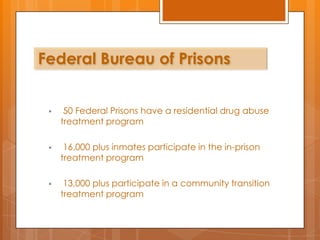
Federal Bureau of Prisons


     50 Federal Prisons have a residential drug abuse
     treatment program

     16,000 plus inmates participate in the in-prison
     treatment program

     13,000 plus participate in a community transition
     treatment program
   reduce relapse
   reduce criminality
   reduce recidivism
   reduce inmate
    misconduct
   reduce mental illness   Treatment Studies
   reduce behavioral       for In Prison
    disorders
   increase the level of   Programs Have
    the inmate's stake in
    societal norms          Shown
   increase levels of
    education and
    employment upon
    return to the
    community
   Improved physical
    and mental health
   improve relationships
Federal Prison Bureaus
         Drug Abuse Strategy

   Drug Abuse Education
    Nonresidential Drug Abuse Treatment
   RDAP
   Community Transition Drug Abuse
    Treatment (TDAT)
Residential Substance Abuse Treatment
Programs (RDAP’s) Base On


   cognitive-behavioral model which
    attempted to identify, confront, and alter
    the attitudes, values, and thinking
    patterns that led to criminal behaviors
    and drug or alcohol use
Success for Those that Completed Treatment


    Untreated subjects had a probability of
    .167 of being arrested in the first 6 months
   Treated subjects had a probability of .031
    of being arrested in the first 6 months
   Treated inmates were 73 percent less
    likely to be re-arrested than untreated
    inmates.
Repeat Usage

   Untreated subjects had a probability of
    .367 of using drugs or alcohol in the first 6
    months
    Treated subjects had a probability of .205
    of using drugs or alcohol in the first 6
    months
    Those who completed drug treatment
    were 44 percent less likely
Less Likely to be Rearrested


   Older Individuals
   Those without Prior Commitments
   Frequent Urinalysis Testing
   Working Many Hours
   Living With a Spouse
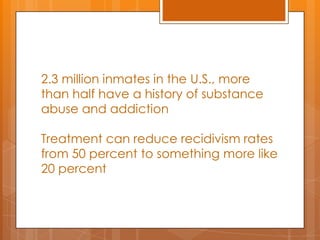
2.3 million inmates in the U.S., more
than half have a history of substance
abuse and addiction

Treatment can reduce recidivism rates
from 50 percent to something more like
20 percent
Bob May, associate director of the Association of State
Correctional Administrators says

“people who work in the system acknowledge the value of
the programs. There was a time, years ago, when that wasn’t
the case. People weren’t convinced that the programs were
effective, or even cost-effective. When I was working as chief
of detectives in a sheriff’s department, I didn’t believe in
these programs, either. My job was to put people away. You
know, you think it’s just some bleeding-heart liberal trying to
make excuses for a crime. But I didn’t know that 75 to 80
percent of people I was arresting for other crimes had an
abuse problem.”

“we know from the research that with people who go
through drug treatment, even if they still use drugs afterwards,
their crimes are less violent and less frequent. Even if it’s not a
100 percent change, it’s a good thing.”
Texas State Sen. John Whitmire who had been robbed
at gunpoint by a cocaine addict, says

“I’ve begged for my life once from someone addicted
to cocaine,” he says. “I would much rather spend
money on his addiction than face that gun again. This
isn’t about being soft on crime. It’s about being
tough, but also smart.”


His initiative saw positive results initially: the prison
population, predicted to climb by more than 5,000 by
the end of 2008, grew by only a 10th of that.
No matter how we feel about drug addicts
and criminals, we are going to pay. So do we
pay to lock them up, or go the arguably
cheaper way and rehabilitate them?
References
   Carmichael, M. (2010). The Case for Treating Drug
    Addicts in Prison. Retrieved from
    http://www.thedailybeast.com/newsweek/2010/06/29/t
    he-case-for-treating-drug-addicts-in-prison.html

   Federal Prison Residential Drug Treatment Reduces
    Substance Use and Arrests After Release. (). Retrieved
    from
    http://www.bop.gov/news/research_projects/published
    _reports/recidivism/orepramjalcd.pdf

   Inmate Drug Abuse Treatment Slows Prison’s Revolving
    Door. (2004). Retrieved from
    http://www.apa.org/research/action/aftercare.aspx

   Substance Abuse Treatment. (2011). Retrieved from
    http://www.bop.gov/inmate_programs/substance.jsp

Prison drug programs

  • 1.
  • 2.
    Repeat Offenders  The therapeutic community model of prison substance abuse treatment and aftercare has been implemented in state and federal prisons across the country, significantly reducing recidivism rates.
  • 3.
    More Inmates, More DrugOffenders  incarcerated population increase by an average of 7.8 percent per year  62.2 percent of state prison inmates  42.1 percent of Federal inmates report being regular drug users
  • 4.
    Federal Bureau ofPrisons  50 Federal Prisons have a residential drug abuse treatment program  16,000 plus inmates participate in the in-prison treatment program  13,000 plus participate in a community transition treatment program
  • 5.
    reduce relapse  reduce criminality  reduce recidivism  reduce inmate misconduct  reduce mental illness Treatment Studies  reduce behavioral for In Prison disorders  increase the level of Programs Have the inmate's stake in societal norms Shown  increase levels of education and employment upon return to the community  Improved physical and mental health  improve relationships
  • 6.
    Federal Prison Bureaus Drug Abuse Strategy  Drug Abuse Education  Nonresidential Drug Abuse Treatment  RDAP  Community Transition Drug Abuse Treatment (TDAT)
  • 7.
    Residential Substance AbuseTreatment Programs (RDAP’s) Base On  cognitive-behavioral model which attempted to identify, confront, and alter the attitudes, values, and thinking patterns that led to criminal behaviors and drug or alcohol use
  • 8.
    Success for Thosethat Completed Treatment  Untreated subjects had a probability of .167 of being arrested in the first 6 months  Treated subjects had a probability of .031 of being arrested in the first 6 months  Treated inmates were 73 percent less likely to be re-arrested than untreated inmates.
  • 9.
    Repeat Usage  Untreated subjects had a probability of .367 of using drugs or alcohol in the first 6 months  Treated subjects had a probability of .205 of using drugs or alcohol in the first 6 months  Those who completed drug treatment were 44 percent less likely
  • 10.
    Less Likely tobe Rearrested  Older Individuals  Those without Prior Commitments  Frequent Urinalysis Testing  Working Many Hours  Living With a Spouse
  • 11.
    2.3 million inmatesin the U.S., more than half have a history of substance abuse and addiction Treatment can reduce recidivism rates from 50 percent to something more like 20 percent
  • 12.
    Bob May, associatedirector of the Association of State Correctional Administrators says “people who work in the system acknowledge the value of the programs. There was a time, years ago, when that wasn’t the case. People weren’t convinced that the programs were effective, or even cost-effective. When I was working as chief of detectives in a sheriff’s department, I didn’t believe in these programs, either. My job was to put people away. You know, you think it’s just some bleeding-heart liberal trying to make excuses for a crime. But I didn’t know that 75 to 80 percent of people I was arresting for other crimes had an abuse problem.” “we know from the research that with people who go through drug treatment, even if they still use drugs afterwards, their crimes are less violent and less frequent. Even if it’s not a 100 percent change, it’s a good thing.”
  • 13.
    Texas State Sen.John Whitmire who had been robbed at gunpoint by a cocaine addict, says “I’ve begged for my life once from someone addicted to cocaine,” he says. “I would much rather spend money on his addiction than face that gun again. This isn’t about being soft on crime. It’s about being tough, but also smart.” His initiative saw positive results initially: the prison population, predicted to climb by more than 5,000 by the end of 2008, grew by only a 10th of that.
  • 14.
    No matter howwe feel about drug addicts and criminals, we are going to pay. So do we pay to lock them up, or go the arguably cheaper way and rehabilitate them?
  • 15.
    References  Carmichael, M. (2010). The Case for Treating Drug Addicts in Prison. Retrieved from http://www.thedailybeast.com/newsweek/2010/06/29/t he-case-for-treating-drug-addicts-in-prison.html  Federal Prison Residential Drug Treatment Reduces Substance Use and Arrests After Release. (). Retrieved from http://www.bop.gov/news/research_projects/published _reports/recidivism/orepramjalcd.pdf  Inmate Drug Abuse Treatment Slows Prison’s Revolving Door. (2004). Retrieved from http://www.apa.org/research/action/aftercare.aspx  Substance Abuse Treatment. (2011). Retrieved from http://www.bop.gov/inmate_programs/substance.jsp