Friday 7.00 to 9.00
COSTING & FINANCE
COST
In business, cost is usually a monetary valuation of
(1) effort,
(2) material,
(3) resources,
(4) time and utilities consumed,
(5) risks incurred, and
(6) opportunity forgone in production and delivery of a
good or service.
The cost that can be directly identified with the specific cost center or cost
object like a product, function, activity, project and so on is known as Direct
Cost.
Based on elements, the direct costs are classified into the following parts:
: The cost of material that can be allocable to production.
Example: Raw material consumed during production of the unit.
: Wages to the laborers that can be identified with a cost object.
Example: The term wages include bonus, gratuity, provident fund, perquisites,
incentives, etc.
: It includes all the other expenses that are directly linked to
the production of a product.
Example: Job processing charges, hire charges for tools and equipment,
subcontracting expenses.
When all these three costs are taken together, they are known as Prime Cost
Definition of Indirect Cost
Indirect cost is those costs that cannot be directly assigned to/related
to/identified with a particular cost center or cost object, but they benefit
multiple cost objects. It is not possible to calculate them for a single cost object.
However, it needs to be apportioned over various products as well as among
the different departments of the organization. It includes production, office &
administration, selling & distribution costs. The indirect cost is divided into the
following categories:
Material Cost which cannot be identified with a
particular product or project.
Example: Lubricants
: Salary to the employees that cannot be allocable to a
particular cost object.
Example: Salary to the management team and employees of the accounts
department.
: All the expenses other than indirect material and
labor are included in this category.
Example: Interest, Rent, Tax, Duty, etc.
Fixed costs
are those costs which do not change as production or sales change within
a relevant range.
Variable costs
are directly proportional to sales or production volumes.
Mixed costs
have components of both but can be divided into their fixed and variable
components.
What is overhead?
Overhead is those costs required to run a business, but which cannot be directly
attributed to any specific business activity, product, or service
Examples of overhead are:
Accounting and legal expenses
Administrative salaries
Depreciation
Insurance
Licenses and government fees
Property taxes
Rent
Utilities
Overhead is also known as burden or indirect costs. A subset of overhead is
manufacturing overhead, which is all overhead costs incurred in the manufacturing
process.
What Is the Breakeven Point?
A company's breakeven point is the point at which its sales exactly cover its
expenses.
To compute a company's breakeven point in sales volume, you need to know
the values of three variables:
Fixed costs: Costs that are independent of sales volume, such as rent
Variable costs: Costs that are dependent on sales volume, such as the
Such as raw materials
Selling price of the product
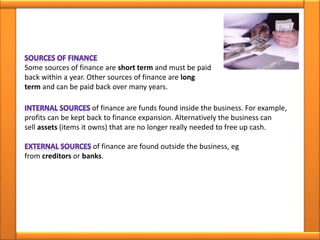
Some sources of finance are short term and must be paid
back within a year. Other sources of finance are long
term and can be paid back over many years.
of finance are funds found inside the business. For example,
profits can be kept back to finance expansion. Alternatively the business can
sell assets (items it owns) that are no longer really needed to free up cash.
of finance are found outside the business, eg
from creditors or banks.
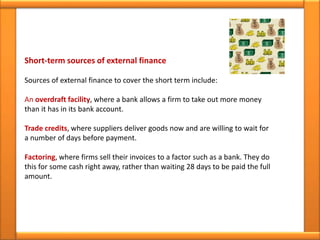
Short-term sources of external finance
Sources of external finance to cover the short term include:
An overdraft facility, where a bank allows a firm to take out more money
than it has in its bank account.
Trade credits, where suppliers deliver goods now and are willing to wait for
a number of days before payment.
Factoring, where firms sell their invoices to a factor such as a bank. They do
this for some cash right away, rather than waiting 28 days to be paid the full
amount.
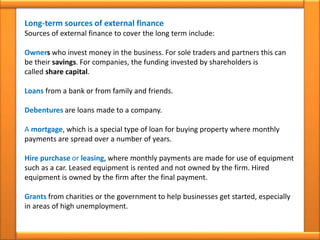
Long-term sources of external finance
Sources of external finance to cover the long term include:
Owners who invest money in the business. For sole traders and partners this can
be their savings. For companies, the funding invested by shareholders is
called share capital.
Loans from a bank or from family and friends.
Debentures are loans made to a company.
A mortgage, which is a special type of loan for buying property where monthly
payments are spread over a number of years.
Hire purchase or leasing, where monthly payments are made for use of equipment
such as a car. Leased equipment is rented and not owned by the firm. Hired
equipment is owned by the firm after the final payment.
Grants from charities or the government to help businesses get started, especially
in areas of high unemployment.
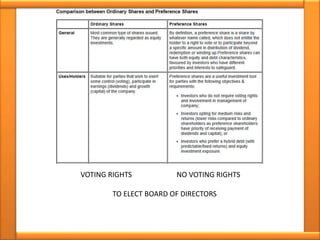
VOTING RIGHTS NO VOTING RIGHTS
TO ELECT BOARD OF DIRECTORS

Costing and Finance Basics

  • 1.
    Friday 7.00 to9.00 COSTING & FINANCE
  • 2.
    COST In business, costis usually a monetary valuation of (1) effort, (2) material, (3) resources, (4) time and utilities consumed, (5) risks incurred, and (6) opportunity forgone in production and delivery of a good or service.
  • 3.
    The cost thatcan be directly identified with the specific cost center or cost object like a product, function, activity, project and so on is known as Direct Cost. Based on elements, the direct costs are classified into the following parts: : The cost of material that can be allocable to production. Example: Raw material consumed during production of the unit. : Wages to the laborers that can be identified with a cost object. Example: The term wages include bonus, gratuity, provident fund, perquisites, incentives, etc. : It includes all the other expenses that are directly linked to the production of a product. Example: Job processing charges, hire charges for tools and equipment, subcontracting expenses. When all these three costs are taken together, they are known as Prime Cost
  • 4.
    Definition of IndirectCost Indirect cost is those costs that cannot be directly assigned to/related to/identified with a particular cost center or cost object, but they benefit multiple cost objects. It is not possible to calculate them for a single cost object. However, it needs to be apportioned over various products as well as among the different departments of the organization. It includes production, office & administration, selling & distribution costs. The indirect cost is divided into the following categories: Material Cost which cannot be identified with a particular product or project. Example: Lubricants : Salary to the employees that cannot be allocable to a particular cost object. Example: Salary to the management team and employees of the accounts department. : All the expenses other than indirect material and labor are included in this category. Example: Interest, Rent, Tax, Duty, etc.
  • 5.
    Fixed costs are thosecosts which do not change as production or sales change within a relevant range. Variable costs are directly proportional to sales or production volumes. Mixed costs have components of both but can be divided into their fixed and variable components.
  • 6.
    What is overhead? Overheadis those costs required to run a business, but which cannot be directly attributed to any specific business activity, product, or service Examples of overhead are: Accounting and legal expenses Administrative salaries Depreciation Insurance Licenses and government fees Property taxes Rent Utilities Overhead is also known as burden or indirect costs. A subset of overhead is manufacturing overhead, which is all overhead costs incurred in the manufacturing process.
  • 7.
    What Is theBreakeven Point? A company's breakeven point is the point at which its sales exactly cover its expenses. To compute a company's breakeven point in sales volume, you need to know the values of three variables: Fixed costs: Costs that are independent of sales volume, such as rent Variable costs: Costs that are dependent on sales volume, such as the Such as raw materials Selling price of the product
  • 9.
    Some sources offinance are short term and must be paid back within a year. Other sources of finance are long term and can be paid back over many years. of finance are funds found inside the business. For example, profits can be kept back to finance expansion. Alternatively the business can sell assets (items it owns) that are no longer really needed to free up cash. of finance are found outside the business, eg from creditors or banks.
  • 10.
    Short-term sources ofexternal finance Sources of external finance to cover the short term include: An overdraft facility, where a bank allows a firm to take out more money than it has in its bank account. Trade credits, where suppliers deliver goods now and are willing to wait for a number of days before payment. Factoring, where firms sell their invoices to a factor such as a bank. They do this for some cash right away, rather than waiting 28 days to be paid the full amount.
  • 11.
    Long-term sources ofexternal finance Sources of external finance to cover the long term include: Owners who invest money in the business. For sole traders and partners this can be their savings. For companies, the funding invested by shareholders is called share capital. Loans from a bank or from family and friends. Debentures are loans made to a company. A mortgage, which is a special type of loan for buying property where monthly payments are spread over a number of years. Hire purchase or leasing, where monthly payments are made for use of equipment such as a car. Leased equipment is rented and not owned by the firm. Hired equipment is owned by the firm after the final payment. Grants from charities or the government to help businesses get started, especially in areas of high unemployment.
  • 12.
    VOTING RIGHTS NOVOTING RIGHTS TO ELECT BOARD OF DIRECTORS