FINANCE
L1. Sources of finance
All businesses need finance. There are a number of funding sources used by
organisations
Why business needs finance
• Finance refers to sources of money for a business. Firms need
finance to:
• start up a business, eg pay for premises, new equipment and advertising
• run the business, eg having enough cash to pay staff wages and suppliers on
time
• expand the business, eg having funds to pay for a new branch in a different
city or country
• New businesses find it difficult to raise finance because they
usually have just a few customers and many competitors. Lenders
are put off by the risk that the start-up may fail. If that happens,
the owners may be unable to repay borrowed money.
Ways to finance a business
• Some sources of finance are short term and must be paid back
within a year. Other sources of finance are long term and can be
paid back over many years.
• Internal sources of finance are funds found inside the business.
For example, profits can be kept back to finance expansion.
Alternatively the business can sell assets (items it owns) that are
no longer really needed to free up cash.
• External sources of finance are found outside the business, eg
from creditors (people you owe money to) or banks.
• Short-term sources of external finance
• Sources of external finance to cover the short term include:
• An overdraft facility - where a bank allows a firm to take out more money
than it has in its bank account.
• Trade credits - where suppliers deliver goods now and are willing to wait
for a number of days before payment.
• Factoring - where firms sell their invoices to a factor such as a bank. They
do this for some cash right away, rather than waiting 28 days to be paid the
full amount.
• Long-term sources of external finance
• Sources of external finance to cover the long term include:
• Owners who invest money in the business. For sole traders and partners this can be
their savings. For companies, the funding invested by shareholders is called share
capital.
• Loans from a bank or from family and friends.
• Debentures are loans made to a company.
• A mortgage, which is a special type of loan for buying property where monthly
payments are spread over a number of years.
• Hire purchase or leasing, where monthly payments are made for use of equipment
such as a car. Leased equipment is rented and not owned by the firm. Hired equipment
is owned by the firm after the final payment.
• Grants from charities or the government to help businesses get started, especially in
areas of high unemployment.
Creditors and debtors
• A creditor is an individual or
business that has lent funds to a
business and is owed money. A
debtor is an individual or
business who has borrowed funds
from a business and so owes it
money.
• There is a cost in borrowing
funds. Money borrowed from
creditors is paid back over time,
usually with an additional
payment of interest. Interest is
the cost of borrowing and the
reward for lending.
• Creditors often ask for security before lending funds. This means
sole traders and partners may have to offer their own house as a
guarantee that monies will be repaid. A company can offer assets,
eg offices as collateral.
• The type of finance chosen depends on the type of business. Start
ups and small firms are considered very high risk and find it
difficult to raise external finance. The only source of funds might
be the owner's own savings, retained profits and borrowing from
friends. Companies can issue extra shares to raise large amounts
of capital in a rights issue.
L2. Revenue, cost and profit
All businesses should keep proper accounts. This involves the calculation of
revenue, costs and profit.
Revenue
• Revenue is the income earned by a business over a period of time,
eg one month. The amount of revenue earned depends on two
things - the number of items sold and their selling price. In short,
revenue = price x quantity.
• For example, the total revenue raised by selling 2,000 items
priced £30 each is 2,000 x £30 = £60,000.
• Revenue is sometimes called sales, sales revenue, total revenue
or turnover.
Costs
• Costs are the expenses involved in making a product. Firms incur costs by
trading.
• Some costs, called variable costs, change with the amount produced. For
example, the cost of raw materials rises as more output is made.
• Other costs, called fixed costs, stay the same even if more is produced. Office
rent is an example of a fixed cost which remains the same each month even if
output rises.
• Another way of classifying costs is to distinguish between direct costs and
indirect costs. Direct costs, such as raw materials, can be linked to a product
whereas indirect costs, such as rent, cannot be linked directly to a product.
• The total cost is the amount of money spent by a firm on producing a given
level of output. Total costs are made up of fixed costs (FC) and variable costs
(VC).
Profit and loss
• Put simply, profit is the surplus left from revenue after paying all
costs. Profit is found by deducting total costs from revenue. In
short: profit = total revenue - total costs.
• For example, if a firm has a total revenue of £100,000 and a total
cost of £80,000, then they are left with £20,000 profit.
• Profit is the reward for risk-taking. A business can use profit to
either:
• reward owners
• invest in growth
• save for the future, in case there is a downturn in revenue
• Losses
• Trading does not guarantee profit. A loss is made when the revenue from
sales is not enough to cover all the costs of production. For example, if a
company has a total revenue of £60,000 and a total cost of £90,000, then
they have lost £30,000 from trading.
• Losses can be reduced or turned into profit by:
• cutting costs - eg by letting staff go and asking those who remain to accept
lower wages
• increasing revenue - eg by cutting prices and selling more items - if
demand is elastic
L3. Cash flow
Companies need to budget and be aware of cash flow in order to stay solvent.
Solvency
• Cash flow is the movement of
money in and out of the
business.
• cash flows into the business as
receipts - eg from cash received
from selling products or from
loans
• cash flows out of the business as
payments - eg to pay wages,
supplies and interest on loans
• net cash flow is the difference
between money in and money
out
• Profit and cash flow are two very different things. Cash flow is
simply about money coming and going from the business. The
challenge for managers is to make sure there is always enough
cash to pay expenses when they are due, as running out of cash
threatens the survival of the business.
Insolvency
• If a business runs out of cash and cannot pay its suppliers or
workers it is insolvent. The owners must raise extra finance or
cease trading. This is why planning ahead and drawing up a cash
flow forecast is so important, as it identifies when the firm might
need an overdraft (an agreement with the bank to overspend on
an account).
Calculating the cash flow
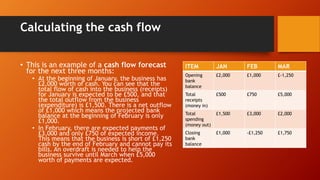
• This is an example of a cash flow forecast
for the next three months:
• At the beginning of January, the business has
£2,000 worth of cash. You can see that the
total flow of cash into the business (receipts)
for January is expected to be £500, and that
the total outflow from the business
(expenditure) is £1,500. There is a net outflow
of £1,000 which means the projected bank
balance at the beginning of February is only
£1,000.
• In February, there are expected payments of
£3,000 and only £750 of expected income.
This means that the business is short of £1,250
cash by the end of February and cannot pay its
bills. An overdraft is needed to help the
business survive until March when £5,000
worth of payments are expected.
ITEM JAN FEB MAR
Opening
bank
balance
£2,000 £1,000 £-1,250
Total
receipts
(money in)
£500 £750 £5,000
Total
spending
(money out)
£1,500 £3,000 £2,000
Closing
bank
balance
£1,000 -£1,250 £1,750
• A business can improve its cash flow by:
• reducing cash outflows - eg by delaying the payment of bills, securing
better trade credit terms or factoring
• increasing cash inflows - eg by chasing debtors, selling assets or securing
an overdraft
L4.Breaking even
Calculating profitability involves first working out the minimum level of sales
required to cover all costs.
Break-even point
• At low levels of sales, a business is not selling enough units for
revenue to cover costs. A loss is made. As more items are sold, the
total revenue increases and covers more of the costs. The break-
even point is reached when the total revenue exactly matches the
total costs and the business is not making a profit or a loss. If the
firm can sell at production levels above this point, it will be
making a profit.
• Establishing the break-even point helps a firm to plan the levels of
production it needs to be profitable.
Break-even chart
• The break-even point can be
calculated by drawing a graph
showing how fixed costs, variable
costs, total costs and total revenue
change with the level of output.
• Here is how to work out the break-
even point - using the example of a
firm manufacturing compact discs.
• Assume the firm has the following
costs:
• Fixed costs: £10,000. Variable
costs: £2.00 per unit
• First construct a chart with output
(units) on the horizontal (x) axis, and
costs and revenue on the vertical (y)
axis. On to this, plot a horizontal fixed
costs line (it is horizontal because fixed
costs don't change with output).
• Then plot a variable cost line from this
point, which will, in effect, be the total
costs line. This is because the fixed
cost added to the variable cost gives
the total cost.
• To calculate the variable cost, multiply
variable cost per unit x number of
units. In this example, you can assume
that the variable cost per unit is £2 and
there are 2,000 units = £4,000.
• Now plot the total revenue line. To do this, multiply:
• sales price x number of units (output)
• If the sales price is £6 and 2,000 items were to be manufactured,
the calculation is:
• £6 x 2,000 = £12,000 total revenue
• Where the total revenue line crosses the total costs line is the
break-even point (ie costs and revenue are the same). Everything
below this point is produced at a loss, and everything above it is
produced at a profit.
Limitations
• Break-even analysis is a useful tool for working out the minimum
sales needed to avoid losses. However, it has its limitations. It
makes assumptions about various factors - for example that all
units are sold, that forecasts are reliable and the external
environment is stable. If new rivals enter the market or an
economic recession starts then it could take longer to reach the
break-even point than anticipated.
• Many organisations add on a margin of safety to the break-even
level of output when deciding on their minimum sales target.
L5.Financial records
A business keeps various types of financial records to monitor its performance and
ensure that taxes are paid. These include cash flow statements, profit and loss
accounts and a balance sheet.
Trading, profit and loss account
• A trading,
profit and
loss account
shows the
business's
financial
performance
over a given
time period,
eg one year.
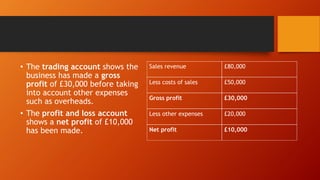
• The trading account shows the
business has made a gross
profit of £30,000 before taking
into account other expenses
such as overheads.
• The profit and loss account
shows a net profit of £10,000
has been made.
Sales revenue £80,000
Less costs of sales £50,000
Gross profit £30,000
Less other expenses £20,000
Net profit £10,000
Balance sheet
• A balance sheet shows the
value of a business on a
particular date. A balance
sheet shows what the business
owns and owes (its assets and
its liabilities).
Fixed assets £150,000
Current assets £25,000
Current liabilities £100,000
Net assets
employed
£75,000
Capital and reserves £75,000
• Fixed assets show the current value of major
purchases that help in the running of the
business, like delivery vans or PCs. In this case
£150,000 of fixed assets are owned. Current
assets show the cash or near-cash available to
the firm. This includes stock ready to sell,
money owed to them by debtors and cash in
the bank. There are £25,000 worth of current
assets.
• Deducting all the current liabilities from the
total amount of fixed and current assets gives
the value of the business on the day the
balance sheet was drawn up. This business is
worth £75,000, financed by £75,000 of share
capital and reserves. Capital and reserves are
in effect liabilities, because the firm owes
this money to the owners. What a firm owns,
it owes.
Working capital
• A business is solvent if it can meet its short-term debts when they
are due for payment. To do this it needs adequate working capital.
There are three main reasons why a business needs adequate
working capital. It must:
• pay staff wages and salaries
• settle debts and therefore avoid legal action by creditors
• benefit from cash discounts offered in return for prompt payment
• You can calculate a firm's working capital by using the following
equation:
• working capital = current assets - current liabilities
• Many groups of people are interested in the published accounts of
a company. The information they provide may influence future
decisions. For example, lenders will be looking at the solvency of
a business. Rivals are interested in monitoring the profits earned
by competitors.

Finance

  • 1.
  • 2.
    L1. Sources offinance All businesses need finance. There are a number of funding sources used by organisations
  • 3.
    Why business needsfinance • Finance refers to sources of money for a business. Firms need finance to: • start up a business, eg pay for premises, new equipment and advertising • run the business, eg having enough cash to pay staff wages and suppliers on time • expand the business, eg having funds to pay for a new branch in a different city or country • New businesses find it difficult to raise finance because they usually have just a few customers and many competitors. Lenders are put off by the risk that the start-up may fail. If that happens, the owners may be unable to repay borrowed money.
  • 5.
    Ways to financea business • Some sources of finance are short term and must be paid back within a year. Other sources of finance are long term and can be paid back over many years. • Internal sources of finance are funds found inside the business. For example, profits can be kept back to finance expansion. Alternatively the business can sell assets (items it owns) that are no longer really needed to free up cash. • External sources of finance are found outside the business, eg from creditors (people you owe money to) or banks.
  • 6.
    • Short-term sourcesof external finance • Sources of external finance to cover the short term include: • An overdraft facility - where a bank allows a firm to take out more money than it has in its bank account. • Trade credits - where suppliers deliver goods now and are willing to wait for a number of days before payment. • Factoring - where firms sell their invoices to a factor such as a bank. They do this for some cash right away, rather than waiting 28 days to be paid the full amount.
  • 8.
    • Long-term sourcesof external finance • Sources of external finance to cover the long term include: • Owners who invest money in the business. For sole traders and partners this can be their savings. For companies, the funding invested by shareholders is called share capital. • Loans from a bank or from family and friends. • Debentures are loans made to a company. • A mortgage, which is a special type of loan for buying property where monthly payments are spread over a number of years. • Hire purchase or leasing, where monthly payments are made for use of equipment such as a car. Leased equipment is rented and not owned by the firm. Hired equipment is owned by the firm after the final payment. • Grants from charities or the government to help businesses get started, especially in areas of high unemployment.
  • 9.
    Creditors and debtors •A creditor is an individual or business that has lent funds to a business and is owed money. A debtor is an individual or business who has borrowed funds from a business and so owes it money. • There is a cost in borrowing funds. Money borrowed from creditors is paid back over time, usually with an additional payment of interest. Interest is the cost of borrowing and the reward for lending.
  • 10.
    • Creditors oftenask for security before lending funds. This means sole traders and partners may have to offer their own house as a guarantee that monies will be repaid. A company can offer assets, eg offices as collateral. • The type of finance chosen depends on the type of business. Start ups and small firms are considered very high risk and find it difficult to raise external finance. The only source of funds might be the owner's own savings, retained profits and borrowing from friends. Companies can issue extra shares to raise large amounts of capital in a rights issue.
  • 11.
    L2. Revenue, costand profit All businesses should keep proper accounts. This involves the calculation of revenue, costs and profit.
  • 12.
    Revenue • Revenue isthe income earned by a business over a period of time, eg one month. The amount of revenue earned depends on two things - the number of items sold and their selling price. In short, revenue = price x quantity. • For example, the total revenue raised by selling 2,000 items priced £30 each is 2,000 x £30 = £60,000. • Revenue is sometimes called sales, sales revenue, total revenue or turnover.
  • 13.
    Costs • Costs arethe expenses involved in making a product. Firms incur costs by trading. • Some costs, called variable costs, change with the amount produced. For example, the cost of raw materials rises as more output is made. • Other costs, called fixed costs, stay the same even if more is produced. Office rent is an example of a fixed cost which remains the same each month even if output rises. • Another way of classifying costs is to distinguish between direct costs and indirect costs. Direct costs, such as raw materials, can be linked to a product whereas indirect costs, such as rent, cannot be linked directly to a product. • The total cost is the amount of money spent by a firm on producing a given level of output. Total costs are made up of fixed costs (FC) and variable costs (VC).
  • 15.
    Profit and loss •Put simply, profit is the surplus left from revenue after paying all costs. Profit is found by deducting total costs from revenue. In short: profit = total revenue - total costs. • For example, if a firm has a total revenue of £100,000 and a total cost of £80,000, then they are left with £20,000 profit. • Profit is the reward for risk-taking. A business can use profit to either: • reward owners • invest in growth • save for the future, in case there is a downturn in revenue
  • 17.
    • Losses • Tradingdoes not guarantee profit. A loss is made when the revenue from sales is not enough to cover all the costs of production. For example, if a company has a total revenue of £60,000 and a total cost of £90,000, then they have lost £30,000 from trading. • Losses can be reduced or turned into profit by: • cutting costs - eg by letting staff go and asking those who remain to accept lower wages • increasing revenue - eg by cutting prices and selling more items - if demand is elastic
  • 18.
    L3. Cash flow Companiesneed to budget and be aware of cash flow in order to stay solvent.
  • 19.
    Solvency • Cash flowis the movement of money in and out of the business. • cash flows into the business as receipts - eg from cash received from selling products or from loans • cash flows out of the business as payments - eg to pay wages, supplies and interest on loans • net cash flow is the difference between money in and money out
  • 20.
    • Profit andcash flow are two very different things. Cash flow is simply about money coming and going from the business. The challenge for managers is to make sure there is always enough cash to pay expenses when they are due, as running out of cash threatens the survival of the business.
  • 21.
    Insolvency • If abusiness runs out of cash and cannot pay its suppliers or workers it is insolvent. The owners must raise extra finance or cease trading. This is why planning ahead and drawing up a cash flow forecast is so important, as it identifies when the firm might need an overdraft (an agreement with the bank to overspend on an account).
  • 22.
    Calculating the cashflow • This is an example of a cash flow forecast for the next three months: • At the beginning of January, the business has £2,000 worth of cash. You can see that the total flow of cash into the business (receipts) for January is expected to be £500, and that the total outflow from the business (expenditure) is £1,500. There is a net outflow of £1,000 which means the projected bank balance at the beginning of February is only £1,000. • In February, there are expected payments of £3,000 and only £750 of expected income. This means that the business is short of £1,250 cash by the end of February and cannot pay its bills. An overdraft is needed to help the business survive until March when £5,000 worth of payments are expected. ITEM JAN FEB MAR Opening bank balance £2,000 £1,000 £-1,250 Total receipts (money in) £500 £750 £5,000 Total spending (money out) £1,500 £3,000 £2,000 Closing bank balance £1,000 -£1,250 £1,750
  • 23.
    • A businesscan improve its cash flow by: • reducing cash outflows - eg by delaying the payment of bills, securing better trade credit terms or factoring • increasing cash inflows - eg by chasing debtors, selling assets or securing an overdraft
  • 24.
    L4.Breaking even Calculating profitabilityinvolves first working out the minimum level of sales required to cover all costs.
  • 26.
    Break-even point • Atlow levels of sales, a business is not selling enough units for revenue to cover costs. A loss is made. As more items are sold, the total revenue increases and covers more of the costs. The break- even point is reached when the total revenue exactly matches the total costs and the business is not making a profit or a loss. If the firm can sell at production levels above this point, it will be making a profit. • Establishing the break-even point helps a firm to plan the levels of production it needs to be profitable.
  • 27.
    Break-even chart • Thebreak-even point can be calculated by drawing a graph showing how fixed costs, variable costs, total costs and total revenue change with the level of output. • Here is how to work out the break- even point - using the example of a firm manufacturing compact discs. • Assume the firm has the following costs: • Fixed costs: £10,000. Variable costs: £2.00 per unit
  • 28.
    • First constructa chart with output (units) on the horizontal (x) axis, and costs and revenue on the vertical (y) axis. On to this, plot a horizontal fixed costs line (it is horizontal because fixed costs don't change with output). • Then plot a variable cost line from this point, which will, in effect, be the total costs line. This is because the fixed cost added to the variable cost gives the total cost. • To calculate the variable cost, multiply variable cost per unit x number of units. In this example, you can assume that the variable cost per unit is £2 and there are 2,000 units = £4,000.
  • 29.
    • Now plotthe total revenue line. To do this, multiply: • sales price x number of units (output) • If the sales price is £6 and 2,000 items were to be manufactured, the calculation is: • £6 x 2,000 = £12,000 total revenue • Where the total revenue line crosses the total costs line is the break-even point (ie costs and revenue are the same). Everything below this point is produced at a loss, and everything above it is produced at a profit.
  • 30.
    Limitations • Break-even analysisis a useful tool for working out the minimum sales needed to avoid losses. However, it has its limitations. It makes assumptions about various factors - for example that all units are sold, that forecasts are reliable and the external environment is stable. If new rivals enter the market or an economic recession starts then it could take longer to reach the break-even point than anticipated. • Many organisations add on a margin of safety to the break-even level of output when deciding on their minimum sales target.
  • 32.
    L5.Financial records A businesskeeps various types of financial records to monitor its performance and ensure that taxes are paid. These include cash flow statements, profit and loss accounts and a balance sheet.
  • 33.
    Trading, profit andloss account • A trading, profit and loss account shows the business's financial performance over a given time period, eg one year.
  • 34.
    • The tradingaccount shows the business has made a gross profit of £30,000 before taking into account other expenses such as overheads. • The profit and loss account shows a net profit of £10,000 has been made. Sales revenue £80,000 Less costs of sales £50,000 Gross profit £30,000 Less other expenses £20,000 Net profit £10,000
  • 35.
    Balance sheet • Abalance sheet shows the value of a business on a particular date. A balance sheet shows what the business owns and owes (its assets and its liabilities).
  • 36.
    Fixed assets £150,000 Currentassets £25,000 Current liabilities £100,000 Net assets employed £75,000 Capital and reserves £75,000 • Fixed assets show the current value of major purchases that help in the running of the business, like delivery vans or PCs. In this case £150,000 of fixed assets are owned. Current assets show the cash or near-cash available to the firm. This includes stock ready to sell, money owed to them by debtors and cash in the bank. There are £25,000 worth of current assets. • Deducting all the current liabilities from the total amount of fixed and current assets gives the value of the business on the day the balance sheet was drawn up. This business is worth £75,000, financed by £75,000 of share capital and reserves. Capital and reserves are in effect liabilities, because the firm owes this money to the owners. What a firm owns, it owes.
  • 37.
    Working capital • Abusiness is solvent if it can meet its short-term debts when they are due for payment. To do this it needs adequate working capital. There are three main reasons why a business needs adequate working capital. It must: • pay staff wages and salaries • settle debts and therefore avoid legal action by creditors • benefit from cash discounts offered in return for prompt payment
  • 39.
    • You cancalculate a firm's working capital by using the following equation: • working capital = current assets - current liabilities • Many groups of people are interested in the published accounts of a company. The information they provide may influence future decisions. For example, lenders will be looking at the solvency of a business. Rivals are interested in monitoring the profits earned by competitors.