







GROUP MEMBERS:
oAyesha

Saeed
oHuma Shabir
oAmna Rehman
oIqra Qasim
oMadeha Arif
SUBJECT:
SOFTWARE PROJECT MANAGEMENT

Topic:

Cost Xpert
INTRODUCTION
By Ayesha Saeed
ESTIMATING SOFTWARE COSTS


More projects are doomed from poor cost and
schedule estimates rather than from
technical, political, or development team problems.



Software estimating can be a science, not just an
art.



It really is possible to accurately and consistently
estimate development costs and schedules for a
wide range of projects.
ESTIMATING SOFTWARE COSTS






Time
Cost
Effort
Risk
Return on Investment



These project elements can describe a software
development success or decry a project failure. They
also frequently cause management nightmares.



Wide range of software cost estimating tools on the
market to help with this process.
COST XPERT


Industry leading software cost estimation tool



Transform plans into concrete and quantifiable
results



Cost Xpert is specially designed to help
organization improve and manage
processes, mitigate risks, and exceed bottom line
expectations.
COST XPERT- ADVANTAGES


Easy to use for novices



Sophisticated features for advanced user



Integrates multiple estimating models



Most extensive options for project type, lifecycle
and documentation standards



Interfaces with standard management and analysis
tools
COMPETITIVE EDGE:


Cost Xpert Tool differentiates itself from competitors
by integrating multiple estimation models into one
user-friendly solution that provides the most
accurate and comprehensive estimates possible.



Cost Xpert can be used to forecast any software
development project, regardless of size or
objective. The tool has been endorsed by both the
private and public sector.
ALGORITHMIC COST MODELING


Cost is estimated as a mathematical function of
product, project and process attributes whose
values are estimated by project managers



The function is derived from a study of historical
costing data



Most commonly used product attribute for cost
estimation is LOC (code size)



Most models are basically similar but with different
attribute values
COST XPERT EFFORT AND SCHEDULE
CALCULATIONS

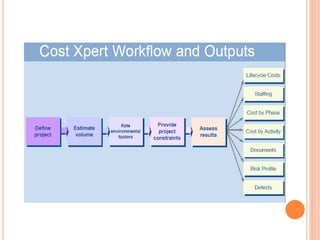
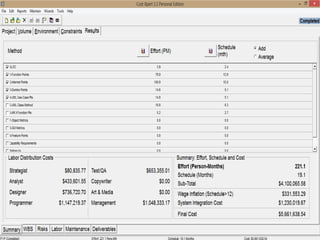
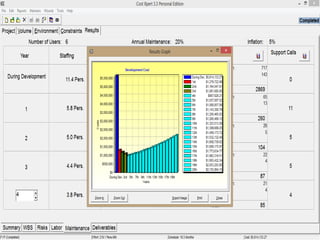
Algorithmically, Cost Xpert started with the
COCOMO models, Revised Enhanced Version of
Intermediate COCOMO (REVIC) extensions, and
then layered functionality on top of this base.
BY HUMA SHABBIR
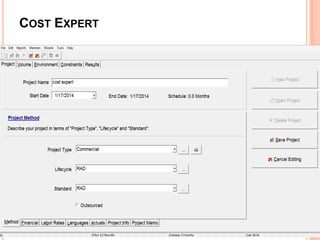
COST EXPERT
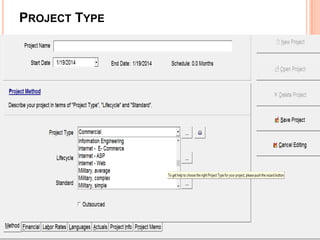
PROJECT TYPE
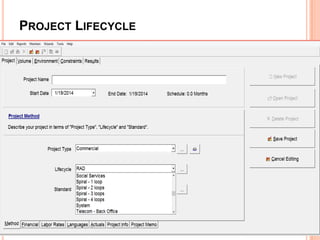
PROJECT LIFECYCLE
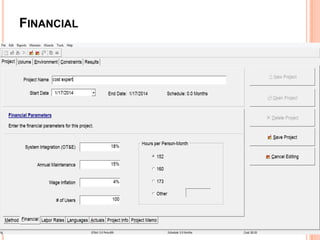
FINANCIAL
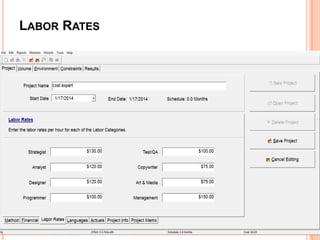
LABOR RATES
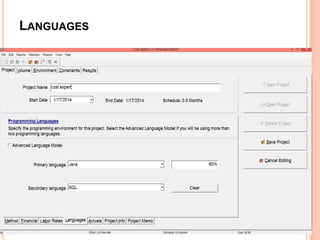
LANGUAGES
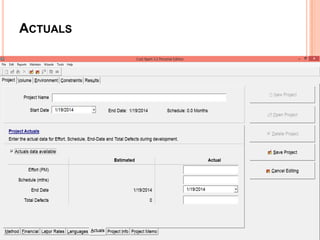
ACTUALS
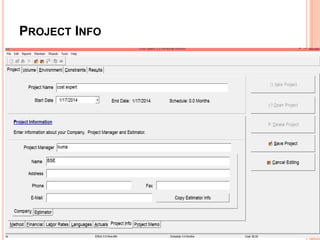
PROJECT INFO
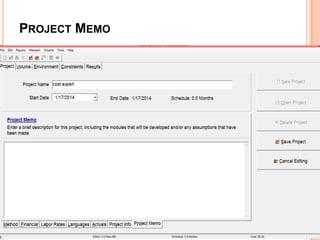
PROJECT MEMO
BY AMNA RAHMAN
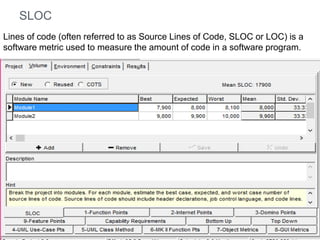
SLOC
Lines of code (often referred to as Source Lines of Code, SLOC or LOC) is a
software metric used to measure the amount of code in a software program.
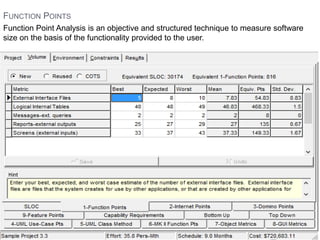
FUNCTION POINTS
Function Point Analysis is an objective and structured technique to measure software
size on the basis of the functionality provided to the user.
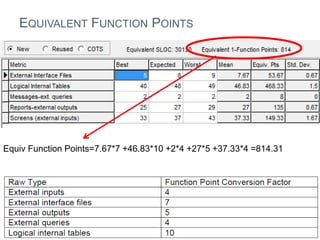
EQUIVALENT FUNCTION POINTS

Equiv Function Points=7.67*7 +46.83*10 +2*4 +27*5 +37.33*4 =814.31
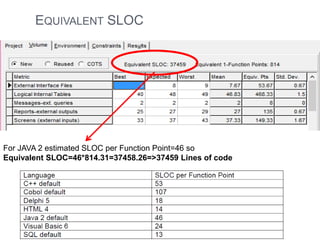
EQUIVALENT SLOC

For JAVA 2 estimated SLOC per Function Point=46 so
Equivalent SLOC=46*814.31=37458.26=>37459 Lines of code
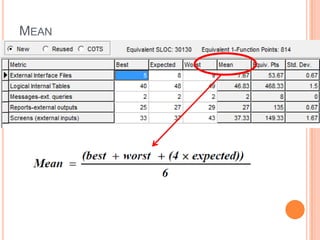
MEAN
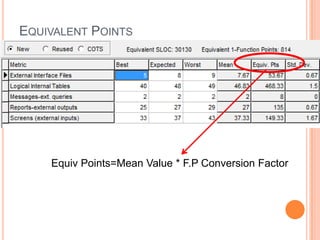
EQUIVALENT POINTS

Equiv Points=Mean Value * F.P Conversion Factor
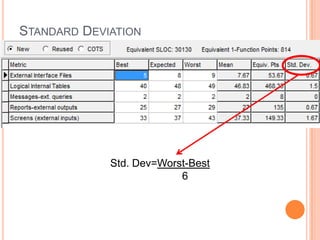
STANDARD DEVIATION

Std. Dev=Worst-Best
6
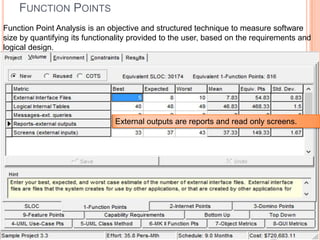
FUNCTION POINTS
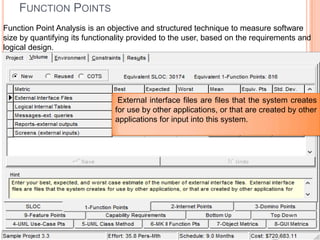
Function Point Analysis is an objective and structured technique to measure software
size by quantifying its functionality provided to the user, based on the requirements and
logical design.

External interface files are files that the system creates
for use by other applications, or that are created by other
applications for input into this system.
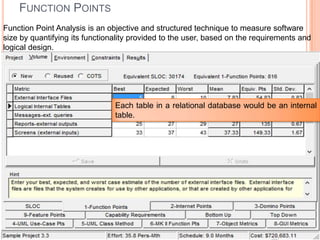
FUNCTION POINTS
Function Point Analysis is an objective and structured technique to measure software
size by quantifying its functionality provided to the user, based on the requirements and
logical design.

Each table in a relational database would be an internal
table.
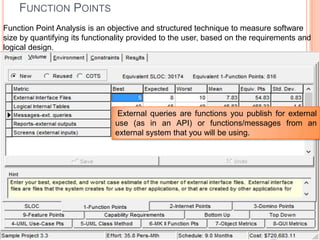
FUNCTION POINTS
Function Point Analysis is an objective and structured technique to measure software
size by quantifying its functionality provided to the user, based on the requirements and
logical design.

External queries are functions you publish for external
use (as in an API) or functions/messages from an
external system that you will be using.
FUNCTION POINTS
Function Point Analysis is an objective and structured technique to measure software
size by quantifying its functionality provided to the user, based on the requirements and
logical design.

External outputs are reports and read only screens.
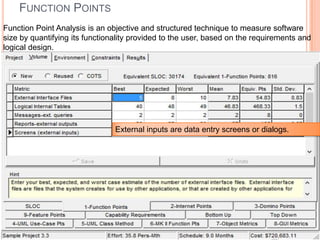
FUNCTION POINTS
Function Point Analysis is an objective and structured technique to measure software
size by quantifying its functionality provided to the user, based on the requirements and
logical design.

External inputs are data entry screens or dialogs.
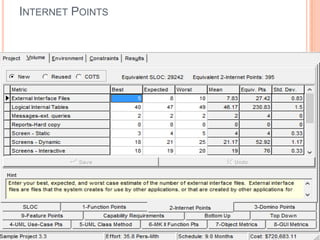
INTERNET POINTS
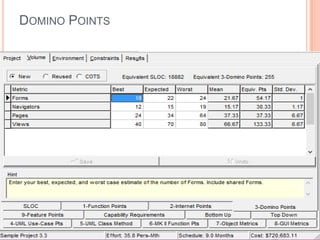
DOMINO POINTS
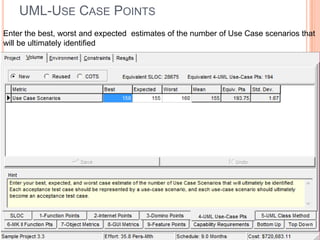
UML-USE CASE POINTS
Enter the best, worst and expected estimates of the number of Use Case scenarios that
will be ultimately identified
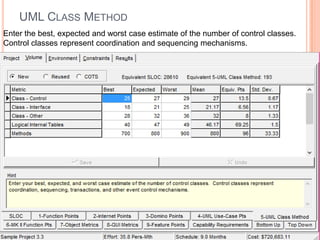
UML CLASS METHOD
Enter the best, expected and worst case estimate of the number of control classes.
Control classes represent coordination and sequencing mechanisms.
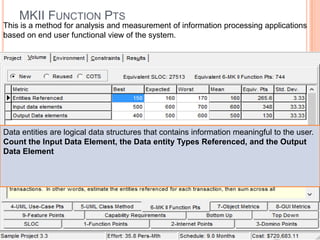
MKII FUNCTION PTS
This is a method for analysis and measurement of information processing applications
based on end user functional view of the system.

Data entities are logical data structures that contains information meaningful to the user.
Count the Input Data Element, the Data entity Types Referenced, and the Output
Data Element
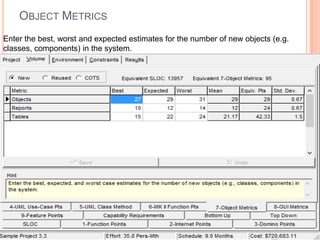
OBJECT METRICS
Enter the best, worst and expected estimates for the number of new objects (e.g.
classes, components) in the system.
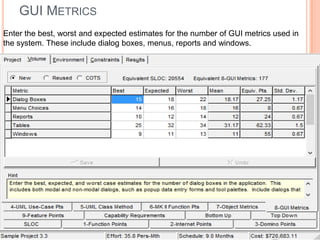
GUI METRICS
Enter the best, worst and expected estimates for the number of GUI metrics used in
the system. These include dialog boxes, menus, reports and windows.
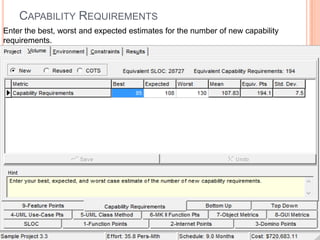
CAPABILITY REQUIREMENTS
Enter the best, worst and expected estimates for the number of new capability
requirements.
BY MADIHA ARIF
BY IQRA QASIM
LIMITATIONS


Highly extensive estimates needs to be determined
which can be complex and tedious.



For example lines of codes, number of queries &
functions , working labor and working hours.



Difficult to predict at the start of project.
THANK

YOU

Cost xpert

  • 1.
    GROUP MEMBERS: oAyesha Saeed oHuma Shabir oAmnaRehman oIqra Qasim oMadeha Arif
  • 2.
  • 3.
  • 4.
    ESTIMATING SOFTWARE COSTS  Moreprojects are doomed from poor cost and schedule estimates rather than from technical, political, or development team problems.  Software estimating can be a science, not just an art.  It really is possible to accurately and consistently estimate development costs and schedules for a wide range of projects.
  • 5.
    ESTIMATING SOFTWARE COSTS      Time Cost Effort Risk Returnon Investment  These project elements can describe a software development success or decry a project failure. They also frequently cause management nightmares.  Wide range of software cost estimating tools on the market to help with this process.
  • 6.
    COST XPERT  Industry leadingsoftware cost estimation tool  Transform plans into concrete and quantifiable results  Cost Xpert is specially designed to help organization improve and manage processes, mitigate risks, and exceed bottom line expectations.
  • 7.
    COST XPERT- ADVANTAGES  Easyto use for novices  Sophisticated features for advanced user  Integrates multiple estimating models  Most extensive options for project type, lifecycle and documentation standards  Interfaces with standard management and analysis tools
  • 8.
    COMPETITIVE EDGE:  Cost XpertTool differentiates itself from competitors by integrating multiple estimation models into one user-friendly solution that provides the most accurate and comprehensive estimates possible.  Cost Xpert can be used to forecast any software development project, regardless of size or objective. The tool has been endorsed by both the private and public sector.
  • 9.
    ALGORITHMIC COST MODELING  Costis estimated as a mathematical function of product, project and process attributes whose values are estimated by project managers  The function is derived from a study of historical costing data  Most commonly used product attribute for cost estimation is LOC (code size)  Most models are basically similar but with different attribute values
  • 11.
    COST XPERT EFFORTAND SCHEDULE CALCULATIONS Algorithmically, Cost Xpert started with the COCOMO models, Revised Enhanced Version of Intermediate COCOMO (REVIC) extensions, and then layered functionality on top of this base.
  • 12.
  • 13.
  • 14.
  • 15.
  • 16.
  • 17.
  • 18.
  • 19.
  • 20.
  • 21.
  • 22.
  • 23.
    SLOC Lines of code(often referred to as Source Lines of Code, SLOC or LOC) is a software metric used to measure the amount of code in a software program.
  • 24.
    FUNCTION POINTS Function PointAnalysis is an objective and structured technique to measure software size on the basis of the functionality provided to the user.
  • 25.
    EQUIVALENT FUNCTION POINTS EquivFunction Points=7.67*7 +46.83*10 +2*4 +27*5 +37.33*4 =814.31
  • 26.
    EQUIVALENT SLOC For JAVA2 estimated SLOC per Function Point=46 so Equivalent SLOC=46*814.31=37458.26=>37459 Lines of code
  • 27.
  • 28.
    EQUIVALENT POINTS Equiv Points=MeanValue * F.P Conversion Factor
  • 29.
  • 30.
    FUNCTION POINTS Function PointAnalysis is an objective and structured technique to measure software size by quantifying its functionality provided to the user, based on the requirements and logical design. External interface files are files that the system creates for use by other applications, or that are created by other applications for input into this system.
  • 31.
    FUNCTION POINTS Function PointAnalysis is an objective and structured technique to measure software size by quantifying its functionality provided to the user, based on the requirements and logical design. Each table in a relational database would be an internal table.
  • 32.
    FUNCTION POINTS Function PointAnalysis is an objective and structured technique to measure software size by quantifying its functionality provided to the user, based on the requirements and logical design. External queries are functions you publish for external use (as in an API) or functions/messages from an external system that you will be using.
  • 33.
    FUNCTION POINTS Function PointAnalysis is an objective and structured technique to measure software size by quantifying its functionality provided to the user, based on the requirements and logical design. External outputs are reports and read only screens.
  • 34.
    FUNCTION POINTS Function PointAnalysis is an objective and structured technique to measure software size by quantifying its functionality provided to the user, based on the requirements and logical design. External inputs are data entry screens or dialogs.
  • 35.
  • 36.
  • 37.
    UML-USE CASE POINTS Enterthe best, worst and expected estimates of the number of Use Case scenarios that will be ultimately identified
  • 38.
    UML CLASS METHOD Enterthe best, expected and worst case estimate of the number of control classes. Control classes represent coordination and sequencing mechanisms.
  • 39.
    MKII FUNCTION PTS Thisis a method for analysis and measurement of information processing applications based on end user functional view of the system. Data entities are logical data structures that contains information meaningful to the user. Count the Input Data Element, the Data entity Types Referenced, and the Output Data Element
  • 40.
    OBJECT METRICS Enter thebest, worst and expected estimates for the number of new objects (e.g. classes, components) in the system.
  • 41.
    GUI METRICS Enter thebest, worst and expected estimates for the number of GUI metrics used in the system. These include dialog boxes, menus, reports and windows.
  • 42.
    CAPABILITY REQUIREMENTS Enter thebest, worst and expected estimates for the number of new capability requirements.
  • 43.
  • 57.
  • 69.
    LIMITATIONS  Highly extensive estimatesneeds to be determined which can be complex and tedious.  For example lines of codes, number of queries & functions , working labor and working hours.  Difficult to predict at the start of project.
  • 70.