correlatio
n
Correlation is a statistical measure that expresses the extent to which two variables
are linearly related (meaning they change together at a constant rate). It's a common
tool for describing simple relationships without making a statement about cause and
effect
How is correlation measured?
The sample correlation coefficient, r, quantifies the strength of the
relationship. Correlations are also tested for statistical significance.
What are some limitations of correlation analysis?
Correlation can’t look at the presence or effect of other variables outside of
the two being explored. Importantly, correlation doesn’t tell us about cause
and effect. Correlation also cannot accurately describe curvilinear
relationships.
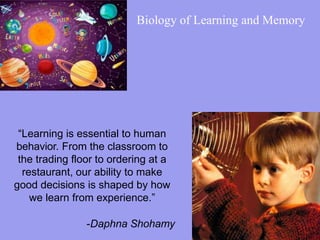
“Learning is essential to human
behavior. From the classroom to
the trading floor to ordering at a
restaurant, our ability to make
good decisions is shaped by how
we learn from experience.”
-Daphna Shohamy
Biology of Learning and Memory
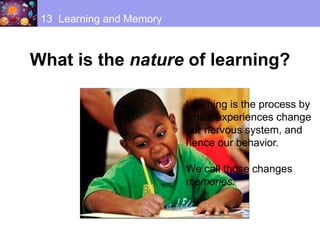
13 Learning and Memory
What is the nature of learning?
Learning is the process by
which experiences change
our nervous system, and
hence our behavior.
We call those changes
memories.
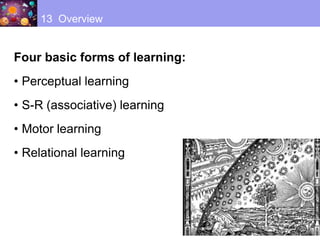
13 Overview
Four basic forms of learning:
• Perceptual learning
• S-R (associative) learning
• Motor learning
• Relational learning
Perceptual Learning
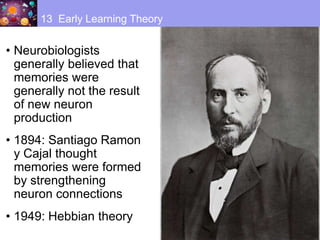
• Neurobiologists
generally believed that
memories were
generally not the result
of new neuron
production
• 1894: Santiago Ramon
y Cajal thought
memories were formed
by strengthening
neuron connections
• 1949: Hebbian theory
13 Early Learning Theory
TAKE NOTE!
• Changes in the structure or biochemistry
of synapses that alter their effects on
postsynaptic neurons
• Long-term Potentiation: long term
increase in the excitability of a neuron to a
particular synaptic input caused by
repeated high-frequency activity of that
input.
• Long-term Depression: produces a long-
lasting decrease in synaptic strength.
13 Synaptic Plasticity
• Associative long-term potentiation:
weak synapses are strengthened by the
action of strong synapses
• NMDA receptor: A specialized ionotropic
glutamate receptor that controls a calcium
channel that is normally blocked by Mg2+
ions; involved in long-term potentiation.
• AMPA receptor: An ionotropic glutamate
receptor that controls a sodium channel;
when open, it produces EPSPs.
13 Synaptic Plasticity
13 Perceptual Learning
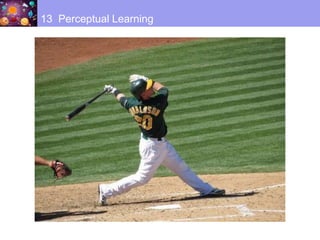
• Involves learning to recognize things, not what
to do when they are present
• Can involve learning to recognize entirely new
stimuli, or it can involve learning to recognize
changes or variations in familiar stimuli
• We learn that particular stimuli are found in
particular locations or contexts or in the
presence of other stimuli. We can even learn
and remember particular episodes: sequences
of events taking place at a particular time and
place.
• Thalamus LGN -> primary visual cortex ->
extrastriate cortex
• Objects are recognized visually by circuits
of neurons in the visual association cortex.
• Damage to the inferior temporal cortex
leaves vision unaffected but causes
inability to discriminate visual stimuli
• Ventral = what, Dorsal = where
13 Perceptual Learning
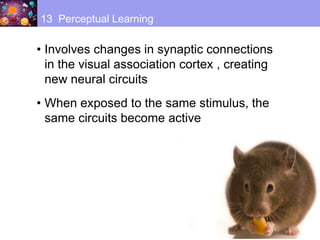
• Involves changes in synaptic connections
in the visual association cortex , creating
new neural circuits
• When exposed to the same stimulus, the
same circuits become active
13 Perceptual Learning
• MT/MST: region of the visual association
cortex that perceives movement
• Memory contains information about
previously seen movements
• Brain saves sensory information for future
reference
13 Perceptual Learning
• The memory for a stimulus or an event
that lasts for a short while
• Involves activating established neural
circuits even after stimulus is gone
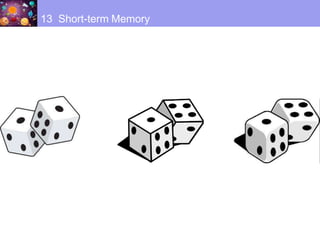
• Delayed matching-to-sample task: A
task that requires the subject to indicate
which of several stimuli has just been
perceived.
13 Short-term Memory
• Involves several brain regions
• Prefrontal cortex manipulates and
organizes information to be remembered
• PFC devises strategies for retrieval and
monitors the outcome of those processes
• Successful remembering requires: filtering
out irrelevant info and maintaining relevant
info
13 Short-term Memory
S-R Learning
13 S-R Learning
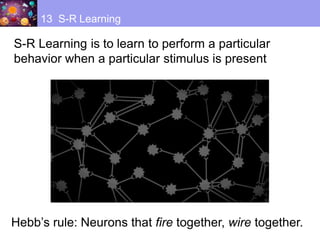
Hebb’s rule: Neurons that fire together, wire together.
S-R Learning is to learn to perform a particular
behavior when a particular stimulus is present
Ivan Pavlov
While studying salivation in
dogs, Pavlov “stumbled”
upon the principles of
classical conditioning.
13 S-R Learning
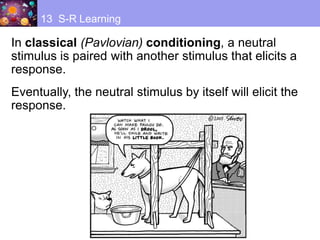
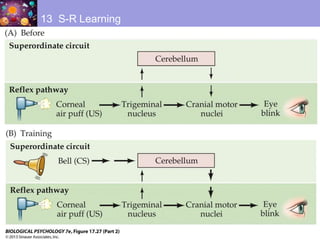
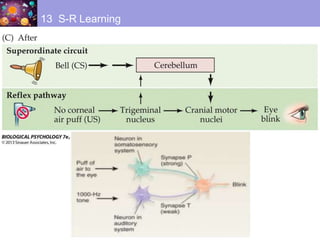
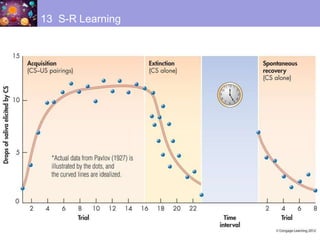
In classical (Pavlovian) conditioning, a neutral
stimulus is paired with another stimulus that elicits a
response.
Eventually, the neutral stimulus by itself will elicit the
response.
13 S-R Learning
13 S-R Learning
13 S-R Learning
13 S-R Learning
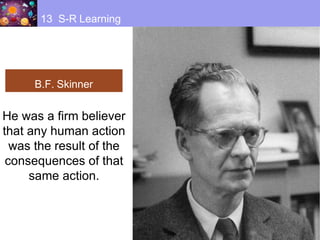
B.F. Skinner
13 S-R Learning
He was a firm believer
that any human action
was the result of the
consequences of that
same action.
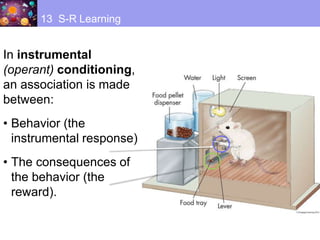
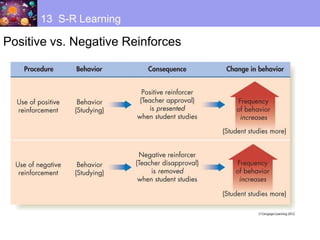
In instrumental
(operant) conditioning,
an association is made
between:
• Behavior (the
instrumental response)
• The consequences of
the behavior (the
reward).
13 S-R Learning
Positive vs. Negative Reinforces
13 S-R Learning
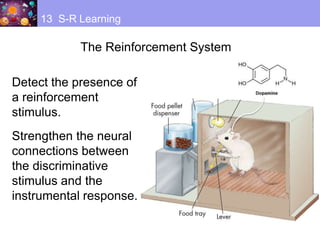
The Reinforcement System
13 S-R Learning
Detect the presence of
a reinforcement
stimulus.
Strengthen the neural
connections between
the discriminative
stimulus and the
instrumental response.
13 S-R Learning
Relational Learning
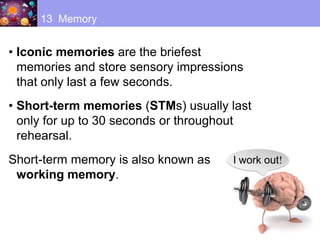
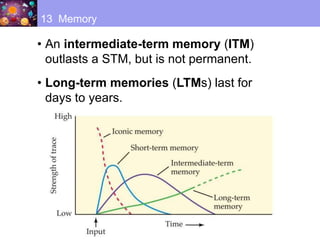
• Iconic memories are the briefest
memories and store sensory impressions
that only last a few seconds.
• Short-term memories (STMs) usually last
only for up to 30 seconds or throughout
rehearsal.
Short-term memory is also known as
working memory.
13 Memory
I work out!
• An intermediate-term memory (ITM)
outlasts a STM, but is not permanent.
• Long-term memories (LTMs) last for
days to years.
13 Memory
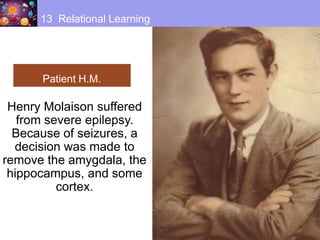
13 Relational Learning
Henry Molaison suffered
from severe epilepsy.
Because of seizures, a
decision was made to
remove the amygdala, the
hippocampus, and some
cortex.
Patient H.M.
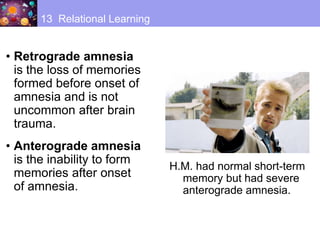
• Retrograde amnesia
is the loss of memories
formed before onset of
amnesia and is not
uncommon after brain
trauma.
• Anterograde amnesia
is the inability to form
memories after onset
of amnesia.
13 Relational Learning
H.M. had normal short-term
memory but had severe
anterograde amnesia.
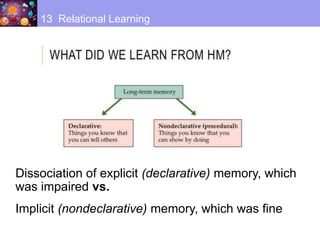
Dissociation of explicit (declarative) memory, which
was impaired vs.
Implicit (nondeclarative) memory, which was fine
13 Relational Learning
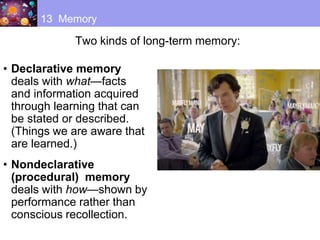
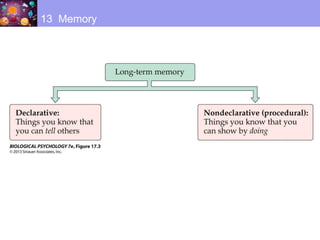
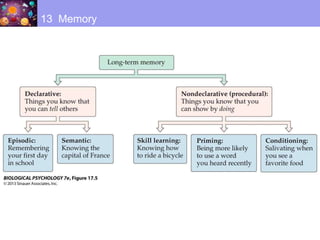
• Declarative memory
deals with what—facts
and information acquired
through learning that can
be stated or described.
(Things we are aware that
are learned.)
• Nondeclarative
(procedural) memory
deals with how—shown by
performance rather than
conscious recollection.
13 Memory
Two kinds of long-term memory:
13 Memory
13 Memory
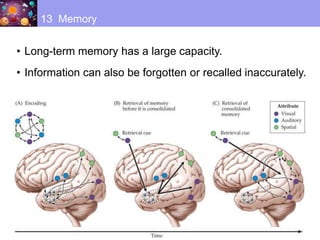
• Long-term memory has a large capacity.
• Information can also be forgotten or recalled inaccurately.
13 Memory
THE END

Correlation.pptx

  • 1.
    correlatio n Correlation is astatistical measure that expresses the extent to which two variables are linearly related (meaning they change together at a constant rate). It's a common tool for describing simple relationships without making a statement about cause and effect How is correlation measured? The sample correlation coefficient, r, quantifies the strength of the relationship. Correlations are also tested for statistical significance. What are some limitations of correlation analysis? Correlation can’t look at the presence or effect of other variables outside of the two being explored. Importantly, correlation doesn’t tell us about cause and effect. Correlation also cannot accurately describe curvilinear relationships.
  • 2.
    “Learning is essentialto human behavior. From the classroom to the trading floor to ordering at a restaurant, our ability to make good decisions is shaped by how we learn from experience.” -Daphna Shohamy Biology of Learning and Memory
  • 3.
    13 Learning andMemory What is the nature of learning? Learning is the process by which experiences change our nervous system, and hence our behavior. We call those changes memories.
  • 4.
    13 Overview Four basicforms of learning: • Perceptual learning • S-R (associative) learning • Motor learning • Relational learning
  • 5.
  • 6.
    • Neurobiologists generally believedthat memories were generally not the result of new neuron production • 1894: Santiago Ramon y Cajal thought memories were formed by strengthening neuron connections • 1949: Hebbian theory 13 Early Learning Theory
  • 7.
    13 Early LearningTheory TAKE NOTE!
  • 8.
    • Changes inthe structure or biochemistry of synapses that alter their effects on postsynaptic neurons • Long-term Potentiation: long term increase in the excitability of a neuron to a particular synaptic input caused by repeated high-frequency activity of that input. • Long-term Depression: produces a long- lasting decrease in synaptic strength. 13 Synaptic Plasticity
  • 9.
    • Associative long-termpotentiation: weak synapses are strengthened by the action of strong synapses • NMDA receptor: A specialized ionotropic glutamate receptor that controls a calcium channel that is normally blocked by Mg2+ ions; involved in long-term potentiation. • AMPA receptor: An ionotropic glutamate receptor that controls a sodium channel; when open, it produces EPSPs. 13 Synaptic Plasticity
  • 10.
    13 Perceptual Learning •Involves learning to recognize things, not what to do when they are present • Can involve learning to recognize entirely new stimuli, or it can involve learning to recognize changes or variations in familiar stimuli • We learn that particular stimuli are found in particular locations or contexts or in the presence of other stimuli. We can even learn and remember particular episodes: sequences of events taking place at a particular time and place.
  • 11.
    • Thalamus LGN-> primary visual cortex -> extrastriate cortex • Objects are recognized visually by circuits of neurons in the visual association cortex. • Damage to the inferior temporal cortex leaves vision unaffected but causes inability to discriminate visual stimuli • Ventral = what, Dorsal = where 13 Perceptual Learning
  • 12.
    • Involves changesin synaptic connections in the visual association cortex , creating new neural circuits • When exposed to the same stimulus, the same circuits become active 13 Perceptual Learning
  • 13.
  • 14.
  • 15.
    • MT/MST: regionof the visual association cortex that perceives movement • Memory contains information about previously seen movements • Brain saves sensory information for future reference 13 Perceptual Learning
  • 16.
    • The memoryfor a stimulus or an event that lasts for a short while • Involves activating established neural circuits even after stimulus is gone • Delayed matching-to-sample task: A task that requires the subject to indicate which of several stimuli has just been perceived. 13 Short-term Memory
  • 17.
  • 18.
    • Involves severalbrain regions • Prefrontal cortex manipulates and organizes information to be remembered • PFC devises strategies for retrieval and monitors the outcome of those processes • Successful remembering requires: filtering out irrelevant info and maintaining relevant info 13 Short-term Memory
  • 19.
  • 20.
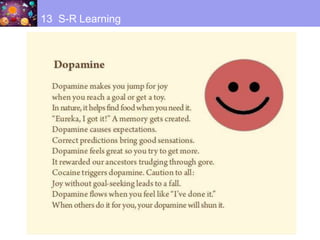
    13 S-R Learning Hebb’srule: Neurons that fire together, wire together. S-R Learning is to learn to perform a particular behavior when a particular stimulus is present
  • 21.
    Ivan Pavlov While studyingsalivation in dogs, Pavlov “stumbled” upon the principles of classical conditioning. 13 S-R Learning
  • 22.
    In classical (Pavlovian)conditioning, a neutral stimulus is paired with another stimulus that elicits a response. Eventually, the neutral stimulus by itself will elicit the response. 13 S-R Learning
  • 23.
  • 24.
  • 25.
  • 26.
    B.F. Skinner 13 S-RLearning He was a firm believer that any human action was the result of the consequences of that same action.
  • 27.
    In instrumental (operant) conditioning, anassociation is made between: • Behavior (the instrumental response) • The consequences of the behavior (the reward). 13 S-R Learning
  • 28.
    Positive vs. NegativeReinforces 13 S-R Learning
  • 29.
    The Reinforcement System 13S-R Learning Detect the presence of a reinforcement stimulus. Strengthen the neural connections between the discriminative stimulus and the instrumental response.
  • 30.
  • 31.
  • 33.
    • Iconic memoriesare the briefest memories and store sensory impressions that only last a few seconds. • Short-term memories (STMs) usually last only for up to 30 seconds or throughout rehearsal. Short-term memory is also known as working memory. 13 Memory I work out!
  • 34.
    • An intermediate-termmemory (ITM) outlasts a STM, but is not permanent. • Long-term memories (LTMs) last for days to years. 13 Memory
  • 35.
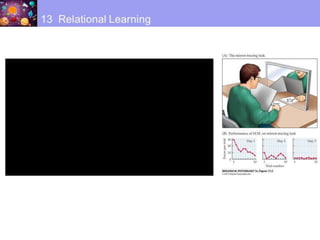
    13 Relational Learning HenryMolaison suffered from severe epilepsy. Because of seizures, a decision was made to remove the amygdala, the hippocampus, and some cortex. Patient H.M.
  • 36.
    • Retrograde amnesia isthe loss of memories formed before onset of amnesia and is not uncommon after brain trauma. • Anterograde amnesia is the inability to form memories after onset of amnesia. 13 Relational Learning H.M. had normal short-term memory but had severe anterograde amnesia.
  • 38.
    Dissociation of explicit(declarative) memory, which was impaired vs. Implicit (nondeclarative) memory, which was fine 13 Relational Learning
  • 39.
    • Declarative memory dealswith what—facts and information acquired through learning that can be stated or described. (Things we are aware that are learned.) • Nondeclarative (procedural) memory deals with how—shown by performance rather than conscious recollection. 13 Memory Two kinds of long-term memory:
  • 40.
  • 41.
  • 42.
    • Long-term memoryhas a large capacity. • Information can also be forgotten or recalled inaccurately. 13 Memory
  • 43.