CORRELATIONAL
RESEARCH
By: Charmaine P. Quisora
Correlation is a way to measure how
associated or related two variables
are. The researcher looks at things
that already exist and determines if
and in what way those things are
related to each other.
Positive correlation
Negative correlation
Zero Correlation
Types of correlation
1.
2.
3.
In a positive correlation, as the values
of one of the variables increase, the
values of the second variable also
increase. Likewise, as the value of one
of the variables decreases, the value of
the other variable also decreases.
Positive correlation
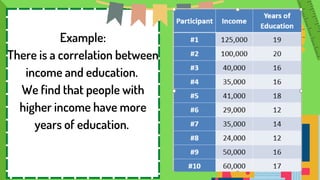
Example:
There is a correlation between
income and education.
We find that people with
higher income have more
years of education.
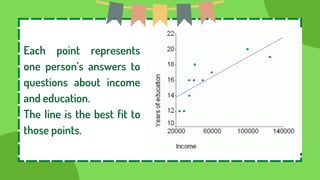
Each point represents
one person’s answers to
questions about income
and education.
The line is the best fit to
those points.
Students with strong attendance records also
have higher grades.
Becoming more involved with school activities
increases students' self-esteem.
As the values of one of the variables
increase, the values of the second variable
decrease. Likewise, as the value of one of the
variables decreases, the value of the other
variable increases.
Negative correlation
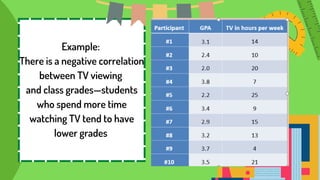
Example:
There is a negative correlation
between TV viewing
and class grades—students
who spend more time
watching TV tend to have
lower grades
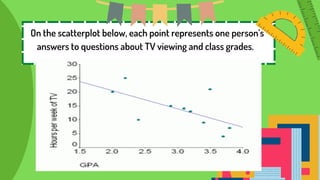
On the scatterplot below, each point represents one person’s
answers to questions about TV viewing and class grades.
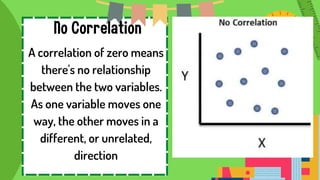
A correlation of zero means
there's no relationship
between the two variables.
As one variable moves one
way, the other moves in a
different, or unrelated,
direction
No Correlation
The more you exercise, the more you sing.
The higher the room temperature, the lower
the rabbit population
The less you sleep, the more soda you might
drink
No Correlation
Finding the positive or negative
correlation between two variables is an
important way to study cause and
effect. By making these connections, we
can understand more about the world
around us.
Thank You

CORRELATION.pdf

  • 1.
  • 2.
    Correlation is away to measure how associated or related two variables are. The researcher looks at things that already exist and determines if and in what way those things are related to each other.
  • 3.
    Positive correlation Negative correlation ZeroCorrelation Types of correlation 1. 2. 3.
  • 4.
    In a positivecorrelation, as the values of one of the variables increase, the values of the second variable also increase. Likewise, as the value of one of the variables decreases, the value of the other variable also decreases. Positive correlation
  • 5.
    Example: There is acorrelation between income and education. We find that people with higher income have more years of education.
  • 6.
    Each point represents oneperson’s answers to questions about income and education. The line is the best fit to those points.
  • 7.
    Students with strongattendance records also have higher grades. Becoming more involved with school activities increases students' self-esteem.
  • 8.
    As the valuesof one of the variables increase, the values of the second variable decrease. Likewise, as the value of one of the variables decreases, the value of the other variable increases. Negative correlation
  • 9.
    Example: There is anegative correlation between TV viewing and class grades—students who spend more time watching TV tend to have lower grades
  • 10.
    On the scatterplotbelow, each point represents one person’s answers to questions about TV viewing and class grades.
  • 11.
    A correlation ofzero means there's no relationship between the two variables. As one variable moves one way, the other moves in a different, or unrelated, direction No Correlation
  • 12.
    The more youexercise, the more you sing. The higher the room temperature, the lower the rabbit population The less you sleep, the more soda you might drink No Correlation
  • 13.
    Finding the positiveor negative correlation between two variables is an important way to study cause and effect. By making these connections, we can understand more about the world around us.
  • 14.