Correlation
Correlation Analysis
 Correlations tell us to the degree that
two variables are similar or associated
with each other. It is a measure of
association.
 Correlations are bivariate or multivariate
in nature, i.e., relational between
variables.
Correlation Analysis
 Correlations measure association by
measuring how when one variable
changes another changes with it, which
means it is measuring dynamic
relationships (change).
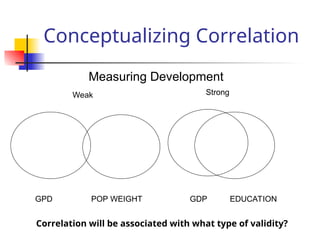
Conceptualizing Correlation
Measuring Development
GPD POP WEIGHT
Weak
GDP EDUCATION
Strong
Correlation will be associated with what type of validity?
Correlation Analysis
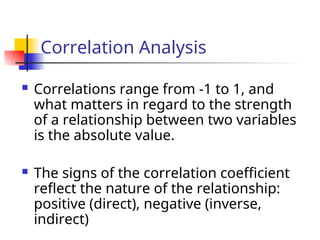
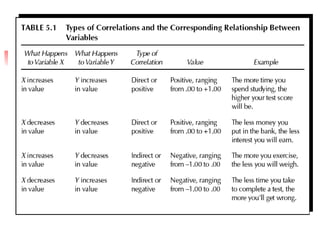
 Correlations range from -1 to 1, and
what matters in regard to the strength
of a relationship between two variables
is the absolute value.
 The signs of the correlation coefficient
reflect the nature of the relationship:
positive (direct), negative (inverse,
indirect)
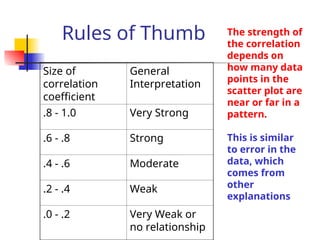
Rules of Thumb
Size of
correlation
coefficient
General
Interpretation
.8 - 1.0 Very Strong
.6 - .8 Strong
.4 - .6 Moderate
.2 - .4 Weak
.0 - .2 Very Weak or
no relationship
The strength of
the correlation
depends on
how many data
points in the
scatter plot are
near or far in a
pattern.
This is similar
to error in the
data, which
comes from
other
explanations
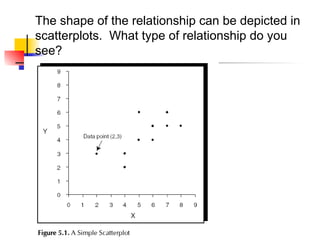
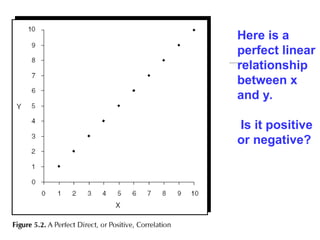
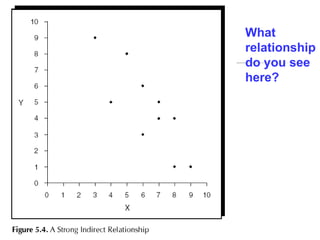
The shape of the relationship can be depicted in
scatterplots. What type of relationship do you
see?
Here is a
perfect linear
relationship
between x
and y.
Is it positive
or negative?
What
relationship
do you see
here?
Correlation Analysis
 We focus here on the Pearson
product-moment correlation, which is
used for continuous measures (ratio,
interval = scalar)
 Spearman’s rho Kendall’s Tau-b used
to compare ordered variables
Correlation Coefficient
]
)
(
][
)
(
[ 2
2
2
2
Y
Y
n
X
X
n
Y
X
XY
n
rxy











Correlation and Causation
 We want to know how two variables
are related to, overlap with, each other
 If one variable causes another, it will
be correlated with it.
 However, some correlations are
spurious and association does not
automatically mean causation.
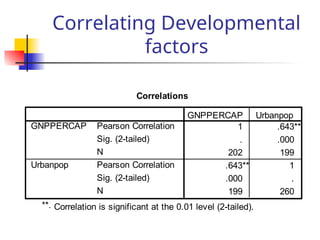
Correlating Developmental
factors
Correlations
1 .643**
. .000
202 199
.643** 1
.000 .
199 260
Pearson Correlation
Sig. (2-tailed)
N
Pearson Correlation
Sig. (2-tailed)
N
GNPPERCAP
Urbanpop
GNPPERCAP Urbanpop
Correlation is significant at the 0.01 level (2-tailed).
**.
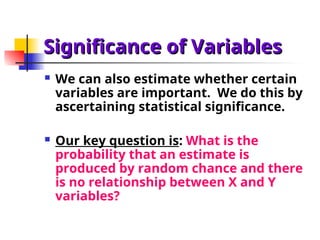
Significance of Variables
 We can also estimate whether certain
variables are important. We do this by
ascertaining statistical significance.
 Our key question is: What is the
probability that an estimate is
produced by random chance and there
is no relationship between X and Y
variables?
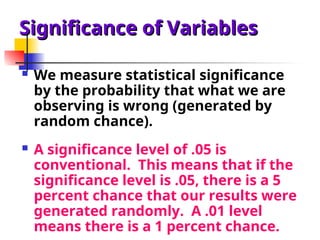
Significance of Variables
 We measure statistical significance
by the probability that what we are
observing is wrong (generated by
random chance).
 A significance level of .05 is
conventional. This means that if the
significance level is .05, there is a 5
percent chance that our results were
generated randomly. A .01 level
means there is a 1 percent chance.
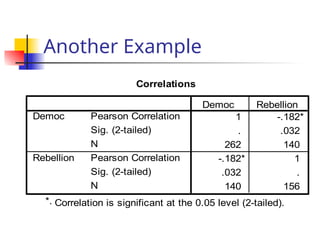
Another Example
Correlations
1 -.182*
. .032
262 140
-.182* 1
.032 .
140 156
Pearson Correlation
Sig. (2-tailed)
N
Pearson Correlation
Sig. (2-tailed)
N
Democ
Rebellion
Democ Rebellion
Correlation is significant at the 0.05 level (2-tailed).
*.
Limitation of correlation
coefficients
 They tell us how strongly two variables are related
 May capture causation between variables but
cannot differentiate from spurious ones.
 However, r coefficients are limited because they
cannot tell anything about:
• Marginal impact of X on Y
• Direction of causation when present
• Forecasting
Because of the above Ordinary Least Square regression
analysis (OLS) is most useful

Correlation test guidances for beginner.

  • 1.
  • 2.
    Correlation Analysis  Correlationstell us to the degree that two variables are similar or associated with each other. It is a measure of association.  Correlations are bivariate or multivariate in nature, i.e., relational between variables.
  • 3.
    Correlation Analysis  Correlationsmeasure association by measuring how when one variable changes another changes with it, which means it is measuring dynamic relationships (change).
  • 4.
    Conceptualizing Correlation Measuring Development GPDPOP WEIGHT Weak GDP EDUCATION Strong Correlation will be associated with what type of validity?
  • 5.
    Correlation Analysis  Correlationsrange from -1 to 1, and what matters in regard to the strength of a relationship between two variables is the absolute value.  The signs of the correlation coefficient reflect the nature of the relationship: positive (direct), negative (inverse, indirect)
  • 7.
    Rules of Thumb Sizeof correlation coefficient General Interpretation .8 - 1.0 Very Strong .6 - .8 Strong .4 - .6 Moderate .2 - .4 Weak .0 - .2 Very Weak or no relationship The strength of the correlation depends on how many data points in the scatter plot are near or far in a pattern. This is similar to error in the data, which comes from other explanations
  • 8.
    The shape ofthe relationship can be depicted in scatterplots. What type of relationship do you see?
  • 9.
    Here is a perfectlinear relationship between x and y. Is it positive or negative?
  • 10.
  • 11.
    Correlation Analysis  Wefocus here on the Pearson product-moment correlation, which is used for continuous measures (ratio, interval = scalar)  Spearman’s rho Kendall’s Tau-b used to compare ordered variables
  • 12.
  • 13.
    Correlation and Causation We want to know how two variables are related to, overlap with, each other  If one variable causes another, it will be correlated with it.  However, some correlations are spurious and association does not automatically mean causation.
  • 14.
    Correlating Developmental factors Correlations 1 .643** ..000 202 199 .643** 1 .000 . 199 260 Pearson Correlation Sig. (2-tailed) N Pearson Correlation Sig. (2-tailed) N GNPPERCAP Urbanpop GNPPERCAP Urbanpop Correlation is significant at the 0.01 level (2-tailed). **.
  • 15.
    Significance of Variables Significanceof Variables  We can also estimate whether certain variables are important. We do this by ascertaining statistical significance.  Our key question is: What is the probability that an estimate is produced by random chance and there is no relationship between X and Y variables?
  • 16.
    Significance of Variables Significanceof Variables  We measure statistical significance by the probability that what we are observing is wrong (generated by random chance).  A significance level of .05 is conventional. This means that if the significance level is .05, there is a 5 percent chance that our results were generated randomly. A .01 level means there is a 1 percent chance.
  • 17.
    Another Example Correlations 1 -.182* ..032 262 140 -.182* 1 .032 . 140 156 Pearson Correlation Sig. (2-tailed) N Pearson Correlation Sig. (2-tailed) N Democ Rebellion Democ Rebellion Correlation is significant at the 0.05 level (2-tailed). *.
  • 18.
    Limitation of correlation coefficients They tell us how strongly two variables are related  May capture causation between variables but cannot differentiate from spurious ones.  However, r coefficients are limited because they cannot tell anything about: • Marginal impact of X on Y • Direction of causation when present • Forecasting Because of the above Ordinary Least Square regression analysis (OLS) is most useful