Correlation
UNIVERSITY OF GUJRAT
Table of Content
Correlation with Example
Types of Correlation
Correlation Coefficient
Method of Studying Correlation
 Karl Pearson´s Coefficient of Correlation
Properties of Pearson´s Correlation Coefficient
Correlation
Correlation describes the strength of a linear relationship
between two variables.
Correlation includes various methods and techniques used to
study and measure the relationship between variables.
Correlation is the relationship between two variables. Data can
be represented by ordered pairs (x, y) where x is the independent
variable and Y is the dependent variable.
Example
Height of Children
Weight of Children
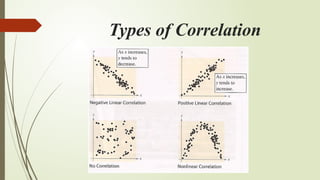
Types of Correlation
Positive Correlation
Negative Correlation
No Correlation
Non Linear Correlation
Types of Correlation
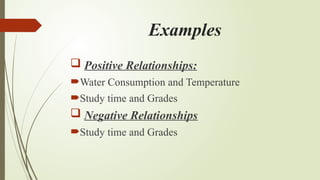
Examples
 Positive Relationships:
Water Consumption and Temperature
Study time and Grades
 Negative Relationships
Study time and Grades
Correlation Coefficient
The correlation coefficient is used to measure the
strength of the linear relationship between two
variables.
Its value always lies between (-1) and (+1).
Coefficient of Correlation
𝑟 =
𝑛(∑ 𝑥𝑦 )−(∑ 𝑥)(∑ 𝑦 )
√[𝑛∑ 𝑥2
¿− (∑ 𝑥 )
2
][𝑛∑ 𝑦2
−(∑ 𝑦 )
2
]¿
Method of Studying Correlation
Scatter Diagram Method
Karl Pearson Coefficient Correlation of Method
Spearman's Rank Coefficient
Scatter Diagram Method
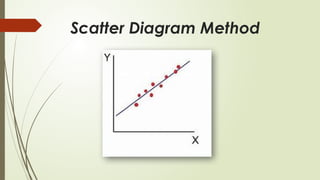
The scatter diagram method is the simplest way to
study the correlation between two variables in
which the values ​
​
of each pair of variables are
plotted on a graph in the form of dots, thus
obtaining as many points as there are observations.
Scatter Diagram Method
Karl Pearson´s Coefficient of
Correlation
Pearson´s ´r´ is the most common correlation coefficient.
Karl Pearson´s Coefficient of Correlation denoted by - ´r´.
The Coefficient of ´r´ measure the degree of linear
relationship between two variables say x & y.
Properties of Pearson´s
Correlation Coefficient
The value of Coefficient of Correlation is always between -1
and +1.
If r = +1 or -1, the sample point lie on a straight line.
If r is near to +1 or -1 there is strong correlation between the
variables.
If r is small there is low degree of correlation between the
variables.
Karl Pearson´s Coefficient of
Correlation
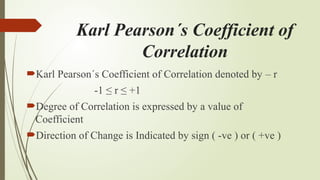
Karl Pearson´s Coefficient of Correlation denoted by – r
-1 ≤ r ≤ +1
Degree of Correlation is expressed by a value of
Coefficient
Direction of Change is Indicated by sign ( -ve ) or ( +ve )
Example
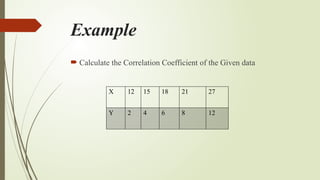
 Calculate the Correlation Coefficient of the Given data
X 12 15 18 21 27
Y 2 4 6 8 12
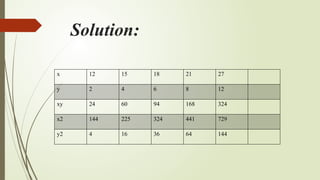
Solution:
x 12 15 18 21 27
y 2 4 6 8 12
xy 24 60 94 168 324
x2 144 225 324 441 729
y2 4 16 36 64 144
 Formula:
 Putting values in the equation.
  
84
.
0
)
296
)(
666
(
374
)
1024
1320
)(
8649
9315
(
2976
3350
)
32
(
)
264
(
5
)
93
(
)
1863
(
5
)
32
)(
93
(
)
670
(
5
2
2










r
r
r
r
𝑟 =
𝑛 (∑ 𝑥𝑦 )−(∑ 𝑥)(∑ 𝑦 )
√[𝑛∑ 𝑥
2
¿− (∑ 𝑥 )
2
][𝑛∑ 𝑦
2
−(∑ 𝑦 )
2
]¿
Thank you!
Any Question?

Correlation Explained with Examples | Types, Methods & Karl Pearson’s Coefficient

  • 1.
  • 2.
    Table of Content Correlationwith Example Types of Correlation Correlation Coefficient Method of Studying Correlation  Karl Pearson´s Coefficient of Correlation Properties of Pearson´s Correlation Coefficient
  • 3.
    Correlation Correlation describes thestrength of a linear relationship between two variables. Correlation includes various methods and techniques used to study and measure the relationship between variables. Correlation is the relationship between two variables. Data can be represented by ordered pairs (x, y) where x is the independent variable and Y is the dependent variable.
  • 4.
  • 5.
    Types of Correlation PositiveCorrelation Negative Correlation No Correlation Non Linear Correlation
  • 6.
  • 7.
    Examples  Positive Relationships: WaterConsumption and Temperature Study time and Grades  Negative Relationships Study time and Grades
  • 8.
    Correlation Coefficient The correlationcoefficient is used to measure the strength of the linear relationship between two variables. Its value always lies between (-1) and (+1).
  • 9.
    Coefficient of Correlation 𝑟= 𝑛(∑ 𝑥𝑦 )−(∑ 𝑥)(∑ 𝑦 ) √[𝑛∑ 𝑥2 ¿− (∑ 𝑥 ) 2 ][𝑛∑ 𝑦2 −(∑ 𝑦 ) 2 ]¿
  • 10.
    Method of StudyingCorrelation Scatter Diagram Method Karl Pearson Coefficient Correlation of Method Spearman's Rank Coefficient
  • 11.
    Scatter Diagram Method Thescatter diagram method is the simplest way to study the correlation between two variables in which the values ​ ​ of each pair of variables are plotted on a graph in the form of dots, thus obtaining as many points as there are observations.
  • 12.
  • 13.
    Karl Pearson´s Coefficientof Correlation Pearson´s ´r´ is the most common correlation coefficient. Karl Pearson´s Coefficient of Correlation denoted by - ´r´. The Coefficient of ´r´ measure the degree of linear relationship between two variables say x & y.
  • 14.
    Properties of Pearson´s CorrelationCoefficient The value of Coefficient of Correlation is always between -1 and +1. If r = +1 or -1, the sample point lie on a straight line. If r is near to +1 or -1 there is strong correlation between the variables. If r is small there is low degree of correlation between the variables.
  • 15.
    Karl Pearson´s Coefficientof Correlation Karl Pearson´s Coefficient of Correlation denoted by – r -1 ≤ r ≤ +1 Degree of Correlation is expressed by a value of Coefficient Direction of Change is Indicated by sign ( -ve ) or ( +ve )
  • 16.
    Example  Calculate theCorrelation Coefficient of the Given data X 12 15 18 21 27 Y 2 4 6 8 12
  • 17.
    Solution: x 12 1518 21 27 y 2 4 6 8 12 xy 24 60 94 168 324 x2 144 225 324 441 729 y2 4 16 36 64 144
  • 18.
     Formula:  Puttingvalues in the equation.    84 . 0 ) 296 )( 666 ( 374 ) 1024 1320 )( 8649 9315 ( 2976 3350 ) 32 ( ) 264 ( 5 ) 93 ( ) 1863 ( 5 ) 32 )( 93 ( ) 670 ( 5 2 2           r r r r 𝑟 = 𝑛 (∑ 𝑥𝑦 )−(∑ 𝑥)(∑ 𝑦 ) √[𝑛∑ 𝑥 2 ¿− (∑ 𝑥 ) 2 ][𝑛∑ 𝑦 2 −(∑ 𝑦 ) 2 ]¿
  • 19.