Presented by;
Alka Diwakar
M.Pharm (Pharmaceutics)
1st Semester (2019-2020)
CSJM UNIVERSITY KANPUR
UNIVERSITY INSTITUTE OF PHARMACY
TRANSDERMAL DRUG
DELIVERY SYSTEM
1CSJM UNIVERSITY KANPUR
INTRODUCTION
The passage of substance from the outside of the
skin through its various layers into the bloodstream.
Definition: Transdermal drug delivery system can deliver the
drugs through the skin portal to systemic circulation at a
predetermined rate and maintain clinically the effective
concentration over the prolonged period of time.
CSJM UNIVERSITY KANPUR 2
 Transdermal drug delivery system (TDDS)also know as
pacth’s are dosage from designed to deliver
therapeutically effective amount of drug across a
patient’s skin
 The primary objective of controlled drug delivery is to
ensure safety and efficacy of the drug as well as
patients compliance.
 TDDS a realistic application as the next generation of
drug delivery.
CSJM UNIVERSITY KANPUR 3
ANATOMY OF SKIN
 It composed of 3 layer-
a) Epidermis-
i) Stratum Corneum
ii) Stratum Lucidum
iii) Stratum Granulosum
iv) Stratum Spinosum
b)Dermis
c)Subcutaneous
CSJM UNIVERSITY KANPUR 4
PATHWAY OF DRUG ABSORPTION
THROUGH THE SKIN
 Intercellular diffusion through
lipid layer.
 Transcellular diffusion through
lipid bilayer and keratinocytes .
 Diffusion through hair follicles
and sweat ducts.
The lipophilic drug pass mainly
through the lipid matrix present
in the stratum corneum .
The hydrophilic drug permeate
through hydrated stratum
corneum by polar pathway.
CSJM UNIVERSITY KANPUR 5
FUNDAMENTALS OF SKIN PERMEATION
Rate of permeation dQ/dt across a skin can be expressed
as
dQ/dt = Ps[ Cd - Cr ]
Where
dQ/dt – Rate of permeation
Ps – Permeability coefficient
Cd – Concentration in donor compartment
Cr – Concentration in receptor compartment
CSJM UNIVERSITY KANPUR 6
FACTORS AFFECTING
TRANSDERMAL BIOAVAILABILITY
.
 Physiological factors
 Formulation factors
 Physicochemical
factors.
 Physiological factors
1. Hydration of skin
2. Skin temperature
3. Skin age
4. Blood flow
5. Regional skin sites
6. Skin metabolism
Contd…CSJM UNIVERSITY KANPUR 7
Formulation factor
 Release rate of the
drug
 Ingredient of the
formulation
Presence of permeation
enhancers
Physicochemical
factors of drug
 PH
 Diffusion coefficient
 Partition coefficient
 Drug concentration
 Molecular size and
shape
CSJM UNIVERSITY KANPUR 8
Contd...
Advantages of TDDS
 Avoidance of first-pass effect,
 Comparable characteristic with IV infusion.
 Ease of termination of drug action, if necessary.
 Long duration of action.
 No interference with gastric and intestinal fluids.
 Suitable for administered of drug having –
Very short half-life e.g. NITROGLYCERINE
Narrow therapeutic window.
Poor oral availability
CSJM UNIVERSITY KANPUR 9
DISADVANTAGES OF TDDS
 Transdermal drug delivery system cannot deliver ionic drugs.
 It cannot achieve high drug levels in blood.
 It cannot develop for drugs of large molecular size.
 It cannot develop if drug or formulation causes irritation to
skin.
 Possibility of local irritation at site of application.
 May cause allergic reaction.
 Long time adherence is difficult.
CSJM UNIVERSITY KANPUR 10
TYPES OF TRASDERMAL PATCHS
1. SINGLE-LAYER DRUG-IN-ADHESIVE
2. MULTI-LAYER DRUG-IN-ADHESIVE
3. RESERVOIR SYSTEM
4. MATRIX SYSTEM
CSJM UNIVERSITY KANPUR 11
SINGLE-LAYER DRUG-IN- ADHESIVE
 The adhesive layer of this system contains the drug.
 The adhesive layer not only severs adhere the various
layer together, along with the entire system of the skin,
but it is also responsible for the releasing of the drug.
 The adhesive layer is surrounded by a temporary liner and
a backing
 Example –Deponit
CSJM UNIVERSITY KANPUR 12
MULTI-LAYER DRUG-IN-ADHESIVE
 Similar to the single layer system in the both adhesive layer
are also responsible for the releasing of the drug.
 In add another layer of drug-in adhesive usually separated by a
membrane .
 The patch also has a temporary liner layer and permanent
backing .
 Example- Nicotrol.
CSJM UNIVERSITY KANPUR 13
RESERVOIR SYSTEM
 Reservoir transdermal system has a separate drug layer.
 The drug layer is a liquid compartment containing a drug
solution or suspension separated by the adhesive layer.
 This patch is also packed by the backing layer this type of
system the rate of release is zero oder.
 Example – Transdermal -Nitro
CSJM UNIVERSITY KANPUR 14
MATRIX SYSTEM
 Matrix system has a drug layer of a semisolid matrix
containing a drug solution or suspension .
 The adhesive layer in this patch surrounded the drug layer
partially over layering it.
 Example – Nitro-Dur.
CSJM UNIVERSITY KANPUR 15
TYPES OF TRANSDERMAL PATCHES
AVAILABLE TODAY
 Transdermal patch Nicotine.
 Transdermal patch for severe pain.
 Transdermal patch for harmone therapy.
 Transdermal patch for anti hypertensive,
 Transdermal patch for anti depressant.
 Transdermal patch for deficit hyper activity disorder.
 Transdermal patch for vitamin B12.
 Transdermal patch for easy breath.
CSJM UNIVERSITY KANPUR 16
MARKETED TRANSDERMAL
PATCHS
CSJM UNIVERSITY KANPUR 17
FORMULATION OF TRANSDERMAL PATCH
COMPONENT EXAMPLES
DRUG Fentanyl, Ketoprofen
Polymer matrix
Synthetic polymers Polyvinyl alcohol, Polypropylene.
Natural polymers Gums, Waxes, Starch.
Penetration enhancers Water, Alcohols, Glycols, Fatty acid
Adhesive Polyisobutylene.
Backing membrane Silicon
Release liner Laminates of metals and foils of polyesters.
Other excipients
Solvent Methanol, Chloroform, Acetone.
plasticizer Propylene glycol .CSJM UNIVERSITY KANPUR 18
EVALUATION
In-vivo evaluation
In- vitro
evaluation
Physicochemical
evaluation
CSJM UNIVERSITY KANPUR 19
Physicochemical Evaluation
 Thickness of patch
 Weight uniformity
 Drug content determination
 Content uniformity
 Folding endurance
 Flatness
 Percentage moisture content
 Interaction studies
 Percentage moisture uptake
 Water vapour permeability
evaluation
 Tensile strength
 Evaluation of adhesive
A. shear adhesion test
B. Peel adhesion test
C. Tack properties
a) Thumb tack test
b) Rolling ball test
c) Quick stick (peel tack test)
test
CSJM UNIVERSITY KANPUR 20
Physicochemial evaluation
 Interaction studies
Interaction studies(drug and excipient).
Interaction studies ( drug and excipients ) are commonly
carried out in Thermal analysis, Fourier transform infrared
spectroscopy (FTIR), UV and chromatographic techniques by
comparing their physicochemical characters such as assay,
melting point, wave numbers, absorption maxima etc.
 Thickness of the patch:
The thickness of the drug loaded patch is measured in
different points by using a digital micrometer.
.
CSJM UNIVERSITY KANPUR 21
Cont.
 Weight uniformity:
The prepared patches are to be dried at 60°c for
4 hrs before testing.
Individually weighing 10 randomly selected patches a
specified area of patch is to be cut in different parts of the patch
and weigh in digital balance.
CSJM UNIVERSITY KANPUR 22
Cont....
 Drug content determination:
accurately weighed portion of film (about 100 mg) is
dissolved in 100 ml of suitable solvent & shaken
continuously for 24 h, then sonicated
After sonication and subsequent filtration, drug in
solution is estimated spectrophotometrically
CSJM UNIVERSITY KANPUR 23
Cont..
 Content uniformity test:
10 patches are selected, in 9 out of 10 patches have content
between 85% to 115% and 1 has content not less than 75% to
125% of the specified value, patches pass the test
3 patches range of 75% to 125%, then additional 20 patches are
tested . If these 20 patches have range from 85% to 115%, then
the transdermal patches pass the test.
CSJM UNIVERSITY KANPUR 24
Cont...
 Folding endurance:
 Flatness test:
In flatness determination one strip is cut from the centre and two
from each side of patches. The length of each strip is measured
and variation in length is measured by determining percent
constriction. 0 % constriction is equivalent to 100 % flatness.
% constriction = I1 – I2 X 100 ∕I1
I1 = Initial length of each strip I2 = Final length of each strip
Repeatedly folding a small strip of the patch at the
same place till it broke. The number of times the
patch could be folded at the same place without
breaking Folding endurance value
CSJM UNIVERSITY KANPUR 25
Cont....
 Percentage Moisture content:
 calcium chloride
 Percentage moisture content = [Initial weight - Final
weight/ Final weight] ×100
 Percentage Moisture uptake:
 potassium chloride
 Percentage moisture uptake = [Final weight - Initial
weight/ initial weight] ×100
CSJM UNIVERSITY KANPUR 26
Cont...
 Evaluation of adhesive
a) Shear Adhesion test:
Shear adhesion strength is determined by measuring (cohesive
strength of an adhesive polymer) the time it takes to pull the
tape off the plate.
CSJM UNIVERSITY KANPUR 27
Cont....
b) Peel Adhesion test:
 In this test, the force required to remove an adhesive coating
form a test substrate is referred to as peel adhesion.
CSJM UNIVERSITY KANPUR 28
cont
c) Tack properties:
 It is ability of a polymer to adhere to a substrate with little
contact pressure. Test is includes.
 Thumb tack test:
 It is a qualitative test and the force required to remove thumb
from adhesive is a measure of tack.
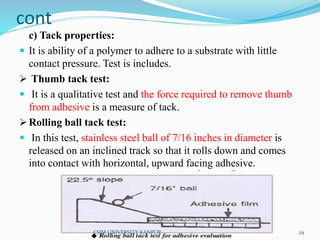
 Rolling ball tack test:
 In this test, stainless steel ball of 7/16 inches in diameter is
released on an inclined track so that it rolls down and comes
into contact with horizontal, upward facing adhesive.
CSJM UNIVERSITY KANPUR 29
Cont....
 Quick Stick (peel-tack) test:
 The peel force required breaking the bond between an
adhesive and substrate is measured by pulling the tape away
from the substrate at 90 at the speed of 12 inch/min.
CSJM UNIVERSITY KANPUR 30
Cont.....
 Probe Tack test:
 The tip of a clean probe is contact with adhesive and bond is
formed between probe and adhesive.
 The force required to pull the probe away from the adhesive
at fixed rate is recorded as tack and it is expressed in grams
CSJM UNIVERSITY KANPUR 31
In- vitro evaluation
In-vitro drug release
studies
In-vitro skin
permeation studies
CSJM UNIVERSITY KANPUR 32
In-vitro evaluation
 In- vitro drug release studies
 A number of mathematical model is describe the drug
dissolution kinetics from controlled release drug delivery
system e.g., Higuchi model, First order, Zero order and Peppas
& Korsenmeyer model.
 The dissolution data is fitted to these models and obtained
the release mechanism of the drug. There are various
methods available for determination of drug release rate of
TDDS.
CSJM UNIVERSITY KANPUR 33
Cont..
 Higuchi model
A=[D (2C-Cs) Cs x t] ½
A – amount of drug released
in time ‘t’ per unit area
C – initial drug concentration
Cs – drug solubility in the
matrix media
D – diffusivity of drug
molecule in the matrix
substance
 Peppas & Korsenmeyer
model
F = (Mt/M) = Km tn
F – fraction of drug release at
time ‘t’
Mt - amount of drug release at
time ‘t’
M – total amount of drug in
dosage form
Km - kinetic constant
n – diffusion or release
exponent
CSJM UNIVERSITY KANPUR 34
cont.
 Paddle over disc: (USP apparatus 5)
 This method the transdermal system is attached to a disc or
cell resting at the bottom of the vessel which contains medium
at 32 ±5°C.
CSJM UNIVERSITY KANPUR 35
Cont...
 Cylinder modified USP Basket: (USP apparatus 6)
This method is similar to the USP basket type dissolution
apparatus, except that the system is attached to the surface of a
hollow cylinder immersed in medium at 32 ±5°C.
CSJM UNIVERSITY KANPUR 36
In – vivo evaluation
1. Animal models:
 In-vivo animals models are preferred because considerable
time and resources are required to carry out studies in humans.
Some of the species are used : mouse, rabbit, rat, cat, dog, pig,
house, monkey small hairy animals (e.g. rat, rabbit) is most
reliable or in vivo evaluation of transdermal patches standard
radiotracer methodology used.
2. Human models:
 It is first described by Fieldman and Maibach.
 They includes determination of percutaneous absorption by an
indirect method of measuring radioactivity in excreta following
topical application of the labeled drug. 14C is generally used
for radio labeling.
CSJM UNIVERSITY KANPUR 37
Cont....
(a) Reservoir technique :
It makes use of the relationship
between stratum corneum
reservoir function and in vivo
percutaneous absorption to
predict in vivo penetration.
This method is involves a
simple, short exposure of the
skin to the compound under
study followed by removal of
the stratum corneum by tape
stripping and analysis of the
content of the compound in
the stratum corneum.
(b) Mass balance technique
The application site is covered
with an occlusive chamber,
the chamber being replaced by
a new one after a particular
time interval. The site is also
subjected to washing at these
time.
Radio labeling techniques are
used and the chamber,
washing and the faces and
urine of the patients are
subjected to analysis. In this
technique include
achievement of mass balance
CSJM UNIVERSITY KANPUR 38
ADVANCES IN TRANSDERMAL DRUG
DELIVERY SYSTEMS
 Transdermal drug delivery technologies are becoming one
of the fastest growing sectors with in the pharmaceutical
industry.
 Advance in drug delivery systems having increasingly
brought about rate controlled delivery with fewer side
effects as well as increased efficacy and constant drug
delivery.
CSJM UNIVERSITY KANPUR 39
REFERENCES
1. Y.W. Chien, Noval Drug Delivery Systems, 2nd edition,
revised and expanded, Marcel Dekker, Inc., new York,
1992.
2. N. K. Jain, Controlled and Noval Drug Delivery ,CBS
Publishers & Distributors, New Delhi, first edition 1997
3. (reprint in 2001). Jain NK. Controlled And Novel Drug
Delivery. 1st edition. CBS Publishers &
Distributors.1997,107-110.
4. Rolling ball tack test for adhesive evaluation T Himanshi,
S Ruchika. Transdermal Drug Delivery System: A Review.
International Journal Of Pharmaceutical Sciences And
Research. 2016;7(6): 2274-90
CSJM UNIVERSITY KANPUR 40
CSJM UNIVERSITY KANPUR 41

Tdds ppt

  • 1.
    Presented by; Alka Diwakar M.Pharm(Pharmaceutics) 1st Semester (2019-2020) CSJM UNIVERSITY KANPUR UNIVERSITY INSTITUTE OF PHARMACY TRANSDERMAL DRUG DELIVERY SYSTEM 1CSJM UNIVERSITY KANPUR
  • 2.
    INTRODUCTION The passage ofsubstance from the outside of the skin through its various layers into the bloodstream. Definition: Transdermal drug delivery system can deliver the drugs through the skin portal to systemic circulation at a predetermined rate and maintain clinically the effective concentration over the prolonged period of time. CSJM UNIVERSITY KANPUR 2
  • 3.
     Transdermal drugdelivery system (TDDS)also know as pacth’s are dosage from designed to deliver therapeutically effective amount of drug across a patient’s skin  The primary objective of controlled drug delivery is to ensure safety and efficacy of the drug as well as patients compliance.  TDDS a realistic application as the next generation of drug delivery. CSJM UNIVERSITY KANPUR 3
  • 4.
    ANATOMY OF SKIN It composed of 3 layer- a) Epidermis- i) Stratum Corneum ii) Stratum Lucidum iii) Stratum Granulosum iv) Stratum Spinosum b)Dermis c)Subcutaneous CSJM UNIVERSITY KANPUR 4
  • 5.
    PATHWAY OF DRUGABSORPTION THROUGH THE SKIN  Intercellular diffusion through lipid layer.  Transcellular diffusion through lipid bilayer and keratinocytes .  Diffusion through hair follicles and sweat ducts. The lipophilic drug pass mainly through the lipid matrix present in the stratum corneum . The hydrophilic drug permeate through hydrated stratum corneum by polar pathway. CSJM UNIVERSITY KANPUR 5
  • 6.
    FUNDAMENTALS OF SKINPERMEATION Rate of permeation dQ/dt across a skin can be expressed as dQ/dt = Ps[ Cd - Cr ] Where dQ/dt – Rate of permeation Ps – Permeability coefficient Cd – Concentration in donor compartment Cr – Concentration in receptor compartment CSJM UNIVERSITY KANPUR 6
  • 7.
    FACTORS AFFECTING TRANSDERMAL BIOAVAILABILITY . Physiological factors  Formulation factors  Physicochemical factors.  Physiological factors 1. Hydration of skin 2. Skin temperature 3. Skin age 4. Blood flow 5. Regional skin sites 6. Skin metabolism Contd…CSJM UNIVERSITY KANPUR 7
  • 8.
    Formulation factor  Releaserate of the drug  Ingredient of the formulation Presence of permeation enhancers Physicochemical factors of drug  PH  Diffusion coefficient  Partition coefficient  Drug concentration  Molecular size and shape CSJM UNIVERSITY KANPUR 8
  • 9.
    Contd... Advantages of TDDS Avoidance of first-pass effect,  Comparable characteristic with IV infusion.  Ease of termination of drug action, if necessary.  Long duration of action.  No interference with gastric and intestinal fluids.  Suitable for administered of drug having – Very short half-life e.g. NITROGLYCERINE Narrow therapeutic window. Poor oral availability CSJM UNIVERSITY KANPUR 9
  • 10.
    DISADVANTAGES OF TDDS Transdermal drug delivery system cannot deliver ionic drugs.  It cannot achieve high drug levels in blood.  It cannot develop for drugs of large molecular size.  It cannot develop if drug or formulation causes irritation to skin.  Possibility of local irritation at site of application.  May cause allergic reaction.  Long time adherence is difficult. CSJM UNIVERSITY KANPUR 10
  • 11.
    TYPES OF TRASDERMALPATCHS 1. SINGLE-LAYER DRUG-IN-ADHESIVE 2. MULTI-LAYER DRUG-IN-ADHESIVE 3. RESERVOIR SYSTEM 4. MATRIX SYSTEM CSJM UNIVERSITY KANPUR 11
  • 12.
    SINGLE-LAYER DRUG-IN- ADHESIVE The adhesive layer of this system contains the drug.  The adhesive layer not only severs adhere the various layer together, along with the entire system of the skin, but it is also responsible for the releasing of the drug.  The adhesive layer is surrounded by a temporary liner and a backing  Example –Deponit CSJM UNIVERSITY KANPUR 12
  • 13.
    MULTI-LAYER DRUG-IN-ADHESIVE  Similarto the single layer system in the both adhesive layer are also responsible for the releasing of the drug.  In add another layer of drug-in adhesive usually separated by a membrane .  The patch also has a temporary liner layer and permanent backing .  Example- Nicotrol. CSJM UNIVERSITY KANPUR 13
  • 14.
    RESERVOIR SYSTEM  Reservoirtransdermal system has a separate drug layer.  The drug layer is a liquid compartment containing a drug solution or suspension separated by the adhesive layer.  This patch is also packed by the backing layer this type of system the rate of release is zero oder.  Example – Transdermal -Nitro CSJM UNIVERSITY KANPUR 14
  • 15.
    MATRIX SYSTEM  Matrixsystem has a drug layer of a semisolid matrix containing a drug solution or suspension .  The adhesive layer in this patch surrounded the drug layer partially over layering it.  Example – Nitro-Dur. CSJM UNIVERSITY KANPUR 15
  • 16.
    TYPES OF TRANSDERMALPATCHES AVAILABLE TODAY  Transdermal patch Nicotine.  Transdermal patch for severe pain.  Transdermal patch for harmone therapy.  Transdermal patch for anti hypertensive,  Transdermal patch for anti depressant.  Transdermal patch for deficit hyper activity disorder.  Transdermal patch for vitamin B12.  Transdermal patch for easy breath. CSJM UNIVERSITY KANPUR 16
  • 17.
  • 18.
    FORMULATION OF TRANSDERMALPATCH COMPONENT EXAMPLES DRUG Fentanyl, Ketoprofen Polymer matrix Synthetic polymers Polyvinyl alcohol, Polypropylene. Natural polymers Gums, Waxes, Starch. Penetration enhancers Water, Alcohols, Glycols, Fatty acid Adhesive Polyisobutylene. Backing membrane Silicon Release liner Laminates of metals and foils of polyesters. Other excipients Solvent Methanol, Chloroform, Acetone. plasticizer Propylene glycol .CSJM UNIVERSITY KANPUR 18
  • 19.
  • 20.
    Physicochemical Evaluation  Thicknessof patch  Weight uniformity  Drug content determination  Content uniformity  Folding endurance  Flatness  Percentage moisture content  Interaction studies  Percentage moisture uptake  Water vapour permeability evaluation  Tensile strength  Evaluation of adhesive A. shear adhesion test B. Peel adhesion test C. Tack properties a) Thumb tack test b) Rolling ball test c) Quick stick (peel tack test) test CSJM UNIVERSITY KANPUR 20
  • 21.
    Physicochemial evaluation  Interactionstudies Interaction studies(drug and excipient). Interaction studies ( drug and excipients ) are commonly carried out in Thermal analysis, Fourier transform infrared spectroscopy (FTIR), UV and chromatographic techniques by comparing their physicochemical characters such as assay, melting point, wave numbers, absorption maxima etc.  Thickness of the patch: The thickness of the drug loaded patch is measured in different points by using a digital micrometer. . CSJM UNIVERSITY KANPUR 21
  • 22.
    Cont.  Weight uniformity: Theprepared patches are to be dried at 60°c for 4 hrs before testing. Individually weighing 10 randomly selected patches a specified area of patch is to be cut in different parts of the patch and weigh in digital balance. CSJM UNIVERSITY KANPUR 22
  • 23.
    Cont....  Drug contentdetermination: accurately weighed portion of film (about 100 mg) is dissolved in 100 ml of suitable solvent & shaken continuously for 24 h, then sonicated After sonication and subsequent filtration, drug in solution is estimated spectrophotometrically CSJM UNIVERSITY KANPUR 23
  • 24.
    Cont..  Content uniformitytest: 10 patches are selected, in 9 out of 10 patches have content between 85% to 115% and 1 has content not less than 75% to 125% of the specified value, patches pass the test 3 patches range of 75% to 125%, then additional 20 patches are tested . If these 20 patches have range from 85% to 115%, then the transdermal patches pass the test. CSJM UNIVERSITY KANPUR 24
  • 25.
    Cont...  Folding endurance: Flatness test: In flatness determination one strip is cut from the centre and two from each side of patches. The length of each strip is measured and variation in length is measured by determining percent constriction. 0 % constriction is equivalent to 100 % flatness. % constriction = I1 – I2 X 100 ∕I1 I1 = Initial length of each strip I2 = Final length of each strip Repeatedly folding a small strip of the patch at the same place till it broke. The number of times the patch could be folded at the same place without breaking Folding endurance value CSJM UNIVERSITY KANPUR 25
  • 26.
    Cont....  Percentage Moisturecontent:  calcium chloride  Percentage moisture content = [Initial weight - Final weight/ Final weight] ×100  Percentage Moisture uptake:  potassium chloride  Percentage moisture uptake = [Final weight - Initial weight/ initial weight] ×100 CSJM UNIVERSITY KANPUR 26
  • 27.
    Cont...  Evaluation ofadhesive a) Shear Adhesion test: Shear adhesion strength is determined by measuring (cohesive strength of an adhesive polymer) the time it takes to pull the tape off the plate. CSJM UNIVERSITY KANPUR 27
  • 28.
    Cont.... b) Peel Adhesiontest:  In this test, the force required to remove an adhesive coating form a test substrate is referred to as peel adhesion. CSJM UNIVERSITY KANPUR 28
  • 29.
    cont c) Tack properties: It is ability of a polymer to adhere to a substrate with little contact pressure. Test is includes.  Thumb tack test:  It is a qualitative test and the force required to remove thumb from adhesive is a measure of tack.  Rolling ball tack test:  In this test, stainless steel ball of 7/16 inches in diameter is released on an inclined track so that it rolls down and comes into contact with horizontal, upward facing adhesive. CSJM UNIVERSITY KANPUR 29
  • 30.
    Cont....  Quick Stick(peel-tack) test:  The peel force required breaking the bond between an adhesive and substrate is measured by pulling the tape away from the substrate at 90 at the speed of 12 inch/min. CSJM UNIVERSITY KANPUR 30
  • 31.
    Cont.....  Probe Tacktest:  The tip of a clean probe is contact with adhesive and bond is formed between probe and adhesive.  The force required to pull the probe away from the adhesive at fixed rate is recorded as tack and it is expressed in grams CSJM UNIVERSITY KANPUR 31
  • 32.
    In- vitro evaluation In-vitrodrug release studies In-vitro skin permeation studies CSJM UNIVERSITY KANPUR 32
  • 33.
    In-vitro evaluation  In-vitro drug release studies  A number of mathematical model is describe the drug dissolution kinetics from controlled release drug delivery system e.g., Higuchi model, First order, Zero order and Peppas & Korsenmeyer model.  The dissolution data is fitted to these models and obtained the release mechanism of the drug. There are various methods available for determination of drug release rate of TDDS. CSJM UNIVERSITY KANPUR 33
  • 34.
    Cont..  Higuchi model A=[D(2C-Cs) Cs x t] ½ A – amount of drug released in time ‘t’ per unit area C – initial drug concentration Cs – drug solubility in the matrix media D – diffusivity of drug molecule in the matrix substance  Peppas & Korsenmeyer model F = (Mt/M) = Km tn F – fraction of drug release at time ‘t’ Mt - amount of drug release at time ‘t’ M – total amount of drug in dosage form Km - kinetic constant n – diffusion or release exponent CSJM UNIVERSITY KANPUR 34
  • 35.
    cont.  Paddle overdisc: (USP apparatus 5)  This method the transdermal system is attached to a disc or cell resting at the bottom of the vessel which contains medium at 32 ±5°C. CSJM UNIVERSITY KANPUR 35
  • 36.
    Cont...  Cylinder modifiedUSP Basket: (USP apparatus 6) This method is similar to the USP basket type dissolution apparatus, except that the system is attached to the surface of a hollow cylinder immersed in medium at 32 ±5°C. CSJM UNIVERSITY KANPUR 36
  • 37.
    In – vivoevaluation 1. Animal models:  In-vivo animals models are preferred because considerable time and resources are required to carry out studies in humans. Some of the species are used : mouse, rabbit, rat, cat, dog, pig, house, monkey small hairy animals (e.g. rat, rabbit) is most reliable or in vivo evaluation of transdermal patches standard radiotracer methodology used. 2. Human models:  It is first described by Fieldman and Maibach.  They includes determination of percutaneous absorption by an indirect method of measuring radioactivity in excreta following topical application of the labeled drug. 14C is generally used for radio labeling. CSJM UNIVERSITY KANPUR 37
  • 38.
    Cont.... (a) Reservoir technique: It makes use of the relationship between stratum corneum reservoir function and in vivo percutaneous absorption to predict in vivo penetration. This method is involves a simple, short exposure of the skin to the compound under study followed by removal of the stratum corneum by tape stripping and analysis of the content of the compound in the stratum corneum. (b) Mass balance technique The application site is covered with an occlusive chamber, the chamber being replaced by a new one after a particular time interval. The site is also subjected to washing at these time. Radio labeling techniques are used and the chamber, washing and the faces and urine of the patients are subjected to analysis. In this technique include achievement of mass balance CSJM UNIVERSITY KANPUR 38
  • 39.
    ADVANCES IN TRANSDERMALDRUG DELIVERY SYSTEMS  Transdermal drug delivery technologies are becoming one of the fastest growing sectors with in the pharmaceutical industry.  Advance in drug delivery systems having increasingly brought about rate controlled delivery with fewer side effects as well as increased efficacy and constant drug delivery. CSJM UNIVERSITY KANPUR 39
  • 40.
    REFERENCES 1. Y.W. Chien,Noval Drug Delivery Systems, 2nd edition, revised and expanded, Marcel Dekker, Inc., new York, 1992. 2. N. K. Jain, Controlled and Noval Drug Delivery ,CBS Publishers & Distributors, New Delhi, first edition 1997 3. (reprint in 2001). Jain NK. Controlled And Novel Drug Delivery. 1st edition. CBS Publishers & Distributors.1997,107-110. 4. Rolling ball tack test for adhesive evaluation T Himanshi, S Ruchika. Transdermal Drug Delivery System: A Review. International Journal Of Pharmaceutical Sciences And Research. 2016;7(6): 2274-90 CSJM UNIVERSITY KANPUR 40
  • 41.