CORPORATE FORM OF
ORGANIZATION
 A corporation is a legal entity created by
law that is separate and distinct from its
owners
Accounting for
shareholders
equity
Lesson
CLASSIFICATION OF
CORPORATIONS
 A corporation’s purpose may be to earn
a profit, or it may be organized as non-
profit.
 Classification by ownership distinguishes
between publicly-held corporations and
privately-held corporations.
CHARACTERISTICS
 Separate legal existence
 Limited liability of shareholders
 Transferable ownership rights
 Ability to acquire capital
 Continuous life
 Corporation management
 Government regulations
 Additional taxes
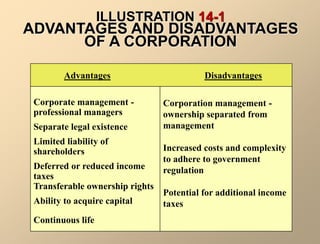
ILLUSTRATION 14-1
ADVANTAGES AND DISADVANTAGES
OF A CORPORATION
Advantages Disadvantages
Corporate management -
professional managers
Separate legal existence
Limited liability of
shareholders
Deferred or reduced income
taxes
Transferable ownership rights
Ability to acquire capital
Continuous life
Corporation management -
ownership separated from
management
Increased costs and complexity
to adhere to government
regulation
Potential for additional income
taxes
ORGANIZATION COSTS
 Costs incurred in forming a corporation are
called organization costs.
 These costs include fees to underwriters,
legal fees, incorporation fees, and
promotional expenditures.
 Organization costs are normally expensed in
the year the organization cost is incurred.
SHAREHOLDER RIGHTS
 To raise capital, the corporation sells
shares
 If only one class of shares-common
shares
 Ownership rights specified in articles of
incorporation or by-laws
– Voting…owners
SHARE TERMINOLOGY
 Authorized shares – maximum amount
of shares a corporation is allowed to sell
as authorized by corporate charter
 Issued shares – number of shares sold
 How many shares should be authorized for
sale?
 How should the shares be issued?
 At what price should the shares be issued?
 What value should be assigned to the
shares?
SHARE ISSUE CONSIDERATION
STOCK MARKET PRICE
 Shares of publicly held companies are
traded on organized exchanges at dollar
prices per share established by the
interaction between buyers and sellers
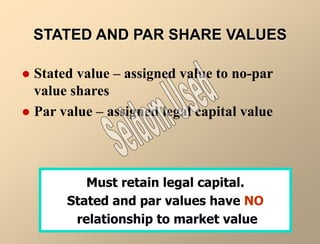
 Stated value – assigned value to no-par
value shares
 Par value – assigned legal capital value
STATED AND PAR SHARE VALUES
Must retain legal capital.
Stated and par values have NO
relationship to market value
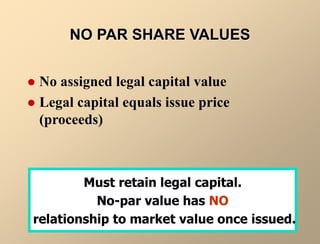
NO PAR SHARE VALUES
 No assigned legal capital value
 Legal capital equals issue price
(proceeds)
Must retain legal capital.
No-par value has NO
relationship to market value once issued.
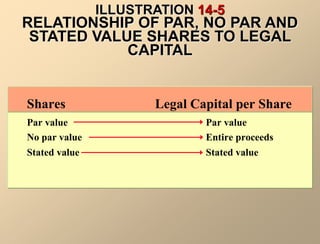
ILLUSTRATION 14-5
RELATIONSHIP OF PAR, NO PAR AND
STATED VALUE SHARES TO LEGAL
CAPITAL
Shares Legal Capital per Share
Par value Par value
No par value Entire proceeds
Stated value Stated value
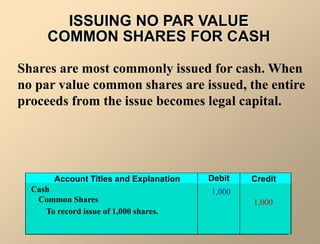
Account Titles and Explanation Debit Credit
Cash
Common Shares
To record issue of 1,000 shares.
ISSUING NO PAR VALUE
COMMON SHARES FOR CASH
Shares are most commonly issued for cash. When
no par value common shares are issued, the entire
proceeds from the issue becomes legal capital.
1,000
1,000
CORPORATE CAPITAL
 Shareholders’ equity (owner’s equity)
 The shareholders’ equity section of a
corporation’s balance sheet consists of:
– Contributed capital
• Share capital
• Additional contributed capital
– Retained earnings
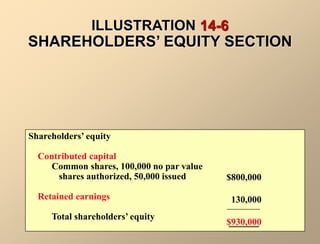
ILLUSTRATION 14-6
SHAREHOLDERS’ EQUITY SECTION
Shareholders’ equity
Contributed capital
Common shares, 100,000 no par value
shares authorized, 50,000 issued
Retained earnings
Total shareholders’ equity
$800,000
130,000
$930,000
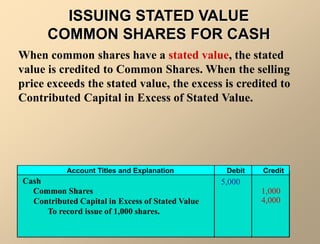
ISSUING STATED VALUE
COMMON SHARES FOR CASH
Account Titles and Explanation Debit Credit
Cash
Common Shares
Contributed Capital in Excess of Stated Value
To record issue of 1,000 shares.
5,000
1,000
4,000
When common shares have a stated value, the stated
value is credited to Common Shares. When the selling
price exceeds the stated value, the excess is credited to
Contributed Capital in Excess of Stated Value.
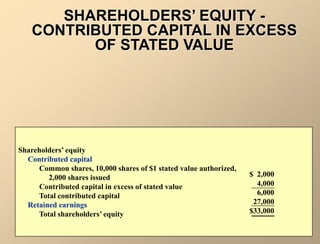
SHAREHOLDERS’ EQUITY -
CONTRIBUTED CAPITAL IN EXCESS
OF STATED VALUE
Shareholders’ equity
Contributed capital
Common shares, 10,000 shares of $1 stated value authorized,
2,000 shares issued
Contributed capital in excess of stated value
Total contributed capital
Retained earnings
Total shareholders’ equity
$ 2,000
4,000
6,000
27,000
$33,000
ISSUING COMMON SHARES FOR
SERVICES OR NON-CASH ASSETS
 Shares may be issued for services, such as
compensation to lawyers, or for non-cash assets,
such as land.
 When common shares are issued for services or
non-cash assets, cost is either the fair market
value of the consideration given up or the
consideration received, whichever is more clearly
determinable.
REACQUIRED SHARES
 Reacquired shares are a corporation’s own
shares that have been issued, fully paid for,
and then reacquired by the corporation.
 Reacquired shares are generally retired
and cancelled.
 In certain restricted circumstances, these
shares are not retired, but are held as
treasury shares for later reissue.
REACQUISITION OF SHARES
 Why would a company choose to
reacquire its shares?
– Reduce quantity/raise share price
– Increase EPS
– If authorized share limit reached, may need
additional shares for use in bonus or
compensation plans or acquisitions
 Preferred shares have priority over common
shares with regards to:
1. Dividends and
2. Assets in the event of liquidation
 Preferred shareholders usually do not have
voting rights
 Preferred shares are shown first in the share
capital section of shareholders' equity
PREFERRED SHARES
 Liquidation preference
 Cumulative (dividends in arrears)
 Convertible (book value)
 Redeemable/callable (company option)
 Retractable (shareholder option)
PREFERRED SHARE
PREFERENCES
DIVIDEND PREFERENCES
CUMULATIVE DIVIDEND
 A cumulative dividend requires that preferred
shareholders be paid both current and prior year
dividends before common shareholders receive any
dividends.
 Preferred dividends not declared in a given period are
called dividends in arrears.
 Dividends in arrears are not considered a liability, but
the amount of the dividends in arrears should be
disclosed in the notes to the financial statements.
CONVERTIBLE PREFERRED
SHARES
 Convertible preferred shares allow the exchange
of preferred shares into common shares at a
specified ratio.
 This kind of share is purchased by investors who
want the greater security of a preferred share, but
who also desire the added option of conversion.
 In recording the conversion, the book value of the
preferred shares is used.
 The conversion of preferred shares does not result
in either gain or loss to the corporation.
 The market value of the shares is not considered.
REDEEMABLE PREFERRED
 Redeemable (callable) preferred shares grant the issuing
corporation the right to purchase the shares from
shareholders at specified future dates and prices.
 This call feature allows some flexibility to a corporation
by enabling it to eliminate this type of equity when
it is advantageous to do so.
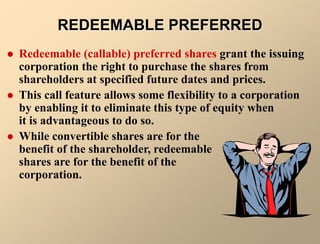
 While convertible shares are for the
benefit of the shareholder, redeemable
shares are for the benefit of the
corporation.
RETRACTABLE PREFERRED
 Retractable preferred shares are similar to
redeemable preferred shares except that the
shareholder can redeem shares at their option instead
of the corporation’s.
 Retractable preferred shares and debt have many
similarities.
 Both offer a rate of return to the investor, and with the
redemption of the shares they both offer a repayment
of the principal investment.
 Retractable preferred shares are presented in the
liability section of the balance sheet rather than in the
equity section because it has more of the features of
debt than equity.
REMINDER-
STATEMENT PRESENTATION OF
SHAREHOLDERS’ EQUITY
 In the shareholders’ equity section of the balance
sheet, contributed capital and retained earnings
are reported and the specific sources of
contributed capital are identified.
 Within contributed capital, two classifications are
recognized:
1. Share capital
2. Additional contributed capital
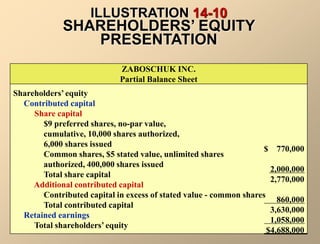
ILLUSTRATION 14-10
SHAREHOLDERS’ EQUITY
PRESENTATION
ZABOSCHUK INC.
Partial Balance Sheet
Shareholders’ equity
Contributed capital
Share capital
$9 preferred shares, no-par value,
cumulative, 10,000 shares authorized,
6,000 shares issued
Common shares, $5 stated value, unlimited shares
authorized, 400,000 shares issued
Total share capital
Additional contributed capital
Contributed capital in excess of stated value - common shares
Total contributed capital
Retained earnings
Total shareholders’ equity
$ 770,000
2,000,000
2,770,000
860,000
3,630,000
1,058,000
$4,688,000
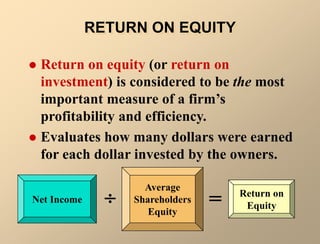
RETURN ON EQUITY
 Return on equity (or return on
investment) is considered to be the most
important measure of a firm’s
profitability and efficiency.
 Evaluates how many dollars were earned
for each dollar invested by the owners.
 =
Net Income
Average
Shareholders
Equity
Return on
Equity
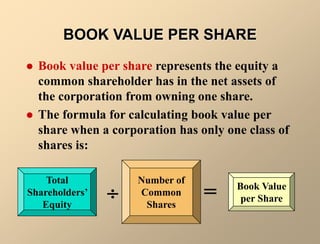
BOOK VALUE PER SHARE
 Book value per share represents the equity a
common shareholder has in the net assets of
the corporation from owning one share.
 The formula for calculating book value per
share when a corporation has only one class of
shares is:
 =
Total
Shareholders’
Equity
Number of
Common
Shares
Book Value
per Share
When a company has both preferred and common
shares, the calculation of book value is more complex.
Steps required are:
1. Calculate the preferred shareholders’ equity (the sum of
redemption price of preferred shares plus any
cumulative dividends in arrears).
2. Determine the common shareholders’ equity (total
shareholders’ equity less preferred shareholders’ equity).
3. Divide common shareholders’ equity by the number of
common shares to determine book value per share.
CALCULATION OF BOOK VALUE
WITH PREFERRED SHARES
BOOK VALUE VS. MARKET VALUE
 Book value per share seldom equals market value.
 Book value is based on historical costs; market
value reflects the subjective judgement of
thousands of shareholders and prospective
investors about the company’s potential for future
earnings and dividends.
 Market value per share may exceed book value per
share, but that fact does not necessarily mean that
the shares are overpriced.
END
THANK YOU

ACCOUNTING FOR SHAREHOLDERS EQUITY ..ppt

  • 1.
    CORPORATE FORM OF ORGANIZATION A corporation is a legal entity created by law that is separate and distinct from its owners
  • 2.
  • 3.
    CLASSIFICATION OF CORPORATIONS  Acorporation’s purpose may be to earn a profit, or it may be organized as non- profit.  Classification by ownership distinguishes between publicly-held corporations and privately-held corporations.
  • 4.
    CHARACTERISTICS  Separate legalexistence  Limited liability of shareholders  Transferable ownership rights  Ability to acquire capital  Continuous life  Corporation management  Government regulations  Additional taxes
  • 5.
    ILLUSTRATION 14-1 ADVANTAGES ANDDISADVANTAGES OF A CORPORATION Advantages Disadvantages Corporate management - professional managers Separate legal existence Limited liability of shareholders Deferred or reduced income taxes Transferable ownership rights Ability to acquire capital Continuous life Corporation management - ownership separated from management Increased costs and complexity to adhere to government regulation Potential for additional income taxes
  • 6.
    ORGANIZATION COSTS  Costsincurred in forming a corporation are called organization costs.  These costs include fees to underwriters, legal fees, incorporation fees, and promotional expenditures.  Organization costs are normally expensed in the year the organization cost is incurred.
  • 7.
    SHAREHOLDER RIGHTS  Toraise capital, the corporation sells shares  If only one class of shares-common shares  Ownership rights specified in articles of incorporation or by-laws – Voting…owners
  • 8.
    SHARE TERMINOLOGY  Authorizedshares – maximum amount of shares a corporation is allowed to sell as authorized by corporate charter  Issued shares – number of shares sold
  • 9.
     How manyshares should be authorized for sale?  How should the shares be issued?  At what price should the shares be issued?  What value should be assigned to the shares? SHARE ISSUE CONSIDERATION
  • 10.
    STOCK MARKET PRICE Shares of publicly held companies are traded on organized exchanges at dollar prices per share established by the interaction between buyers and sellers
  • 11.
     Stated value– assigned value to no-par value shares  Par value – assigned legal capital value STATED AND PAR SHARE VALUES Must retain legal capital. Stated and par values have NO relationship to market value
  • 12.
    NO PAR SHAREVALUES  No assigned legal capital value  Legal capital equals issue price (proceeds) Must retain legal capital. No-par value has NO relationship to market value once issued.
  • 13.
    ILLUSTRATION 14-5 RELATIONSHIP OFPAR, NO PAR AND STATED VALUE SHARES TO LEGAL CAPITAL Shares Legal Capital per Share Par value Par value No par value Entire proceeds Stated value Stated value
  • 14.
    Account Titles andExplanation Debit Credit Cash Common Shares To record issue of 1,000 shares. ISSUING NO PAR VALUE COMMON SHARES FOR CASH Shares are most commonly issued for cash. When no par value common shares are issued, the entire proceeds from the issue becomes legal capital. 1,000 1,000
  • 15.
    CORPORATE CAPITAL  Shareholders’equity (owner’s equity)  The shareholders’ equity section of a corporation’s balance sheet consists of: – Contributed capital • Share capital • Additional contributed capital – Retained earnings
  • 16.
    ILLUSTRATION 14-6 SHAREHOLDERS’ EQUITYSECTION Shareholders’ equity Contributed capital Common shares, 100,000 no par value shares authorized, 50,000 issued Retained earnings Total shareholders’ equity $800,000 130,000 $930,000
  • 17.
    ISSUING STATED VALUE COMMONSHARES FOR CASH Account Titles and Explanation Debit Credit Cash Common Shares Contributed Capital in Excess of Stated Value To record issue of 1,000 shares. 5,000 1,000 4,000 When common shares have a stated value, the stated value is credited to Common Shares. When the selling price exceeds the stated value, the excess is credited to Contributed Capital in Excess of Stated Value.
  • 18.
    SHAREHOLDERS’ EQUITY - CONTRIBUTEDCAPITAL IN EXCESS OF STATED VALUE Shareholders’ equity Contributed capital Common shares, 10,000 shares of $1 stated value authorized, 2,000 shares issued Contributed capital in excess of stated value Total contributed capital Retained earnings Total shareholders’ equity $ 2,000 4,000 6,000 27,000 $33,000
  • 19.
    ISSUING COMMON SHARESFOR SERVICES OR NON-CASH ASSETS  Shares may be issued for services, such as compensation to lawyers, or for non-cash assets, such as land.  When common shares are issued for services or non-cash assets, cost is either the fair market value of the consideration given up or the consideration received, whichever is more clearly determinable.
  • 20.
    REACQUIRED SHARES  Reacquiredshares are a corporation’s own shares that have been issued, fully paid for, and then reacquired by the corporation.  Reacquired shares are generally retired and cancelled.  In certain restricted circumstances, these shares are not retired, but are held as treasury shares for later reissue.
  • 21.
    REACQUISITION OF SHARES Why would a company choose to reacquire its shares? – Reduce quantity/raise share price – Increase EPS – If authorized share limit reached, may need additional shares for use in bonus or compensation plans or acquisitions
  • 22.
     Preferred shareshave priority over common shares with regards to: 1. Dividends and 2. Assets in the event of liquidation  Preferred shareholders usually do not have voting rights  Preferred shares are shown first in the share capital section of shareholders' equity PREFERRED SHARES
  • 23.
     Liquidation preference Cumulative (dividends in arrears)  Convertible (book value)  Redeemable/callable (company option)  Retractable (shareholder option) PREFERRED SHARE PREFERENCES
  • 24.
    DIVIDEND PREFERENCES CUMULATIVE DIVIDEND A cumulative dividend requires that preferred shareholders be paid both current and prior year dividends before common shareholders receive any dividends.  Preferred dividends not declared in a given period are called dividends in arrears.  Dividends in arrears are not considered a liability, but the amount of the dividends in arrears should be disclosed in the notes to the financial statements.
  • 25.
    CONVERTIBLE PREFERRED SHARES  Convertiblepreferred shares allow the exchange of preferred shares into common shares at a specified ratio.  This kind of share is purchased by investors who want the greater security of a preferred share, but who also desire the added option of conversion.  In recording the conversion, the book value of the preferred shares is used.  The conversion of preferred shares does not result in either gain or loss to the corporation.  The market value of the shares is not considered.
  • 26.
    REDEEMABLE PREFERRED  Redeemable(callable) preferred shares grant the issuing corporation the right to purchase the shares from shareholders at specified future dates and prices.  This call feature allows some flexibility to a corporation by enabling it to eliminate this type of equity when it is advantageous to do so.  While convertible shares are for the benefit of the shareholder, redeemable shares are for the benefit of the corporation.
  • 27.
    RETRACTABLE PREFERRED  Retractablepreferred shares are similar to redeemable preferred shares except that the shareholder can redeem shares at their option instead of the corporation’s.  Retractable preferred shares and debt have many similarities.  Both offer a rate of return to the investor, and with the redemption of the shares they both offer a repayment of the principal investment.  Retractable preferred shares are presented in the liability section of the balance sheet rather than in the equity section because it has more of the features of debt than equity.
  • 28.
    REMINDER- STATEMENT PRESENTATION OF SHAREHOLDERS’EQUITY  In the shareholders’ equity section of the balance sheet, contributed capital and retained earnings are reported and the specific sources of contributed capital are identified.  Within contributed capital, two classifications are recognized: 1. Share capital 2. Additional contributed capital
  • 29.
    ILLUSTRATION 14-10 SHAREHOLDERS’ EQUITY PRESENTATION ZABOSCHUKINC. Partial Balance Sheet Shareholders’ equity Contributed capital Share capital $9 preferred shares, no-par value, cumulative, 10,000 shares authorized, 6,000 shares issued Common shares, $5 stated value, unlimited shares authorized, 400,000 shares issued Total share capital Additional contributed capital Contributed capital in excess of stated value - common shares Total contributed capital Retained earnings Total shareholders’ equity $ 770,000 2,000,000 2,770,000 860,000 3,630,000 1,058,000 $4,688,000
  • 30.
    RETURN ON EQUITY Return on equity (or return on investment) is considered to be the most important measure of a firm’s profitability and efficiency.  Evaluates how many dollars were earned for each dollar invested by the owners.  = Net Income Average Shareholders Equity Return on Equity
  • 31.
    BOOK VALUE PERSHARE  Book value per share represents the equity a common shareholder has in the net assets of the corporation from owning one share.  The formula for calculating book value per share when a corporation has only one class of shares is:  = Total Shareholders’ Equity Number of Common Shares Book Value per Share
  • 32.
    When a companyhas both preferred and common shares, the calculation of book value is more complex. Steps required are: 1. Calculate the preferred shareholders’ equity (the sum of redemption price of preferred shares plus any cumulative dividends in arrears). 2. Determine the common shareholders’ equity (total shareholders’ equity less preferred shareholders’ equity). 3. Divide common shareholders’ equity by the number of common shares to determine book value per share. CALCULATION OF BOOK VALUE WITH PREFERRED SHARES
  • 33.
    BOOK VALUE VS.MARKET VALUE  Book value per share seldom equals market value.  Book value is based on historical costs; market value reflects the subjective judgement of thousands of shareholders and prospective investors about the company’s potential for future earnings and dividends.  Market value per share may exceed book value per share, but that fact does not necessarily mean that the shares are overpriced.
  • 34.