Corporate Strategy By KMI
Corporate Parent Many large businesses consist of a corporate parent and a number of SBUs SBUs have own products, markets, responsible for success and failure. Corporate parent has no direct contact with the buyers or competitors Role is to manage overall scope of organization Diversity of products and markets International and geographic diversity In the process can create or destroy value By KMI
Diversity of products & markets: advantages: economies of scope, corporate management skills and cross subsidy Economies of scope 1. Marketing synergy 2. Operating synergy 3. Investment synergy 4. Management synergy By KMI
Diversification Why Response to environment Risk spreading Expectation of stakeholders Related Diversification: is development beyond current products and markets but within the capabilities or value network of the organization (Starbucks) By KMI
Horizontal Integration: makes use of current capabilities by development into activities that are competitive with or directly complementary to a company’s present activities. An example would be a TV company that moved into film production. Vertical Integration: occurs when a company expands backwards and forwards within its existing value network and thus becomes its own supplier or distributor. Example Canned Milk/Dairy Farm. Example Cloth/Shirts making. By KMI
Vertical Integration Potential for success when final customers’ needs are not being properly satisfied Advantages: Secure supplies Strong relationships with customers Share of profits Effective differentiation Creation of entry barriers Disadvantages: Over-concentration No economies of scale – little technical advances By KMI
Unrelated Diversification Is the development of products and services beyond the current capabilities or value network. (Such a company also known as conglomerate) Advantages: Risk spreading Improved profit opportunities Escape from declining markets Use of company’s image and reputation Disadvantages: Dilution of share-holders earnings Lack of common identity or purpose Failure in one business will drag down the rest Lack of management experience By KMI
International Diversification Developing the global business Exporting: same product, economies of scale, low risk strategy, dependent on foreign intermediaries Overseas branches: high sales, replace intermediaries, set own branches Overseas production: so high sales, export costs rise too, overseas production, exploit local labor and other opportunities Insiderisation: adapt to local market and environment, multi-national, independent in managing business, exchange rate risk, political risk By KMI
Global company: central HR, R & D, Finance, integrate learning & skills, competencies and technologies in order to achieve global efficiencies with local experiences. By KMI
Corporate Parent & Value Creation Value creating roles Communicating vision to stakeholders and SBU managers Intervention to improve performance Provision of services, resources and expertise Value destruction:  Costs: must create value at least equal to these costs Corporate hierarchy: manager’s political ambitions Size and complexity: can hinder development Decision making can be slowed down. Response to market can also slow down By KMI
Approaches to value creation Portfolio managers: Services in financial disciplines; purchasing & acquiring companies; improve their performance; keep their own costs low; provide few central services Synergy managers: Pursue economies of scope, shared use of resources, need to overcome: cost involved in sharing, impact of self-interest in SBUs, incompatibility of systems & cultures among SBUs, variation in local conditions Parental developer: deploying its specific competencies to aid SBUs, must be able to do it, external capabilities may be bought if parent cannot do so cost effectively, understanding about SBUs By KMI
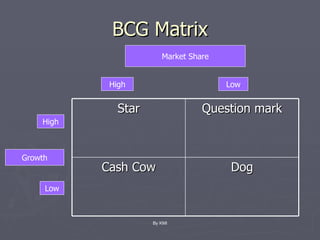
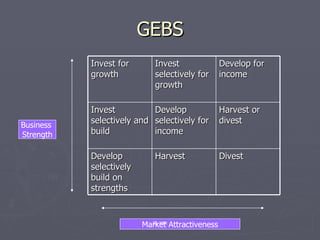
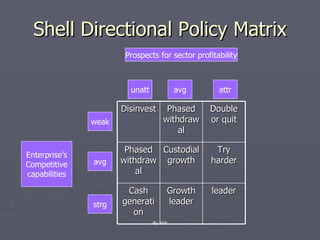
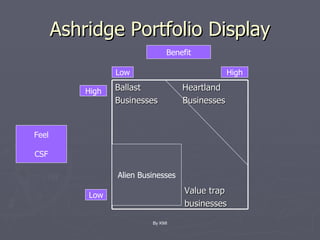
The Corporate Portfolio Build, Hold, Harvest, Divest BCG Matrix GEBS Shell Directional Matrix Ashridge Portfolio Display By KMI
BCG Matrix High Low High Low Market Share Growth By KMI Star Question mark Cash Cow Dog
GEBS Business  Strength Market Attractiveness By KMI Invest for growth Invest selectively for growth Develop for income Invest selectively and build Develop selectively for income Harvest or divest Develop selectively build on strengths Harvest Divest
Shell Directional Policy Matrix Prospects for sector profitability Enterprise’s Competitive capabilities weak avg strg unatt avg attr By KMI Disinvest Phased withdrawal Double or quit Phased withdrawal Custodial growth Try harder Cash generation Growth leader leader
Ashridge Portfolio Display Alien Businesses Benefit Feel CSF Low High Low High By KMI Ballast  Heartland  Businesses  Businesses Value trap businesses
Business Unit Strategy Coping successfully with competitive forces Cost-leadership (cost-focus) Differentiation leadership (differentiation – focus) Stuck in the middle By KMI
Cost Leadership Position of low cost producer in the entire industry Can compete on price Earn higher profits How? Set up production facilities to achieve economies of scale Use technology Exploit learning curve Concentrate on improved productivity Minimize overhead costs Get favorable access to source supply South West; Wal-Mart; Black n Decker  By KMI
Differentiation Particular characteristics of a firm’s product Break-through products Improved products Competitive products – attraction How? Build brand image Add special features Exploit other activities of value chain By KMI
The Strategy Clock Analyzing strategies in terms of price and perceived value (8 strategies) Draw on the board 1, 2 will attract customer on price 3 serviceability 4, 5 customized 6,7,8 destined to meet failure By KMI
Sustaining Competitive Advantage Need for rapid innovation Response to competitors’ moves Sustaining price based strategies: Low margins: scale/cross-subsidization Drive costs down Win price wars  No frills strategy By KMI
Sustaining Differentiation Difference must be valued by customers Obstruct imitation Cost advantage Intangible resources Lock-in: when a product becomes industry standard Factors influencing lock in: Perception of dominance First mover advantage Self-reinforcement Fierce defence By KMI
Strategy and Competition Short term moves Reposition strategy clock Counter attack Remain unpredictable Attack competitor’s weaknesses Give misleading signals Using value chain: create value, add/eliminate By KMI
Other strategies Product Market strategy Withdrawal/underperformance Change of objective/strategic fit Break up value of SBUs Divestment: to rationalize a business Selling off subsidiary To raise funds By KMI
Methods of Growth Building own products and markets Learning Innovation No target for acquisition Can be planned Financing from co’s current cash flow Unseen losses are less likely Economies of scale By KMI
Acquisitions and Mergers Buy a new product, market presence, distribution channel Utilization of production facilities, technologies, raw materials, bulk purchases Highly skilled management teams Cash resources Gain assets Tax advantage Risk spreading Hedge-hog Conglomerate diversification By KMI
Problems Costs Customers Incompatibility Personal goals Consultants Little chances of success Non financial factors By KMI
Joint Ventures Way of co-operation Consortia: on specific business areas, purchase or research Joint ventures: manufacturing, financial and marketing: a) cost sharing (b) cut risk (c) profits (d) knowledge sharing (e) synergies Licensing: commercial contract Sub-contracting By KMI
Disadvantages Conflict of interest Disagreements Chances of unilateral withdrawal Competencies may be acquired By KMI
Franchising Method of expansion Less capital by franchiser Franchisee pays set up and running costs Inputs: Franchiser: name, good will, management knowledge, expertise, support services, ads, training, R & D, site coordination Franchisee: capital, personal involvement, local market knowledge, pays to franchiser for rights and for support services, day to day operations By KMI
Advantages Reduces capital requirements Reduces HR resources requirements Speed of growth, improved return Specialization Low head office costs Reduced supervision costs Risk management  By KMI
Disadvantages Profits are shared Finding the right franchisee Control Risk to reputation Potential for conflict By KMI
Alliances Reasons: Cost sharing When take overs prohibited Complementary markets Learning Technology ( R & D ) Innovation Problems: core competencies/not new ones By KMI
Strategy & Market Position Leader: expand the market, product innovation, market share Challenger: trying to take over the leader, risky strategy Follower: status quo, me too Nicher: specialist By KMI
Success Criteria Suitability – strategic fit Feasibility – in terms of resources and competencies Acceptability – to stake holders By KMI
Suitability requirements Exploit strengths Rectify weaknesses Deflect threats Seize opportunities Goal achievement Competitive advantage Minimizing risk Feel Life Cycle analysis Business portfolio analysis TOWS By KMI
Feasibility: Ms Acceptability:  Achievement of financial goals: ROI, Profits, Growth, EPS, Cash flow, Price/earnings, market capitalization, CB analysis By KMI

Corporate strategy

  • 1.
  • 2.
    Corporate Parent Manylarge businesses consist of a corporate parent and a number of SBUs SBUs have own products, markets, responsible for success and failure. Corporate parent has no direct contact with the buyers or competitors Role is to manage overall scope of organization Diversity of products and markets International and geographic diversity In the process can create or destroy value By KMI
  • 3.
    Diversity of products& markets: advantages: economies of scope, corporate management skills and cross subsidy Economies of scope 1. Marketing synergy 2. Operating synergy 3. Investment synergy 4. Management synergy By KMI
  • 4.
    Diversification Why Responseto environment Risk spreading Expectation of stakeholders Related Diversification: is development beyond current products and markets but within the capabilities or value network of the organization (Starbucks) By KMI
  • 5.
    Horizontal Integration: makesuse of current capabilities by development into activities that are competitive with or directly complementary to a company’s present activities. An example would be a TV company that moved into film production. Vertical Integration: occurs when a company expands backwards and forwards within its existing value network and thus becomes its own supplier or distributor. Example Canned Milk/Dairy Farm. Example Cloth/Shirts making. By KMI
  • 6.
    Vertical Integration Potentialfor success when final customers’ needs are not being properly satisfied Advantages: Secure supplies Strong relationships with customers Share of profits Effective differentiation Creation of entry barriers Disadvantages: Over-concentration No economies of scale – little technical advances By KMI
  • 7.
    Unrelated Diversification Isthe development of products and services beyond the current capabilities or value network. (Such a company also known as conglomerate) Advantages: Risk spreading Improved profit opportunities Escape from declining markets Use of company’s image and reputation Disadvantages: Dilution of share-holders earnings Lack of common identity or purpose Failure in one business will drag down the rest Lack of management experience By KMI
  • 8.
    International Diversification Developingthe global business Exporting: same product, economies of scale, low risk strategy, dependent on foreign intermediaries Overseas branches: high sales, replace intermediaries, set own branches Overseas production: so high sales, export costs rise too, overseas production, exploit local labor and other opportunities Insiderisation: adapt to local market and environment, multi-national, independent in managing business, exchange rate risk, political risk By KMI
  • 9.
    Global company: centralHR, R & D, Finance, integrate learning & skills, competencies and technologies in order to achieve global efficiencies with local experiences. By KMI
  • 10.
    Corporate Parent &Value Creation Value creating roles Communicating vision to stakeholders and SBU managers Intervention to improve performance Provision of services, resources and expertise Value destruction: Costs: must create value at least equal to these costs Corporate hierarchy: manager’s political ambitions Size and complexity: can hinder development Decision making can be slowed down. Response to market can also slow down By KMI
  • 11.
    Approaches to valuecreation Portfolio managers: Services in financial disciplines; purchasing & acquiring companies; improve their performance; keep their own costs low; provide few central services Synergy managers: Pursue economies of scope, shared use of resources, need to overcome: cost involved in sharing, impact of self-interest in SBUs, incompatibility of systems & cultures among SBUs, variation in local conditions Parental developer: deploying its specific competencies to aid SBUs, must be able to do it, external capabilities may be bought if parent cannot do so cost effectively, understanding about SBUs By KMI
  • 12.
    The Corporate PortfolioBuild, Hold, Harvest, Divest BCG Matrix GEBS Shell Directional Matrix Ashridge Portfolio Display By KMI
  • 13.
    BCG Matrix HighLow High Low Market Share Growth By KMI Star Question mark Cash Cow Dog
  • 14.
    GEBS Business Strength Market Attractiveness By KMI Invest for growth Invest selectively for growth Develop for income Invest selectively and build Develop selectively for income Harvest or divest Develop selectively build on strengths Harvest Divest
  • 15.
    Shell Directional PolicyMatrix Prospects for sector profitability Enterprise’s Competitive capabilities weak avg strg unatt avg attr By KMI Disinvest Phased withdrawal Double or quit Phased withdrawal Custodial growth Try harder Cash generation Growth leader leader
  • 16.
    Ashridge Portfolio DisplayAlien Businesses Benefit Feel CSF Low High Low High By KMI Ballast Heartland Businesses Businesses Value trap businesses
  • 17.
    Business Unit StrategyCoping successfully with competitive forces Cost-leadership (cost-focus) Differentiation leadership (differentiation – focus) Stuck in the middle By KMI
  • 18.
    Cost Leadership Positionof low cost producer in the entire industry Can compete on price Earn higher profits How? Set up production facilities to achieve economies of scale Use technology Exploit learning curve Concentrate on improved productivity Minimize overhead costs Get favorable access to source supply South West; Wal-Mart; Black n Decker By KMI
  • 19.
    Differentiation Particular characteristicsof a firm’s product Break-through products Improved products Competitive products – attraction How? Build brand image Add special features Exploit other activities of value chain By KMI
  • 20.
    The Strategy ClockAnalyzing strategies in terms of price and perceived value (8 strategies) Draw on the board 1, 2 will attract customer on price 3 serviceability 4, 5 customized 6,7,8 destined to meet failure By KMI
  • 21.
    Sustaining Competitive AdvantageNeed for rapid innovation Response to competitors’ moves Sustaining price based strategies: Low margins: scale/cross-subsidization Drive costs down Win price wars No frills strategy By KMI
  • 22.
    Sustaining Differentiation Differencemust be valued by customers Obstruct imitation Cost advantage Intangible resources Lock-in: when a product becomes industry standard Factors influencing lock in: Perception of dominance First mover advantage Self-reinforcement Fierce defence By KMI
  • 23.
    Strategy and CompetitionShort term moves Reposition strategy clock Counter attack Remain unpredictable Attack competitor’s weaknesses Give misleading signals Using value chain: create value, add/eliminate By KMI
  • 24.
    Other strategies ProductMarket strategy Withdrawal/underperformance Change of objective/strategic fit Break up value of SBUs Divestment: to rationalize a business Selling off subsidiary To raise funds By KMI
  • 25.
    Methods of GrowthBuilding own products and markets Learning Innovation No target for acquisition Can be planned Financing from co’s current cash flow Unseen losses are less likely Economies of scale By KMI
  • 26.
    Acquisitions and MergersBuy a new product, market presence, distribution channel Utilization of production facilities, technologies, raw materials, bulk purchases Highly skilled management teams Cash resources Gain assets Tax advantage Risk spreading Hedge-hog Conglomerate diversification By KMI
  • 27.
    Problems Costs CustomersIncompatibility Personal goals Consultants Little chances of success Non financial factors By KMI
  • 28.
    Joint Ventures Wayof co-operation Consortia: on specific business areas, purchase or research Joint ventures: manufacturing, financial and marketing: a) cost sharing (b) cut risk (c) profits (d) knowledge sharing (e) synergies Licensing: commercial contract Sub-contracting By KMI
  • 29.
    Disadvantages Conflict ofinterest Disagreements Chances of unilateral withdrawal Competencies may be acquired By KMI
  • 30.
    Franchising Method ofexpansion Less capital by franchiser Franchisee pays set up and running costs Inputs: Franchiser: name, good will, management knowledge, expertise, support services, ads, training, R & D, site coordination Franchisee: capital, personal involvement, local market knowledge, pays to franchiser for rights and for support services, day to day operations By KMI
  • 31.
    Advantages Reduces capitalrequirements Reduces HR resources requirements Speed of growth, improved return Specialization Low head office costs Reduced supervision costs Risk management By KMI
  • 32.
    Disadvantages Profits areshared Finding the right franchisee Control Risk to reputation Potential for conflict By KMI
  • 33.
    Alliances Reasons: Costsharing When take overs prohibited Complementary markets Learning Technology ( R & D ) Innovation Problems: core competencies/not new ones By KMI
  • 34.
    Strategy & MarketPosition Leader: expand the market, product innovation, market share Challenger: trying to take over the leader, risky strategy Follower: status quo, me too Nicher: specialist By KMI
  • 35.
    Success Criteria Suitability– strategic fit Feasibility – in terms of resources and competencies Acceptability – to stake holders By KMI
  • 36.
    Suitability requirements Exploitstrengths Rectify weaknesses Deflect threats Seize opportunities Goal achievement Competitive advantage Minimizing risk Feel Life Cycle analysis Business portfolio analysis TOWS By KMI
  • 37.
    Feasibility: Ms Acceptability: Achievement of financial goals: ROI, Profits, Growth, EPS, Cash flow, Price/earnings, market capitalization, CB analysis By KMI