10 management
lessons from the
dabbawalas
2
the dabbawalas are semi-literate, they are
“suitably educated” for their jobs because they
believe in serving the customer above all else.
“We couldn’t hire MBAs,” says Manish
Tripathi, founder and chairman of the
Dabbawala Foundation.
1. Commitment and attitude
3
Much of the dabbawala organisation’s success is
due to their human resource system, in the way
they hire, develop, manage and reward people,
says Stefan Thomke, William Barclay Harding
Professor of Business Administration at Harvard
Business School. “It’s an organization built
around people, not around technology.”
2. Build your organisation around people
4
The dedication of the dabbawalas can be partly
attributed to the value they place on the work they
do. “Our dabbawalas view their work as worship.
They are grateful to have work, and to serve others
by delivering food is to serve God,” says Manish.
As a result, he says, everyone in Mumbai respects
the dabbawalas for the work they do.
3. Give employees a sense of purpose and value
5
While the dabbawala organisation has received
suggestions to branch out into other business
lines, such as cooking the food instead of
merely supplying it, it has stayed true to its
century-old purpose. “We focus on delivering
dabbas to our customers as best as we can,”
says Manish.
4. Stay true to your core purpose
New dabbawalas go through a strict six-month
probationary period and are hired from only
the villages around Pune, so they suit the
working culture. “We are all one family, from
the Vakari sect. We eat lunch together and we
pray together,” says Manish.
5. Recruit carefully
“Each dabbawala is capable of collecting up
to 20 dabbas a day – but this is the
maximum. Usually, in a group, each
dabbawala will collect less so that if a
dabbawala is sick the others can compensate.
New dabbawalas are hired only to replace a
member or when there are too many new
customers in an area,” says Manish.
6. Don’t be too lean, build in buffers
8
The dabbawalas are self-motivated to be
disciplined, not because they have a superior
telling them what to do, says Manish. “They
work right because it’s the right thing to do. Self-
discipline is the way to make an organisation
great.”
7. Encourage self-discipline
9
The dabbawala organisation has no employees
because every member is a shareholder, says
Manish. “So if one member does less work and
earns less money, he’s also hurting himself.”
8. Create a sense of ownership
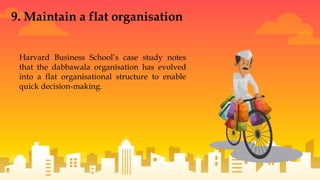
Harvard Business School’s case study notes
that the dabbawala organisation has evolved
into a flat organisational structure to enable
quick decision-making.
9. Maintain a flat organisation
“One customer should not cause thousands to
suffer. If a Mumbai housewife is late with the
dabba for more than one week, we no longer
serve that customer,” says Manish.
10. Abandon bad customers
Thank You
Dhruvang Dhamecha
dhruvang.dhamecha
dhruvang-dhamecha
. dhruvangdhamecha94@gmail.com
8490802332
• Management Consultant
• Lean sixsigma Consultant
• ISO Consultant

10 management lessons from the dabbawalas

  • 1.
  • 2.
    2 the dabbawalas aresemi-literate, they are “suitably educated” for their jobs because they believe in serving the customer above all else. “We couldn’t hire MBAs,” says Manish Tripathi, founder and chairman of the Dabbawala Foundation. 1. Commitment and attitude
  • 3.
    3 Much of thedabbawala organisation’s success is due to their human resource system, in the way they hire, develop, manage and reward people, says Stefan Thomke, William Barclay Harding Professor of Business Administration at Harvard Business School. “It’s an organization built around people, not around technology.” 2. Build your organisation around people
  • 4.
    4 The dedication ofthe dabbawalas can be partly attributed to the value they place on the work they do. “Our dabbawalas view their work as worship. They are grateful to have work, and to serve others by delivering food is to serve God,” says Manish. As a result, he says, everyone in Mumbai respects the dabbawalas for the work they do. 3. Give employees a sense of purpose and value
  • 5.
    5 While the dabbawalaorganisation has received suggestions to branch out into other business lines, such as cooking the food instead of merely supplying it, it has stayed true to its century-old purpose. “We focus on delivering dabbas to our customers as best as we can,” says Manish. 4. Stay true to your core purpose
  • 6.
    New dabbawalas gothrough a strict six-month probationary period and are hired from only the villages around Pune, so they suit the working culture. “We are all one family, from the Vakari sect. We eat lunch together and we pray together,” says Manish. 5. Recruit carefully
  • 7.
    “Each dabbawala iscapable of collecting up to 20 dabbas a day – but this is the maximum. Usually, in a group, each dabbawala will collect less so that if a dabbawala is sick the others can compensate. New dabbawalas are hired only to replace a member or when there are too many new customers in an area,” says Manish. 6. Don’t be too lean, build in buffers
  • 8.
    8 The dabbawalas areself-motivated to be disciplined, not because they have a superior telling them what to do, says Manish. “They work right because it’s the right thing to do. Self- discipline is the way to make an organisation great.” 7. Encourage self-discipline
  • 9.
    9 The dabbawala organisationhas no employees because every member is a shareholder, says Manish. “So if one member does less work and earns less money, he’s also hurting himself.” 8. Create a sense of ownership
  • 10.
    Harvard Business School’scase study notes that the dabbawala organisation has evolved into a flat organisational structure to enable quick decision-making. 9. Maintain a flat organisation
  • 11.
    “One customer shouldnot cause thousands to suffer. If a Mumbai housewife is late with the dabba for more than one week, we no longer serve that customer,” says Manish. 10. Abandon bad customers
  • 12.
    Thank You Dhruvang Dhamecha dhruvang.dhamecha dhruvang-dhamecha .dhruvangdhamecha94@gmail.com 8490802332 • Management Consultant • Lean sixsigma Consultant • ISO Consultant