Corporate Governance
and
Accountability

December 4th, 2013
•
•
•
•
•
•
•
•
•

Content
Introduction: Definitions and Role of
Business
Trends in CG: Red Flags and Best Practices
Diversity and Group-Think
Independence and Compliance
Strategic Role and Value Creation
Risk Management
Social Media and IT Governance
Disclosure and CG Rating
Summary and Way Forward
Introduction
The relationship between the governance
structure of corporations within the region
and mechanisms to ensure compliance and
sustainability should be examined and
strengthened
Definition
• Rules and regulation that govern the relationship between
the managers and shareholders of companies as well as
stakeholders like employees and creditors.’ OECD (2004)
• “procedures and processes according to which an
organisation is directed and controlled. The corporate
governance structure specifies the distribution of rights
and responsibilities among the different participants in
the organisation – such as the board, managers,
shareholders and other stakeholders – and lays down the
rules and procedures for decision-making.” OECD (2010)
Definitions

• Cadbury (1992) states that “Corporate Governance is
the system by which companies are directed and
controlled.”
• Fahy et al (2006) states that “corporate governance is
the systems and processes put in place to direct and
control an organisation in order to increase
performance and achieve sustainable shareholder
value.”
• The firm has a particular governance structure to
enable it to balance the rights and responsibilities of
varying stakeholders.
Role of Business
• Research indicate that the country
environment or political-economic climate
affect corporate performance, Shleifer and
Vishny (1997), Doidge et al (2007),
Aggarwal et al (2009).
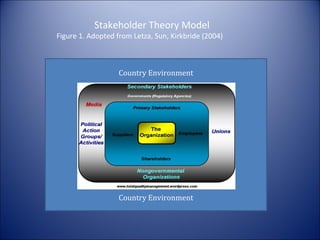
Stakeholder Theory Model

Figure 1. Adopted from Letza, Sun, Kirkbride (2004)


Country Environment

Country Environment
Trends in CG
• Corporate Governance (CG) trends is not a
question about whether your board will be
affected, the question is when and how.
Areas of focus and change
• Explicit documentation
• Best practices: customization (right-fit) and
proportionality
• Independence, competence and behavior
• Transparency and disclosure
• Commitment of resources
• Assurance: internal and external
CG red flags and best practices
• Captured / owned board member (trips,
gifts, donations, favors etc); independence
compromised (perception vs objectivity)
• Legacy, over-tenured or ‘zombie’ boards
• Lack of board member expertise (skills,
knowledge, experience, education, training)
• Boilerplate, inadequate, biography puffery
CG red flags and best practices
• Lack of women and diversity
• CEO / director succession planning (40%
don’t have any)
• Board member competencies and
performance evaluation
Diversity and Group-think
• Component: age, gender and ethnicity
• No diversity definition, plan, policy, report or
method
• Deliberate non-transparency of director
recruitment
• Boards in denial to world around them
Independence and competences
• Tenure limits of board members (up to 9yrs
for directors, up for yearly elections)
• Rigorous assessment of directors and
auditors (self-evaluation, peer reviews, 360
evaluations, rotation of external auditors)
• Independence of mind / duty of care
• Performed by trusted member (not chair)
• Feedback (council non performing directors, plan to
improve deficiencies)
• Assessment can be used to review performance and
removal of poor CEO/members
• Mentoring, leadership / executive sessions
• Training in areas of poor competencies
• Budget and plan for improvement
• Edu. / training: Presentations to board,
seminars
• Major areas: legal, risk, strategy, competition
• Staggered orientation of new members
• Board composition assessment (2yrs)
• Start small and build-out; be flexible
Strategic concerns
• A board incapable of directing or controlling
underperforming, ineffective CEO
• Undue influence of CEO/major shareholder
• Self enrichment and conflict of interest
• Conflicted or legacy service providers (law,
audit)
• Compensation not performance based,
should be linked to risk
Strategic concerns
• Inexperienced, incapable, no credibility
• No value maximization plan; dysfunctional
board culture
• Engaged, focused, results-oriented and
disciplined
Board Value Creation
• Value maximization plan – key timelines,
milestones, targets, individual accountability for
each component and specific results
• Reporting format – info flow direct to
board/committees, adjust as necessary
• Quick to address variances, accountability: by who
and when
Board Value Creation
• Primacy role of chair
• Deep dive into operation, highly engaged, shift
to value creation
• 50% of time on strategy; 50% on compliance
• Robust debate on strategy; at least one
presentation from key personnel below exec
Value Creation
• KPIs linked to value creation; include non
financial matrices – customer, employee,
community (75% of value is now non-financial,
e.g. brand, reputation, IP, knowledge)
• KPI include qualitative health of firm
• Pay for performance – exec comp, clawback vs
malus
Risk Management
• Health and safety of employees, customers
• List of 12-15 major risk factors (competitor
risk, gov’t policy risk, leadership risk,
operational risks, reputational erosion,
labor risks, security, IT)
• Provide internal controls for listed risks and
assurances for these controls
Internal audit and control
•
•
•
•

Linked to audit committee
Work plan review
Reduction of residual business risks
Test design and effectiveness of all internal
controls
• Risks are known to board and mgmt
• Compensation linked to risk mgmt
• Risk adjusted compensation – lag, comp spread over
period due to risk
• Board committee to oversee non-financial risk –
health, safety, environmental (vs audit committee)
• Documentation of risks, with accountabilities,
dynamic, integrated
• Oversight outside business units – board committee,
3rd party
• Crisis, contingency, scenario planning by board
Risk management
• Is there an internal audit function?
• Are internal controls adequate?
• Does the board fully understand business
risks?
• Is there an effective whistle blowing
process?
• Is corporate culture aligned with explicit
risk appetite?
Social Media and Governance
• Use of IT devices by members during
meetings (ipad, smartphones, BYOD)
• Paperless board room
• Remote plug in – teleconferencing
• SM policy (twitter, fb, linkedin, tumblr) –
brand, reputation
• Communication policy
• Concerns: accuracy of info, micro-mgmt,
reliance on mgmt, SM admin (seniority), IT
security
• Passwords, code of conduct on SM
• Crisis and response planning
• SM is two way
Disclosure
• Related parties (source of potential fraud –
seek service based on value and quality of
service; bidding process)
• Local business practices, culture
• Controls, whistle-blowing, due diligence,
potential bribery
• No boiler-plate disclosure (deep dive)
• Sanctions in cases of non-compliance
CG Ratings
• Varying interests, incentives and rights of
the stakeholders make it difficult to design
and measure a suitable rubric across
corporations and countries.
• The fact that the institutional setting varies
and the country context are different make
comparative analysis a challenge
• 3rd party ratings e.g.
• Investor Responsibility Research Center
(IRRC) G-Index of 24 matrices;
• Governance Matrix International
(GMIRatings) uses 600 matrices;
• Institutional Shareholder Services (ISS) CGQ
of 60 matrices;
• Most matrices are more quantitative based,
need qualitative aspect to address CG
• Need to develop more appropriate CG
measures esp. regionally….?!?!
• CG should be implement not because of
regulation but because it is good for
business
Summary and Way Forward
• Start small, build out, 3-5 year process
• Formal documentation (integrity code, role
of CEO, chair, board, committees)
• Performance evaluation (exec and board)
• Succession planning
• Board should focus on strategy, risks,
compliance and assurance
Possibilities
• Two tier board (one similar to exec mgmt
with employee rep., alliance / strategic
partners)
• Pseudo – board as starting point (act as
advisory council, less formalized but
convertible when appropriate)
• Flexibility in adaptation of best practices
The Hallmark of Excellence!!!
Thank you
Comments / Questions?

Corporate governance trends

  • 1.
  • 2.
    • • • • • • • • • Content Introduction: Definitions andRole of Business Trends in CG: Red Flags and Best Practices Diversity and Group-Think Independence and Compliance Strategic Role and Value Creation Risk Management Social Media and IT Governance Disclosure and CG Rating Summary and Way Forward
  • 3.
    Introduction The relationship betweenthe governance structure of corporations within the region and mechanisms to ensure compliance and sustainability should be examined and strengthened
  • 4.
    Definition • Rules andregulation that govern the relationship between the managers and shareholders of companies as well as stakeholders like employees and creditors.’ OECD (2004) • “procedures and processes according to which an organisation is directed and controlled. The corporate governance structure specifies the distribution of rights and responsibilities among the different participants in the organisation – such as the board, managers, shareholders and other stakeholders – and lays down the rules and procedures for decision-making.” OECD (2010)
  • 5.
    Definitions • Cadbury (1992)states that “Corporate Governance is the system by which companies are directed and controlled.” • Fahy et al (2006) states that “corporate governance is the systems and processes put in place to direct and control an organisation in order to increase performance and achieve sustainable shareholder value.” • The firm has a particular governance structure to enable it to balance the rights and responsibilities of varying stakeholders.
  • 6.
    Role of Business •Research indicate that the country environment or political-economic climate affect corporate performance, Shleifer and Vishny (1997), Doidge et al (2007), Aggarwal et al (2009).
  • 7.
    Stakeholder Theory Model Figure1. Adopted from Letza, Sun, Kirkbride (2004)   Country Environment Country Environment
  • 8.
    Trends in CG •Corporate Governance (CG) trends is not a question about whether your board will be affected, the question is when and how.
  • 9.
    Areas of focusand change • Explicit documentation • Best practices: customization (right-fit) and proportionality • Independence, competence and behavior • Transparency and disclosure • Commitment of resources • Assurance: internal and external
  • 10.
    CG red flagsand best practices • Captured / owned board member (trips, gifts, donations, favors etc); independence compromised (perception vs objectivity) • Legacy, over-tenured or ‘zombie’ boards • Lack of board member expertise (skills, knowledge, experience, education, training) • Boilerplate, inadequate, biography puffery
  • 11.
    CG red flagsand best practices • Lack of women and diversity • CEO / director succession planning (40% don’t have any) • Board member competencies and performance evaluation
  • 12.
    Diversity and Group-think •Component: age, gender and ethnicity • No diversity definition, plan, policy, report or method • Deliberate non-transparency of director recruitment • Boards in denial to world around them
  • 13.
    Independence and competences •Tenure limits of board members (up to 9yrs for directors, up for yearly elections) • Rigorous assessment of directors and auditors (self-evaluation, peer reviews, 360 evaluations, rotation of external auditors) • Independence of mind / duty of care • Performed by trusted member (not chair)
  • 14.
    • Feedback (councilnon performing directors, plan to improve deficiencies) • Assessment can be used to review performance and removal of poor CEO/members • Mentoring, leadership / executive sessions • Training in areas of poor competencies • Budget and plan for improvement
  • 15.
    • Edu. /training: Presentations to board, seminars • Major areas: legal, risk, strategy, competition • Staggered orientation of new members • Board composition assessment (2yrs) • Start small and build-out; be flexible
  • 16.
    Strategic concerns • Aboard incapable of directing or controlling underperforming, ineffective CEO • Undue influence of CEO/major shareholder • Self enrichment and conflict of interest • Conflicted or legacy service providers (law, audit) • Compensation not performance based, should be linked to risk
  • 17.
    Strategic concerns • Inexperienced,incapable, no credibility • No value maximization plan; dysfunctional board culture • Engaged, focused, results-oriented and disciplined
  • 18.
    Board Value Creation •Value maximization plan – key timelines, milestones, targets, individual accountability for each component and specific results • Reporting format – info flow direct to board/committees, adjust as necessary • Quick to address variances, accountability: by who and when
  • 19.
    Board Value Creation •Primacy role of chair • Deep dive into operation, highly engaged, shift to value creation • 50% of time on strategy; 50% on compliance • Robust debate on strategy; at least one presentation from key personnel below exec
  • 20.
    Value Creation • KPIslinked to value creation; include non financial matrices – customer, employee, community (75% of value is now non-financial, e.g. brand, reputation, IP, knowledge) • KPI include qualitative health of firm • Pay for performance – exec comp, clawback vs malus
  • 21.
    Risk Management • Healthand safety of employees, customers • List of 12-15 major risk factors (competitor risk, gov’t policy risk, leadership risk, operational risks, reputational erosion, labor risks, security, IT) • Provide internal controls for listed risks and assurances for these controls
  • 22.
    Internal audit andcontrol • • • • Linked to audit committee Work plan review Reduction of residual business risks Test design and effectiveness of all internal controls • Risks are known to board and mgmt • Compensation linked to risk mgmt
  • 23.
    • Risk adjustedcompensation – lag, comp spread over period due to risk • Board committee to oversee non-financial risk – health, safety, environmental (vs audit committee) • Documentation of risks, with accountabilities, dynamic, integrated • Oversight outside business units – board committee, 3rd party • Crisis, contingency, scenario planning by board
  • 24.
    Risk management • Isthere an internal audit function? • Are internal controls adequate? • Does the board fully understand business risks? • Is there an effective whistle blowing process? • Is corporate culture aligned with explicit risk appetite?
  • 25.
    Social Media andGovernance • Use of IT devices by members during meetings (ipad, smartphones, BYOD) • Paperless board room • Remote plug in – teleconferencing • SM policy (twitter, fb, linkedin, tumblr) – brand, reputation • Communication policy
  • 26.
    • Concerns: accuracyof info, micro-mgmt, reliance on mgmt, SM admin (seniority), IT security • Passwords, code of conduct on SM • Crisis and response planning • SM is two way
  • 27.
    Disclosure • Related parties(source of potential fraud – seek service based on value and quality of service; bidding process) • Local business practices, culture • Controls, whistle-blowing, due diligence, potential bribery • No boiler-plate disclosure (deep dive) • Sanctions in cases of non-compliance
  • 28.
    CG Ratings • Varyinginterests, incentives and rights of the stakeholders make it difficult to design and measure a suitable rubric across corporations and countries. • The fact that the institutional setting varies and the country context are different make comparative analysis a challenge
  • 29.
    • 3rd partyratings e.g. • Investor Responsibility Research Center (IRRC) G-Index of 24 matrices; • Governance Matrix International (GMIRatings) uses 600 matrices; • Institutional Shareholder Services (ISS) CGQ of 60 matrices; • Most matrices are more quantitative based, need qualitative aspect to address CG
  • 30.
    • Need todevelop more appropriate CG measures esp. regionally….?!?! • CG should be implement not because of regulation but because it is good for business
  • 31.
    Summary and WayForward • Start small, build out, 3-5 year process • Formal documentation (integrity code, role of CEO, chair, board, committees) • Performance evaluation (exec and board) • Succession planning • Board should focus on strategy, risks, compliance and assurance
  • 32.
    Possibilities • Two tierboard (one similar to exec mgmt with employee rep., alliance / strategic partners) • Pseudo – board as starting point (act as advisory council, less formalized but convertible when appropriate) • Flexibility in adaptation of best practices
  • 33.
    The Hallmark ofExcellence!!! Thank you Comments / Questions?