CORPORATE
GOVERNANCE
By Jayanth Viswanathan
27.08.2013
(total slides 29)

1
WHAT IS CORPORATE
GOVERNANCE

To understand that, we need to know what
is “Governance”

2
GOVERNANCE = ETHICS
 Ethics as per Oxford Dictionary is

“moral principles that govern a person’s
behavior or the conducting of an activity ”

3
Who mandates
“Corporate Governance”

 Securities Exchange Board of India,

known as “SEBI” mandates Corporate
Governance in listing agreement.

4
Whom are these “Ethics” applicable to
 Listed Companies.
 Why only listed companies? Why not other

companies?

5
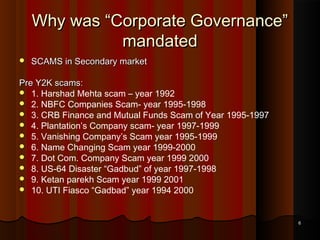
Why was “Corporate Governance”
mandated


SCAMS in Secondary market

Pre Y2K scams:
 1. Harshad Mehta scam – year 1992
 2. NBFC Companies Scam- year 1995-1998
 3. CRB Finance and Mutual Funds Scam of Year 1995-1997
 4. Plantation’s Company scam- year 1997-1999
 5. Vanishing Company’s Scam year 1995-1999
 6. Name Changing Scam year 1999-2000
 7. Dot Com. Company Scam year 1999 2000
 8. US-64 Disaster “Gadbud” of year 1997-1998
 9. Ketan parekh Scam year 1999 2001
 10. UTI Fiasco “Gadbad” year 1994 2000

6
Why was “Corporate Governance”
mandated
 After effects of such scams:
Loss to the exchequer
Loss of faith by Stake holders
Loss of faith by Share holders

7
Why was “Corporate Governance”
mandated
 Thus in order to mitigate further losses,

SEBI came up with “Corporate
Governance” also called “Clause 49”

 Effects of CG:

Transparency in working of the company
Loss to exchequers were “minimized”

Faith of Stake holders and share holders

restored.

8
Who drafted Corporate Governance
 First Corporate Governance was drafted

by Confederation of Indian Industry (CII) in
the year 1998.

 It was a voluntary code, since it was not

recognized by any statutory authority.

9
Who drafted Corporate Governance
 Subsequently the Statutory Authorities

felt

that under Indian conditions a statutory
rather than a voluntary code would be
more purposeful, and meaningful.
 First Committee on Corporate Governance
was set:
Kumaramangalam

Birla Committee - 1999

10
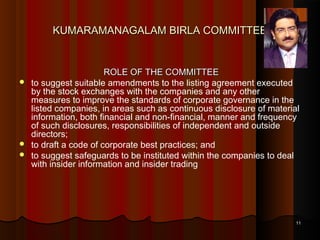
KUMARAMANAGALAM BIRLA COMMITTEE






ROLE OF THE COMMITTEE
to suggest suitable amendments to the listing agreement executed
by the stock exchanges with the companies and any other
measures to improve the standards of corporate governance in the
listed companies, in areas such as continuous disclosure of material
information, both financial and non-financial, manner and frequency
of such disclosures, responsibilities of independent and outside
directors;
to draft a code of corporate best practices; and
to suggest safeguards to be instituted within the companies to deal
with insider information and insider trading

11
Key objectives of KBC
 enhancement of shareholder value,

keeping in view the interests of other
stakeholder
 Stakeholders: includes suppliers,
customers, creditors, the bankers, the
employees of the company, the
government and the society at large

12
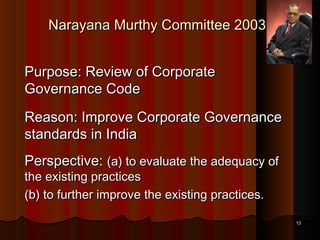
Narayana Murthy Committee 2003
Purpose: Review of Corporate
Governance Code
Reason: Improve Corporate Governance
standards in India
Perspective: (a) to evaluate the adequacy of
the existing practices
(b) to further improve the existing practices.

13
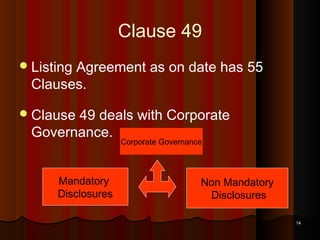
Clause 49
 Listing

Agreement as on date has 55
Clauses.

 Clause

49 deals with Corporate
Governance.
Corporate Governance

Mandatory
Disclosures

Non Mandatory
Disclosures
14
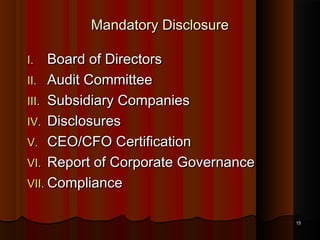
Mandatory Disclosure
Board of Directors
II. Audit Committee
III. Subsidiary Companies
IV. Disclosures
V. CEO/CFO Certification
VI. Report of Corporate Governance
VII. Compliance
I.

15
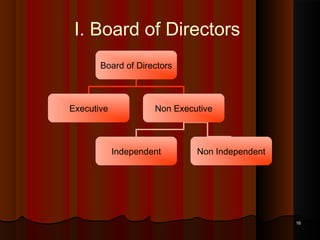
I. Board of Directors
Board of Directors

Executive

Non Executive

Independent

Non Independent

16
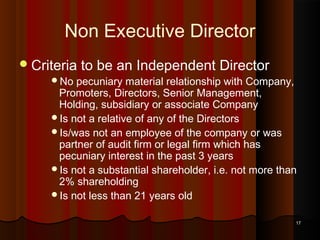
Non Executive Director
 Criteria
No

to be an Independent Director

pecuniary material relationship with Company,
Promoters, Directors, Senior Management,
Holding, subsidiary or associate Company
Is not a relative of any of the Directors
Is/was not an employee of the company or was
partner of audit firm or legal firm which has
pecuniary interest in the past 3 years
Is not a substantial shareholder, i.e. not more than
2% shareholding
Is not less than 21 years old
17
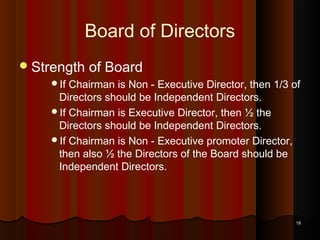
Board of Directors
 Strength

of Board

If

Chairman is Non - Executive Director, then 1/3 of
Directors should be Independent Directors.
If Chairman is Executive Director, then ½ the
Directors should be Independent Directors.
If Chairman is Non - Executive promoter Director,
then also ½ the Directors of the Board should be
Independent Directors.

18
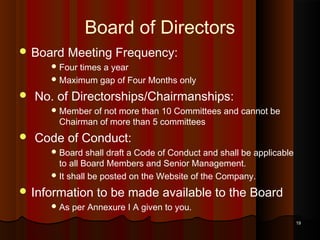
Board of Directors
 Board

Meeting Frequency:

 Four

times a year
 Maximum gap of Four Months only



No. of Directorships/Chairmanships:
 Member

of not more than 10 Committees and cannot be
Chairman of more than 5 committees



Code of Conduct:
 Board

shall draft a Code of Conduct and shall be applicable
to all Board Members and Senior Management.
 It shall be posted on the Website of the Company.

 Information
 As

to be made available to the Board

per Annexure I A given to you.
19
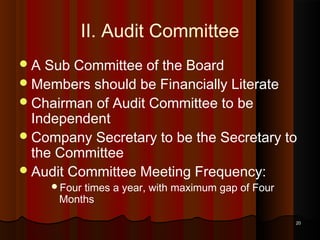
II. Audit Committee
A

Sub Committee of the Board
 Members should be Financially Literate
 Chairman of Audit Committee to be
Independent
 Company Secretary to be the Secretary to
the Committee
 Audit Committee Meeting Frequency:
Four

times a year, with maximum gap of Four
Months

20
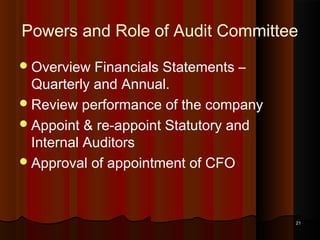
Powers and Role of Audit Committee
 Overview

Financials Statements –
Quarterly and Annual.
 Review performance of the company
 Appoint & re-appoint Statutory and
Internal Auditors
 Approval of appointment of CFO

21
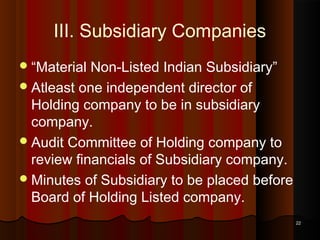
III. Subsidiary Companies
 “Material

Non-Listed Indian Subsidiary”
 Atleast one independent director of
Holding company to be in subsidiary
company.
 Audit Committee of Holding company to
review financials of Subsidiary company.
 Minutes of Subsidiary to be placed before
Board of Holding Listed company.
22
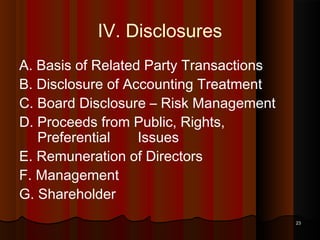
IV. Disclosures
A. Basis of Related Party Transactions
B. Disclosure of Accounting Treatment
C. Board Disclosure – Risk Management
D. Proceeds from Public, Rights,
Preferential
Issues
E. Remuneration of Directors
F. Management
G. Shareholder
23
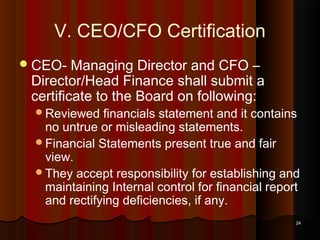
V. CEO/CFO Certification
 CEO-

Managing Director and CFO –
Director/Head Finance shall submit a
certificate to the Board on following:
Reviewed

financials statement and it contains
no untrue or misleading statements.
Financial Statements present true and fair
view.
They accept responsibility for establishing and
maintaining Internal control for financial report
and rectifying deficiencies, if any.
24
VI. Report on Corporate Governance
 Annual

Report should contain a separate
section on Corporate Governance with
detailed compliance report. Format as per
Annexure I-C given to you.

 Quarterly

Compliance certificate should be
submitted to Stock Exchange. Format as
per Annexure I-B given to you.
25
VII. Compliance
A

Certificate from either the Auditor or a
Practicing Company Secretary on
compliance of conditions of corporate
Governance should form part of Directors
Report.

26
Non Mandatory Compliance
 There

are certain Non- mandatory
provisions in this clause, which can be
implemented at the discretion of the
Company.

 Details

of which are available in Annexure
I D as given to you.
27
Latest update


SEBI has vide it PR 4/2013 dated January 04, 2013
issued a consultative paper to review the norms of
Corporate Governance.



Main Objective:
 To bring in line with the principles and text of
Companies Bill, 2012.



Suggestions shall be made and the Committee set up
for the purpose will review the suggestions and bring
ammendments to Clause 49.
28
THE END
 O,

what a goodly outside falsehood hath!
William Shakespeare

Email: jayanthviswanathan@gmail.com

29

Corporate governance presentation by jayanth viswanathan

  • 1.
  • 2.
    WHAT IS CORPORATE GOVERNANCE Tounderstand that, we need to know what is “Governance” 2
  • 3.
    GOVERNANCE = ETHICS Ethics as per Oxford Dictionary is “moral principles that govern a person’s behavior or the conducting of an activity ” 3
  • 4.
    Who mandates “Corporate Governance” Securities Exchange Board of India, known as “SEBI” mandates Corporate Governance in listing agreement. 4
  • 5.
    Whom are these“Ethics” applicable to  Listed Companies.  Why only listed companies? Why not other companies? 5
  • 6.
    Why was “CorporateGovernance” mandated  SCAMS in Secondary market Pre Y2K scams:  1. Harshad Mehta scam – year 1992  2. NBFC Companies Scam- year 1995-1998  3. CRB Finance and Mutual Funds Scam of Year 1995-1997  4. Plantation’s Company scam- year 1997-1999  5. Vanishing Company’s Scam year 1995-1999  6. Name Changing Scam year 1999-2000  7. Dot Com. Company Scam year 1999 2000  8. US-64 Disaster “Gadbud” of year 1997-1998  9. Ketan parekh Scam year 1999 2001  10. UTI Fiasco “Gadbad” year 1994 2000 6
  • 7.
    Why was “CorporateGovernance” mandated  After effects of such scams: Loss to the exchequer Loss of faith by Stake holders Loss of faith by Share holders 7
  • 8.
    Why was “CorporateGovernance” mandated  Thus in order to mitigate further losses, SEBI came up with “Corporate Governance” also called “Clause 49”  Effects of CG: Transparency in working of the company Loss to exchequers were “minimized” Faith of Stake holders and share holders restored. 8
  • 9.
    Who drafted CorporateGovernance  First Corporate Governance was drafted by Confederation of Indian Industry (CII) in the year 1998.  It was a voluntary code, since it was not recognized by any statutory authority. 9
  • 10.
    Who drafted CorporateGovernance  Subsequently the Statutory Authorities felt that under Indian conditions a statutory rather than a voluntary code would be more purposeful, and meaningful.  First Committee on Corporate Governance was set: Kumaramangalam Birla Committee - 1999 10
  • 11.
    KUMARAMANAGALAM BIRLA COMMITTEE    ROLEOF THE COMMITTEE to suggest suitable amendments to the listing agreement executed by the stock exchanges with the companies and any other measures to improve the standards of corporate governance in the listed companies, in areas such as continuous disclosure of material information, both financial and non-financial, manner and frequency of such disclosures, responsibilities of independent and outside directors; to draft a code of corporate best practices; and to suggest safeguards to be instituted within the companies to deal with insider information and insider trading 11
  • 12.
    Key objectives ofKBC  enhancement of shareholder value, keeping in view the interests of other stakeholder  Stakeholders: includes suppliers, customers, creditors, the bankers, the employees of the company, the government and the society at large 12
  • 13.
    Narayana Murthy Committee2003 Purpose: Review of Corporate Governance Code Reason: Improve Corporate Governance standards in India Perspective: (a) to evaluate the adequacy of the existing practices (b) to further improve the existing practices. 13
  • 14.
    Clause 49  Listing Agreementas on date has 55 Clauses.  Clause 49 deals with Corporate Governance. Corporate Governance Mandatory Disclosures Non Mandatory Disclosures 14
  • 15.
    Mandatory Disclosure Board ofDirectors II. Audit Committee III. Subsidiary Companies IV. Disclosures V. CEO/CFO Certification VI. Report of Corporate Governance VII. Compliance I. 15
  • 16.
    I. Board ofDirectors Board of Directors Executive Non Executive Independent Non Independent 16
  • 17.
    Non Executive Director Criteria No to be an Independent Director pecuniary material relationship with Company, Promoters, Directors, Senior Management, Holding, subsidiary or associate Company Is not a relative of any of the Directors Is/was not an employee of the company or was partner of audit firm or legal firm which has pecuniary interest in the past 3 years Is not a substantial shareholder, i.e. not more than 2% shareholding Is not less than 21 years old 17
  • 18.
    Board of Directors Strength of Board If Chairman is Non - Executive Director, then 1/3 of Directors should be Independent Directors. If Chairman is Executive Director, then ½ the Directors should be Independent Directors. If Chairman is Non - Executive promoter Director, then also ½ the Directors of the Board should be Independent Directors. 18
  • 19.
    Board of Directors Board Meeting Frequency:  Four times a year  Maximum gap of Four Months only  No. of Directorships/Chairmanships:  Member of not more than 10 Committees and cannot be Chairman of more than 5 committees  Code of Conduct:  Board shall draft a Code of Conduct and shall be applicable to all Board Members and Senior Management.  It shall be posted on the Website of the Company.  Information  As to be made available to the Board per Annexure I A given to you. 19
  • 20.
    II. Audit Committee A SubCommittee of the Board  Members should be Financially Literate  Chairman of Audit Committee to be Independent  Company Secretary to be the Secretary to the Committee  Audit Committee Meeting Frequency: Four times a year, with maximum gap of Four Months 20
  • 21.
    Powers and Roleof Audit Committee  Overview Financials Statements – Quarterly and Annual.  Review performance of the company  Appoint & re-appoint Statutory and Internal Auditors  Approval of appointment of CFO 21
  • 22.
    III. Subsidiary Companies “Material Non-Listed Indian Subsidiary”  Atleast one independent director of Holding company to be in subsidiary company.  Audit Committee of Holding company to review financials of Subsidiary company.  Minutes of Subsidiary to be placed before Board of Holding Listed company. 22
  • 23.
    IV. Disclosures A. Basisof Related Party Transactions B. Disclosure of Accounting Treatment C. Board Disclosure – Risk Management D. Proceeds from Public, Rights, Preferential Issues E. Remuneration of Directors F. Management G. Shareholder 23
  • 24.
    V. CEO/CFO Certification CEO- Managing Director and CFO – Director/Head Finance shall submit a certificate to the Board on following: Reviewed financials statement and it contains no untrue or misleading statements. Financial Statements present true and fair view. They accept responsibility for establishing and maintaining Internal control for financial report and rectifying deficiencies, if any. 24
  • 25.
    VI. Report onCorporate Governance  Annual Report should contain a separate section on Corporate Governance with detailed compliance report. Format as per Annexure I-C given to you.  Quarterly Compliance certificate should be submitted to Stock Exchange. Format as per Annexure I-B given to you. 25
  • 26.
    VII. Compliance A Certificate fromeither the Auditor or a Practicing Company Secretary on compliance of conditions of corporate Governance should form part of Directors Report. 26
  • 27.
    Non Mandatory Compliance There are certain Non- mandatory provisions in this clause, which can be implemented at the discretion of the Company.  Details of which are available in Annexure I D as given to you. 27
  • 28.
    Latest update  SEBI hasvide it PR 4/2013 dated January 04, 2013 issued a consultative paper to review the norms of Corporate Governance.  Main Objective:  To bring in line with the principles and text of Companies Bill, 2012.  Suggestions shall be made and the Committee set up for the purpose will review the suggestions and bring ammendments to Clause 49. 28
  • 29.
    THE END  O, whata goodly outside falsehood hath! William Shakespeare Email: jayanthviswanathan@gmail.com 29