CORPORATE ACCOUNTING
Student name:
Student ID:
INTRODUCTION
Corporate accounting plays crucial role in the field of the business evaluating financial
position of the organization in an effective manner. There is an important role of
accounting in running the business because it helps in ensuring the statutory
compliance, tracking the income and expenditures, providing the management and
industry and the investors with the quantitative information of finance which can be
useful in making decisions regarding business. Corporate accounting is a special
branch of accounting which deals with preparing the final accounts of the company,
analysing the financial results of the company and some specific events like
amalgamation and absorption. Here in the assignment two banking industry that is
the Westpac bank and the National Australian Bank (NAB) has been chosen and
there is description of their source of income and annual reports has been analysed.
IDENTIFICATION OF THE DIFFERENT TYPES
OF SOURCES OF FUNDS USED BY THE
SELECTED COMPANIES
• Income of total interest: This consist of the value of calculations with the
use of method of effective interest which in the year 2018 was $m32, 571
and in 2019 was $m33, 222. There had been a little increase in the values
compared to the last year.
• Net fee income: The net fee income calculated in the year 2018 was
$m2424 which decreased in the year 2019 to $m1655. The decrement is
calculated to be approximately $m769 (westpac.com.au, 2018).
• Net wealth management and income insurance: The value of net wealth
management has been calculated to be decreased compared to last year.
In the year 2018 the value was $m2061 which decreased to $m1029 in the
year 2019.
• Trading income: Trading income calculated in the year 2018 was $m945
which decreased to $m929 in the year 2019. There was a slight decrement
compared to last year.
• Other income: This also shows the value of last year which was recorded
to be $m72 and it be increased to $m129. The other income includes the
different rated securities and fees charged by the banks (westpac.com.au,
2019).
EXAMINING THE EVALUATION OF THE
SOURCES OF THE VARIOUS FUNDS
NAB
• NAB showed a paid up share capital of $m35,
976 in the year 2019 and $m32276 in the
year 2018. There is also a contribution of
some of the other equities like securities of
national income and preferred trusted
securities whose balances stood to be
$m1945 in both the years and after the
addition of the values it became $m37921 in
the year 2019 and $m34221 in the year 2018
Thus the remaining equity calculated were
$m45239 for 2018 and $m42670 for 2017.
• The balance of 2019 also showed a
comprehensive decrease. In the balances of
the year of 2018 and 2017 there is addition of
tier I capital of $m9144 in the year 2018 and
$m8505 in the year 2017 (westpac.com.au,
2019). The balance of 2019 has an addition
of the balance of movements of the other
equity movements and with its help there is
an increase in the balance of equity of the
company.
IDENTIFICATION OF THE PERCENTAGE OF THE
FUND GENERATED INTERNALLY AND EXTERNALLY
• The internal process of generation of funds are the selling
of stock, fixed assets, retained earnings and debt
collection whereas process of collection of found externally
were financial Institutions, bank loans, and debentures
(Kahn and Baum, 2020, p.14).
• Through the internal process the funds generated in the
Westpac were$m14476 and the total funds generated
were $m611610. Therefore in the form of percentage =
14476/611610*100=2.37%.
• Whereas the funds of the National Bank of Australia
generated a fund of $m54811 and in total it was
$m869166. Therefore in the form of percentage it was
54811/869166*100= 6.30%.
EXPLANATION OF THE MERITS AND
DEMERITS OF THE DIFFERENT TYPES OF
SOURCES FUNDS USED BY THESE
COMPANIES
• Equity debts:
It utilizes a variety of, source of finance which are
initially broken that has been debt and equity
(Mookdee and Bellamy, 2017, p.65). Debt gives
a meaning that is borrowing money towards the
repaid and with the addition of interests whereas
equity means the involving of money raised by
selling the interests of the company. On the
positives usage of debt equity there are no
attachment of any accrued interests or attached
string. The Personal method of finance and is the
fastest and easiest ways of securing funds.
• Funding from investors and Banks:
Capital Venture of the firms is also a wealthy
individuals. These are also another source of
starting a business and can also expand the
business with a concern of gouging. These types
of source sales have an advantage of fast
accessing of funds which might in the future can
lead to the loan or gift .
IDENTIFICATION OF THE INTEREST BEARING
LIABILITIES OF WHICH INTERESTS ARE NOT
BEARING
• Tax Liabilities: In the year 2017 the balance sheet of
National Australian bank showed a balance of $m71
whereas the balance of the year 2018 and 2019 are 0.
• Other liabilities: Other liabilities of the year 2017 was
$m6942 and the value of the year2018 and 2019are
$m7108 and $m8582 (capital.nab.com.au, 2018).
• Similarly, according to the balance sheet of Westpac
the different liabilities are
• Derivative Financial instruments: The derivative
financial instruments showed a balance of $m 29096 in
2019,$m24407 in 2018 and $m25375 in 2017
• Debt issues: The debt issue recorded a balance of
$m181457 in 2019, $m172596 in 2018, $m168356 in
2017 (westpac.com.au, 2019).
• Fair financial liabilities through income statements:
The value recorded in the year 2019 was $m19628, in
2018it was $m2040 and 2017 it recorded to be
$m2345.
CRITICAL EXAMINATION OF THE PROVISIONS
UNDER AASB 137 ‘PROVISIONS, CONTINGENT
LIABILITIES, AND CONTINGENT ASSETS
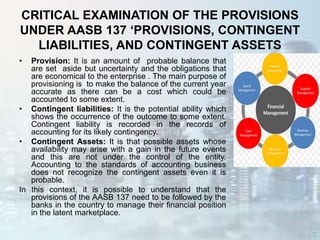
• Provision: It is an amount of probable balance that
are set aside but uncertainty and the obligations that
are economical to the enterprise . The main purpose of
provisioning is to make the balance of the current year
accurate as there can be a cost which could be
accounted to some extent.
• Contingent liabilities: It is the potential ability which
shows the occurrence of the outcome to some extent.
Contingent liability is recorded in the records of
accounting for its likely contingency.
• Contingent Assets: It is that possible assets whose
availability may arise with a gain in the future events
and this are not under the control of the entity.
Accounting to the standards of accounting business
does not recognize the contingent assets even it is
probable.
In this context, it is possible to understand that the
provisions of the AASB 137 need to be followed by the
banks in the country to manage their financial position
in the latent marketplace.
RECOGNITION OF MULTIPLE CATEGORIES OF
ASSETS
CRITICAL EXAMINATION OF THE
MEASUREMENT
The National Australia Bank
• This organization mainly focuses on the historical cost in order to measure
the recorded organizational assets.
• However, certain assets of the company are measured with the help of fair
value.
• By considering the fair value of the bank, it is feasible to determine the
financial performance in the marketplace (Kanagaretnam et al. 2017, p. 37).
Westpac Banking Corporation
• On the other hand, it has been detected from the study of Srivastav and
Hagendorff (2016, p. 334) that fair value is one of the essential aspects of
the company to analyze the exact financial condition of the organization.
• It is likely to describe that Westpac Banking Corporation uses the fair value
for measuring recorded assets of the company in an ethical manner.
• The observable along with the unobservable financial information is used
for determining the financial position of the company in the potential
marketplace of a country like Australia.
CONCLUSION
It can be concluded that corporate accounting is significant in order to
understand the financial condition of the companies in the potential
marketplace. It has been identified that AASB provisions need to be
considered by the organization like the National Australia Bank and
Westpac Banking Corporation. In addition to that, it has been detected that
there are several assets of the organization that can be recognized for
understanding the overall financial condition of the company like the
Westpac Banking Corporation as well as National Australia Bank. In this
context, sources of the company’s funds are illustrated in a well manner. As
for this reason, it is possible to consider the accounting situation of the
banks to manage financial position in the potential marketplace. Therefore,
assets of the organization need to be recorded on the basis of the
measurement basis in an effective method.
REFERENCE
• aasb.gov.au (2019), Compiled AASB Standard, AASB 137, Available at:
https://www.aasb.gov.au/admin/file/content105/c9/AASB137_07-04_COMPjun14_04-14.pdf [Accessed on 14th January,
2019]
• Anginer, D., Demirguc-Kunt, A., Huizinga, H. and Ma, K., 2016. Corporate governance and bank capitalization
strategies. Journal of Financial Intermediation, 26, pp.1-27.
• Berger, A.N., Imbierowicz, B. and Rauch, C., 2016. The roles of corporate governance in bank failures during the recent
financial crisis. Journal of Money, Credit and Banking, 48(4), pp.729-770.
• Bushman, R.M., 2016. Transparency, accounting discretion, and bank stability. Economic Policy Review, Issue Aug, pp.129-
149.
• capital.nab.com.au (2018), Annual report 2018, Available
at: https://capital.nab.com.au/docs/2018_NAB_Annual_Financial_Report.pdf [Accessed on 14th January, 2020]
• capital.nab.com.au (2019), Annual report 2019, Available at: http://capital.nab.com.au/docs/2019-Annual-Financial-
Report.pdf [Accessed on 14th January, 2019]
• Carnegie, G.D., 2016. The accounting professional project and bank failures. Journal of Management History.
• Chen, Q. and Vashishtha, R., 2017. The effects of bank mergers on corporate information disclosure. Journal of Accounting
and Economics, 64(1), pp.56-77.
• Kahn, M.J. and Baum, N., 2020. Basic Accounting and Interpretation of Financial Statements. In The Business Basics of
Building and Managing a Healthcare Practice (pp. 13-18).
• Kanagaretnam, K., Lee, J., Lim, C.Y. and Lobo, G.J., 2017. Effects of informal institutions on the relationship between
accounting measures of risk and bank distress. Journal of International Accounting Research, 16(2), pp.37-66.
• Mookdee, T. and Bellamy, S., 2017. Asset classification, subsequent measurement and impairment testing for carbon
emission trading. European Financial and Accounting Journal, 12(3), pp.65-86.
• Springer, Cham.
• Srivastav, A. and Hagendorff, J., 2016. Corporate governance and bank risk‐taking. Corporate Governance: An International
Review, 24(3), pp.334-345.
• Wang, X., 2019. Compliance Over Time by Australian Firms with IFRS Disclosure Requirements. Australian Accounting
Review, 29(4), pp.679-691.
• westpac.com.au (2018), Annual report 2018, Available
at: https://www.westpac.com.au/content/dam/public/wbc/documents/pdf/aw/ic/2018_Westpac_Annual_Report.pdf[Accessed
on 14th January, 2020]
• westpac.com.au (2019), Annual report 2019, Available at:
https://www.westpac.com.au/content/dam/public/wbc/documents/pdf/aw/ic/2019_Westpac_Group_Annual_Report.pdf
[Accessed on 14th January, 2019]
• Winfree, J.A., Rosentraub, M.S., Mills, B.M. and Zondlak, M.P., 2018. Financial Statements, Revenues, and Costs. In Sports
Finance and Management (pp. 72-95). Taylor & Francis.
•
Corporate Accounting Assignment Sample

Corporate Accounting Assignment Sample

  • 1.
  • 2.
    INTRODUCTION Corporate accounting playscrucial role in the field of the business evaluating financial position of the organization in an effective manner. There is an important role of accounting in running the business because it helps in ensuring the statutory compliance, tracking the income and expenditures, providing the management and industry and the investors with the quantitative information of finance which can be useful in making decisions regarding business. Corporate accounting is a special branch of accounting which deals with preparing the final accounts of the company, analysing the financial results of the company and some specific events like amalgamation and absorption. Here in the assignment two banking industry that is the Westpac bank and the National Australian Bank (NAB) has been chosen and there is description of their source of income and annual reports has been analysed.
  • 3.
    IDENTIFICATION OF THEDIFFERENT TYPES OF SOURCES OF FUNDS USED BY THE SELECTED COMPANIES • Income of total interest: This consist of the value of calculations with the use of method of effective interest which in the year 2018 was $m32, 571 and in 2019 was $m33, 222. There had been a little increase in the values compared to the last year. • Net fee income: The net fee income calculated in the year 2018 was $m2424 which decreased in the year 2019 to $m1655. The decrement is calculated to be approximately $m769 (westpac.com.au, 2018). • Net wealth management and income insurance: The value of net wealth management has been calculated to be decreased compared to last year. In the year 2018 the value was $m2061 which decreased to $m1029 in the year 2019. • Trading income: Trading income calculated in the year 2018 was $m945 which decreased to $m929 in the year 2019. There was a slight decrement compared to last year. • Other income: This also shows the value of last year which was recorded to be $m72 and it be increased to $m129. The other income includes the different rated securities and fees charged by the banks (westpac.com.au, 2019).
  • 4.
    EXAMINING THE EVALUATIONOF THE SOURCES OF THE VARIOUS FUNDS NAB • NAB showed a paid up share capital of $m35, 976 in the year 2019 and $m32276 in the year 2018. There is also a contribution of some of the other equities like securities of national income and preferred trusted securities whose balances stood to be $m1945 in both the years and after the addition of the values it became $m37921 in the year 2019 and $m34221 in the year 2018 Thus the remaining equity calculated were $m45239 for 2018 and $m42670 for 2017. • The balance of 2019 also showed a comprehensive decrease. In the balances of the year of 2018 and 2017 there is addition of tier I capital of $m9144 in the year 2018 and $m8505 in the year 2017 (westpac.com.au, 2019). The balance of 2019 has an addition of the balance of movements of the other equity movements and with its help there is an increase in the balance of equity of the company.
  • 5.
    IDENTIFICATION OF THEPERCENTAGE OF THE FUND GENERATED INTERNALLY AND EXTERNALLY • The internal process of generation of funds are the selling of stock, fixed assets, retained earnings and debt collection whereas process of collection of found externally were financial Institutions, bank loans, and debentures (Kahn and Baum, 2020, p.14). • Through the internal process the funds generated in the Westpac were$m14476 and the total funds generated were $m611610. Therefore in the form of percentage = 14476/611610*100=2.37%. • Whereas the funds of the National Bank of Australia generated a fund of $m54811 and in total it was $m869166. Therefore in the form of percentage it was 54811/869166*100= 6.30%.
  • 6.
    EXPLANATION OF THEMERITS AND DEMERITS OF THE DIFFERENT TYPES OF SOURCES FUNDS USED BY THESE COMPANIES • Equity debts: It utilizes a variety of, source of finance which are initially broken that has been debt and equity (Mookdee and Bellamy, 2017, p.65). Debt gives a meaning that is borrowing money towards the repaid and with the addition of interests whereas equity means the involving of money raised by selling the interests of the company. On the positives usage of debt equity there are no attachment of any accrued interests or attached string. The Personal method of finance and is the fastest and easiest ways of securing funds. • Funding from investors and Banks: Capital Venture of the firms is also a wealthy individuals. These are also another source of starting a business and can also expand the business with a concern of gouging. These types of source sales have an advantage of fast accessing of funds which might in the future can lead to the loan or gift .
  • 7.
    IDENTIFICATION OF THEINTEREST BEARING LIABILITIES OF WHICH INTERESTS ARE NOT BEARING • Tax Liabilities: In the year 2017 the balance sheet of National Australian bank showed a balance of $m71 whereas the balance of the year 2018 and 2019 are 0. • Other liabilities: Other liabilities of the year 2017 was $m6942 and the value of the year2018 and 2019are $m7108 and $m8582 (capital.nab.com.au, 2018). • Similarly, according to the balance sheet of Westpac the different liabilities are • Derivative Financial instruments: The derivative financial instruments showed a balance of $m 29096 in 2019,$m24407 in 2018 and $m25375 in 2017 • Debt issues: The debt issue recorded a balance of $m181457 in 2019, $m172596 in 2018, $m168356 in 2017 (westpac.com.au, 2019). • Fair financial liabilities through income statements: The value recorded in the year 2019 was $m19628, in 2018it was $m2040 and 2017 it recorded to be $m2345.
  • 8.
    CRITICAL EXAMINATION OFTHE PROVISIONS UNDER AASB 137 ‘PROVISIONS, CONTINGENT LIABILITIES, AND CONTINGENT ASSETS • Provision: It is an amount of probable balance that are set aside but uncertainty and the obligations that are economical to the enterprise . The main purpose of provisioning is to make the balance of the current year accurate as there can be a cost which could be accounted to some extent. • Contingent liabilities: It is the potential ability which shows the occurrence of the outcome to some extent. Contingent liability is recorded in the records of accounting for its likely contingency. • Contingent Assets: It is that possible assets whose availability may arise with a gain in the future events and this are not under the control of the entity. Accounting to the standards of accounting business does not recognize the contingent assets even it is probable. In this context, it is possible to understand that the provisions of the AASB 137 need to be followed by the banks in the country to manage their financial position in the latent marketplace.
  • 9.
    RECOGNITION OF MULTIPLECATEGORIES OF ASSETS
  • 10.
    CRITICAL EXAMINATION OFTHE MEASUREMENT The National Australia Bank • This organization mainly focuses on the historical cost in order to measure the recorded organizational assets. • However, certain assets of the company are measured with the help of fair value. • By considering the fair value of the bank, it is feasible to determine the financial performance in the marketplace (Kanagaretnam et al. 2017, p. 37). Westpac Banking Corporation • On the other hand, it has been detected from the study of Srivastav and Hagendorff (2016, p. 334) that fair value is one of the essential aspects of the company to analyze the exact financial condition of the organization. • It is likely to describe that Westpac Banking Corporation uses the fair value for measuring recorded assets of the company in an ethical manner. • The observable along with the unobservable financial information is used for determining the financial position of the company in the potential marketplace of a country like Australia.
  • 11.
    CONCLUSION It can beconcluded that corporate accounting is significant in order to understand the financial condition of the companies in the potential marketplace. It has been identified that AASB provisions need to be considered by the organization like the National Australia Bank and Westpac Banking Corporation. In addition to that, it has been detected that there are several assets of the organization that can be recognized for understanding the overall financial condition of the company like the Westpac Banking Corporation as well as National Australia Bank. In this context, sources of the company’s funds are illustrated in a well manner. As for this reason, it is possible to consider the accounting situation of the banks to manage financial position in the potential marketplace. Therefore, assets of the organization need to be recorded on the basis of the measurement basis in an effective method.
  • 12.
    REFERENCE • aasb.gov.au (2019),Compiled AASB Standard, AASB 137, Available at: https://www.aasb.gov.au/admin/file/content105/c9/AASB137_07-04_COMPjun14_04-14.pdf [Accessed on 14th January, 2019] • Anginer, D., Demirguc-Kunt, A., Huizinga, H. and Ma, K., 2016. Corporate governance and bank capitalization strategies. Journal of Financial Intermediation, 26, pp.1-27. • Berger, A.N., Imbierowicz, B. and Rauch, C., 2016. The roles of corporate governance in bank failures during the recent financial crisis. Journal of Money, Credit and Banking, 48(4), pp.729-770. • Bushman, R.M., 2016. Transparency, accounting discretion, and bank stability. Economic Policy Review, Issue Aug, pp.129- 149. • capital.nab.com.au (2018), Annual report 2018, Available at: https://capital.nab.com.au/docs/2018_NAB_Annual_Financial_Report.pdf [Accessed on 14th January, 2020] • capital.nab.com.au (2019), Annual report 2019, Available at: http://capital.nab.com.au/docs/2019-Annual-Financial- Report.pdf [Accessed on 14th January, 2019] • Carnegie, G.D., 2016. The accounting professional project and bank failures. Journal of Management History. • Chen, Q. and Vashishtha, R., 2017. The effects of bank mergers on corporate information disclosure. Journal of Accounting and Economics, 64(1), pp.56-77. • Kahn, M.J. and Baum, N., 2020. Basic Accounting and Interpretation of Financial Statements. In The Business Basics of Building and Managing a Healthcare Practice (pp. 13-18). • Kanagaretnam, K., Lee, J., Lim, C.Y. and Lobo, G.J., 2017. Effects of informal institutions on the relationship between accounting measures of risk and bank distress. Journal of International Accounting Research, 16(2), pp.37-66. • Mookdee, T. and Bellamy, S., 2017. Asset classification, subsequent measurement and impairment testing for carbon emission trading. European Financial and Accounting Journal, 12(3), pp.65-86. • Springer, Cham. • Srivastav, A. and Hagendorff, J., 2016. Corporate governance and bank risk‐taking. Corporate Governance: An International Review, 24(3), pp.334-345. • Wang, X., 2019. Compliance Over Time by Australian Firms with IFRS Disclosure Requirements. Australian Accounting Review, 29(4), pp.679-691. • westpac.com.au (2018), Annual report 2018, Available at: https://www.westpac.com.au/content/dam/public/wbc/documents/pdf/aw/ic/2018_Westpac_Annual_Report.pdf[Accessed on 14th January, 2020] • westpac.com.au (2019), Annual report 2019, Available at: https://www.westpac.com.au/content/dam/public/wbc/documents/pdf/aw/ic/2019_Westpac_Group_Annual_Report.pdf [Accessed on 14th January, 2019] • Winfree, J.A., Rosentraub, M.S., Mills, B.M. and Zondlak, M.P., 2018. Financial Statements, Revenues, and Costs. In Sports Finance and Management (pp. 72-95). Taylor & Francis. •

Editor's Notes

  • #3 Introduction There is an important role of accounting in running the business because it helps in ensuring the statutory compliance, tracking the income and expenditures, providing the management and industry and the investors with the quantitative information of finance which can be useful in making decisions regarding business. Corporate accounting is a special branch of accounting which deals with preparing the final accounts of the company, analysing the financial results of the company and some specific events like amalgamation and absorption. Here in the assignment two banking industry that is the Westpac bank and the National Australian Bank (NAB) has been chosen and there is description of their source of income and annual reports has been analysed.
  • #4 According to the latest annual financial report of National Australian bank some of the elements that act as a source of income are the: Dues from the other banks: There is a slight decrease in the dues from the other banks which can be considered as liabilities can be compared to last year that is 2018. In the year 2018, the value of the due was $m553 which was decreased to $m432. This shows a good condition of the company due to the decrease in the liability (Winfree et al. 2018, p.72). Marketable securities of debt: There is an increase in the debt securities compared to the last year which also shows a good sign of income for the company. In the year 2018 the marketable securities of debt was found to be $m2022 and it increased to $m2185 in the year 2019. Advances and Loans: There is an increase in the value of loans and advances in the year 2019 compared to 2018. The Value in the year 2018 was $m19, 825 which increased to $m20, 093. Dues on acceptance from the customers: The dues on acceptance from the customers also decreased in the year 2019 compared to 2018 (capital.nab.com.au, 2018). The values of the dues in the year 2018 was 248$m and it decreased to $m155 in the year 2019. Other income of interests: The values of the other interest income in the year 2018 was $m983 and it increased to $m1187 in the year 2019.This shows the different methods of income of interest like deposits certificates and savings accounts. Table 1: Income sources of NAB (Source: capital.nab.com.au, 2018)   According to the latest annual financial report of Westpac bank some of the elements that act as a source of income have been described with the comparison of the last three years. Some of the sources of income are: Income of total interest: This consist of the value of calculations with the use of method of effective interest which in the year 2018 was $m32, 571 and in 2019 was $m33, 222. There had been a little increase in the values compared to the last year. Net fee income: The net fee income calculated in the year 2018 was $m2424 which decreased in the year 2019 to $m1655. The decrement is calculated to be approximately $m769 (westpac.com.au, 2018). Net wealth management and income insurance: The value of net wealth management has been calculated to be decreased compared to last year. In the year 2018 the value was $m2061 which decreased to $m1029 in the year 2019. Trading income: Trading income calculated in the year 2018 was $m945 which decreased to $m929 in the year 2019. There was a slight decrement compared to last year. Other income: This also shows the value of last year which was recorded to be $m72 and it be increased to $m129. The other income includes the different rated securities and fees charged by the banks (westpac.com.au, 2019). Table 2: Income sources of Westpac (Source: westpac.com.au, 2019)
  • #5 NAB NAB showed a paid up share capital of $m35, 976 in the year 2019 and $m32276 in the year 2018. There is also a contribution of some of the other equities like securities of national income and preferred trusted securities whose balances stood to be $m1945 in both the years and after the addition of the values it became $m37921 in the year 2019 and $m34221 in the year 2018. The balances of the year 2017 showed an opening balance of the year 2017 with a balance of $m55513 (capital.nab.com.au, 2018). The balance of the net profit amounted to $m6425 was added and there is also a decrease in the balance of net loss of $m-6068 and then the resultant is the continued balance of the comprehensive year. Westpac bank The balance of equity calculated in the year 2018, 2017and 2019 where $m63576 and $m58120. There were some deductions in the balance of equity in 2018 and of 2017 was $m-18337. Thus the remaining equity calculated were $m45239 for 2018 and $m42670 for 2017. The balance of 2019 also showed a comprehensive decrease. In the balances of the year of 2018 and 2017 there is addition of tier I capital of $m9144 in the year 2018 and $m8505 in the year 2017 (westpac.com.au, 2019). The balance of 2019 has an addition of the balance of movements of the other equity movements and with its help there is an increase in the balance of equity of the company.
  • #7 The different types of funds used by the company and their merits and demerits are: Equity debts: It utilizes a variety of, source of finance which are initially broken that has been debt and equity (Mookdee and Bellamy, 2017, p.65). Debt gives a meaning that is borrowing money towards the repaid and with the addition of interests whereas equity means the involving of money raised by selling the interests of the company. On the positives usage of debt equity there are no attachment of any accrued interests or attached string. The Personal method of finance and is the fastest and easiest ways of securing funds. Owner’s Investment: Investing in the bootstrapping trapping can also mean to the financial assistance. A funding to the parent may offer a start button the business and also help in the fast assessment of funds. Funding from investors and Banks: Capital Venture of the firms is also a wealthy individuals. These are also another source of starting a business and can also expand the business with a concern of gouging. These types of source sales have an advantage of fast accessing of funds which might in the future can lead to the loan or gift . These also can be a risk of jeopardizing a personal relationship which can fail in a business when it is ill-used.
  • #8 According to the balance sheet of NAB the different liabilities are Due from the other banks: The balance is due in the year 2017 was recorded as $m36201 while in the year 2018 $m36371 and 2019 $m32552 Derivative of trading: The derivatives of trading liability showed a liable balance of $m 27086 in the year 2017whereas in the year 2018 and 2019 the balance stood to $m25863 and $m37945 (capital.nab.com.au, 2019). Other financial liabilities at fair value: Other financial liabilities showed a balance of $m6830 in the year 2017 whereas in the year 2018 and 2019 the balance were $m7381 Derivatives of hedging: In the year 2017 the balance of the derivatives of hedging showed a balance of $m3868 whereas in the year 2018 and 2019 balance were recorded to be $m1818 and $m2939. Deposits and borrowings: The balance of deposits and borrowing in the year 2017 showed a balance of $m4,60,010 and in the year 2018 and 2019 the value recorded to be $m4,48,616 and $m4,63,026. Tax Liabilities: In the year 2017 the balance sheet of National Australian bank showed a balance of $m71 whereas the balance of the year 2018 and 2019 are 0. Other liabilities: Other liabilities of the year 2017 was $m6942 and the value of the year2018 and 2019are $m7108 and $m8582 (capital.nab.com.au, 2018). Similarly, according to the balance sheet of Westpac the different liabilities are Deposit and other borrowings: The Balance recorded in the year 2019 was $m563247, 2018 $m559285 and 2017 was $m533591. Derivative Financial instruments: The derivative financial instruments showed a balance of $m 29096 in 2019,$m24407 in 2018 and $m25375 in 2017 Debt issues: The debt issue recorded a balance of $m181457 in 2019, $m172596 in 2018, $m168356 in 2017 (westpac.com.au, 2019). Fair financial liabilities through income statements: The value recorded in the year 2019 was $m19628, in 2018it was $m2040 and 2017 it recorded to be $m2345.  
  • #9 Provision: It is an amount of  probable balance that are set  aside but uncertainty and the obligations that are economical to the enterprise . The main purpose of provisioning is  to make the balance of the current year accurate as there can be a cost which could be accounted to some extent.   Contingent liabilities: It is the potential ability which shows the occurrence of the outcome to some extent. Contingent liability is recorded in the records of accounting for its likely contingency.     Contingent Assets: It is that possible assets whose availability may arise with a gain in the future events and this are not under the control of the entity. Accounting to the standards of accounting business does not recognize the contingent assets even it is probable. In this context, it is possible to understand that the provisions of the AASB 137 need to be followed by the banks in the country to manage their financial position in the latent marketplace.
  • #10 viii. Recognition of multiple categories of assets In this aspect, it is required to ensure the organizational assets in a systematic manner. It has been identified from the point of view of Anginer et al. (2016, p. 24) that there are certain categories of the organizational assets which are mentioned in the financial statement.     The National Australia Bank Westpac Banking Corporation In the context of the National Australia Bank, it has been recognized that there are some assets of the company which help to understand the profitability level of the organization in the latent marketplace. In this aspect, it is possible to explain that liquid assets and cash of the company have been increased from 2018 (capital.nab.com.au, 2020). On the other hand, debt instruments of the company have been reduced. It is required to manage all the assets of the organization in a systematic manner for earning profit from the marketplace. On the contrary, it has been determined that the cash balance of the organization has been augmented from 2018 in 2019. In addition to that, it has been identified that the life insurance assets of the bank have been decreased from the previous year (westpac.com.au, 2020). Table 1: Categories of organizational assets in the financial statement (Source: Berger et al. 2016, p. 770) Figure 1: Assets of the National Australia Bank (Source: capital.nab.com.au, 2020) Figure 1: Assets of the Westpac Banking Corporation (Source: westpac.com.au, 2020) From the above images, it has been found that there are different categories of the asset used by both banks in the country. In this aspect, the total assets of the bank like Westpac Banking Corporation have been slightly increased from the previous year. On the other hand, The National Australia Bank has faced a high increment in total assets in the year 2019.
  • #11 In this regard, it has been recognized both companies use the basis of measurements in order to understand the liabilities as well as assets in an effective manner. In this regard, it is required to explain from the study of Bushman (2016, p. 129) that measurement basis of the organization helps to determine the amount of organizational finance in a significant approach. It is required to identify the measurement basis for determining the monetary concept of the organization. The National Australia Bank This organization mainly focuses on the historical cost in order to measure the recorded organizational assets. However, certain assets of the company are measured with the help of fair value. By considering the fair value of the bank, it is feasible to determine the financial performance in the marketplace (Kanagaretnam et al. 2017, p. 37). Westpac Banking Corporation On the other hand, it has been detected from the study of Srivastav and Hagendorff (2016, p. 334) that fair value is one of the essential aspects of the company to analyze the exact financial condition of the organization. It is likely to describe that Westpac Banking Corporation uses the fair value for measuring recorded assets of the company in an ethical manner. The observable along with the unobservable financial information is used for determining the financial position of the company in the potential marketplace of a country like Australia. From the above analysis, it is possible to explain that measurement basis helps to understand the financial position of the companies in the competitive marketplace of the country.
  • #12 It can be concluded that corporate accounting is significant in order to understand the financial condition of the companies in the potential marketplace. It has been identified that AASB provisions need to be considered by the organization like the National Australia Bank and Westpac Banking Corporation. In addition to that, it has been detected that there are several assets of the organization that can be recognized for understanding the overall financial condition of the company like the Westpac Banking Corporation as well as National Australia Bank. In this context, sources of the company’s funds are illustrated in a well manner. As for this reason, it is possible to consider the accounting situation of the banks to manage financial position in the potential marketplace. Therefore, assets of the organization need to be recorded on the basis of the measurement basis in an effective method.