CORONAVIRUS
Facts, and Precautions of the 2019-nCoV
By Capt. Rodney Jetton –March 10, 2020
INTRODUCTION
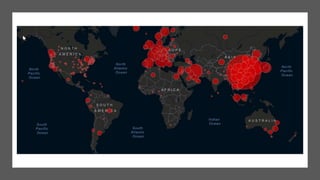
 Where it is present- How many have died
 How it Impacts Humans
 Symptoms
 Testing
 How it Spreads
 How to Kill the Virus
 Compared to Flu
 Economic Fallout
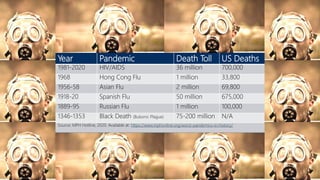
 Pandemic History
 Conclusion
Coronavirus Cases:
118,624
Deaths:
4,269
Recovered:
65,105
ACTIVE CASES
49,250
Currently Infected Patients
37,774 (88%) 6,045 (12%)
in Mild Condition Serious or Critical
CLOSED CASES
69,374
Cases which had an outcome
65,105 (94%) 4,269 (6%)
Recovered/Discharged Deaths
Source: Worldometer 2002. Available at: https://www.worldometers.info/coronavirus/
INFECTION
AND
FATALITY
RATES
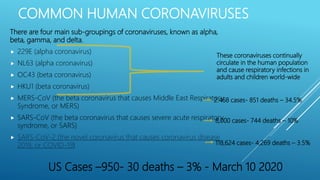
COMMON HUMAN CORONAVIRUSES
There are four main sub-groupings of coronaviruses, known as alpha,
beta, gamma, and delta.
 229E (alpha coronavirus)
 NL63 (alpha coronavirus)
 OC43 (beta coronavirus)
 HKU1 (beta coronavirus)
 MERS-CoV (the beta coronavirus that causes Middle East Respiratory
Syndrome, or MERS)
 SARS-CoV (the beta coronavirus that causes severe acute respiratory
syndrome, or SARS)
 SARS-CoV-2 (the novel coronavirus that causes coronavirus disease
2019, or COVID-19)
These coronaviruses continually
circulate in the human population
and cause respiratory infections in
adults and children world-wide
2.468 cases- 851 deaths – 34.5%
8,000 cases- 744 deaths – 10%
118,624 cases- 4,269 deaths – 3.5%
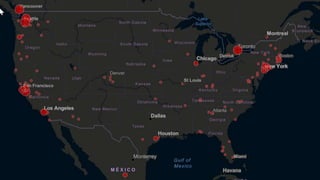
US Cases –950- 30 deaths – 3% - March 10 2020
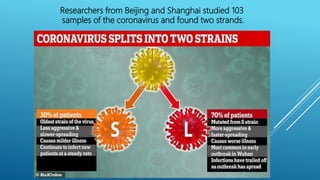
Researchers from Beijing and Shanghai studied 103
samples of the coronavirus and found two strands.
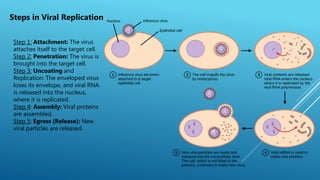
Step 1: Attachment: The virus
attaches itself to the target cell.
Step 2: Penetration: The virus is
brought into the target cell.
Step 3: Uncoating and
Replication: The enveloped virus
loses its envelope, and viral RNA
is released into the nucleus,
where it is replicated.
Step 4: Assembly: Viral proteins
are assembled.
Step 5: Egress (Release): New
viral particles are released.
Steps in Viral Replication
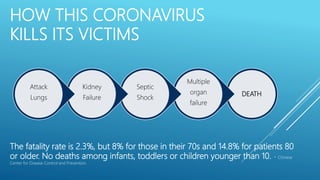
HOW THIS CORONAVIRUS
KILLS ITS VICTIMS
DEATH
Multiple
organ
failure
Septic
Shock
Kidney
Failure
Attack
Lungs
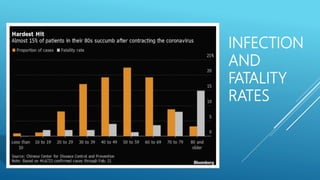
The fatality rate is 2.3%, but 8% for those in their 70s and 14.8% for patients 80
or older. No deaths among infants, toddlers or children younger than 10. - Chinese
Center for Disease Control and Prevention.
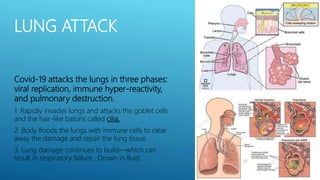
LUNG ATTACK
Covid-19 attacks the lungs in three phases:
viral replication, immune hyper-reactivity,
and pulmonary destruction.
1. Rapidly invades lungs and attacks the goblet cells
and the hair-like batons called cilia.
2. Body floods the lungs with immune cells to clear
away the damage and repair the lung tissue.
3. Lung damage continues to build—which can
result in respiratory failure. Drown in fluid.
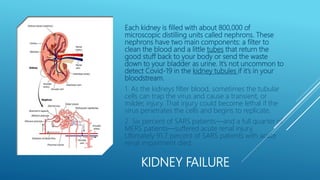
KIDNEY FAILURE
Each kidney is filled with about 800,000 of
microscopic distilling units called nephrons. These
nephrons have two main components: a filter to
clean the blood and a little tubes that return the
good stuff back to your body or send the waste
down to your bladder as urine. It’s not uncommon to
detect Covid-19 in the kidney tubules if it’s in your
bloodstream.
1. As the kidneys filter blood, sometimes the tubular
cells can trap the virus and cause a transient, or
milder, injury. That injury could become lethal if the
virus penetrates the cells and begins to replicate.
2. Six percent of SARS patients—and a full quarter of
MERS patients—suffered acute renal injury.
Ultimately 91.7 percent of SARS patients with acute
renal impairment died.
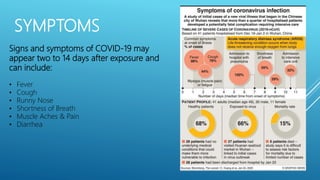
SYMPTOMS
Signs and symptoms of COVID-19 may
appear two to 14 days after exposure and
can include:
• Fever
• Cough
• Runny Nose
• Shortness of Breath
• Muscle Aches & Pain
• Diarrhea
TESTING
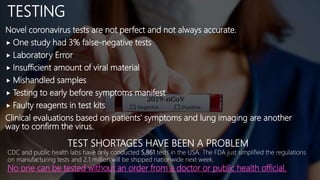
Novel coronavirus tests are not perfect and not always accurate.
 One study had 3% false-negative tests
 Laboratory Error
 Insufficient amount of viral material
 Mishandled samples
 Testing to early before symptoms manifest
 Faulty reagents in test kits
Clinical evaluations based on patients' symptoms and lung imaging are another
way to confirm the virus.
TEST SHORTAGES HAVE BEEN A PROBLEM
CDC and public health labs have only conducted 5,861 tests in the USA. The FDA just simplified the regulations
on manufacturing tests and 2.1 million will be shipped nationwide next week.
No one can be tested without an order from a doctor or public health official.
HOW IT SPREADS
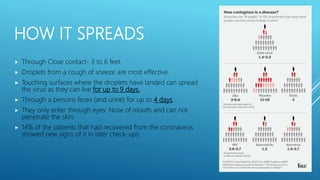
 Through Close contact- 3 to 6 feet.
 Droplets from a cough of sneeze are most effective.
 Touching surfaces where the droplets have landed can spread
the virus as they can live for up to 9 days.
 Through a persons feces (and urine) for up to 4 days.
 They only enter through eyes. Nose of mouth and can not
penetrate the skin.
 14% of the patients that had recovered from the coronavirus
showed new signs of it in later check-ups.
HOW TO KILL IT
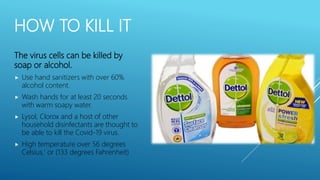
The virus cells can be killed by
soap or alcohol.
 Use hand sanitizers with over 60%
alcohol content.
 Wash hands for at least 20 seconds
with warm soapy water.
 Lysol, Clorox and a host of other
household disinfectants are thought to
be able to kill the Covid-19 virus.
 High temperature over 56 degrees
Celsius,' or (133 degrees Fahrenheit)
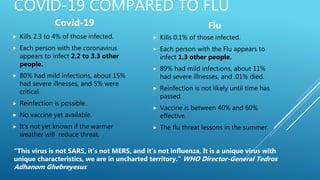
COVID-19 COMPARED TO FLU
 Kills 2.3 to 4% of those infected.
 Each person with the coronavirus
appears to infect 2.2 to 3.3 other
people.
 80% had mild infections, about 15%
had severe illnesses, and 5% were
critical.
 Reinfection is possible.
 No vaccine yet available.
 It’s not yet known if the warmer
weather will reduce threat.
 Kills 0.1% of those infected.
 Each person with the Flu appears to
infect 1.3 other people.
 89% had mild infections, about 11%
had severe illnesses, and .01% died.
 Reinfection is not likely until time has
passed.
 Vaccine is between 40% and 60%
effective.
 The flu threat lessons in the summer.
“This virus is not SARS, it’s not MERS, and it’s not influenza, It is a unique virus with
unique characteristics, we are in uncharted territory.” WHO Director-General Tedros
Adhanom Ghebreyesus
Covid-19 Flu
ECONOMIC FALLOUT
 Travel and tourism will take a deep hit
 Global supply chains interrupted
 Stores shelves empty = higher prices
 Restaurants close
 Sporting Events with no fans
“A severe pandemic could cause economic losses equal to nearly 5% of global GDP, or more than $3
trillion.” - World Bank Study
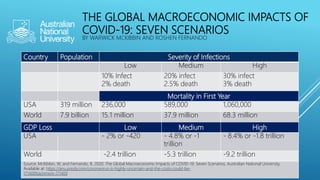
THE GLOBAL MACROECONOMIC IMPACTS OF
COVID-19: SEVEN SCENARIOS
BY WARWICK MCKIBBIN AND ROSHEN FERNANDO
Country Population Severity of Infections
Low Medium High
10% Infect
2% death
20% infect
2.5% death
30% infect
3% death
Mortality in First Year
USA 319 million 236,000 589,000 1,060,000
World 7.9 billion 15.1 million 37.9 million 68.3 million
GDP Loss Low Medium High
USA - 2% or -420 - 4.8% or -1
trillion
- 8.4% or -1.8 trillion
World -2.4 trillion -5.3 trillion -9.2 trillion
Source: McKibbin, W, and Fernando, R, 2020. The Global Macroeconomic Impacts of COVID-19: Seven Scenarios, Australian National University,
Available at: https://anu.prezly.com/coronavirus-is-highly-uncertain-and-the-costs-could-be-
171409ttachment-171409
Year Pandemic Death Toll US Deaths
1981-2020 HIV/AIDS 36 million 700,000
1968 Hong Cong Flu 1 million 33,800
1956-58 Asian Flu 2 million 69,800
1918-20 Spanish Flu 50 million 675,000
1889-95 Russian Flu 1 million 100,000
1346-1353 Black Death (Bubonic Plague) 75-200 million N/A
Source: MPH Hotline, 2020. Available at: https://www.mphonline.org/worst-pandemics-in-history/
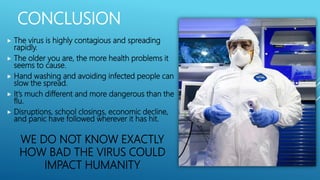
CONCLUSION
 The virus is highly contagious and spreading
rapidly.
 The older you are, the more health problems it
seems to cause.
 Hand washing and avoiding infected people can
slow the spread.
 It’s much different and more dangerous than the
flu.
 Disruptions, school closings, economic decline,
and panic have followed wherever it has hit.
WE DO NOT KNOW EXACTLY
HOW BAD THE VIRUS COULD
IMPACT HUMANITY
References
CDC, 2020. Coronavirus Disease 2019 (COVID-19) Situation Summary, Centers for Disease Control and Prevention, available at:
https://www.cdc.gov/coronavirus/2019-ncov/summary.html
Grady, D., 2020. How Does the Coronavirus Compare With the Flu?, New York Times, available at:
https://www.nytimes.com/2020/02/29/health/coronavirus-flu.html
Lichtenstein, K., 2020. Are Coronavirus Tests Accurate?, MedicineNet, available at:
https://www.medicinenet.com/script/main/art.asp?articlekey=228250
Mckeever, A., 2020. Here’s what coronavirus does to the body, National Geographic, available at:
https://www.nationalgeographic.com/science/2020/02/here-is-what-coronavirus-does-to-the-body/
McKibbin, W., and Fernando, R., 2020. The Global Macroeconomic Impacts of COVID-19: Seven Scenarios, Australian National University,
Canberra. Available at: https://anu.prezly.com/coronavirus-is-highly-uncertain-and-the-costs-could-be-
high?asset_type=attachment&asset_id=171409#attachment-171409ttachment-171409
Samuels, B and Hellmann, J., 2020. CDC has tested 1,583 people for coronavirus, The Hill, available at:
https://thehill.com/homenews/administration/486452-cdc-has-tested-1583-people-for-coronavirus
WHO, 2020. Coronavirus disease (COVID-19) advice for the public: Myth busters, World Health Organization, available at:
https://www.who.int/emergencies/diseases/novel-coronavirus-2019/advice-for-public/myth-busters
WHO, 2020. First data on stability and resistance of SARS coronavirus compiled by members of WHO laboratory network, World Health
Organization, available at: https://www.who.int/csr/sars/survival_2003_05_04/en/

Coronavirus07

  • 1.
    CORONAVIRUS Facts, and Precautionsof the 2019-nCoV By Capt. Rodney Jetton –March 10, 2020
  • 2.
    INTRODUCTION  Where itis present- How many have died  How it Impacts Humans  Symptoms  Testing  How it Spreads  How to Kill the Virus  Compared to Flu  Economic Fallout  Pandemic History  Conclusion
  • 3.
    Coronavirus Cases: 118,624 Deaths: 4,269 Recovered: 65,105 ACTIVE CASES 49,250 CurrentlyInfected Patients 37,774 (88%) 6,045 (12%) in Mild Condition Serious or Critical CLOSED CASES 69,374 Cases which had an outcome 65,105 (94%) 4,269 (6%) Recovered/Discharged Deaths Source: Worldometer 2002. Available at: https://www.worldometers.info/coronavirus/
  • 4.
  • 7.
    COMMON HUMAN CORONAVIRUSES Thereare four main sub-groupings of coronaviruses, known as alpha, beta, gamma, and delta.  229E (alpha coronavirus)  NL63 (alpha coronavirus)  OC43 (beta coronavirus)  HKU1 (beta coronavirus)  MERS-CoV (the beta coronavirus that causes Middle East Respiratory Syndrome, or MERS)  SARS-CoV (the beta coronavirus that causes severe acute respiratory syndrome, or SARS)  SARS-CoV-2 (the novel coronavirus that causes coronavirus disease 2019, or COVID-19) These coronaviruses continually circulate in the human population and cause respiratory infections in adults and children world-wide 2.468 cases- 851 deaths – 34.5% 8,000 cases- 744 deaths – 10% 118,624 cases- 4,269 deaths – 3.5% US Cases –950- 30 deaths – 3% - March 10 2020
  • 8.
    Researchers from Beijingand Shanghai studied 103 samples of the coronavirus and found two strands.
  • 9.
    Step 1: Attachment:The virus attaches itself to the target cell. Step 2: Penetration: The virus is brought into the target cell. Step 3: Uncoating and Replication: The enveloped virus loses its envelope, and viral RNA is released into the nucleus, where it is replicated. Step 4: Assembly: Viral proteins are assembled. Step 5: Egress (Release): New viral particles are released. Steps in Viral Replication
  • 10.
    HOW THIS CORONAVIRUS KILLSITS VICTIMS DEATH Multiple organ failure Septic Shock Kidney Failure Attack Lungs The fatality rate is 2.3%, but 8% for those in their 70s and 14.8% for patients 80 or older. No deaths among infants, toddlers or children younger than 10. - Chinese Center for Disease Control and Prevention.
  • 11.
    LUNG ATTACK Covid-19 attacksthe lungs in three phases: viral replication, immune hyper-reactivity, and pulmonary destruction. 1. Rapidly invades lungs and attacks the goblet cells and the hair-like batons called cilia. 2. Body floods the lungs with immune cells to clear away the damage and repair the lung tissue. 3. Lung damage continues to build—which can result in respiratory failure. Drown in fluid.
  • 12.
    KIDNEY FAILURE Each kidneyis filled with about 800,000 of microscopic distilling units called nephrons. These nephrons have two main components: a filter to clean the blood and a little tubes that return the good stuff back to your body or send the waste down to your bladder as urine. It’s not uncommon to detect Covid-19 in the kidney tubules if it’s in your bloodstream. 1. As the kidneys filter blood, sometimes the tubular cells can trap the virus and cause a transient, or milder, injury. That injury could become lethal if the virus penetrates the cells and begins to replicate. 2. Six percent of SARS patients—and a full quarter of MERS patients—suffered acute renal injury. Ultimately 91.7 percent of SARS patients with acute renal impairment died.
  • 13.
    SYMPTOMS Signs and symptomsof COVID-19 may appear two to 14 days after exposure and can include: • Fever • Cough • Runny Nose • Shortness of Breath • Muscle Aches & Pain • Diarrhea
  • 14.
    TESTING Novel coronavirus testsare not perfect and not always accurate.  One study had 3% false-negative tests  Laboratory Error  Insufficient amount of viral material  Mishandled samples  Testing to early before symptoms manifest  Faulty reagents in test kits Clinical evaluations based on patients' symptoms and lung imaging are another way to confirm the virus. TEST SHORTAGES HAVE BEEN A PROBLEM CDC and public health labs have only conducted 5,861 tests in the USA. The FDA just simplified the regulations on manufacturing tests and 2.1 million will be shipped nationwide next week. No one can be tested without an order from a doctor or public health official.
  • 15.
    HOW IT SPREADS Through Close contact- 3 to 6 feet.  Droplets from a cough of sneeze are most effective.  Touching surfaces where the droplets have landed can spread the virus as they can live for up to 9 days.  Through a persons feces (and urine) for up to 4 days.  They only enter through eyes. Nose of mouth and can not penetrate the skin.  14% of the patients that had recovered from the coronavirus showed new signs of it in later check-ups.
  • 16.
    HOW TO KILLIT The virus cells can be killed by soap or alcohol.  Use hand sanitizers with over 60% alcohol content.  Wash hands for at least 20 seconds with warm soapy water.  Lysol, Clorox and a host of other household disinfectants are thought to be able to kill the Covid-19 virus.  High temperature over 56 degrees Celsius,' or (133 degrees Fahrenheit)
  • 17.
    COVID-19 COMPARED TOFLU  Kills 2.3 to 4% of those infected.  Each person with the coronavirus appears to infect 2.2 to 3.3 other people.  80% had mild infections, about 15% had severe illnesses, and 5% were critical.  Reinfection is possible.  No vaccine yet available.  It’s not yet known if the warmer weather will reduce threat.  Kills 0.1% of those infected.  Each person with the Flu appears to infect 1.3 other people.  89% had mild infections, about 11% had severe illnesses, and .01% died.  Reinfection is not likely until time has passed.  Vaccine is between 40% and 60% effective.  The flu threat lessons in the summer. “This virus is not SARS, it’s not MERS, and it’s not influenza, It is a unique virus with unique characteristics, we are in uncharted territory.” WHO Director-General Tedros Adhanom Ghebreyesus Covid-19 Flu
  • 18.
    ECONOMIC FALLOUT  Traveland tourism will take a deep hit  Global supply chains interrupted  Stores shelves empty = higher prices  Restaurants close  Sporting Events with no fans “A severe pandemic could cause economic losses equal to nearly 5% of global GDP, or more than $3 trillion.” - World Bank Study
  • 19.
    THE GLOBAL MACROECONOMICIMPACTS OF COVID-19: SEVEN SCENARIOS BY WARWICK MCKIBBIN AND ROSHEN FERNANDO Country Population Severity of Infections Low Medium High 10% Infect 2% death 20% infect 2.5% death 30% infect 3% death Mortality in First Year USA 319 million 236,000 589,000 1,060,000 World 7.9 billion 15.1 million 37.9 million 68.3 million GDP Loss Low Medium High USA - 2% or -420 - 4.8% or -1 trillion - 8.4% or -1.8 trillion World -2.4 trillion -5.3 trillion -9.2 trillion Source: McKibbin, W, and Fernando, R, 2020. The Global Macroeconomic Impacts of COVID-19: Seven Scenarios, Australian National University, Available at: https://anu.prezly.com/coronavirus-is-highly-uncertain-and-the-costs-could-be- 171409ttachment-171409
  • 21.
    Year Pandemic DeathToll US Deaths 1981-2020 HIV/AIDS 36 million 700,000 1968 Hong Cong Flu 1 million 33,800 1956-58 Asian Flu 2 million 69,800 1918-20 Spanish Flu 50 million 675,000 1889-95 Russian Flu 1 million 100,000 1346-1353 Black Death (Bubonic Plague) 75-200 million N/A Source: MPH Hotline, 2020. Available at: https://www.mphonline.org/worst-pandemics-in-history/
  • 22.
    CONCLUSION  The virusis highly contagious and spreading rapidly.  The older you are, the more health problems it seems to cause.  Hand washing and avoiding infected people can slow the spread.  It’s much different and more dangerous than the flu.  Disruptions, school closings, economic decline, and panic have followed wherever it has hit. WE DO NOT KNOW EXACTLY HOW BAD THE VIRUS COULD IMPACT HUMANITY
  • 23.
    References CDC, 2020. CoronavirusDisease 2019 (COVID-19) Situation Summary, Centers for Disease Control and Prevention, available at: https://www.cdc.gov/coronavirus/2019-ncov/summary.html Grady, D., 2020. How Does the Coronavirus Compare With the Flu?, New York Times, available at: https://www.nytimes.com/2020/02/29/health/coronavirus-flu.html Lichtenstein, K., 2020. Are Coronavirus Tests Accurate?, MedicineNet, available at: https://www.medicinenet.com/script/main/art.asp?articlekey=228250 Mckeever, A., 2020. Here’s what coronavirus does to the body, National Geographic, available at: https://www.nationalgeographic.com/science/2020/02/here-is-what-coronavirus-does-to-the-body/ McKibbin, W., and Fernando, R., 2020. The Global Macroeconomic Impacts of COVID-19: Seven Scenarios, Australian National University, Canberra. Available at: https://anu.prezly.com/coronavirus-is-highly-uncertain-and-the-costs-could-be- high?asset_type=attachment&asset_id=171409#attachment-171409ttachment-171409 Samuels, B and Hellmann, J., 2020. CDC has tested 1,583 people for coronavirus, The Hill, available at: https://thehill.com/homenews/administration/486452-cdc-has-tested-1583-people-for-coronavirus WHO, 2020. Coronavirus disease (COVID-19) advice for the public: Myth busters, World Health Organization, available at: https://www.who.int/emergencies/diseases/novel-coronavirus-2019/advice-for-public/myth-busters WHO, 2020. First data on stability and resistance of SARS coronavirus compiled by members of WHO laboratory network, World Health Organization, available at: https://www.who.int/csr/sars/survival_2003_05_04/en/