Lower Extremity Consequences of “Core
Dysfunction”
Amitesh Narayan
Professor in Physiotherapy
KMC Mangaluru
Introduction
• “Core stability may provide several benefits to the musculoskeletal
system, from maintaining low back health to preventing knee injury”
Willson J D, Dougherty C P, Ireland M L, and Davis I M, Core stability and its relationship to lower extremity function and injury. J Am Acad Orthop Surg, 2005. 13(5): 316-25.
Where is the “core”?
• Lumbo-pelvic-hip complex
• Includes active & passive structures that
either produce or restrict movements of
the lumbar, hip or pelvic segments
What is the “core”?
• Movements/ stability occurs in 3 planes
• Sagittal Plane
• Frontal Plane
• Transverse Plane
What is the “core”?
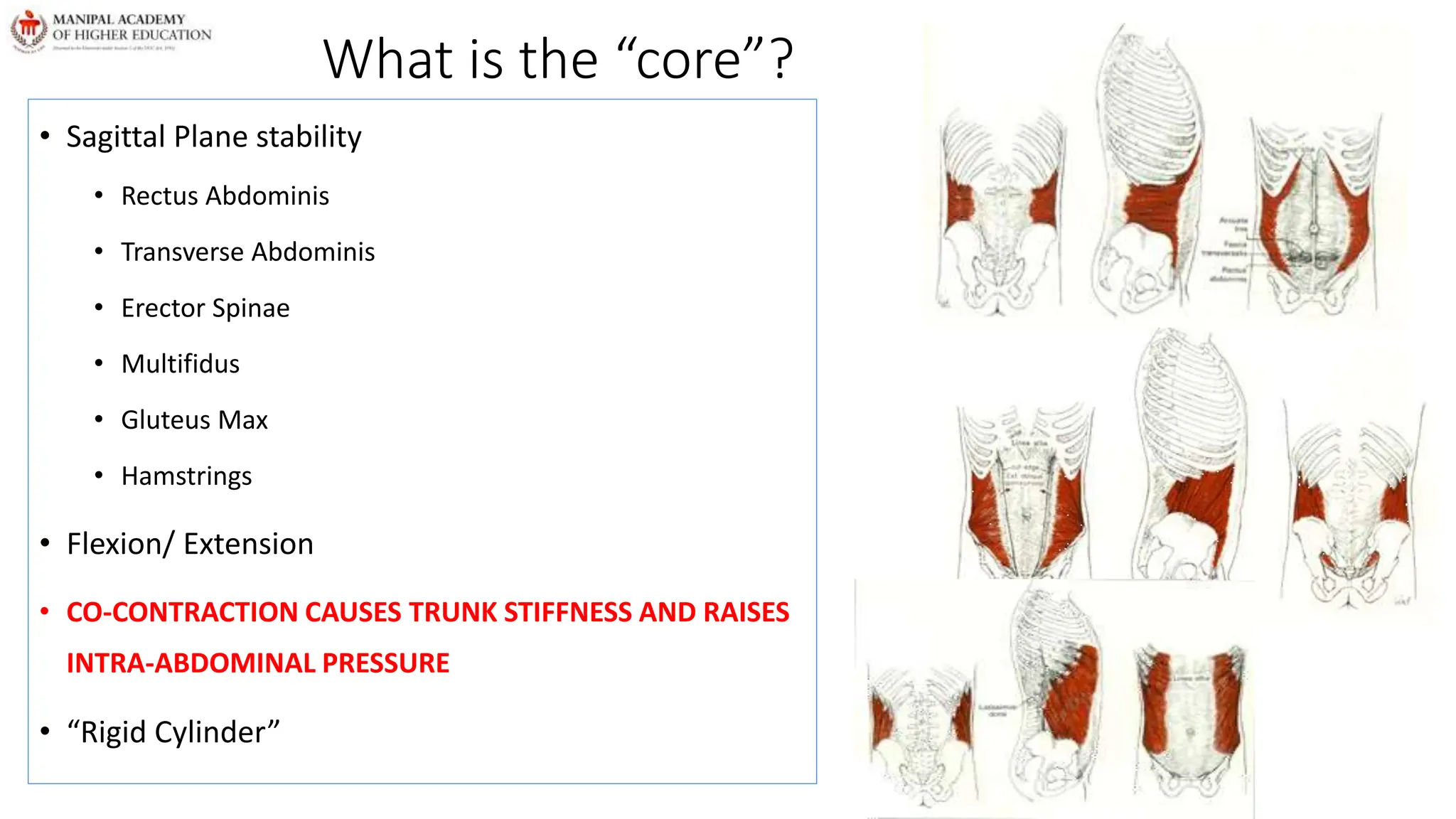
• Sagittal Plane stability
• Rectus Abdominis
• Transverse Abdominis
• Erector Spinae
• Multifidus
• Gluteus Max
• Hamstrings
• Flexion/ Extension
• CO-CONTRACTION CAUSES TRUNK STIFFNESS AND RAISES
INTRA-ABDOMINAL PRESSURE
• “Rigid Cylinder”
What is the “core”?
• Movements/ stability occurs in 3 planes
• Sagittal Plane
• Frontal Plane
• Transverse Plane
What is the “core”?
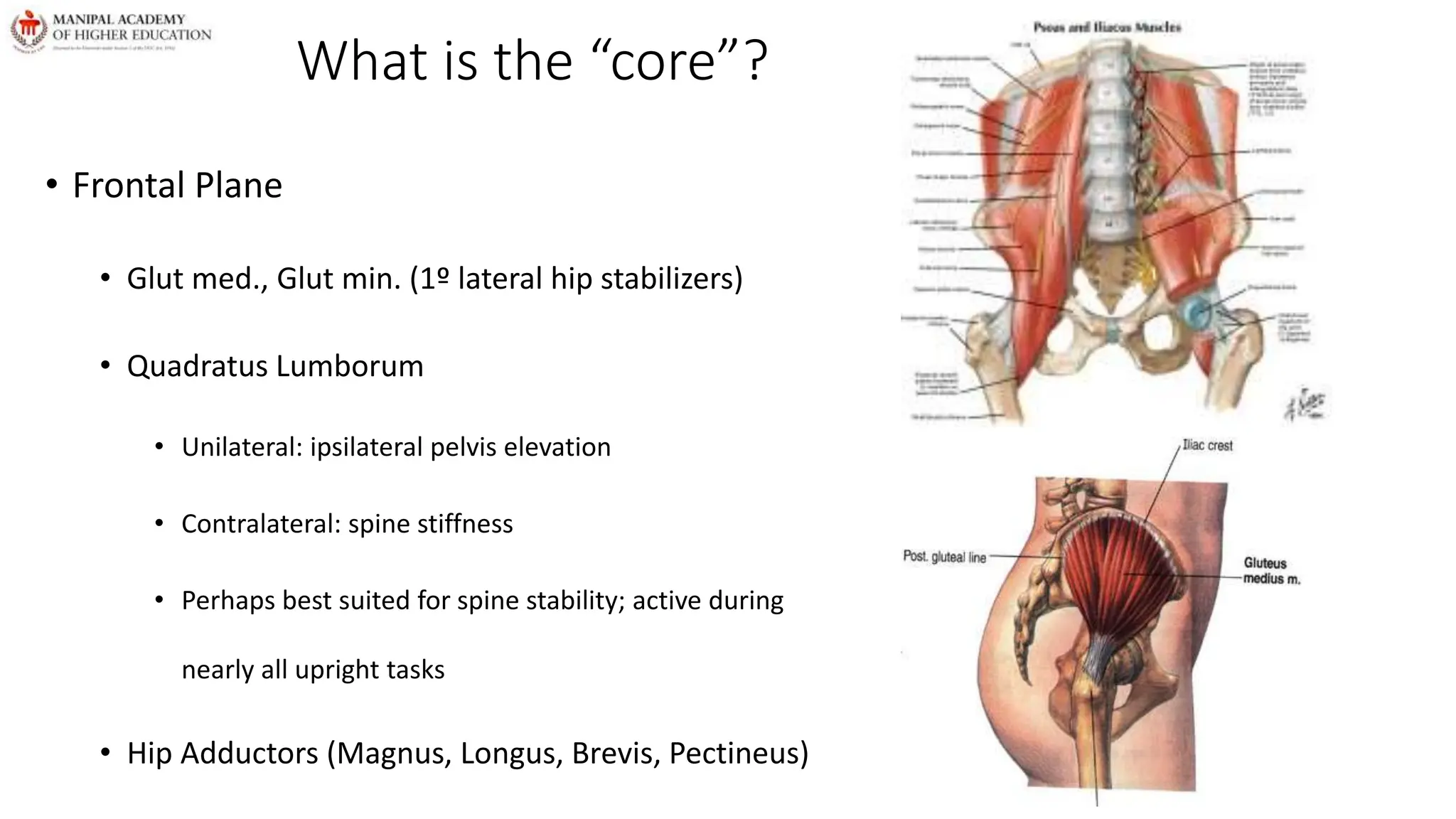
• Frontal Plane
• Glut med., Glut min. (1º lateral hip stabilizers)
• Quadratus Lumborum
• Unilateral: ipsilateral pelvis elevation
• Contralateral: spine stiffness
• Perhaps best suited for spine stability; active during
nearly all upright tasks
• Hip Adductors (Magnus, Longus, Brevis, Pectineus)
What is the “core”?
• Movements/ stability occurs in 3 planes
• Sagittal Plane
• Frontal Plane
• Transverse Plane
What is the “core”?
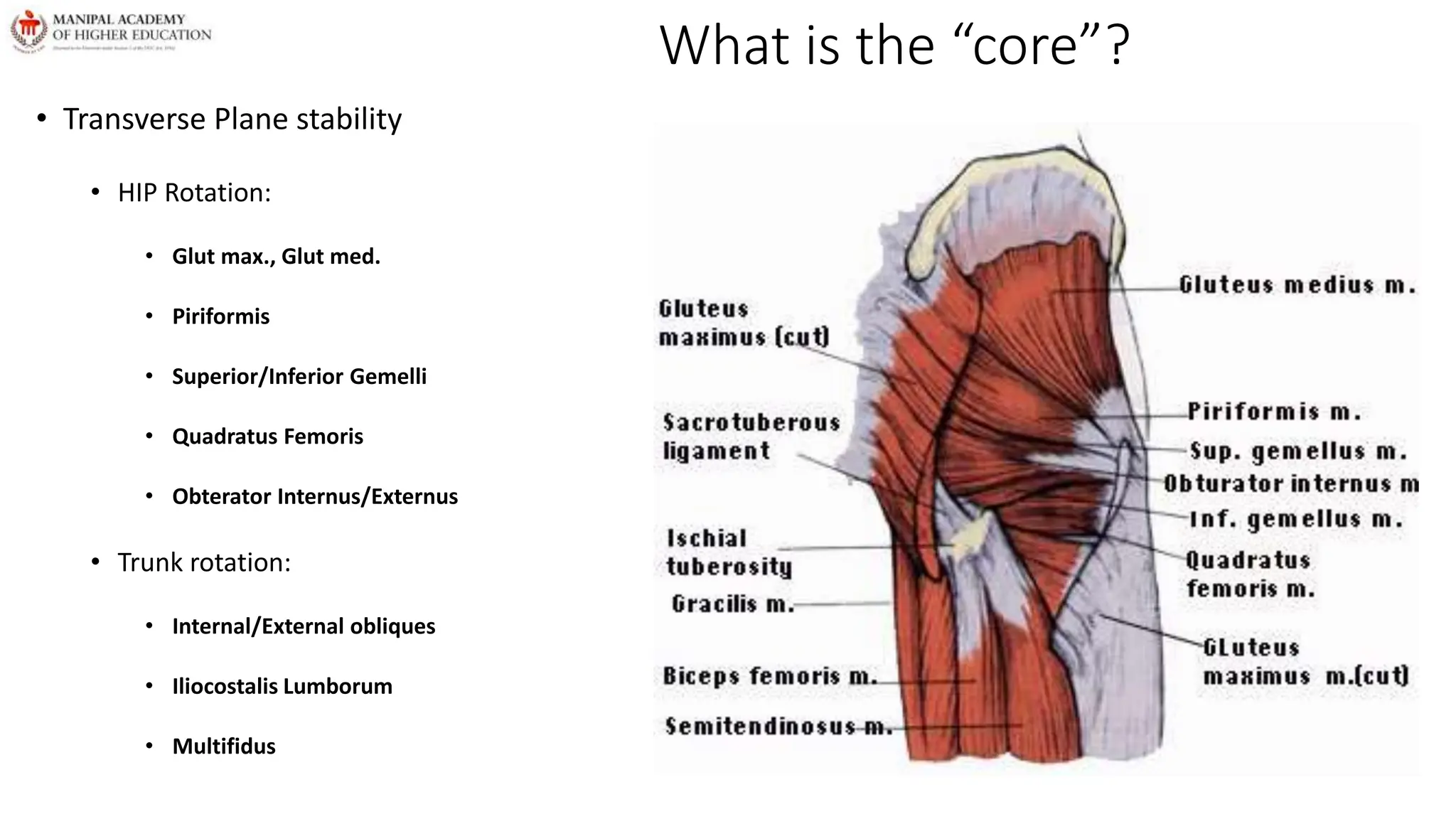
• Transverse Plane stability
• HIP Rotation:
• Glut max., Glut med.
• Piriformis
• Superior/Inferior Gemelli
• Quadratus Femoris
• Obterator Internus/Externus
• Trunk rotation:
• Internal/External obliques
• Iliocostalis Lumborum
• Multifidus
What is the “core”?
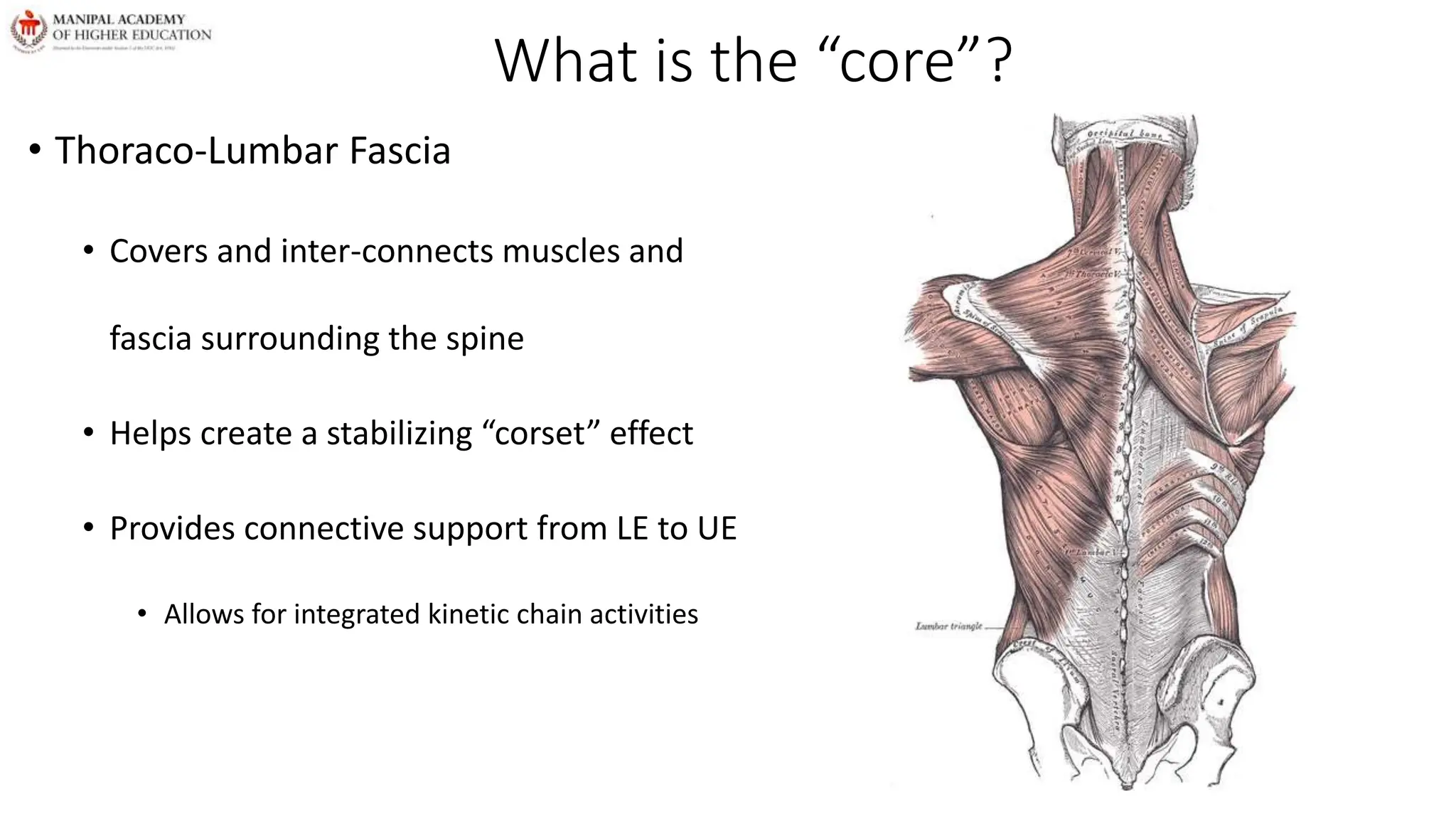
• Thoraco-Lumbar Fascia
• Covers and inter-connects muscles and
fascia surrounding the spine
• Helps create a stabilizing “corset” effect
• Provides connective support from LE to UE
• Allows for integrated kinetic chain activities
What is “core stability”
• “The ability of the Lumbo-pelvic-hip complex to prevent
buckling of the vertebral column and to return it to
equilibrium following perturbation”
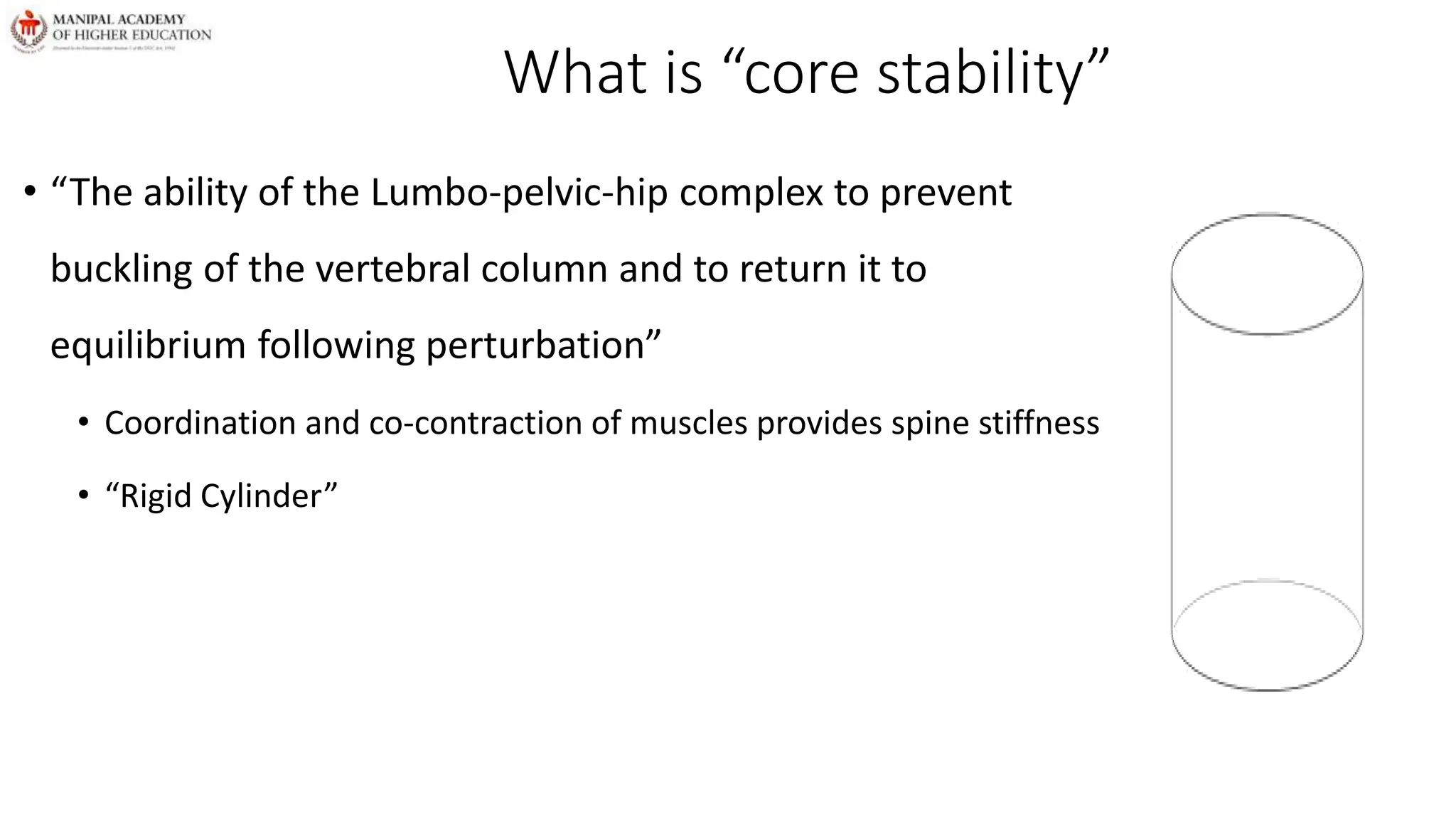
• Coordination and co-contraction of muscles provides spine stiffness
• “Rigid Cylinder”
What is “core stability”
“…the ability to control the position and motion of the trunk over the pelvis
and leg to allow optimum production, transfer and control of force and
motion to the terminal segment in integrated kinetic chain activities.”
Kibler W B, Press J, Sciascia A, The role of core stability in athletic function. Sports Med, 2006. 36(3): 189-98.
What is “core stability”
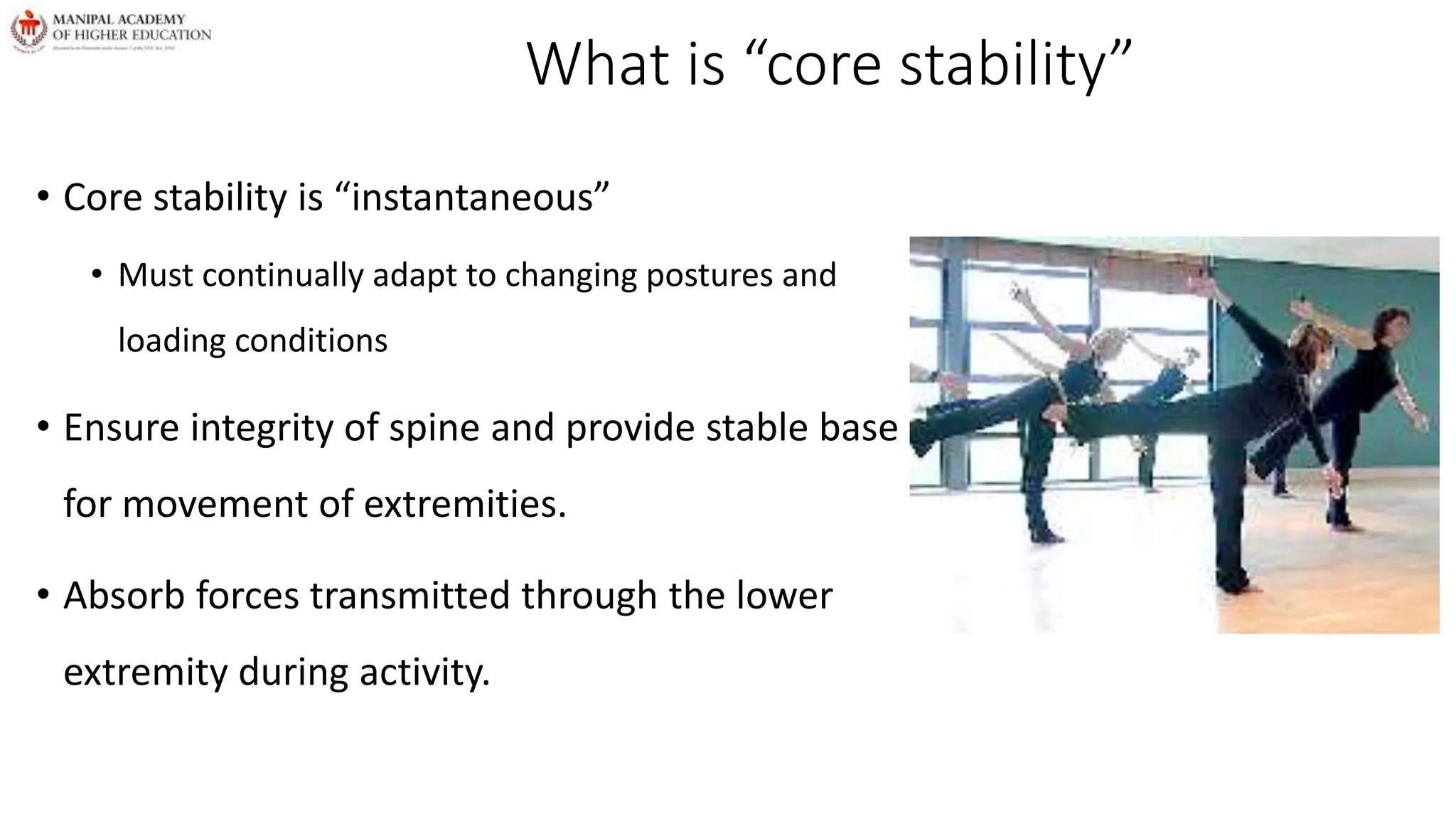
• Core stability is “instantaneous”
• Must continually adapt to changing postures and
loading conditions
• Ensure integrity of spine and provide stable base
for movement of extremities.
• Absorb forces transmitted through the lower
extremity during activity.
Importance of core stability
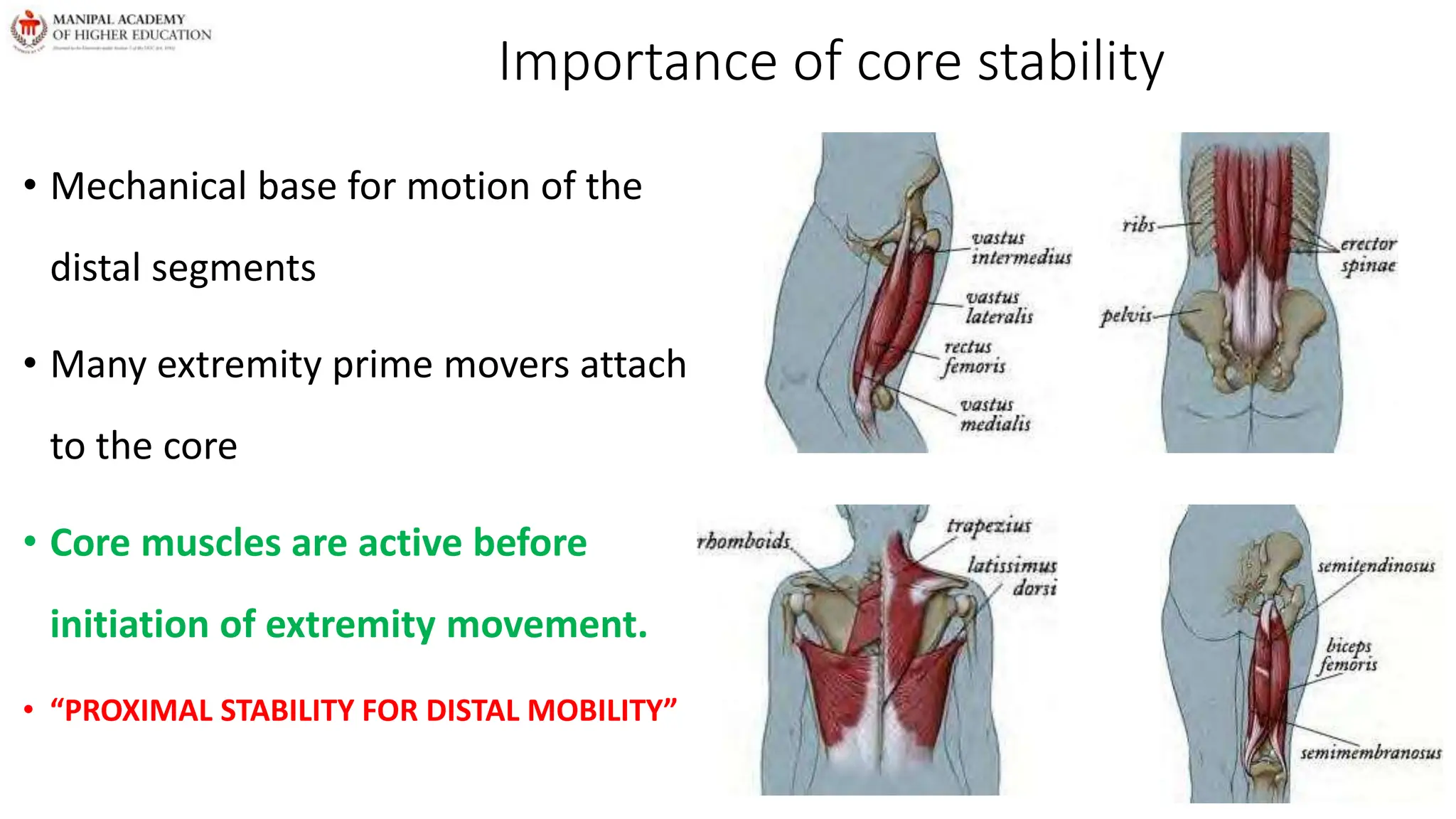
• Mechanical base for motion of the
distal segments
• Many extremity prime movers attach
to the core
• Core muscles are active before
initiation of extremity movement.
• “PROXIMAL STABILITY FOR DISTAL MOBILITY”
Importance of Core Stability
• Motor control
• Carefully coordinated contractions from antagonistic muscles is necessary to stabilize
during posture, activity and to react to perturbations.
• Muscle activity assists with attenuating forces transmitted through the lower
extremity to the spine during activity
• Neuromuscular training (Included abdominal curls, back extension exercise) reduced serious knee
injury in females by 62% (Hewett, 1999)
Importance of Core Stability
• Muscular capacity (i.e: endurance)
• Trunk muscle ENDURANCE is of greater value than the ABILITY TO GENERATE FORCE in
the prevention of LBP (McGill, 2003)
• “…the product of motor control and muscular capacity of the lumbo-pelvic-hip
complex.” Leetun D T, Ireland M L, Willson J D, Ballantyne B T, and Davis I M, Core stability measures as risk factors for lower extremity injury in
athletes. Med Sci Sports Exerc, 2004. 36(6): 926-34.
Importance of Core Stability
• What is needed to achieve optimal stability?
• Depends on task/ activity
• Balance/ symmetry for co-contraction
• Endurance/ motor control during fatiguing tasks
• Same muscles that stabilize also needed for breathing at times of high O2 demand (fatiguing
exercise)
• Loss of stabilization during high intensity exercise?
--(McGill, 1995)
Core Dysfunction
• Poor/ altered function of muscles that stabilize the lumbar-pelvic-hip complex
• Causes?
• Muscle Weakness
• Poor muscular endurance
• Fatigue
• Pain/ injury avoidance
Core Dysfunction
• The important question:
• What happens during activity when muscles cannot stabilize
the lumbar spine, pelvis and hips?
Core Dysfunction
• Lumbar spine experiences compressive loads >6000N
• Passive restraints able to resist only 90N
• Remaining support provided by active tissue
• What happens when muscles fatigue quickly or at different rates?
• COPING MECHANISM…..
Low Back Pain
• Core Dysfunction is common in persons with LBP.
The “core” question…
• How does fatigue affect muscular stability of the lumbar spine, pelvis and
hips?
• In the presence of Recurrent Low Back Pain?
• Poor core stability
• How does this affect Lower Extremity muscle function?
• Lower extremity injury risk??
Research Findings
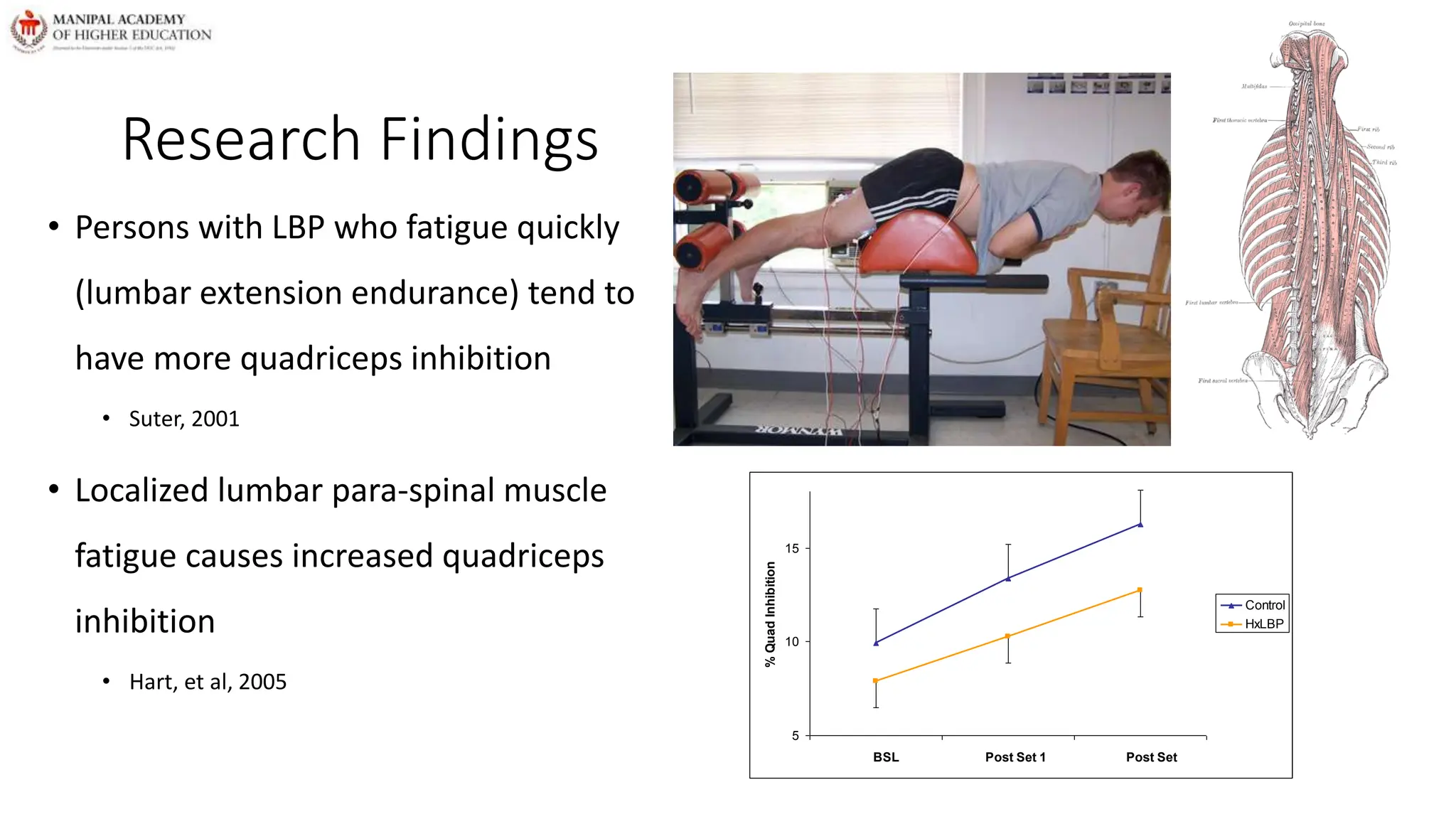
• Persons with LBP who fatigue quickly
(lumbar extension endurance) tend to
have more quadriceps inhibition
• Suter, 2001
• Localized lumbar para-spinal muscle
fatigue causes increased quadriceps
inhibition
• Hart, et al, 2005
5
10
15
BSL Post Set 1 Post Set
%
Quad
Inhibition
Control
HxLBP
Research Findings
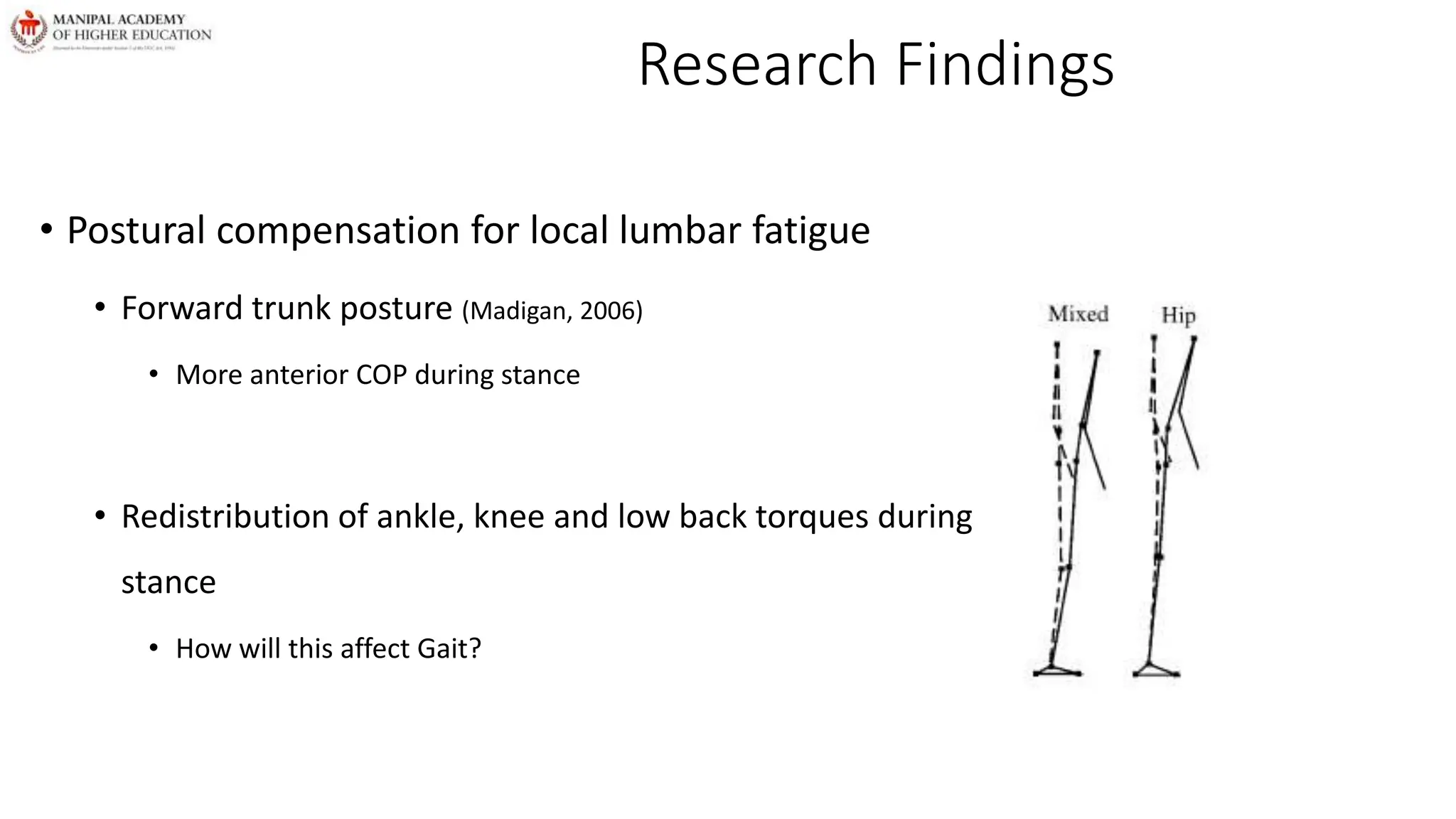
• Postural compensation for local lumbar fatigue
• Forward trunk posture (Madigan, 2006)
• More anterior COP during stance
• Redistribution of ankle, knee and low back torques during
stance
• How will this affect Gait?
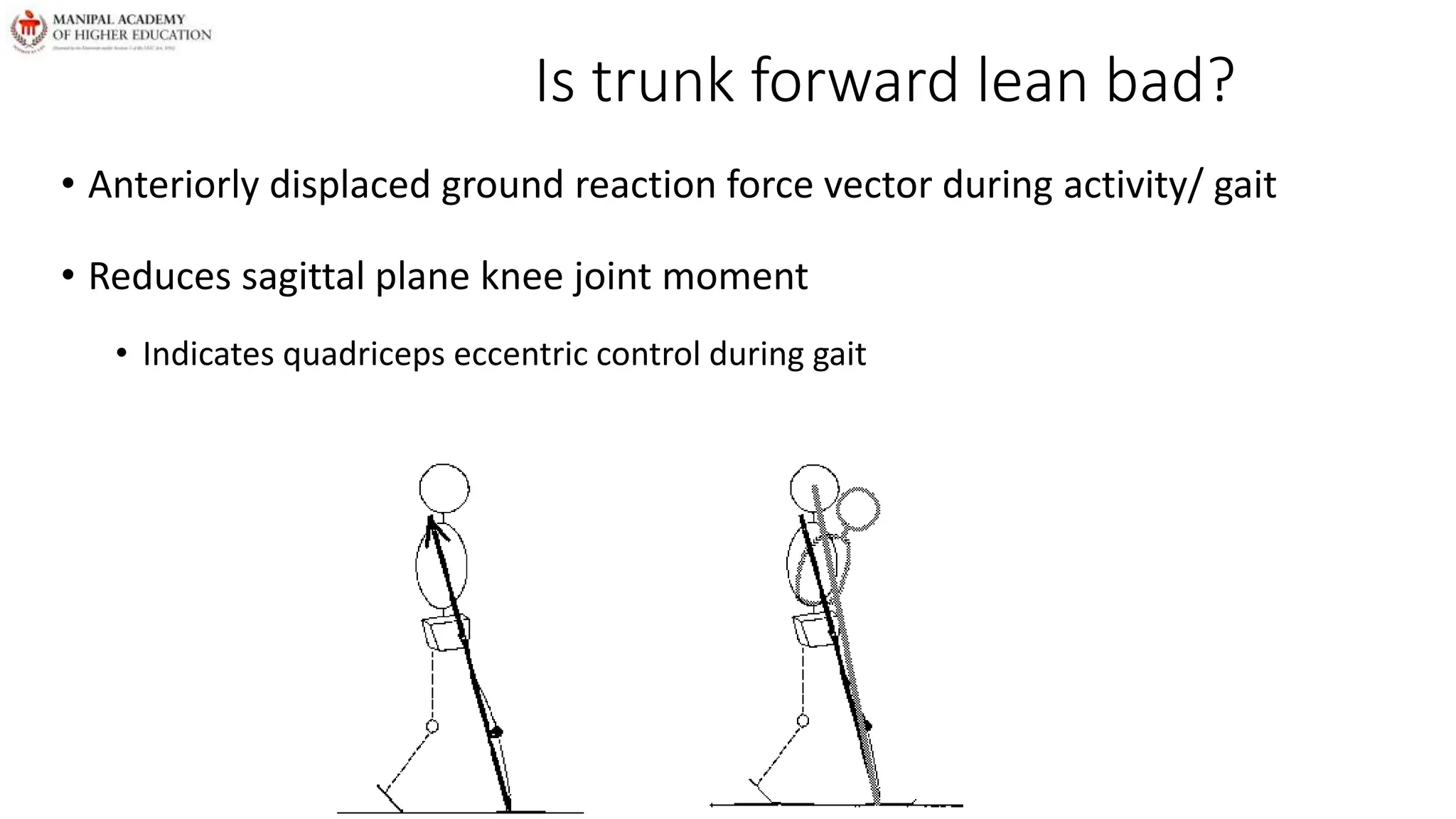
Is trunk forward lean bad?
• Anteriorly displaced ground reaction force vector during activity/ gait
• Reduces sagittal plane knee joint moment
• Indicates quadriceps eccentric control during gait
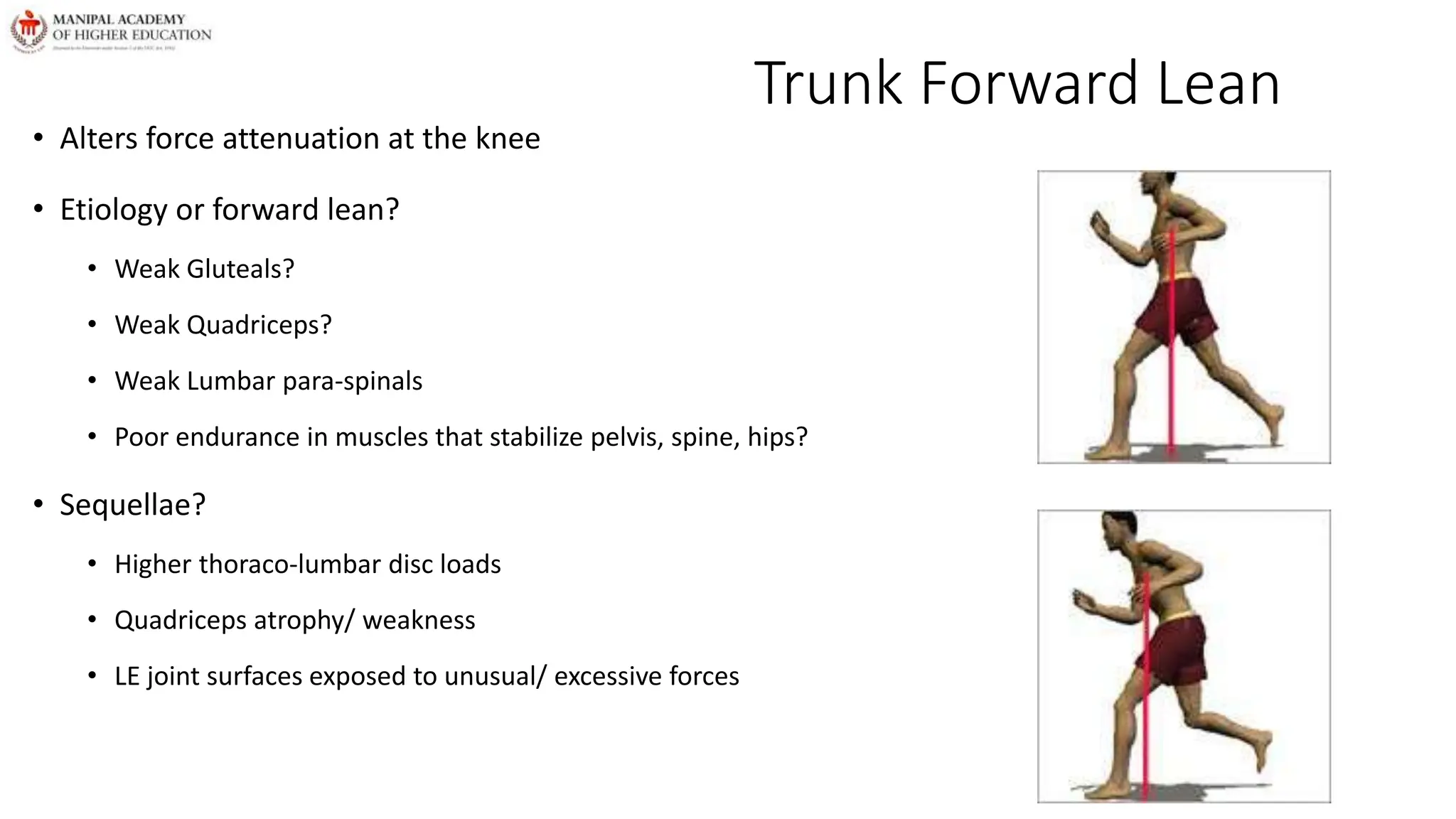
Trunk Forward Lean
• Alters force attenuation at the knee
• Etiology or forward lean?
• Weak Gluteals?
• Weak Quadriceps?
• Weak Lumbar para-spinals
• Poor endurance in muscles that stabilize pelvis, spine, hips?
• Sequellae?
• Higher thoraco-lumbar disc loads
• Quadriceps atrophy/ weakness
• LE joint surfaces exposed to unusual/ excessive forces
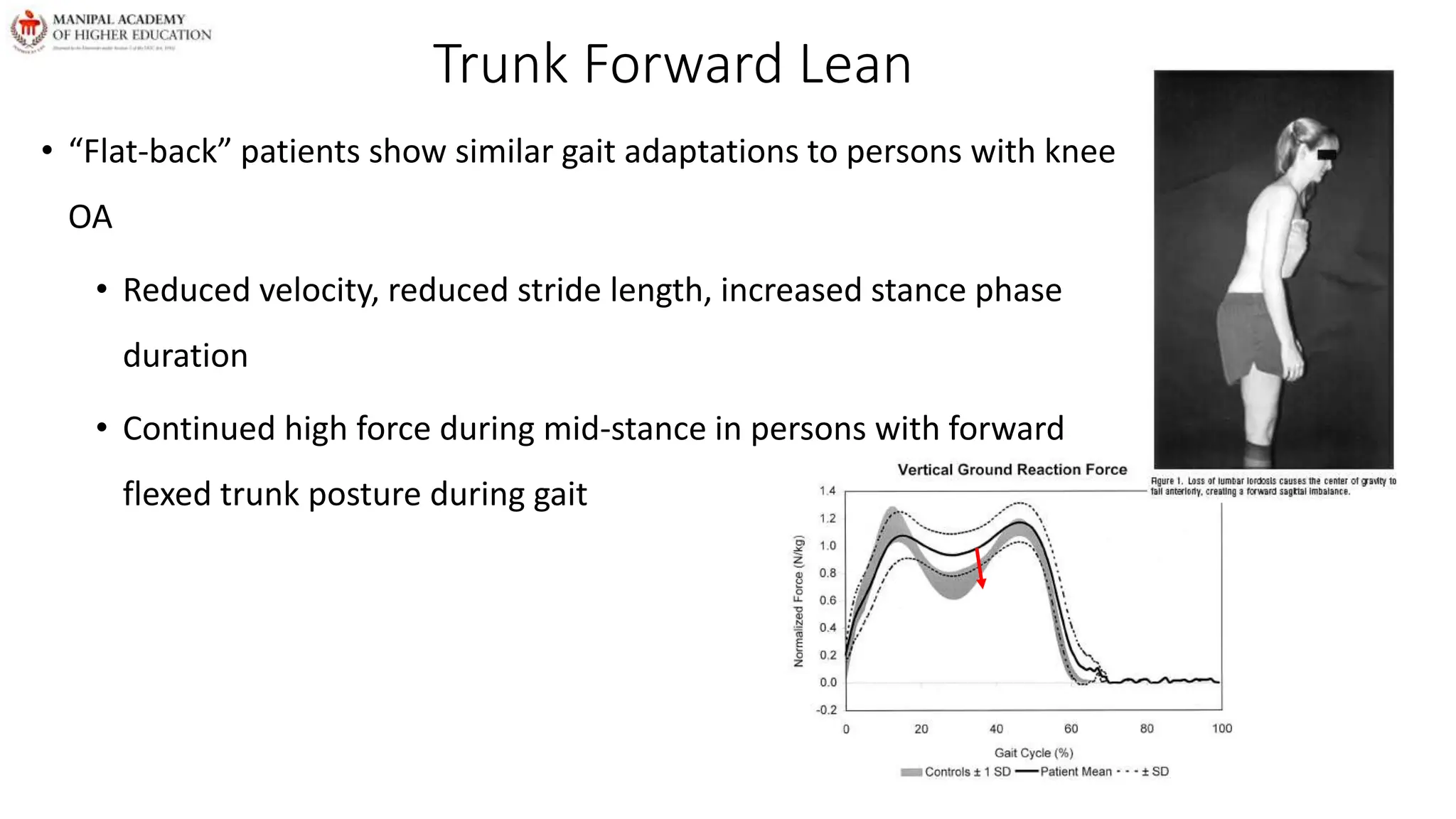
Trunk Forward Lean
• “Flat-back” patients show similar gait adaptations to persons with knee
OA
• Reduced velocity, reduced stride length, increased stance phase
duration
• Continued high force during mid-stance in persons with forward
flexed trunk posture during gait
Trunk Forward Lean
• Compensation for forward flexed position of
the trunk is a crouched posture
• Flexed knee and hip in stance and during gait
(also similar to patients with advanced OA)
• Places weaker gluteals in a mechanically
advantaged position
• Higher demand on quadriceps- Child Krishna!!!
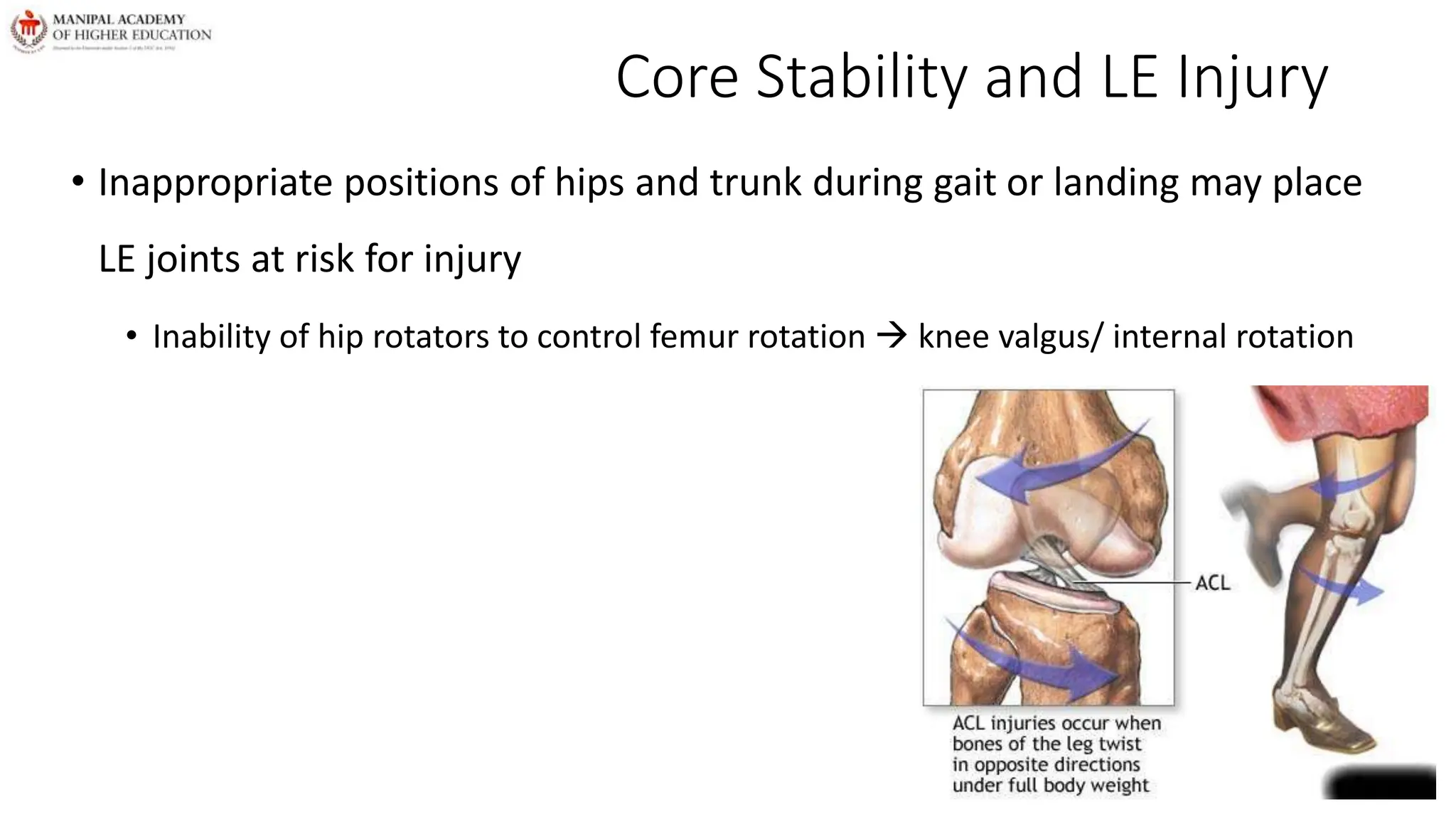
Core Stability and LE Injury
• Inappropriate positions of hips and trunk during gait or landing may place
LE joints at risk for injury
• Inability of hip rotators to control femur rotation  knee valgus/ internal rotation
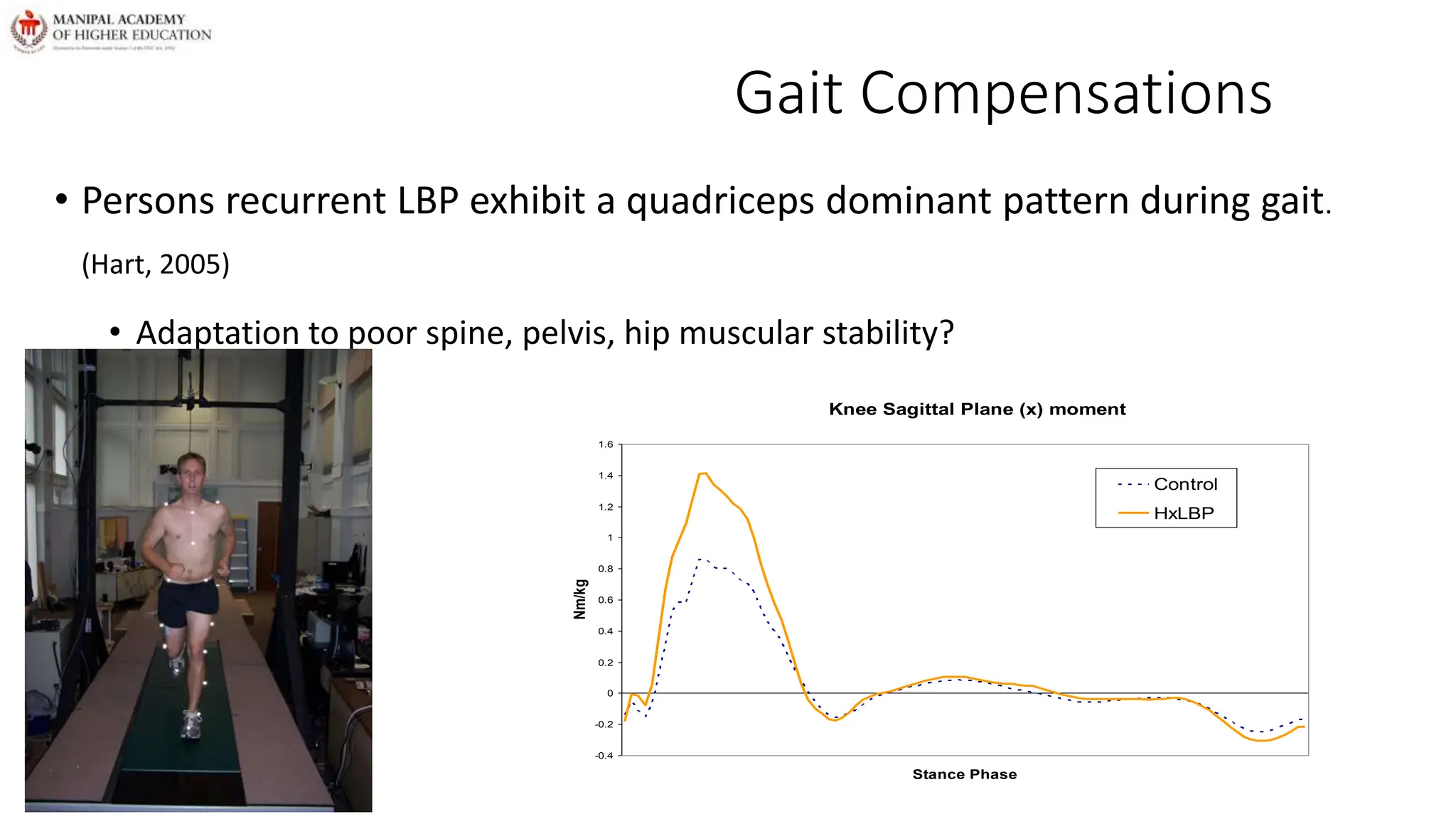
Gait Compensations
• Persons recurrent LBP exhibit a quadriceps dominant pattern during gait.
(Hart, 2005)
• Adaptation to poor spine, pelvis, hip muscular stability?
Knee Sagittal Plane (x) moment
-0.4
-0.2
0
0.2
0.4
0.6
0.8
1
1.2
1.4
1.6
Stance Phase
Nm/kg
Control
HxLBP
Gait Compensations
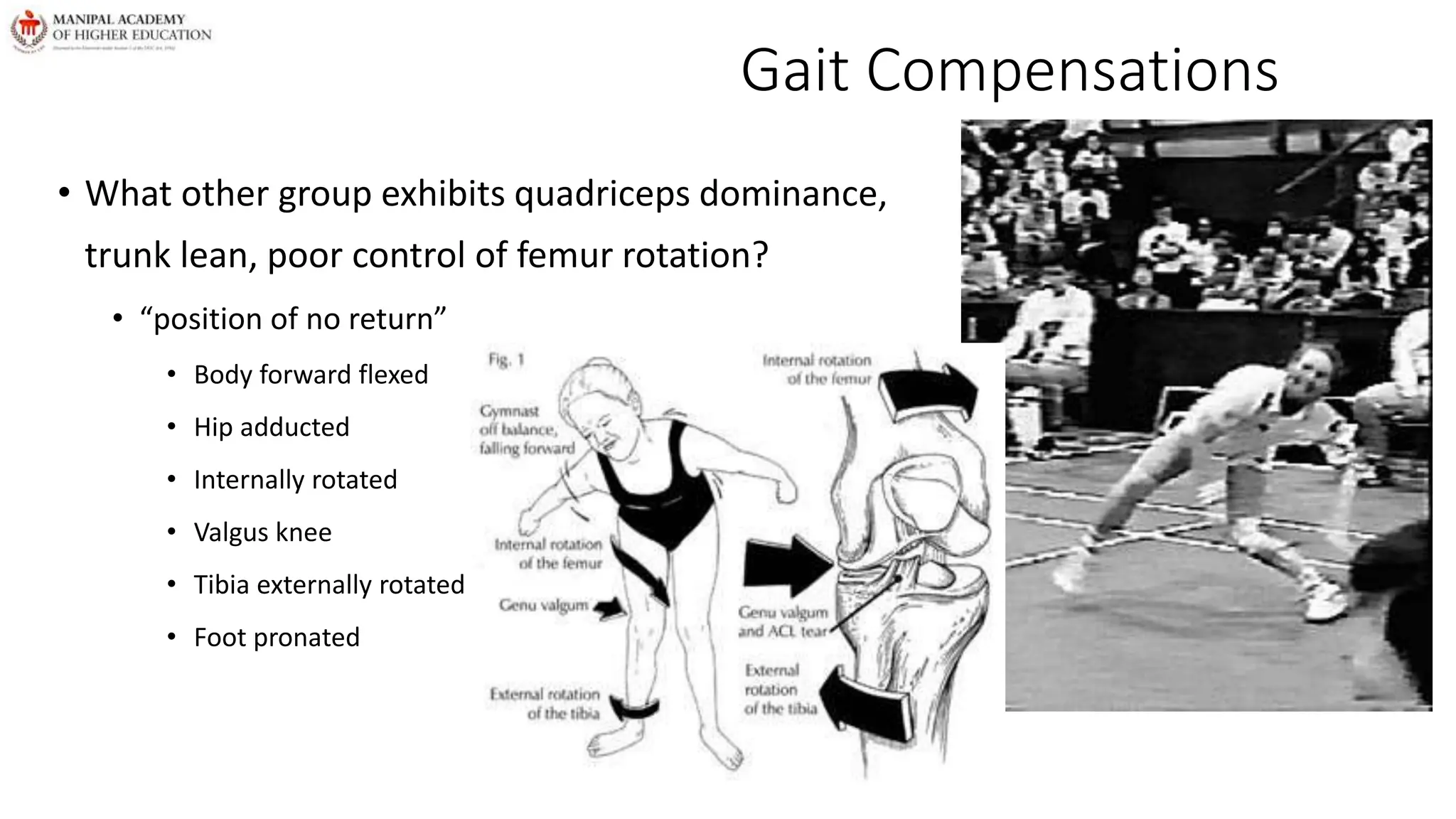
• What other group exhibits quadriceps dominance,
trunk lean, poor control of femur rotation?
• “position of no return”
• Body forward flexed
• Hip adducted
• Internally rotated
• Valgus knee
• Tibia externally rotated
• Foot pronated
Physical & Occupational Therapy In
Pediatrics Volume 24, 2004 - Issue
1-2
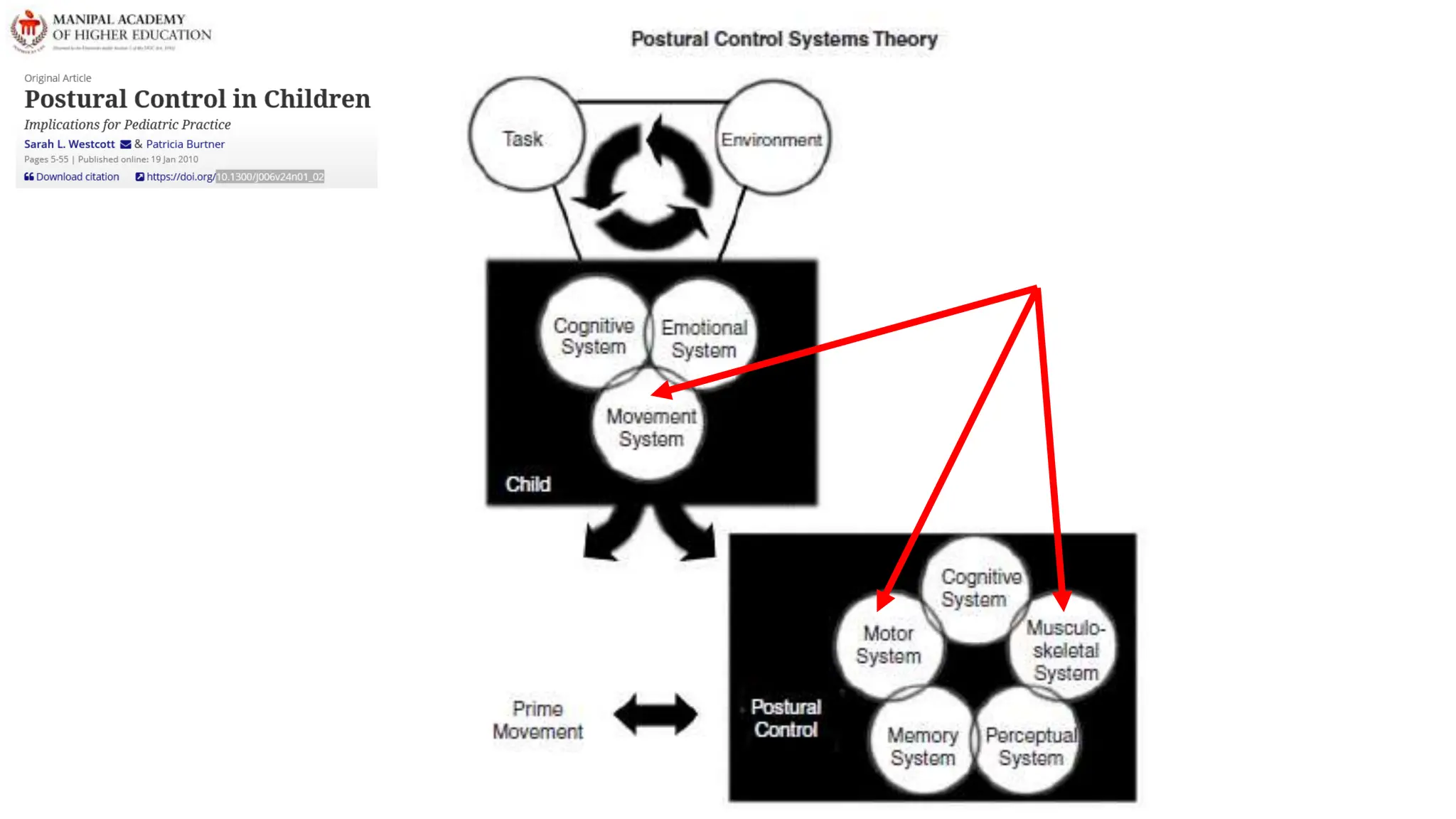
DEVELOPMENT OF RPA AND APA
Three processes critical
1. Motor processes: Emergence of neuromuscular response synergies to maintain stability of the neck, trunk
and legs,
2. Sensory processes: Development of visual, vestibular and somatosensory systems, plus maturation of
central sensory strategies organizing outputs from these senses for body and limb orientation, and
3. Musculoskeletal components: changes in structural and soft tissue morphology, muscle strength
development, and range of motion (including the biomechanical linkage of body segments for movement
(Shumway-Cook & Woollacott, 2001)
Child with CP shows later
onset of the posterior shift of
the APA COP and less
amplitude (Liu, 2001)
Muscle activation in child’s legs with and without spasticity following backward translation of the platform
(vertical arrow).
Note the reversal in muscle onset sequencing (horizontal arrows) in the leg with spasticity [HAMSTRINGS
BEING ACTIVATED PRIOR TO GASTROCNEMIUS] (Nashner, Shumway-Cook, & Marin, 1983)
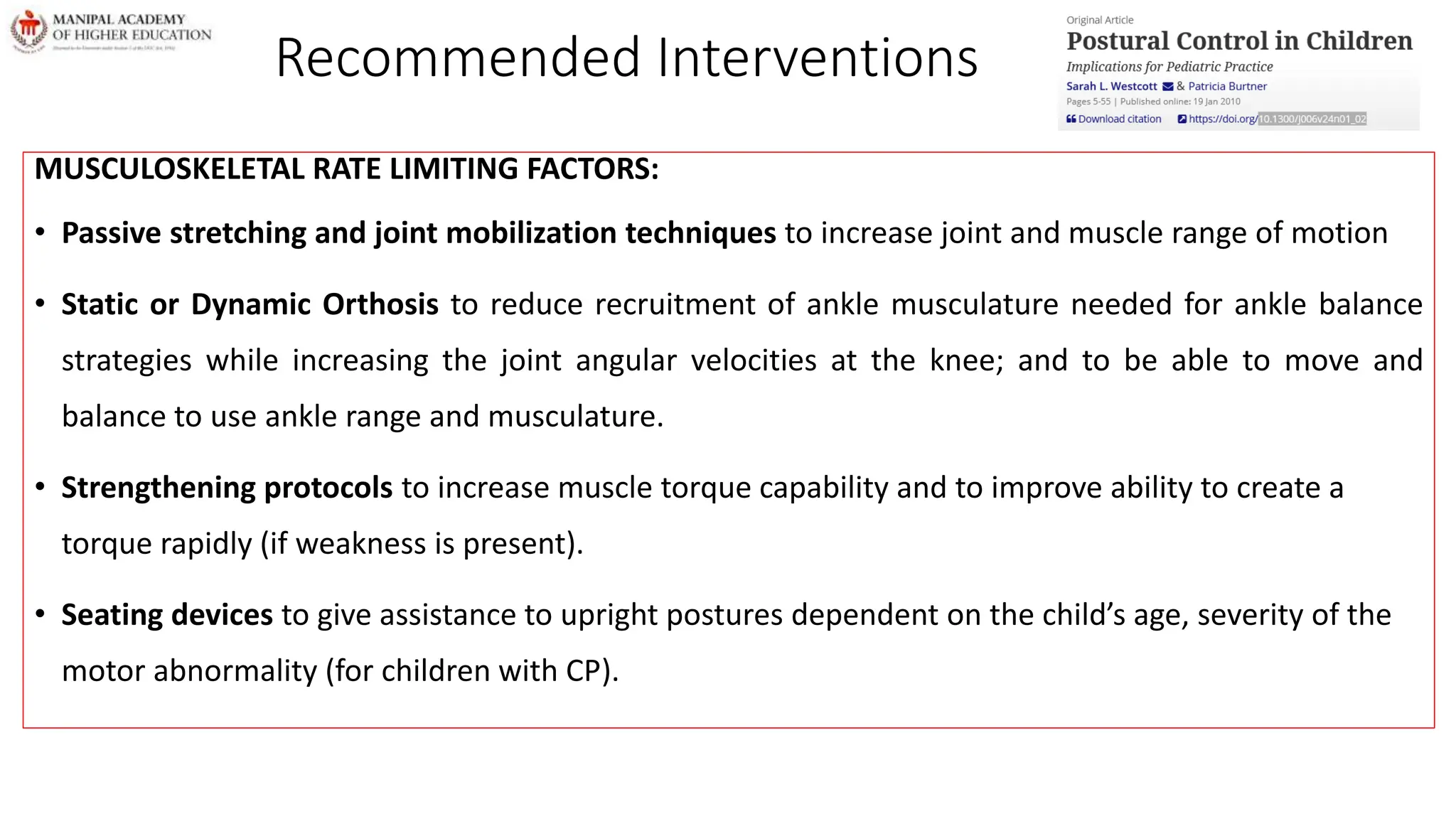
Recommended Interventions
MUSCULOSKELETAL RATE LIMITING FACTORS:
• Passive stretching and joint mobilization techniques to increase joint and muscle range of motion
• Static or Dynamic Orthosis to reduce recruitment of ankle musculature needed for ankle balance
strategies while increasing the joint angular velocities at the knee; and to be able to move and
balance to use ankle range and musculature.
• Strengthening protocols to increase muscle torque capability and to improve ability to create a
torque rapidly (if weakness is present).
• Seating devices to give assistance to upright postures dependent on the child’s age, severity of the
motor abnormality (for children with CP).
Recommended Interventions
MOTOR PROCESSES RATE LIMITING FACTORS:
• Modify environment and task to practice the strategy not used (e.g., provoking use of an ankle strategy when a hip
strategy is primarily used by the child via roller skating) or to provoke a more optimal strategy.
• Practice in reaching to the limits of stability and reaching quickly for children who actively use co-contractions and limit
their movement speed and the distance of COG displacement, so as to not challenge stability. Reaching in reaction to an
external stimulus (ball thrown to child) can be used to provoke faster reach movement and higher amplitude APA.
• Practice reaching with the hand weighted to provide increased proprioception and potential strengthening, and
additionally increased duration of APA in this practice (Bouisset, Richardson, & Zattara, 2000).
• Practice of posture and movement with feedback about posture (using mirrors, auditory input [bells, squeak toys], lights,
or electrical stimulation to cue the child to change starting positions) will affect the RPA and APA for motor coordination
pattern of the movement task.
Findings:
• Infants at high risk for CP grew into a postural deficit;
• @ 18 months start showing delayed development of direction-specificity, and postural
dysfunction due to slower recruitment of postural muscles and less frequent anticipatory
activation.
• Scientific evidences on the effectiveness of therapeutic interventions targeting impaired
trunk control in children with CP is sparse, due to poor-quality experimental designs.
• Need for well-designed intervention studies including a patient-tailored intervention
program and using valid trunk assessment methods to monitor therapy outcome.
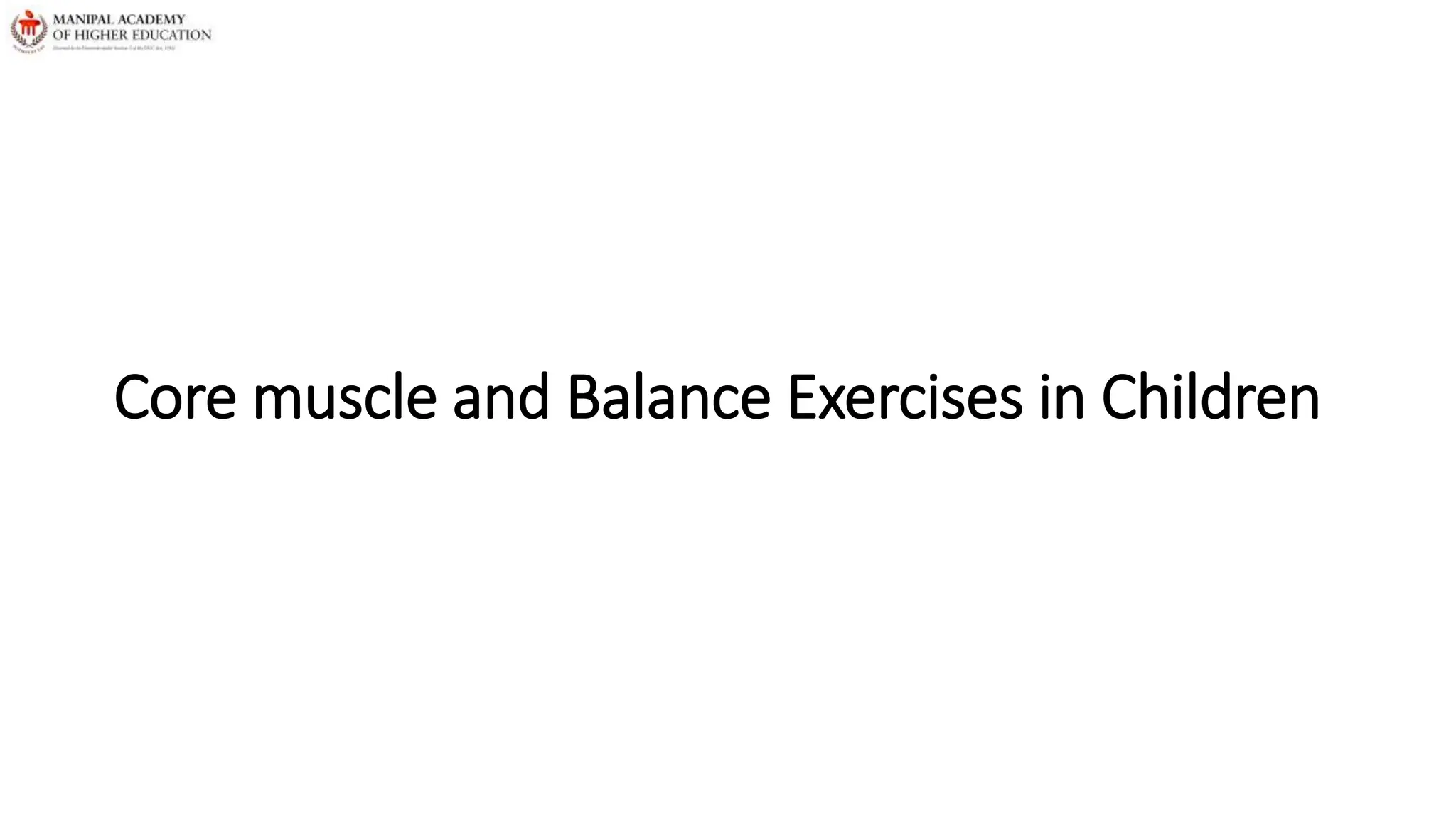
FA- Fcoused Attention
NFA- Non-Focused Attention
• Capacity to minimize extraneous movements in infants, or “sitting still” may
allow greater attention to the task at hand, similar to older children and
adults.
• Premature infants’ excessive trunk/pelvic movement that did not adapt
to task requirements may (in the long term), impact tasks requiring
attentional resources.
Benefits of Good CORE stability in Children
• Core stability: Key to the workings of whole body- STABLE BASE- for good
functioning of arms and legs.
• Strong Core: Easy to master Fine and gross motor (movement) skills.
• Stable core: allow balance in different positions
• Because bodies constantly seeking balance, a good core increases our ability
to focus and concentrate.
Review
• Patients with poor Lumbo-pelvic-hip stability
• During exercise Fatigue:
• Deteriorated postural control
• Difficult for hip muscles to appropriately position femur during gait, landings, etc
• Trunk Forward Lean
• Re-distributing Lower extremity forces during gait
• Inhibited Quadriceps
• Reduced knee joint torque during gait
• Reliance on proximal, postural muscles (which are probably weak, inhibited, poor endurance)
• What absorbs forces if muscles cannot?
Core muscle and Balance Exercises in Children
Tummy Time
• Excellent position to strengthen child’s neck
and back. With improvements, prop up
through elbows/hands while looking up.
• Read book or watch TV to keep looking up and
pushing through their hands or elbows.
• Progression to make the core more active-
work on reaching with 1 hand for a toy or to
roll a ball, while leaning on the other arm/
elbow or hand.
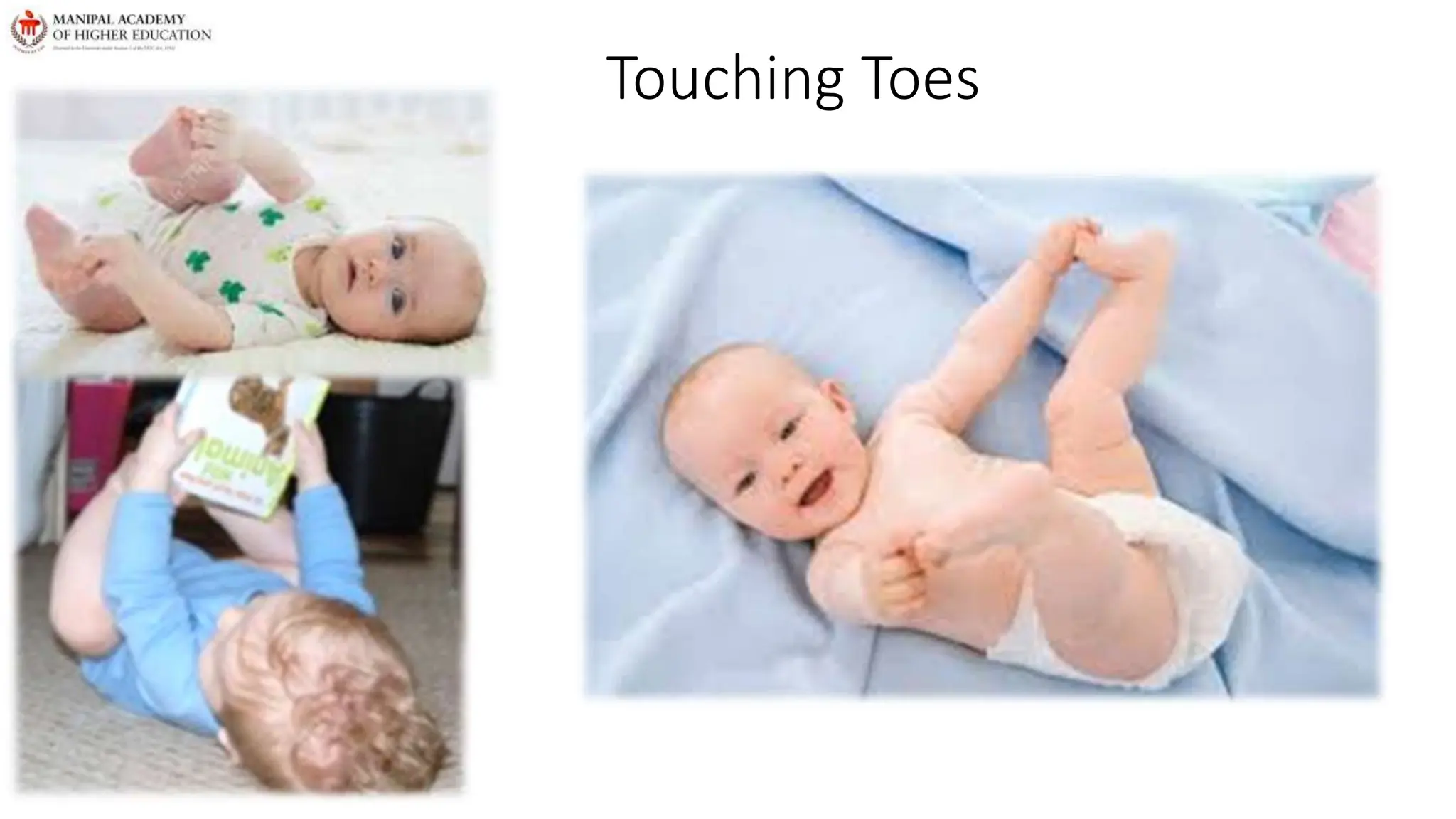
Touching Toes
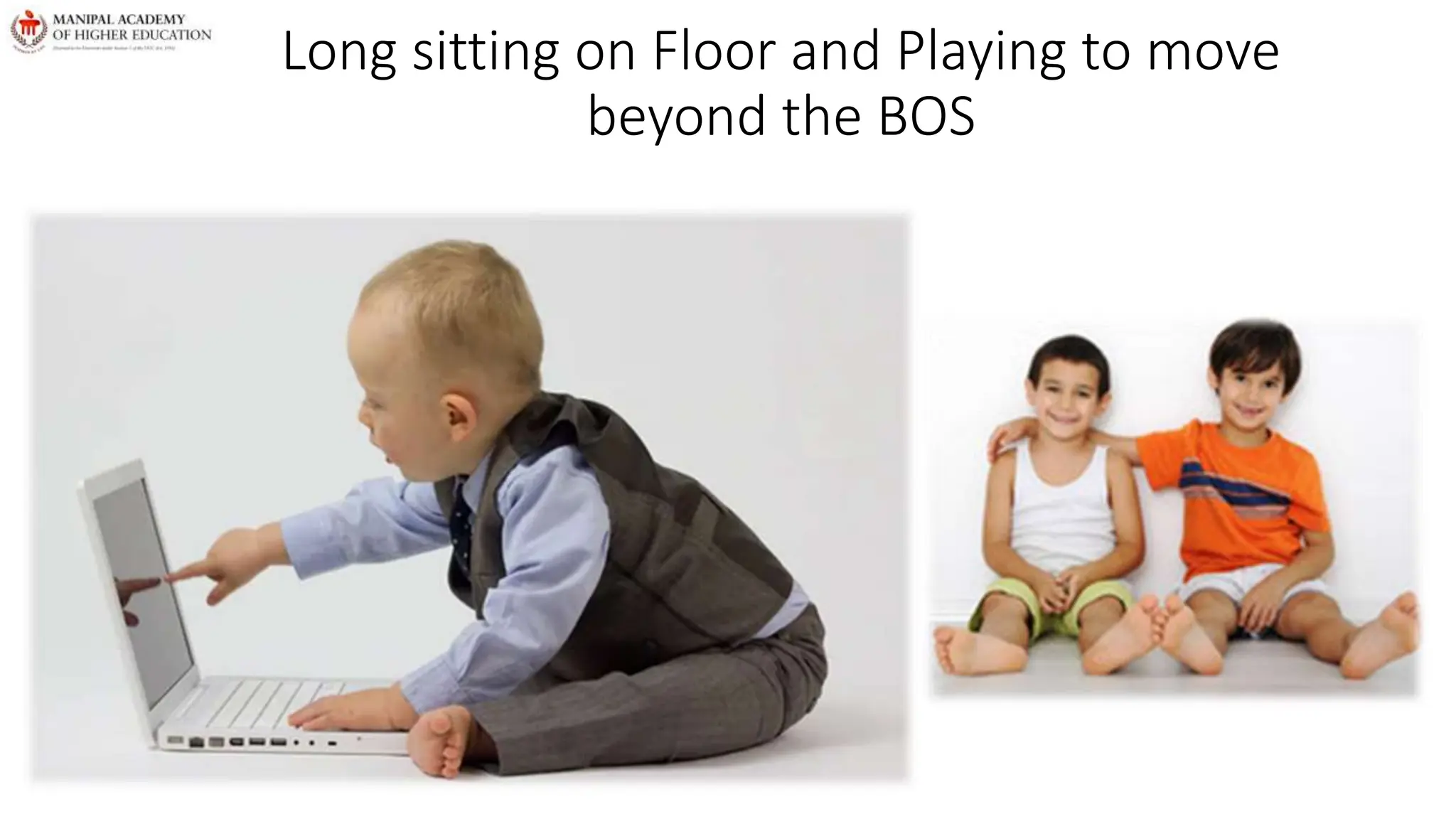
Long sitting on Floor and Playing to move
beyond the BOS
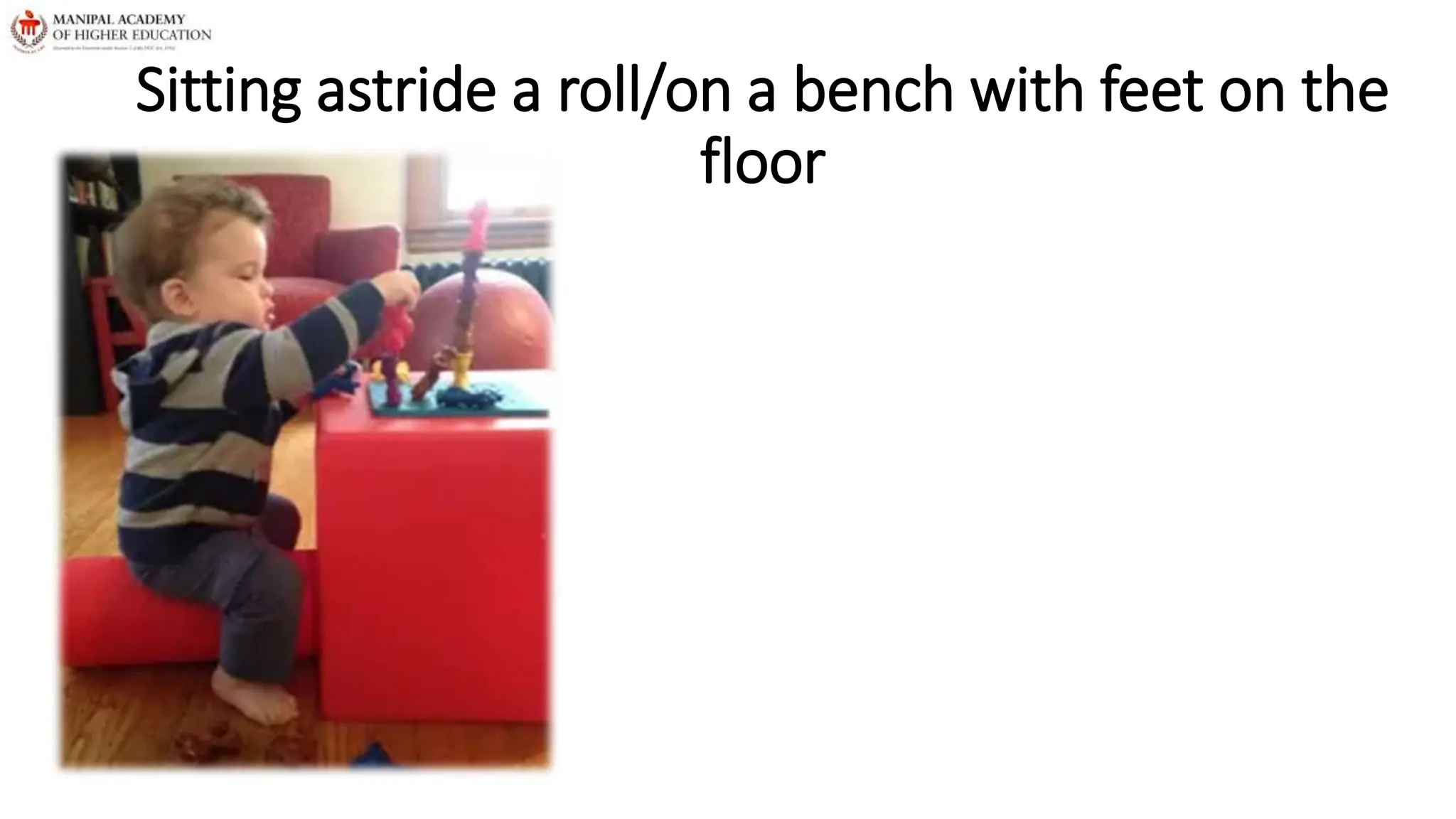
Sitting astride a roll/on a bench with feet on the
floor
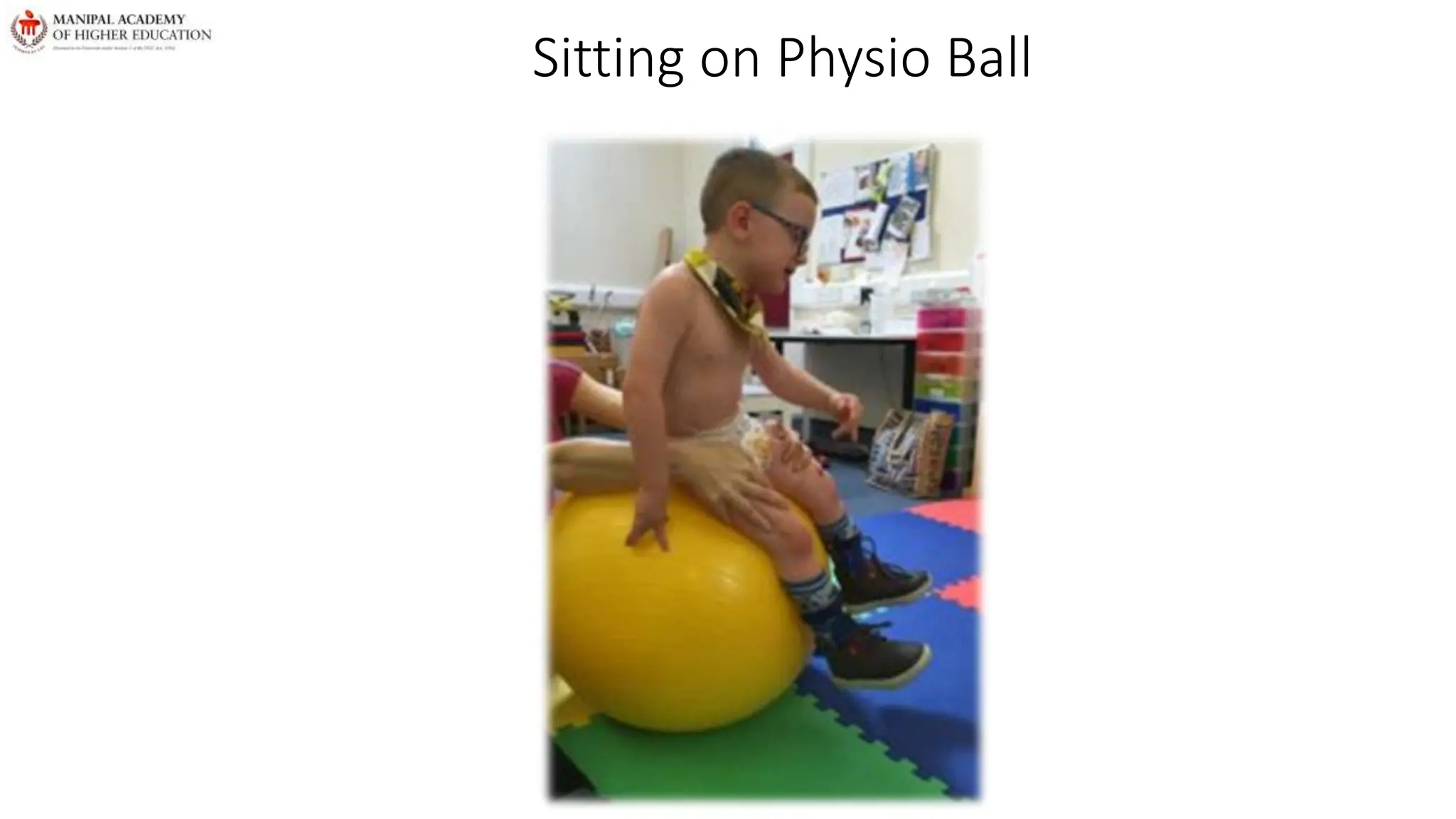
Sitting on Physio Ball
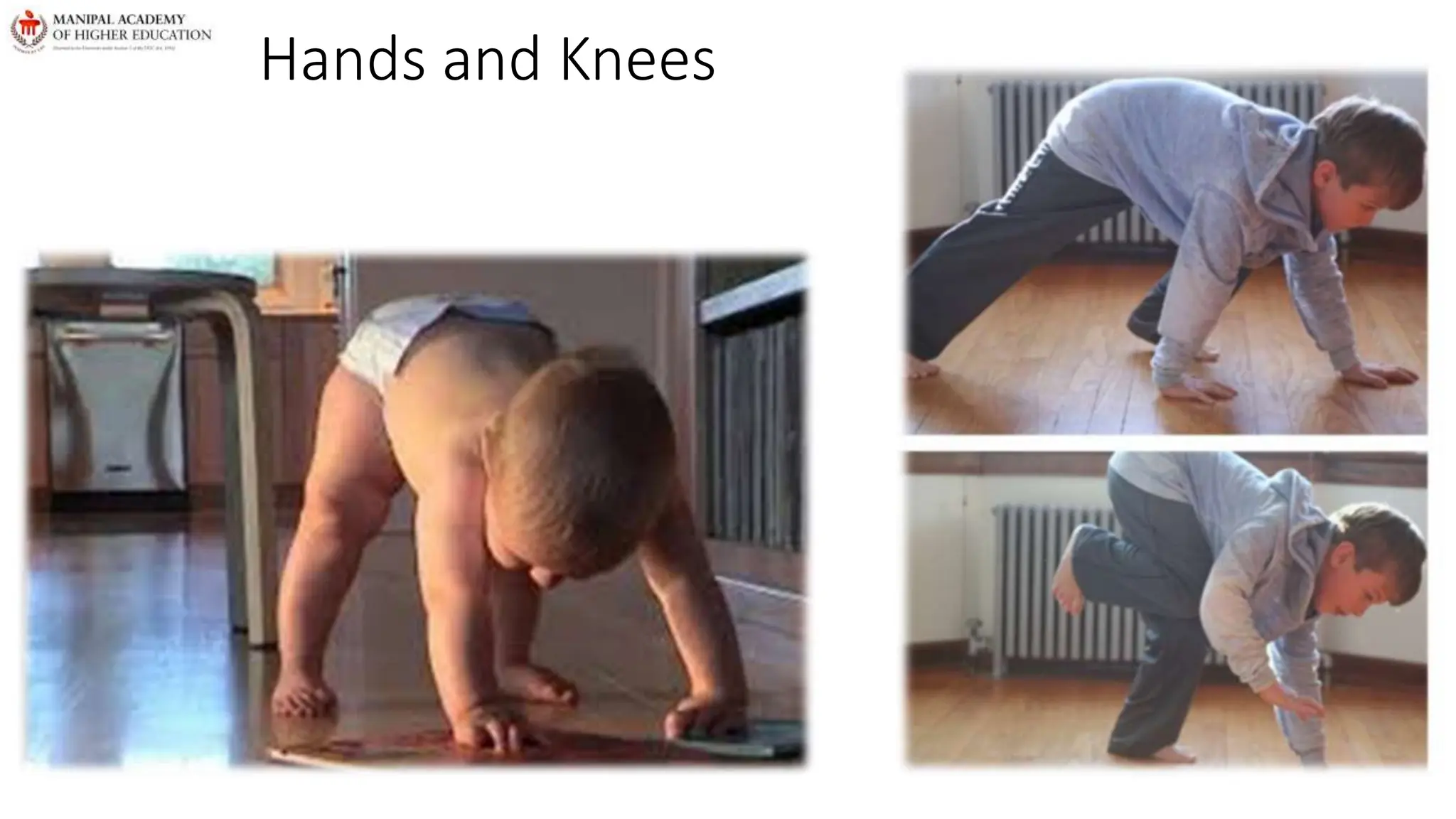
Hands and Knees
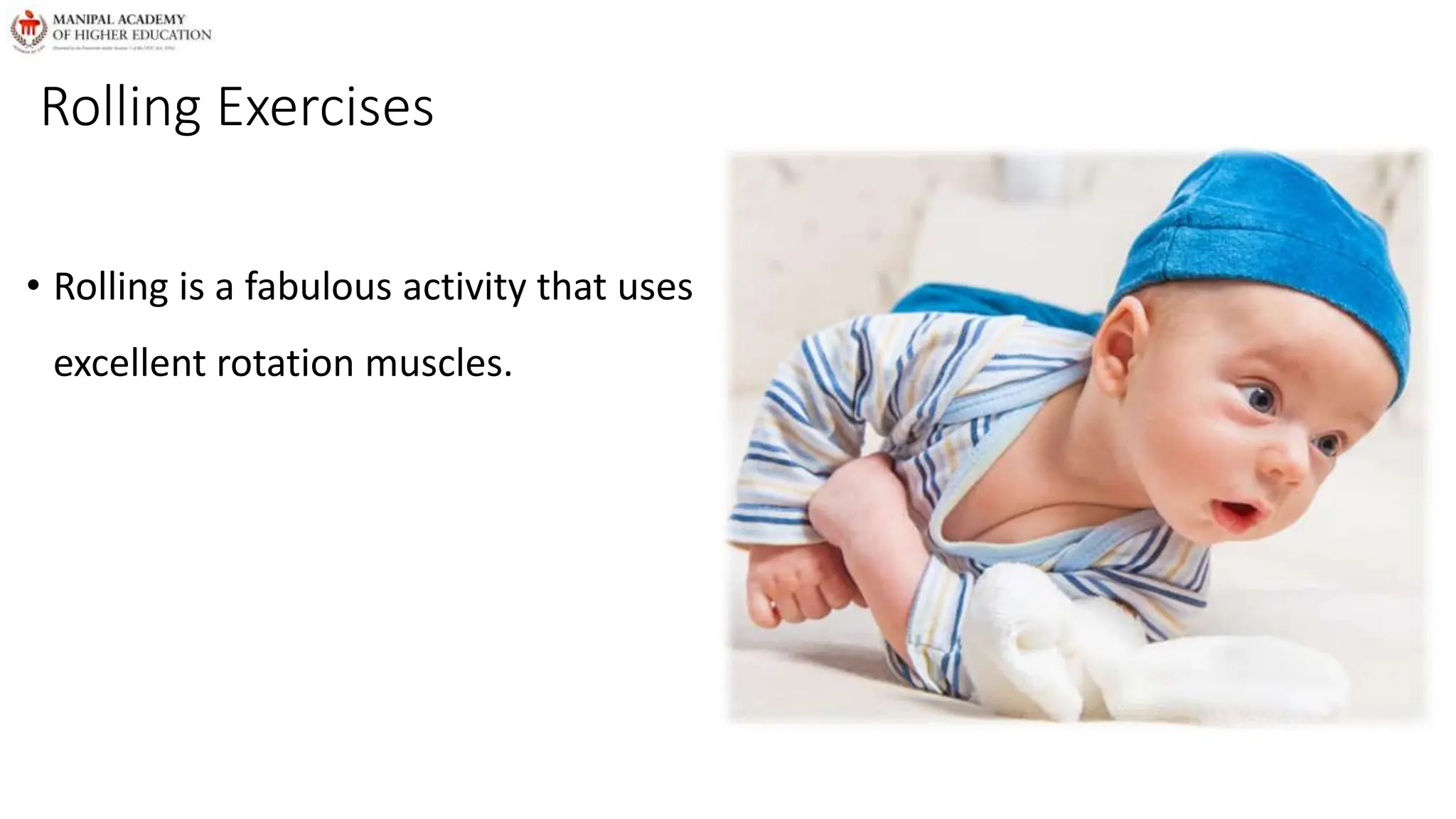
Rolling Exercises
• Rolling is a fabulous activity that uses
excellent rotation muscles.
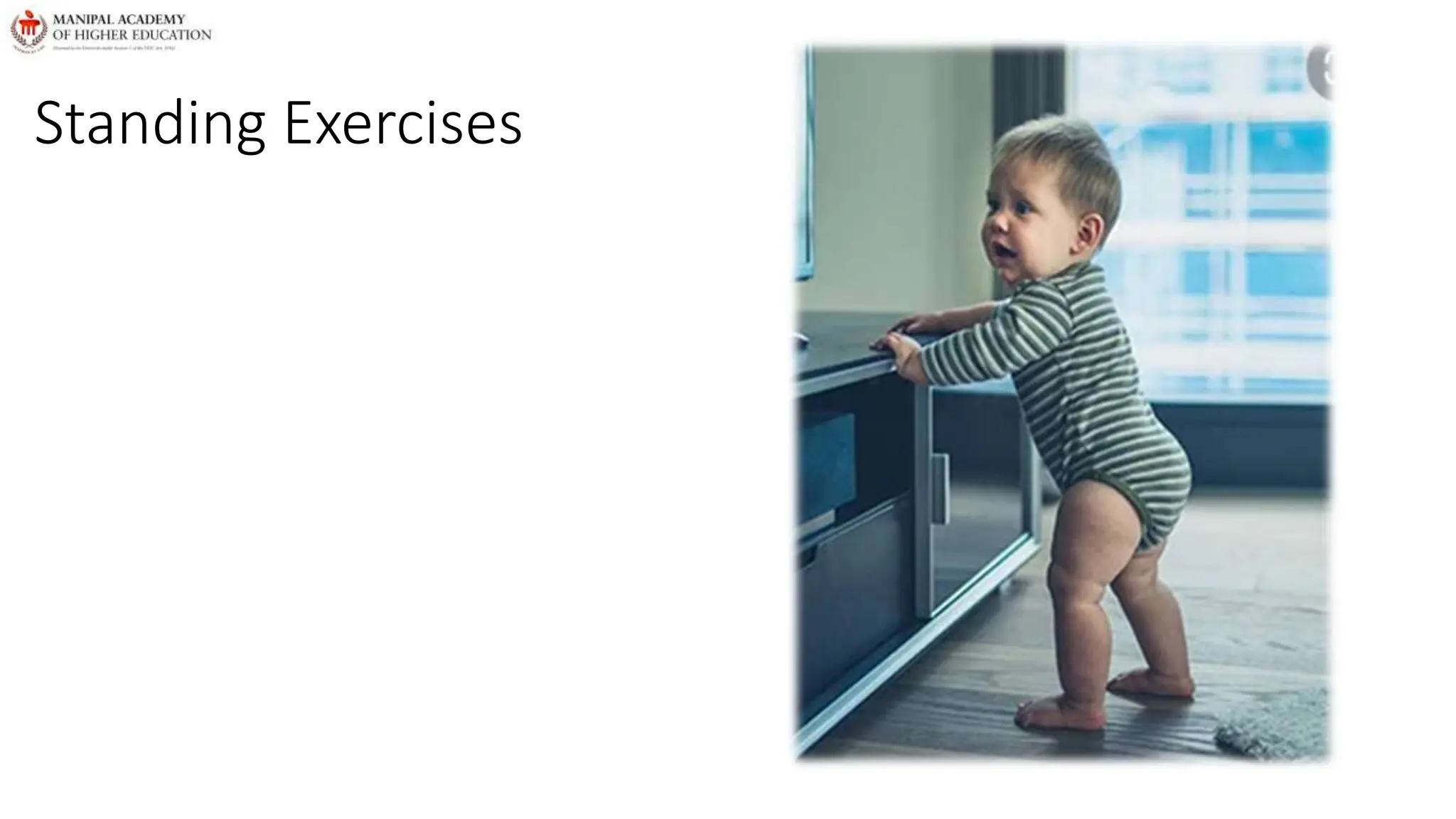
Standing Exercises

Core Dysfunction in children with CP.pptx

  • 1.
    Lower Extremity Consequencesof “Core Dysfunction” Amitesh Narayan Professor in Physiotherapy KMC Mangaluru
  • 2.
    Introduction • “Core stabilitymay provide several benefits to the musculoskeletal system, from maintaining low back health to preventing knee injury” Willson J D, Dougherty C P, Ireland M L, and Davis I M, Core stability and its relationship to lower extremity function and injury. J Am Acad Orthop Surg, 2005. 13(5): 316-25.
  • 3.
    Where is the“core”? • Lumbo-pelvic-hip complex • Includes active & passive structures that either produce or restrict movements of the lumbar, hip or pelvic segments
  • 4.
    What is the“core”? • Movements/ stability occurs in 3 planes • Sagittal Plane • Frontal Plane • Transverse Plane
  • 5.
    What is the“core”? • Sagittal Plane stability • Rectus Abdominis • Transverse Abdominis • Erector Spinae • Multifidus • Gluteus Max • Hamstrings • Flexion/ Extension • CO-CONTRACTION CAUSES TRUNK STIFFNESS AND RAISES INTRA-ABDOMINAL PRESSURE • “Rigid Cylinder”
  • 6.
    What is the“core”? • Movements/ stability occurs in 3 planes • Sagittal Plane • Frontal Plane • Transverse Plane
  • 7.
    What is the“core”? • Frontal Plane • Glut med., Glut min. (1º lateral hip stabilizers) • Quadratus Lumborum • Unilateral: ipsilateral pelvis elevation • Contralateral: spine stiffness • Perhaps best suited for spine stability; active during nearly all upright tasks • Hip Adductors (Magnus, Longus, Brevis, Pectineus)
  • 8.
    What is the“core”? • Movements/ stability occurs in 3 planes • Sagittal Plane • Frontal Plane • Transverse Plane
  • 9.
    What is the“core”? • Transverse Plane stability • HIP Rotation: • Glut max., Glut med. • Piriformis • Superior/Inferior Gemelli • Quadratus Femoris • Obterator Internus/Externus • Trunk rotation: • Internal/External obliques • Iliocostalis Lumborum • Multifidus
  • 10.
    What is the“core”? • Thoraco-Lumbar Fascia • Covers and inter-connects muscles and fascia surrounding the spine • Helps create a stabilizing “corset” effect • Provides connective support from LE to UE • Allows for integrated kinetic chain activities
  • 11.
    What is “corestability” • “The ability of the Lumbo-pelvic-hip complex to prevent buckling of the vertebral column and to return it to equilibrium following perturbation” • Coordination and co-contraction of muscles provides spine stiffness • “Rigid Cylinder”
  • 12.
    What is “corestability” “…the ability to control the position and motion of the trunk over the pelvis and leg to allow optimum production, transfer and control of force and motion to the terminal segment in integrated kinetic chain activities.” Kibler W B, Press J, Sciascia A, The role of core stability in athletic function. Sports Med, 2006. 36(3): 189-98.
  • 13.
    What is “corestability” • Core stability is “instantaneous” • Must continually adapt to changing postures and loading conditions • Ensure integrity of spine and provide stable base for movement of extremities. • Absorb forces transmitted through the lower extremity during activity.
  • 14.
    Importance of corestability • Mechanical base for motion of the distal segments • Many extremity prime movers attach to the core • Core muscles are active before initiation of extremity movement. • “PROXIMAL STABILITY FOR DISTAL MOBILITY”
  • 15.
    Importance of CoreStability • Motor control • Carefully coordinated contractions from antagonistic muscles is necessary to stabilize during posture, activity and to react to perturbations. • Muscle activity assists with attenuating forces transmitted through the lower extremity to the spine during activity • Neuromuscular training (Included abdominal curls, back extension exercise) reduced serious knee injury in females by 62% (Hewett, 1999)
  • 16.
    Importance of CoreStability • Muscular capacity (i.e: endurance) • Trunk muscle ENDURANCE is of greater value than the ABILITY TO GENERATE FORCE in the prevention of LBP (McGill, 2003) • “…the product of motor control and muscular capacity of the lumbo-pelvic-hip complex.” Leetun D T, Ireland M L, Willson J D, Ballantyne B T, and Davis I M, Core stability measures as risk factors for lower extremity injury in athletes. Med Sci Sports Exerc, 2004. 36(6): 926-34.
  • 17.
    Importance of CoreStability • What is needed to achieve optimal stability? • Depends on task/ activity • Balance/ symmetry for co-contraction • Endurance/ motor control during fatiguing tasks • Same muscles that stabilize also needed for breathing at times of high O2 demand (fatiguing exercise) • Loss of stabilization during high intensity exercise? --(McGill, 1995)
  • 18.
    Core Dysfunction • Poor/altered function of muscles that stabilize the lumbar-pelvic-hip complex • Causes? • Muscle Weakness • Poor muscular endurance • Fatigue • Pain/ injury avoidance
  • 19.
    Core Dysfunction • Theimportant question: • What happens during activity when muscles cannot stabilize the lumbar spine, pelvis and hips?
  • 20.
    Core Dysfunction • Lumbarspine experiences compressive loads >6000N • Passive restraints able to resist only 90N • Remaining support provided by active tissue • What happens when muscles fatigue quickly or at different rates? • COPING MECHANISM…..
  • 21.
    Low Back Pain •Core Dysfunction is common in persons with LBP.
  • 22.
    The “core” question… •How does fatigue affect muscular stability of the lumbar spine, pelvis and hips? • In the presence of Recurrent Low Back Pain? • Poor core stability • How does this affect Lower Extremity muscle function? • Lower extremity injury risk??
  • 23.
    Research Findings • Personswith LBP who fatigue quickly (lumbar extension endurance) tend to have more quadriceps inhibition • Suter, 2001 • Localized lumbar para-spinal muscle fatigue causes increased quadriceps inhibition • Hart, et al, 2005 5 10 15 BSL Post Set 1 Post Set % Quad Inhibition Control HxLBP
  • 24.
    Research Findings • Posturalcompensation for local lumbar fatigue • Forward trunk posture (Madigan, 2006) • More anterior COP during stance • Redistribution of ankle, knee and low back torques during stance • How will this affect Gait?
  • 25.
  • 26.
    Is trunk forwardlean bad? • Anteriorly displaced ground reaction force vector during activity/ gait • Reduces sagittal plane knee joint moment • Indicates quadriceps eccentric control during gait
  • 27.
    Trunk Forward Lean •Alters force attenuation at the knee • Etiology or forward lean? • Weak Gluteals? • Weak Quadriceps? • Weak Lumbar para-spinals • Poor endurance in muscles that stabilize pelvis, spine, hips? • Sequellae? • Higher thoraco-lumbar disc loads • Quadriceps atrophy/ weakness • LE joint surfaces exposed to unusual/ excessive forces
  • 28.
    Trunk Forward Lean •“Flat-back” patients show similar gait adaptations to persons with knee OA • Reduced velocity, reduced stride length, increased stance phase duration • Continued high force during mid-stance in persons with forward flexed trunk posture during gait
  • 29.
    Trunk Forward Lean •Compensation for forward flexed position of the trunk is a crouched posture • Flexed knee and hip in stance and during gait (also similar to patients with advanced OA) • Places weaker gluteals in a mechanically advantaged position • Higher demand on quadriceps- Child Krishna!!!
  • 30.
    Core Stability andLE Injury • Inappropriate positions of hips and trunk during gait or landing may place LE joints at risk for injury • Inability of hip rotators to control femur rotation  knee valgus/ internal rotation
  • 31.
    Gait Compensations • Personsrecurrent LBP exhibit a quadriceps dominant pattern during gait. (Hart, 2005) • Adaptation to poor spine, pelvis, hip muscular stability? Knee Sagittal Plane (x) moment -0.4 -0.2 0 0.2 0.4 0.6 0.8 1 1.2 1.4 1.6 Stance Phase Nm/kg Control HxLBP
  • 32.
    Gait Compensations • Whatother group exhibits quadriceps dominance, trunk lean, poor control of femur rotation? • “position of no return” • Body forward flexed • Hip adducted • Internally rotated • Valgus knee • Tibia externally rotated • Foot pronated
  • 33.
    Physical & OccupationalTherapy In Pediatrics Volume 24, 2004 - Issue 1-2
  • 35.
    DEVELOPMENT OF RPAAND APA Three processes critical 1. Motor processes: Emergence of neuromuscular response synergies to maintain stability of the neck, trunk and legs, 2. Sensory processes: Development of visual, vestibular and somatosensory systems, plus maturation of central sensory strategies organizing outputs from these senses for body and limb orientation, and 3. Musculoskeletal components: changes in structural and soft tissue morphology, muscle strength development, and range of motion (including the biomechanical linkage of body segments for movement (Shumway-Cook & Woollacott, 2001)
  • 36.
    Child with CPshows later onset of the posterior shift of the APA COP and less amplitude (Liu, 2001)
  • 37.
    Muscle activation inchild’s legs with and without spasticity following backward translation of the platform (vertical arrow). Note the reversal in muscle onset sequencing (horizontal arrows) in the leg with spasticity [HAMSTRINGS BEING ACTIVATED PRIOR TO GASTROCNEMIUS] (Nashner, Shumway-Cook, & Marin, 1983)
  • 38.
    Recommended Interventions MUSCULOSKELETAL RATELIMITING FACTORS: • Passive stretching and joint mobilization techniques to increase joint and muscle range of motion • Static or Dynamic Orthosis to reduce recruitment of ankle musculature needed for ankle balance strategies while increasing the joint angular velocities at the knee; and to be able to move and balance to use ankle range and musculature. • Strengthening protocols to increase muscle torque capability and to improve ability to create a torque rapidly (if weakness is present). • Seating devices to give assistance to upright postures dependent on the child’s age, severity of the motor abnormality (for children with CP).
  • 39.
    Recommended Interventions MOTOR PROCESSESRATE LIMITING FACTORS: • Modify environment and task to practice the strategy not used (e.g., provoking use of an ankle strategy when a hip strategy is primarily used by the child via roller skating) or to provoke a more optimal strategy. • Practice in reaching to the limits of stability and reaching quickly for children who actively use co-contractions and limit their movement speed and the distance of COG displacement, so as to not challenge stability. Reaching in reaction to an external stimulus (ball thrown to child) can be used to provoke faster reach movement and higher amplitude APA. • Practice reaching with the hand weighted to provide increased proprioception and potential strengthening, and additionally increased duration of APA in this practice (Bouisset, Richardson, & Zattara, 2000). • Practice of posture and movement with feedback about posture (using mirrors, auditory input [bells, squeak toys], lights, or electrical stimulation to cue the child to change starting positions) will affect the RPA and APA for motor coordination pattern of the movement task.
  • 40.
    Findings: • Infants athigh risk for CP grew into a postural deficit; • @ 18 months start showing delayed development of direction-specificity, and postural dysfunction due to slower recruitment of postural muscles and less frequent anticipatory activation.
  • 41.
    • Scientific evidenceson the effectiveness of therapeutic interventions targeting impaired trunk control in children with CP is sparse, due to poor-quality experimental designs. • Need for well-designed intervention studies including a patient-tailored intervention program and using valid trunk assessment methods to monitor therapy outcome.
  • 42.
    FA- Fcoused Attention NFA-Non-Focused Attention • Capacity to minimize extraneous movements in infants, or “sitting still” may allow greater attention to the task at hand, similar to older children and adults. • Premature infants’ excessive trunk/pelvic movement that did not adapt to task requirements may (in the long term), impact tasks requiring attentional resources.
  • 43.
    Benefits of GoodCORE stability in Children • Core stability: Key to the workings of whole body- STABLE BASE- for good functioning of arms and legs. • Strong Core: Easy to master Fine and gross motor (movement) skills. • Stable core: allow balance in different positions • Because bodies constantly seeking balance, a good core increases our ability to focus and concentrate.
  • 44.
    Review • Patients withpoor Lumbo-pelvic-hip stability • During exercise Fatigue: • Deteriorated postural control • Difficult for hip muscles to appropriately position femur during gait, landings, etc • Trunk Forward Lean • Re-distributing Lower extremity forces during gait • Inhibited Quadriceps • Reduced knee joint torque during gait • Reliance on proximal, postural muscles (which are probably weak, inhibited, poor endurance) • What absorbs forces if muscles cannot?
  • 45.
    Core muscle andBalance Exercises in Children
  • 46.
    Tummy Time • Excellentposition to strengthen child’s neck and back. With improvements, prop up through elbows/hands while looking up. • Read book or watch TV to keep looking up and pushing through their hands or elbows. • Progression to make the core more active- work on reaching with 1 hand for a toy or to roll a ball, while leaning on the other arm/ elbow or hand.
  • 47.
  • 48.
    Long sitting onFloor and Playing to move beyond the BOS
  • 49.
    Sitting astride aroll/on a bench with feet on the floor
  • 50.
  • 51.
  • 52.
    Rolling Exercises • Rollingis a fabulous activity that uses excellent rotation muscles.
  • 53.