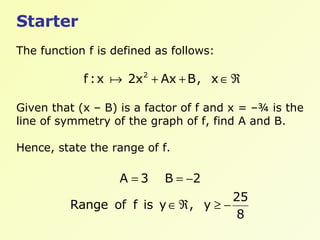
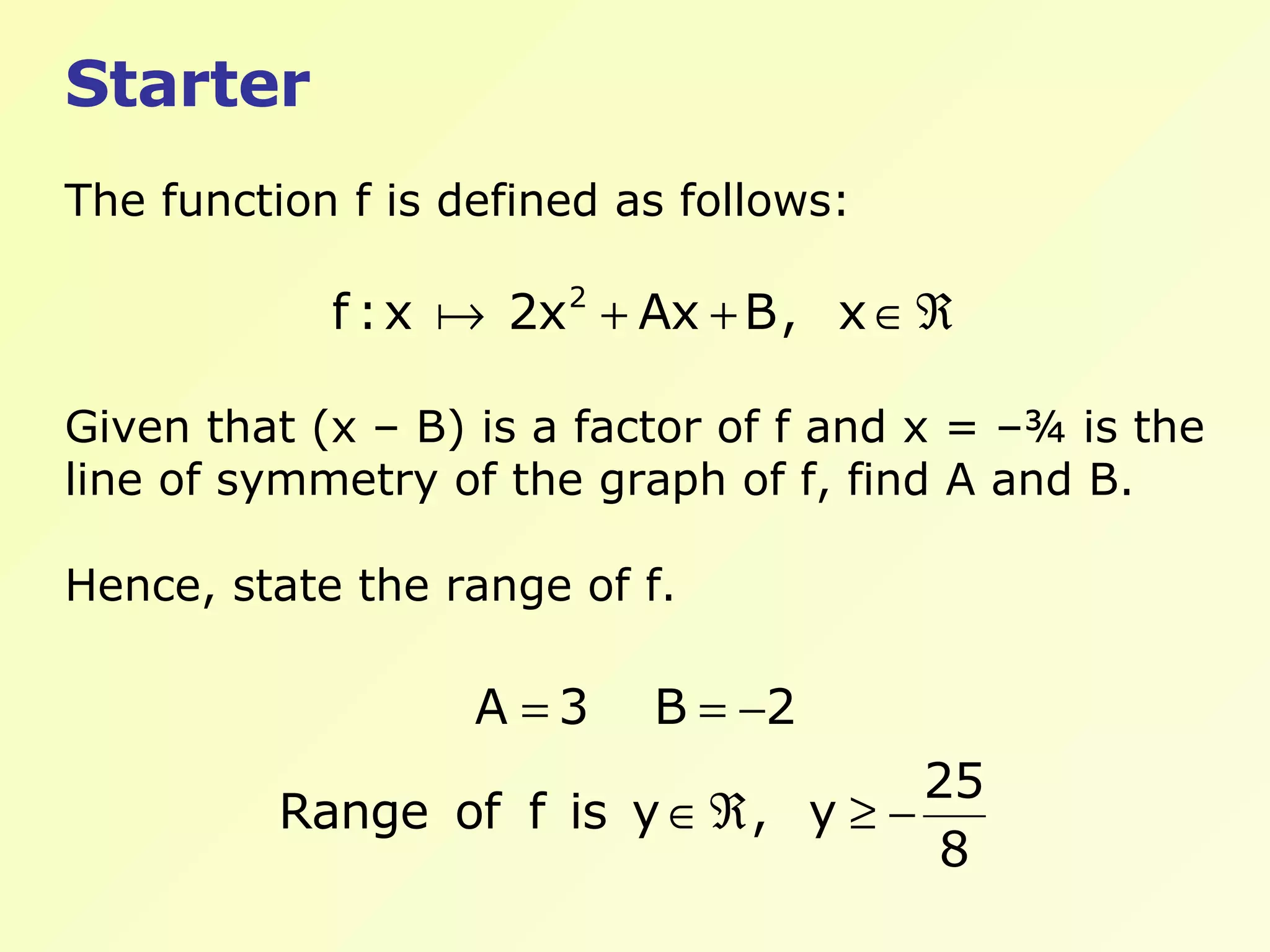
Starter The function f is defined as follows: Given that (x – B) is a factor of f and x = –¾ is the line of symmetry of the graph of f, find A and B. Hence, state the range of f.
Objective: to form composite functions
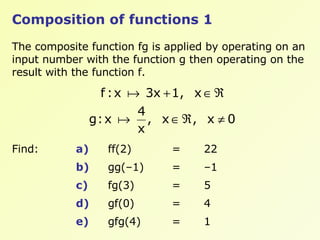
Composition of functions 1 The composite function fg is applied by operating on an input number with the function g then operating on the result with the function f.  Find:  a)   ff(2) = 22 b) gg(–1) = –1 c) fg(3) = 5 d) gf(0) = 4 e) gfg(4) = 1
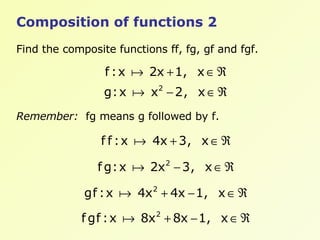
Composition of functions 2 Find the composite functions ff, fg, gf and fgf. Remember:   fg means g followed by f.
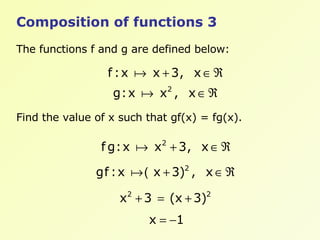
Composition of functions 3 The functions f and g are defined below: Find the value of x such that gf(x) = fg(x).
Core 3 & 4 Textbook Exercise 2B Page 26 Questions 10 to 20

Core 3 Functions 2

  • 1.
    Starter The functionf is defined as follows: Given that (x – B) is a factor of f and x = –¾ is the line of symmetry of the graph of f, find A and B. Hence, state the range of f.
  • 2.
    Objective: to formcomposite functions
  • 3.
    Composition of functions1 The composite function fg is applied by operating on an input number with the function g then operating on the result with the function f. Find: a) ff(2) = 22 b) gg(–1) = –1 c) fg(3) = 5 d) gf(0) = 4 e) gfg(4) = 1
  • 4.
    Composition of functions2 Find the composite functions ff, fg, gf and fgf. Remember: fg means g followed by f.
  • 5.
    Composition of functions3 The functions f and g are defined below: Find the value of x such that gf(x) = fg(x).
  • 6.
    Core 3 &4 Textbook Exercise 2B Page 26 Questions 10 to 20