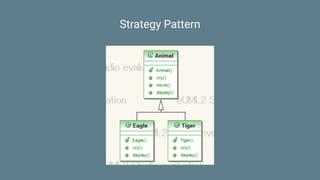
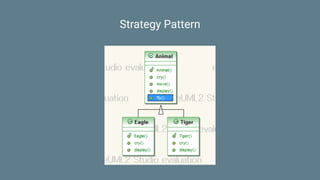
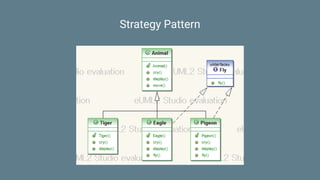
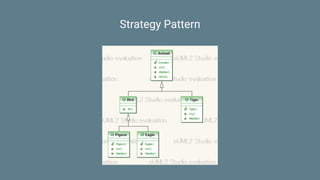
This document discusses functional programming concepts including SOLID design principles, strategy pattern, composition over inheritance, algebraic design, functors, monads, applicatives, and how monads can be used for railway oriented programming. It provides code examples for defining functors and monads in Scala as well as examples of type representations for monomorphism, epimorphism, and isomorphism.
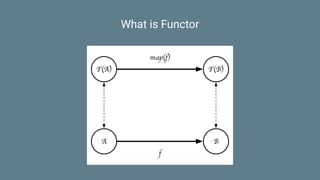
![Functor
trait Functor[F[_]] {
def map[A, B](fa: F[A])(f: A => B): F[B]
def lift[A, B](f: A => B): F[A] => F[B] = map(_)(f)
def mapply[A, B](a: A)(f: F[A => B]): F[B] = map(f)((ff: A => B) => ff(a))
def fproduct[A, B](fa: F[A])(f: A => B): F[(A, B)] = map(fa)(a => (a, f(a)))
}
// Functor Law
// identity element
map(fa)(identity) == fa // must be true](https://image.slidesharecdn.com/monad-170618205136/85/Monad-and-Algebraic-Design-in-Functional-Programming-9-320.jpg)
![What is Monad: Part 1 - flatMap
trait Monad[F[_]] extends Functor[F] {
def pure[A](x: => A): F[A]
def flatMap[A, B](fa: F[A])(f: A => F[B]): F[B]
def map[A, B](fa: F[A])(f: A => B): F[B] = flatMap(fa)((a: A) => pure(f(a)))
}
// Monad Laws
// a. associated law
flatMap(flatMap(fa)(f))(g) == flatMap(fa)(b => flatMap(f(b))(g))
// b. identity element
flatMap(fa)(unit) == fa
flatMap(unit(a))(f) = f(a)](https://image.slidesharecdn.com/monad-170618205136/85/Monad-and-Algebraic-Design-in-Functional-Programming-11-320.jpg)
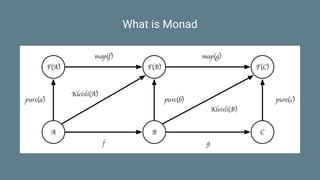
![What is Monad: Part 2 - compose of Kleisli Arrow
type Kleisli[F[_], A, B] = A => F[B]
trait Monad[F[_]] extends Functor[F] {
def pure[A](x: => A): F[A]
def compose[A, B](k1: Kleisli[F, A, B], k2: Kleisli[F, B, C]): Kleisli[F, A, C]
// def compose(k1: A => F[B], k2: B => F[C]): A => F[C]
def flatMap[A, B](fa: F[A])(f: A => F[B]): F[B] = compose(() => fa, f)
}
// Monad Laws
// a. associated law
compose(compose(f, g), h) == compose(f, compose(g, h))
// b. identity element
compose(f, pure) == f
compose(pure, f) == f](https://image.slidesharecdn.com/monad-170618205136/85/Monad-and-Algebraic-Design-in-Functional-Programming-12-320.jpg)


![Why Monad: Railway Oriented Programming
def validate(a: A): Either[Exception, A] = ???
def update(a: A): Either[Exception, B] = ???
def send(b: B): Either[Exception, Response] = ???
val resE: Either[Exception, Response] = for {
va <- validate(a)
b <- update(va)
res <- send(b)
} yield res](https://image.slidesharecdn.com/monad-170618205136/85/Monad-and-Algebraic-Design-in-Functional-Programming-18-320.jpg)
![Sample: Type Representation of Monomorphism &
Epimorphism
type Mon[A, B] = Kleisli[Some, A, B]
type Epi[A, B] = Kleisli[Option, A, B]](https://image.slidesharecdn.com/monad-170618205136/85/Monad-and-Algebraic-Design-in-Functional-Programming-19-320.jpg)
![Isomorphism
type Iso[A, B] = A => B](https://image.slidesharecdn.com/monad-170618205136/85/Monad-and-Algebraic-Design-in-Functional-Programming-20-320.jpg)
![Monomorphism
type Mon[A, B] = Kleisli[Some, A, B]](https://image.slidesharecdn.com/monad-170618205136/85/Monad-and-Algebraic-Design-in-Functional-Programming-21-320.jpg)
![Epimorphism
type Epi[A, B] = Kleisli[Option, A, B]](https://image.slidesharecdn.com/monad-170618205136/85/Monad-and-Algebraic-Design-in-Functional-Programming-22-320.jpg)


![[FT-11][ltchen] A Tale of Two Monads](https://cdn.slidesharecdn.com/ss_thumbnails/monads-140308101321-phpapp01-140421092116-phpapp01-thumbnail.jpg?width=640&height=640&fit=bounds)


