ROMAN LITERATURE
HISTORY OF ROMAN LITERATURE
 THE SIXTH AND THE SEVENTH CENTURIES OF
THE CITY (240-80 B.C), FROM LIVIUS TO SULLA
-which comprises the history of the legitimate drama,
of the early epos and satire, and the beginning of the
prose composition, is marked by a vigorous but ill-
disciplined imitation of Greek poetical models, and in
prose by a dry sententiousness of style, gradually
giving way to a clear and fluent strength, which was
characteristic of the speeches of Gracchus and
Antonius.
 THE GOLDEN AGE, FROM CICERO TO OVID
(80 B.C.-A,D.14)
 Represents the highest excellence in prose and poetry.
The prose era came first, and is signalized by the names
of Cicero, Sallust and Caesar. The celebrated writers
were now mostly men of action and high position in the
state. The principles of the language had become fixed;
its grammatical construction was thoroughly understood,
and its peculiar genius wisely adapted to those forms of
composition in which it was naturally capable of excelling.
The perfection of poetry was not attained until the time of
Augustus. In this period the writers as a rule are not
public men, but belong to what we should call the literary
class. They wrote not for the public but for the select
circle of educated men whose rank were gradually
narrowing their limits to the great injury of literature.
•THE PERIOD OF THE DECLINE, FROM THE ACCESION OF
TIBERIUS TO THE DEATH OF MARCUS AURELIUS
(14-180 A.D)
 The Third period, though a long of duration, has its
chief characteristics clearly defined from the
beginning. The foremost of these unreality, arising
from the extinction of freedom and consequent loss
of interest in public life. At the same time the
Romans, being made for political activity, did not
readily content themselves with the less exciting
successes of literary life.
Major god and goddess
APHRODITE-
goddess of love,
beauty, desire, and
pleasure. Although married
to Hephaestus she had
many lovers, most notably
Ares, Adonis, and Anchises.
She was depicted as a
beautiful woman and of all
the goddesses most likely to
appear nude or seminude.
Poets praise the radiance of
her smile and her laughter.
Her symbols include roses
and other flowers, the
scallop shell, and myrtle
wreath. Her sacred animals
are doves and sparrows.
APOLLO
- god of music, arts,
knowledge, healing, plague,
prophecy, poetry, manly beauty
and archery. He is the son of
Zeus and Leto, and the twin
brother of Artemis. As brother
and sister, they were identified
with the sun and the moon both
use a bow and arrow. Animals
sacred to Apollo include roe
deer, swans, cicadas, hawks,
ravens, cows, foxes, mice and
snakes.
ARES
- god of war, bloodshed and
viloence. The son of Zeus and
Hera, he was depicted as a
beardless youth, either nude with a
helmet and spear or sword, or as
an armed warrior. Homer portrays
him as moody and unreliable , and
he gradually represents chaos of
war in contrast to Athena, a
goddess of military strategy and
skill. Ares’ sacred animals are the
vulture, venomous snakes, dogs
and boars. His roman counterpart
Mars by contrast was regarded as
the dignified ancestor of the
Roman people.
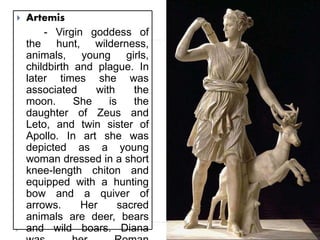
 Artemis
- Virgin goddess of
the hunt, wilderness,
animals, young girls,
childbirth and plague. In
later times she was
associated with the
moon. She is the
daughter of Zeus and
Leto, and twin sister of
Apollo. In art she was
depicted as a young
woman dressed in a short
knee-length chiton and
equipped with a hunting
bow and a quiver of
arrows. Her sacred
animals are deer, bears
and wild boars. Diana
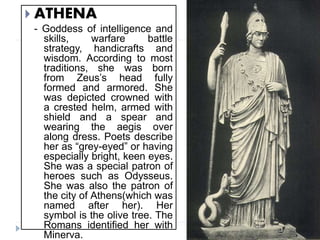
 ATHENA
- Goddess of intelligence and
skills, warfare battle
strategy, handicrafts and
wisdom. According to most
traditions, she was born
from Zeus’s head fully
formed and armored. She
was depicted crowned with
a crested helm, armed with
shield and a spear and
wearing the aegis over
along dress. Poets describe
her as “grey-eyed” or having
especially bright, keen eyes.
She was a special patron of
heroes such as Odysseus.
She was also the patron of
the city of Athens(which was
named after her). Her
symbol is the olive tree. The
Romans identified her with
Minerva.
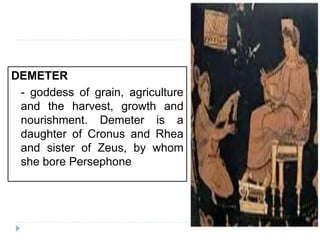
DEMETER
- goddess of grain, agriculture
and the harvest, growth and
nourishment. Demeter is a
daughter of Cronus and Rhea
and sister of Zeus, by whom
she bore Persephone
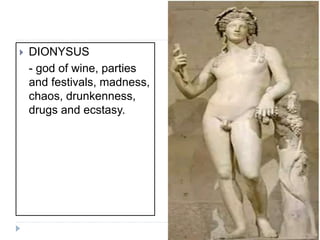
 DIONYSUS
- god of wine, parties
and festivals, madness,
chaos, drunkenness,
drugs and ecstasy.
HADES
- king of the
underworld and the
dead, and god of the
earth’s hidden wealth,
both agricultural
produce and precious
metals. His consort is
Persephone.
 HEPHAESTUS
 Crippled god of fire, metal
working and crafts. Either
the son of Zeus and Hera
or Heraalone, he is the
smith of the gods and the
husband of the adulterous
Aphrodite.
 HERA
 Queen of the gods and
the goddess of
marriage, women,
childbirth, heirs, kings
and empires. She is the
wife of Zeus and
daughter of Cronus and
Rhea. In Rome she
was known as Juno.
HERMES
- god of boundaries,
travel,
communication,
trade , thievery,
trickery, language,
writing, diplomacy,
athletics and animal
husbandry. The son
of Zeus and Maia.
Hermes is the
messenger of the
gods, and the
psychopomp who
leads the souls of the
dead into the
 HESTIA
 Virgin goddess of the
hearth, home and
chastity. She is
daughter of Rhea and
Cronusand sister of
Zeus. Not often
identifiable in Greek
Art, she appeared as
a modestly veiled
woman. Her symbols
are the hearth and
kettle.
 POSEIDON
 God of the sea, rivers,
floods, droughts,
earthquakes, and the
creator of horses;
known as the “earth
shaker”. He is the sun
of Cronus and Rhea
and brother to Zeus
and Hades. He rules
one of the three realms
of the universe as king
of the sea and the
waters. His Roman
counterpart was
Neptune.
 ZEUS
 king of the gods, the ruler
of mount Olympus and the
god of the sky, weather,
thunder, lightning, law,
order, and justice. He is the
youngest son of Cronus and
Rhea. He overthrew Cronus
and gained the sovereignty
of heaven for himself. His
counterpart Jupiter, also
known as Jove, was the
supreme deity of the
Romans.
EPIMETHEUS god of afterthought and the father
of excuses.
HELIOS god of the sun and guardian of
oaths
AURA goddess of the breeze and the
fresh, cool air of early morning.
ASTERIA goddess of nocturnal oracles and
falling stars.
RHEA goddess of fertility, motherhood
and the mountain wilds
OCEANUS god of the all-encircling river
oceans around the earth, the font of
all the earth's fresh-water.
HYPERION god of light, with Thiea, he is the
father of Helios ( the sun) and
Selene (the moon), and Eos (the
Dawn)
IAPETUS god of morality
PONTUS The god of the sea, father of the
fish and other sea craetures.
THE OUREA The gods of the mountain
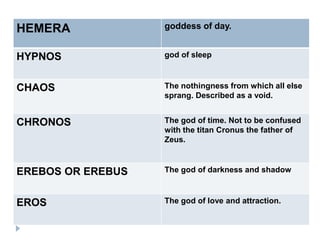
HEMERA goddess of day.
HYPNOS god of sleep
CHAOS The nothingness from which all else
sprang. Described as a void.
CHRONOS The god of time. Not to be confused
with the titan Cronus the father of
Zeus.
EREBOS OR EREBUS The god of darkness and shadow
EROS The god of love and attraction.

Roman literature

  • 1.
  • 2.
    HISTORY OF ROMANLITERATURE  THE SIXTH AND THE SEVENTH CENTURIES OF THE CITY (240-80 B.C), FROM LIVIUS TO SULLA -which comprises the history of the legitimate drama, of the early epos and satire, and the beginning of the prose composition, is marked by a vigorous but ill- disciplined imitation of Greek poetical models, and in prose by a dry sententiousness of style, gradually giving way to a clear and fluent strength, which was characteristic of the speeches of Gracchus and Antonius.
  • 3.
     THE GOLDENAGE, FROM CICERO TO OVID (80 B.C.-A,D.14)  Represents the highest excellence in prose and poetry. The prose era came first, and is signalized by the names of Cicero, Sallust and Caesar. The celebrated writers were now mostly men of action and high position in the state. The principles of the language had become fixed; its grammatical construction was thoroughly understood, and its peculiar genius wisely adapted to those forms of composition in which it was naturally capable of excelling. The perfection of poetry was not attained until the time of Augustus. In this period the writers as a rule are not public men, but belong to what we should call the literary class. They wrote not for the public but for the select circle of educated men whose rank were gradually narrowing their limits to the great injury of literature.
  • 4.
    •THE PERIOD OFTHE DECLINE, FROM THE ACCESION OF TIBERIUS TO THE DEATH OF MARCUS AURELIUS (14-180 A.D)  The Third period, though a long of duration, has its chief characteristics clearly defined from the beginning. The foremost of these unreality, arising from the extinction of freedom and consequent loss of interest in public life. At the same time the Romans, being made for political activity, did not readily content themselves with the less exciting successes of literary life.
  • 5.
  • 6.
    APHRODITE- goddess of love, beauty,desire, and pleasure. Although married to Hephaestus she had many lovers, most notably Ares, Adonis, and Anchises. She was depicted as a beautiful woman and of all the goddesses most likely to appear nude or seminude. Poets praise the radiance of her smile and her laughter. Her symbols include roses and other flowers, the scallop shell, and myrtle wreath. Her sacred animals are doves and sparrows.
  • 7.
    APOLLO - god ofmusic, arts, knowledge, healing, plague, prophecy, poetry, manly beauty and archery. He is the son of Zeus and Leto, and the twin brother of Artemis. As brother and sister, they were identified with the sun and the moon both use a bow and arrow. Animals sacred to Apollo include roe deer, swans, cicadas, hawks, ravens, cows, foxes, mice and snakes.
  • 8.
    ARES - god ofwar, bloodshed and viloence. The son of Zeus and Hera, he was depicted as a beardless youth, either nude with a helmet and spear or sword, or as an armed warrior. Homer portrays him as moody and unreliable , and he gradually represents chaos of war in contrast to Athena, a goddess of military strategy and skill. Ares’ sacred animals are the vulture, venomous snakes, dogs and boars. His roman counterpart Mars by contrast was regarded as the dignified ancestor of the Roman people.
  • 9.
     Artemis - Virgingoddess of the hunt, wilderness, animals, young girls, childbirth and plague. In later times she was associated with the moon. She is the daughter of Zeus and Leto, and twin sister of Apollo. In art she was depicted as a young woman dressed in a short knee-length chiton and equipped with a hunting bow and a quiver of arrows. Her sacred animals are deer, bears and wild boars. Diana
  • 10.
     ATHENA - Goddessof intelligence and skills, warfare battle strategy, handicrafts and wisdom. According to most traditions, she was born from Zeus’s head fully formed and armored. She was depicted crowned with a crested helm, armed with shield and a spear and wearing the aegis over along dress. Poets describe her as “grey-eyed” or having especially bright, keen eyes. She was a special patron of heroes such as Odysseus. She was also the patron of the city of Athens(which was named after her). Her symbol is the olive tree. The Romans identified her with Minerva.
  • 11.
    DEMETER - goddess ofgrain, agriculture and the harvest, growth and nourishment. Demeter is a daughter of Cronus and Rhea and sister of Zeus, by whom she bore Persephone
  • 12.
     DIONYSUS - godof wine, parties and festivals, madness, chaos, drunkenness, drugs and ecstasy.
  • 13.
    HADES - king ofthe underworld and the dead, and god of the earth’s hidden wealth, both agricultural produce and precious metals. His consort is Persephone.
  • 14.
     HEPHAESTUS  Crippledgod of fire, metal working and crafts. Either the son of Zeus and Hera or Heraalone, he is the smith of the gods and the husband of the adulterous Aphrodite.
  • 15.
     HERA  Queenof the gods and the goddess of marriage, women, childbirth, heirs, kings and empires. She is the wife of Zeus and daughter of Cronus and Rhea. In Rome she was known as Juno.
  • 16.
    HERMES - god ofboundaries, travel, communication, trade , thievery, trickery, language, writing, diplomacy, athletics and animal husbandry. The son of Zeus and Maia. Hermes is the messenger of the gods, and the psychopomp who leads the souls of the dead into the
  • 17.
     HESTIA  Virgingoddess of the hearth, home and chastity. She is daughter of Rhea and Cronusand sister of Zeus. Not often identifiable in Greek Art, she appeared as a modestly veiled woman. Her symbols are the hearth and kettle.
  • 18.
     POSEIDON  Godof the sea, rivers, floods, droughts, earthquakes, and the creator of horses; known as the “earth shaker”. He is the sun of Cronus and Rhea and brother to Zeus and Hades. He rules one of the three realms of the universe as king of the sea and the waters. His Roman counterpart was Neptune.
  • 19.
     ZEUS  kingof the gods, the ruler of mount Olympus and the god of the sky, weather, thunder, lightning, law, order, and justice. He is the youngest son of Cronus and Rhea. He overthrew Cronus and gained the sovereignty of heaven for himself. His counterpart Jupiter, also known as Jove, was the supreme deity of the Romans.
  • 20.
    EPIMETHEUS god ofafterthought and the father of excuses. HELIOS god of the sun and guardian of oaths AURA goddess of the breeze and the fresh, cool air of early morning. ASTERIA goddess of nocturnal oracles and falling stars. RHEA goddess of fertility, motherhood and the mountain wilds OCEANUS god of the all-encircling river oceans around the earth, the font of all the earth's fresh-water. HYPERION god of light, with Thiea, he is the father of Helios ( the sun) and Selene (the moon), and Eos (the Dawn) IAPETUS god of morality PONTUS The god of the sea, father of the fish and other sea craetures. THE OUREA The gods of the mountain
  • 21.
    HEMERA goddess ofday. HYPNOS god of sleep CHAOS The nothingness from which all else sprang. Described as a void. CHRONOS The god of time. Not to be confused with the titan Cronus the father of Zeus. EREBOS OR EREBUS The god of darkness and shadow EROS The god of love and attraction.