COPYRIGHT
FOR
EDUCATORS
Whitney Thompson
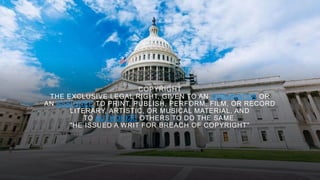
COPYRIGHT
THE EXCLUSIVE LEGAL RIGHT, GIVEN TO AN ORIGINATOR OR
AN ASSIGNEE TO PRINT, PUBLISH, PERFORM, FILM, OR RECORD
LITERARY, ARTISTIC, OR MUSICAL MATERIAL, AND
TO AUTHORIZE OTHERS TO DO THE SAME.
"HE ISSUED A WRIT FOR BREACH OF COPYRIGHT"
WHAT YOU NEED TO
KNOW
Basics of
Copyrights
What is Fair Use?
How to Acquire and Share Work
Legally and Ethically
LEARNING OUTCOME
What is protected and What isn’t??
After competition of the module, the
participant will identify the purpose of
copyright, and its rights.
BASICS OF COPYRIGHT
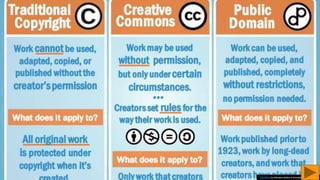
Copyright is a type of intellectual property that
protects original works of authorship as soon as an
author fixes the work in a tangible form of
expression. In copyright law, there are a lot of
different types of works, including paintings,
photographs, illustrations, musical compositions,
sound recordings, computer programs, books,
poems, blog posts, movies, architectural works,
plays, and so much more!
To Do
Required reading:
https://www.copyright.gov/what-is-copyright/
CHECKPOINT
COPYRIGHT
PROTECTION
LASTS THE
AUTHOR LIFE
PLUS SEVENTY
YEARS AFTER
THE AUTHOR’S
DEATH?
CHECKPOINT
COPYRIGHT
PROTECTION
LASTS THE
AUTHOR PLUS
SEVENTY YEARS
AFTER THE
AUTHOR’S
DEATH?
CHECKPOINT
COPYRIGHT
PROTECTION
LASTS THE
AUTHOR PLUS
SEVENTY YEARS
AFTER THE
AUTHOR’S
DEATH?
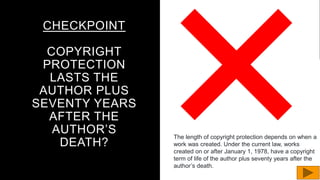
The length of copyright protection depends on when a
work was created. Under the current law, works
created on or after January 1, 1978, have a copyright
term of life of the author plus seventy years after the
author’s death.
LEARNING OUTCOME
How to Use Other’s Work Correctly?
After competition of the module, the
participant will relate to the limitations
of copyright, including fair use.
HISTORY OF
COPYRIGHT
“Congress shall have the Power . . . To promote
the Progress of Science and useful Arts, by
securing for limited Times to Authors and
Inventors the exclusive Right to their respective
Writings and Discoveries.”
– United States Constitution, Art. I, Section 8
To Do:
Required reading:
https://www.copyright.gov/timeline/
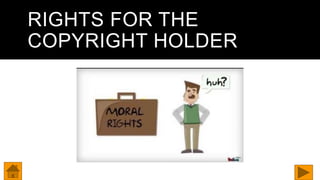
RIGHTS FOR THE
COPYRIGHT HOLDER
WHAT IS
FAIR USE
“Fair use is a legal doctrine that
promotes freedom of expression by
permitting the unlicensed use of
copyright-protected works in certain
circumstances. Section 107 of the
Copyright Act provides the statutory
framework for determining whether
something is a fair use and identifies
certain types of uses—such as
criticism, comment, news reporting,
teaching, scholarship, and research—
as examples of activities that may
qualify as fair use. ”
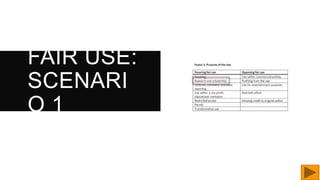
FAIR USE:
SCENARI
O 1
FAIR USE:
SCENARI
O 2
FAIR USE CHECKPOINT
Think of a time when you used some type of media in your
classroom, now that you know what constitutes as fair use, do you
believe you used the media legally without copyright infringement?
Add your response to the discussion thread.
LEARNING OUTCOME
How to Acquire and Share Work?
After competition of the module, the
participant will know how to apply skills
to acquire and share media in lawful and
ethical ways.
This Photo by Unknown Author is licensed under CC BY-NC
ACQUIRING
FREE
CONTENT:
TIP #1
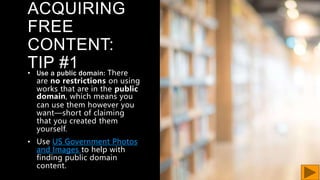
• Use a public domain: There
are no restrictions on using
works that are in the public
domain, which means you
can use them however you
want—short of claiming
that you created them
yourself.
• Use US Government Photos
and Images to help with
finding public domain
content.
ACQUIRING
FREE
CONTENT: TIP
#2
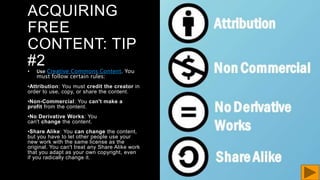
• Use Creative Commons Content. You
must follow certain rules:
•Attribution: You must credit the creator in
order to use, copy, or share the content.
•Non-Commercial: You can't make a
profit from the content.
•No Derivative Works: You
can't change the content.
•Share Alike: You can change the content,
but you have to let other people use your
new work with the same license as the
original. You can't treat any Share Alike work
that you adapt as your own copyright, even
if you radically change it.
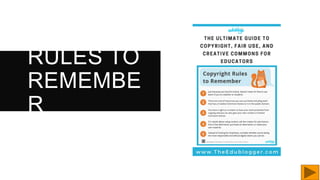
RULES TO
REMEMBE
R
ASSIGNME
NT:
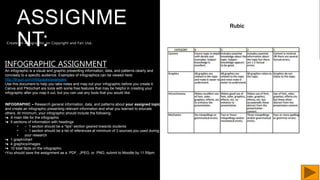
Create an infographic on Copyright and Fair Use.
INFOGRAPHIC ASSIGNMENT
An infographic is a visual and graphic presenting information, data, and patterns clearly and
concisely to a specific audience. Examples of infographics can be viewed here:
http://tinyurl.com/infographicexamples
Use this document to help you take notes and map out your infographic before you create it.
Canva and Piktochart are tools with some free features that may be helpful in creating your
infographic after you map it out, but you can use any tools that you would like.
INFOGRAPHIC – Research general information, data, and patterns about your assigned topic
and create an infographic presenting relevant information and what you learned to educate
others. At minimum, your infographic should include the following:
•● A main title for the infographic
•● 5 sections of information with headings
• ○ 1 section should be a “tips” section geared towards students
• ○ 1 section should be a list of references at minimum of 3 sources you used during
• your research
•● 1 graph/chart
•● 4 graphics/images
•● 10 total facts on the infographic
•You should save the assignment as a .PDF, .JPEG, or .PNG, submit to Moodle by 11:59pm.
Rubic
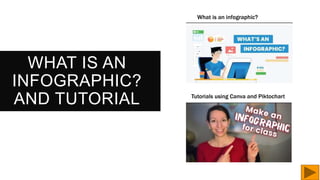
WHAT IS AN
INFOGRAPHIC?
AND TUTORIAL Tutorials using Canva and Piktochart
What is an infographic?
REFERENCES
• https://edu.gcfglobal.org/en/useinformationcorrectly/copyright-and-fair-use/1/
• https://erikaschnatz.com/portfolio/copyright-infographics/
• https://www.copyright.gov
• https://youtu.be/YSlh4bIsukM
• https://youtu.be/IFhF_tHrj4s
• https://youtu.be/6bL8dbEUl-Y
• https://youtu.be/xrvKHe8tlsc
• https://thevisualcommunicationguy.com/2019/02/27/can-i-use-that-picture-infographic-
revised-and-simplified/

Copyright basics powerpoint for educators

  • 1.
  • 2.
    COPYRIGHT THE EXCLUSIVE LEGALRIGHT, GIVEN TO AN ORIGINATOR OR AN ASSIGNEE TO PRINT, PUBLISH, PERFORM, FILM, OR RECORD LITERARY, ARTISTIC, OR MUSICAL MATERIAL, AND TO AUTHORIZE OTHERS TO DO THE SAME. "HE ISSUED A WRIT FOR BREACH OF COPYRIGHT"
  • 3.
    WHAT YOU NEEDTO KNOW Basics of Copyrights What is Fair Use? How to Acquire and Share Work Legally and Ethically
  • 4.
    LEARNING OUTCOME What isprotected and What isn’t?? After competition of the module, the participant will identify the purpose of copyright, and its rights.
  • 5.
    BASICS OF COPYRIGHT Copyrightis a type of intellectual property that protects original works of authorship as soon as an author fixes the work in a tangible form of expression. In copyright law, there are a lot of different types of works, including paintings, photographs, illustrations, musical compositions, sound recordings, computer programs, books, poems, blog posts, movies, architectural works, plays, and so much more! To Do Required reading: https://www.copyright.gov/what-is-copyright/
  • 6.
    CHECKPOINT COPYRIGHT PROTECTION LASTS THE AUTHOR LIFE PLUSSEVENTY YEARS AFTER THE AUTHOR’S DEATH?
  • 7.
  • 8.
    CHECKPOINT COPYRIGHT PROTECTION LASTS THE AUTHOR PLUS SEVENTYYEARS AFTER THE AUTHOR’S DEATH? The length of copyright protection depends on when a work was created. Under the current law, works created on or after January 1, 1978, have a copyright term of life of the author plus seventy years after the author’s death.
  • 9.
    LEARNING OUTCOME How toUse Other’s Work Correctly? After competition of the module, the participant will relate to the limitations of copyright, including fair use.
  • 10.
    HISTORY OF COPYRIGHT “Congress shallhave the Power . . . To promote the Progress of Science and useful Arts, by securing for limited Times to Authors and Inventors the exclusive Right to their respective Writings and Discoveries.” – United States Constitution, Art. I, Section 8 To Do: Required reading: https://www.copyright.gov/timeline/
  • 11.
  • 12.
    WHAT IS FAIR USE “Fairuse is a legal doctrine that promotes freedom of expression by permitting the unlicensed use of copyright-protected works in certain circumstances. Section 107 of the Copyright Act provides the statutory framework for determining whether something is a fair use and identifies certain types of uses—such as criticism, comment, news reporting, teaching, scholarship, and research— as examples of activities that may qualify as fair use. ”
  • 13.
  • 14.
  • 15.
    FAIR USE CHECKPOINT Thinkof a time when you used some type of media in your classroom, now that you know what constitutes as fair use, do you believe you used the media legally without copyright infringement? Add your response to the discussion thread.
  • 16.
    LEARNING OUTCOME How toAcquire and Share Work? After competition of the module, the participant will know how to apply skills to acquire and share media in lawful and ethical ways.
  • 17.
    This Photo byUnknown Author is licensed under CC BY-NC
  • 18.
    ACQUIRING FREE CONTENT: TIP #1 • Usea public domain: There are no restrictions on using works that are in the public domain, which means you can use them however you want—short of claiming that you created them yourself. • Use US Government Photos and Images to help with finding public domain content.
  • 19.
    ACQUIRING FREE CONTENT: TIP #2 • UseCreative Commons Content. You must follow certain rules: •Attribution: You must credit the creator in order to use, copy, or share the content. •Non-Commercial: You can't make a profit from the content. •No Derivative Works: You can't change the content. •Share Alike: You can change the content, but you have to let other people use your new work with the same license as the original. You can't treat any Share Alike work that you adapt as your own copyright, even if you radically change it.
  • 20.
  • 21.
    ASSIGNME NT: Create an infographicon Copyright and Fair Use. INFOGRAPHIC ASSIGNMENT An infographic is a visual and graphic presenting information, data, and patterns clearly and concisely to a specific audience. Examples of infographics can be viewed here: http://tinyurl.com/infographicexamples Use this document to help you take notes and map out your infographic before you create it. Canva and Piktochart are tools with some free features that may be helpful in creating your infographic after you map it out, but you can use any tools that you would like. INFOGRAPHIC – Research general information, data, and patterns about your assigned topic and create an infographic presenting relevant information and what you learned to educate others. At minimum, your infographic should include the following: •● A main title for the infographic •● 5 sections of information with headings • ○ 1 section should be a “tips” section geared towards students • ○ 1 section should be a list of references at minimum of 3 sources you used during • your research •● 1 graph/chart •● 4 graphics/images •● 10 total facts on the infographic •You should save the assignment as a .PDF, .JPEG, or .PNG, submit to Moodle by 11:59pm. Rubic
  • 22.
    WHAT IS AN INFOGRAPHIC? ANDTUTORIAL Tutorials using Canva and Piktochart What is an infographic?
  • 23.
    REFERENCES • https://edu.gcfglobal.org/en/useinformationcorrectly/copyright-and-fair-use/1/ • https://erikaschnatz.com/portfolio/copyright-infographics/ •https://www.copyright.gov • https://youtu.be/YSlh4bIsukM • https://youtu.be/IFhF_tHrj4s • https://youtu.be/6bL8dbEUl-Y • https://youtu.be/xrvKHe8tlsc • https://thevisualcommunicationguy.com/2019/02/27/can-i-use-that-picture-infographic- revised-and-simplified/