Written for the University of TX by Georgia K. Harper
Writing on other’s creative expressionsCourtesy of Funnychix.com
The public domain and orphan works
These are works that are either ineligible for copyright protection or with expired copyrights. No permission whatsoever is needed to copy or use public domain works. photo courtesy by Waldo LEE
In other words…photo courtesy: imtiredonline.com
Doing GOOD!They identifyworksthat actually are in the public domain.
They define reasonable searches for copyright owners of different types of works.Some common assumptions are wrong  Copyright protection!
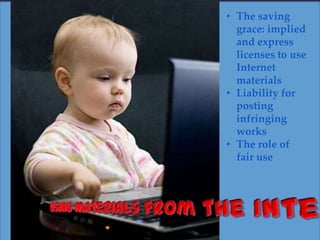
The saving grace: implied and express licenses to use Internet materials
Liability for posting infringing works
The role of fair useUsing materials from the Internet
Some common assumptions are wrong Copyright protection
The saving grace: implied and express licenses to use Internet materialsWhenever an author posts anything on the Internet, he or she should reasonably expect that it will be read, downloaded, printed out, forwarded, and even used as the basis for other works to some degree. So, just by posting, an author impliedly grants a limited license to use her work in this manner.Liability for posting infringing worksThe proliferation of RIAA lawsuits against individuals for peer-to-peer file-sharing make clear that individuals can be liable for their own actions when they copy and distribute others' copyrighted works without permission. The role of fair useFair use plays a critical role in the analog world where duplicating technology is cumbersome and authors make money by controlling copies. It balances authors' rights to reasonable compensation with the public's rights to the ideas contained in copyrighted works.
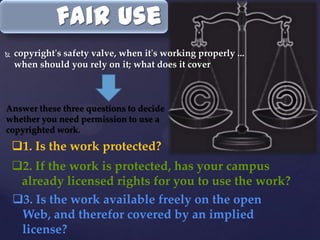
FAIR USE
fair usecopyright's safety valve, when it's working properly ... when should you rely on it; what does it coverAnswer these three questions to decide whether you need permission to use a copyrighted work.1. Is the work protected?
2. If the work is protected, has your campus already licensed rights for you to use the work?
3. Is the work available freely on the open Web, and therefor covered by an implied license?
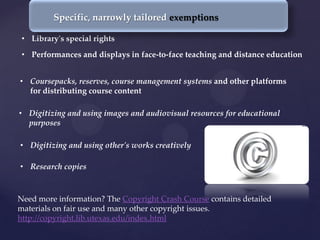
Specific, narrowly tailored exemptionsLibrary's special rights
Performances and displays in face-to-face teaching and distance education
Coursepacks, reserves, course management systems and other platforms for distributing course content
Digitizing and using images and audiovisual resources for educational purposes
Digitizing and using other's works creatively
Research copiesNeed more information? The Copyright Crash Course contains detailed materials on fair use and many other copyright issues. http://copyright.lib.utexas.edu/index.html
The TEACH Act

Edtc 6340.66 dara_cepeda_copyrightcc_powerpoint-4

  • 2.
    Written for theUniversity of TX by Georgia K. Harper
  • 3.
    Writing on other’screative expressionsCourtesy of Funnychix.com
  • 4.
    The public domainand orphan works
  • 5.
    These are worksthat are either ineligible for copyright protection or with expired copyrights. No permission whatsoever is needed to copy or use public domain works. photo courtesy by Waldo LEE
  • 6.
    In other words…photocourtesy: imtiredonline.com
  • 7.
    Doing GOOD!They identifyworksthatactually are in the public domain.
  • 8.
    They define reasonablesearches for copyright owners of different types of works.Some common assumptions are wrong Copyright protection!
  • 9.
    The saving grace:implied and express licenses to use Internet materials
  • 10.
    Liability for postinginfringing works
  • 11.
    The role offair useUsing materials from the Internet
  • 12.
    Some common assumptionsare wrong Copyright protection
  • 13.
    The saving grace:implied and express licenses to use Internet materialsWhenever an author posts anything on the Internet, he or she should reasonably expect that it will be read, downloaded, printed out, forwarded, and even used as the basis for other works to some degree. So, just by posting, an author impliedly grants a limited license to use her work in this manner.Liability for posting infringing worksThe proliferation of RIAA lawsuits against individuals for peer-to-peer file-sharing make clear that individuals can be liable for their own actions when they copy and distribute others' copyrighted works without permission. The role of fair useFair use plays a critical role in the analog world where duplicating technology is cumbersome and authors make money by controlling copies. It balances authors' rights to reasonable compensation with the public's rights to the ideas contained in copyrighted works.
  • 15.
  • 16.
    fair usecopyright's safetyvalve, when it's working properly ... when should you rely on it; what does it coverAnswer these three questions to decide whether you need permission to use a copyrighted work.1. Is the work protected?
  • 17.
    2. If thework is protected, has your campus already licensed rights for you to use the work?
  • 18.
    3. Is thework available freely on the open Web, and therefor covered by an implied license?
  • 19.
    Specific, narrowly tailoredexemptionsLibrary's special rights
  • 20.
    Performances and displaysin face-to-face teaching and distance education
  • 21.
    Coursepacks, reserves, coursemanagement systems and other platforms for distributing course content
  • 22.
    Digitizing and usingimages and audiovisual resources for educational purposes
  • 23.
    Digitizing and usingother's works creatively
  • 24.
    Research copiesNeed moreinformation? The Copyright Crash Course contains detailed materials on fair use and many other copyright issues. http://copyright.lib.utexas.edu/index.html
  • 25.