i
COMMUNITY ENGAGEMENT,
SOLIDARITY AND CITIZENSHIP
Second Quarter – Module 1:
Core Values and Principles of
Community Action Initiatives
SHS
ii
Community Engagement, Solidarity, and Citizenship – Grade 11
Quarter 2 – Module 1: Core Values and Principles of Community Action
Initiatives
Republic Act 8293, section 176 states that: No copyright shall subsist in any
work of the Government of the Philippines. However, prior approval of the government
agency or office wherein the work is created shall be necessary for exploitation of such
work for profit. Such agency or office may, among other things, impose as a condition
the payment of royalties.
Borrowed materials (i.e., songs, stories, poems, pictures, photos, brand names,
trademarks, etc.) included in this book are owned by their respective copyright holders.
Every effort has been exerted to locate and seek permission to use these materials
from their respective copyright owners. The publisher and authors do not represent
nor claim ownership over them.
Regional Director: Gilbert T. Sadsad
Assistant Regional Director: Jessie L. Amin
Development Team of the Module
Writer: Rona A. Despabiladeras
Evaluator: Elmer Valenzuela
Editor: Divina M. Diaz, Ph.D.
Ma. Theresa D. Gacosta
Illustrator:
Layout Artist: Edsel D. Doctama
1
INTRODUCTION
As a student, your role in nation-building is crucial. This module will help you
understand the different core values necessary
for implementing community action initiatives.
These core values will help you determine the
strategies, programs, and policies that would
empower your community.
OBJECTIVES
At the end of this module, you are expected to:
 Explain the core values of community action
initiatives such as human rights, social equity, gender equality, and
participatory development.
 Identify the different core values of community action initiatives.
 Express the importance of human rights, social equity, gender equality and
participatory development in community action initiatives through a poster.
VOCABULARY LIST
UNLOCK THE HIDDEN WORDS
Directions: Each letter in the alphabet from A to Z
corresponds to numbers 1 to 26. Determine the words
described in each item by identifying the letter that
matches up to each number.
1
A 2
B 3
C 4
D 5
E 6
F 7
G 8
H 9
I 10
J
11
K 12
L 13
M 14
N 15
O 16
P 17
Q 18
R 19
S 20
T
21
U 22
V 23
W 24
X 25
Y 26
Z
2
1. 19 15 3 9 1 12 5 17 21 9 20 25
It refers to the fair distribution of society’s benefits, advantages and assets, not
just bylaw and in the court but in all aspects of the society.
2. 8 21 13 1 14 18 9 7 8 20 19
These are rights inherent to all human beings, regardless of nationality,
residence, sex, origin, color, religion, language, or any other status.
3. 7 5 14 4 5 18 5 17 21 1 12 9 20 25
It refers to equal access to goods, services and resources and equal
opportunities in all spheres of life for both men and women.
4. 16 1 18 20 9 3 9 16 1 20 15 18 25 4 5 22 5 12 15 16 13 5 14 20
It refers to the process through which stakeholders can influence and share
control over development initiatives and over the decisions and resources that
affect them.
PRE-TEST
Identify the concept associated with each illustration.
Choose from the options inside the box. Explain briefly
why you associated the concept with the illustration.
Participatory Development Right to Life
Right to Property Right to Liberty
Social Equity Gender Equality
3
1. Concept: _____________________
Explanation: ____________________
______________________________
______________________________
______________________________
2. Concept: _____________________
Explanation: ____________________
______________________________
______________________________
______________________________
3. Concept: _____________________
Explanation: ____________________
______________________________
______________________________
______________________________
4. Concept: _____________________
Explanation: ____________________
______________________________
______________________________
______________________________
5. Concept: _____________________
Explanation: ____________________
______________________________
______________________________
______________________________
6. Concept: _____________________
Explanation: ____________________
______________________________
______________________________
______________________________
delta2020.com Interactioninstitute.org
vachristian.org
eachother.org.uk
www.property24.com
clipart-library.com
4
LEARNING ACTIVITIES
HUMAN RIGHTS
Human rights are rights inherent to all human
beings, regardless of race, sex, nationality, ethnicity,
language, religion, or any other status. Human rights
include the right to life and liberty, freedom from slavery and torture, freedom of opinion
and expression, the right to work and education, and many more. Everyone is entitled
to these rights, without discrimination. (www.un.org)
CHARACTERISTICS OF HUMAN RIGHTS
UNIVERSAL Human rights belong to all people.
INALIENABLE
Human rights cannot be taken away unless
specific situations call for it. However, the
deprivation of a person’s right is subject to due
process.
INTERCONNECTED Human rights are dependent on one another.
INDIVISIBLE Human rights cannot be treated in isolation.
NON-DISCRIMINATORY
Human rights should be respected without
prejudice.
You already have a glimpse of the
concepts in this module. To gain a deeper
understanding of the core values of
community action initiatives, read the
succeeding discussions. Then answer the
activities prepared for you.
5
THE UNIVERSAL DECLARATION OF HUMAN
RIGHTS
The Universal Declaration of Human Rights
(UDHR) is a milestone document in the history of human
rights. Drafted by representatives with different legal and cultural backgrounds from
all regions of the world, the declaration was proclaimed by the United Nations General
Assembly in Paris on December 10, 1948 as a common standard of achievements for
all people and all nations. It has 30 articles that set out for the first time the fundamental
human rights to be universally protected. (www.un.org)
HUMAN RIGHTS ACCORDING TO THE UDHR (hrlibrary.umn.edu)
Article 1: Right to Equality
Article 2: Freedom from Discrimination
Article 3: Right to Life, Liberty, and Personal Security
Article 4: Freedom from Slavery
Article 5: Freedom from Torture and Degrading Treatment
Article 6: Right to Recognition as a Person Before the Law
Article 7: Right to Equality Before the Law
Article 8: Right to Remedy by Competent Tribunal
Article 9: Freedom from Arbitrary Arrest and Exile
Article 10: Right to Fair Public Hearing
Article 11: Right to be Considered Innocent Until Proven Guilty
Article 12: Freedom from Interference with Privacy, Family, Home and
Correspondence
Article 13: Right to Free Movement in and out of the Country
Article 14: Right to Asylum in other Countries from Persecution
6
Article 15: Right to a Nationality and the Freedom to Change it
Article 16: Right to Marriage and Family
Article 17: Right to Own Property
Article 18: Freedom of Belief and Religion
Article 19: Freedom of Opinion and Information
Article 20: Right of Peaceful Assembly and Association
Article 21: Right to Participate in Government and in Free Elections
Article 22: Right to Social Security
Article 23: Right to Desirable Work and to Join Trade Unions
Article 24: Right to Rest and Leisure
Article 25: Right to Adequate Living Standard
Article 26: Right to Education
Article 27: Right to Participate in the Cultural Life of Community
Article 28: Right to a Social Order that Articulates this Document
Article 29: Right to Community Duties Essential to Free and Full Development
Article 30: Freedom from State or Personal Interference in the above Rights
PRACTICE TASK 1
Identify the human rights associated with the
statement in each item. Choose your answer from
the different human rights according to the Universal
Declaration of Human Rights.
_______________________________ 1. The government provides free basic
education from Kindergarten to Grade 12 in all public schools.
7
_______________________________ 2. The will of the people is the basis of the
authority of the government, which is expressed through periodic elections.
_______________________________ 3. Everyone has the right to leave any country,
including his own, and to return to his country.
_______________________________ 4. Men and women of full age, without any
limitation due to race, nationality or religion, have the right to start their own family.
_______________________________ 5. Everyone is given reasonable limitation of
working hours to rest and relax during their spare time.
GENDER EQUALITY
Gender equality is the state of equal access
to resources and opportunities regardless of
gender, including economic participation and
decision-making; and the state of valuing different behaviors, aspirations and needs
equally, regardless of gender (en.m.wikipedia.org).
Gender equality requires equal enjoyment by women and men of socially-
valued goods, opportunities, resources, and rewards. Where gender inequality exists,
it is generally women who are excluded or disadvantaged in relation to decision-
making and access to economic and social resources (www.unfpa.org). But we should
not ignore the negative impact that gender inequality can have on men as well. For
You have already learned that human rights
are granted to everyone without distinction of any
kind. Human rights are essential to the full
development of individuals and communities.
There’s a lot more to learn. Keep moving!
8
example, societal norms regarding the appropriate behavior for men tend to put them
under pressure with regards to the need to provide materially for their family, and also
deny them opportunities of being more nurturing towards their children and wife.
According to UNICEF, gender equality means that women and men, and girls
and boys, enjoy the same rights, resources, opportunities, and protections. It does not
require that girls and boys, or women and men, be the same, or that they be treated
equally alike. On a global scale, achieving gender equality also requires eliminating
harmful practices against women and girls. A critical aspect of promoting gender
equality is the empowerment of women, with a focus on identifying and redressing
power imbalances and giving women more autonomy to manage their own lives.
SOCIAL EQUITY
In the context of societal systems, equality and
equity refer to similar but slightly different concepts.
Equality generally refers to equal opportunity and the
same levels of support for all segments of the society.
Equity goes a step further and refers to offering varying levels of support depending
upon the need to achieve greater fairness of outcomes (www.diffen.com). Equality
seeks to make everyone equal; equity, on the other hand, seeks to address the
underlying and systemic differences of opportunity and access to social resources.
This is more important because we are not all the same and some people need more
help than others (projecthumancity.com).
One example of striving for social equity is affirmative action. Affirmative action
is the policy of explicitly favoring those who tend to suffer from discrimination,
especially in relation to employment or education. In some countries, public
9
universities and government agencies set aside a certain number of slots for people
from disadvantaged socio-economic backgrounds.
Another example of upholding social equity is the progressive tax system that
levies higher taxes on higher income brackets because those with higher incomes
presumably have a higher ability to pay. Giving preferential treatment to the elderly
and to persons with disabilites, as well as women-friendly policies in the workplace are
also other ways of promoting social equity.
PRACTICE TASK 2
A. Analyze the statements below. Write TRUE if the
statement is correct and FALSE if it is incorrect.
__________ 1. Men do not suffer from gender inequality.
_________ 2. When there is gender inequality, it is women that are more likely to be
disadvantaged and marginalized.
_________ 3. Gender equality is not just women’s issue but should concern and fully
engage men as well.
_________ 4. Gender equality means that men and women become the same.
_________ 5. Women empowerment is an important aspect of gender equality.
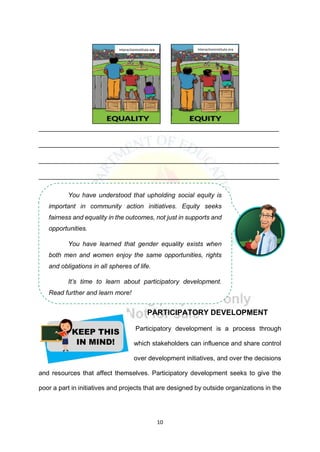
B. Analyze the illustrations below. Explain why the first illustration was labeled with
equality while the second was labeled with equity.
10
___________________________________________________________________
___________________________________________________________________
___________________________________________________________________
___________________________________________________________________
PARTICIPATORY DEVELOPMENT
Participatory development is a process through
which stakeholders can influence and share control
over development initiatives, and over the decisions
and resources that affect themselves. Participatory development seeks to give the
poor a part in initiatives and projects that are designed by outside organizations in the
You have understood that upholding social equity is
important in community action initiatives. Equity seeks
fairness and equality in the outcomes, not just in supports and
opportunities.
You have learned that gender equality exists when
both men and women enjoy the same opportunities, rights
and obligations in all spheres of life.
It’s time to learn about participatory development.
Read further and learn more!
Interactioninstitute.org Interactioninstitute.org
11
hopes that these projects will be more sustainable and successful by involving local
stakeholders in the project goals (www.thegrassrootscollective.org).
Participatory development seeks to engage local populations in development
projects. Participation is defined as the mobilization of people to eliminate unjust
hierarchies of knowledge, power, and economic distribution. Participation is an
empowering process for people to handle challenges and influence the direction of
their own lives.
The concept of participatory development highlights involvement of the
voiceless and those who are marginalized in the development process. It gives
recognition and importance to the poor and disadvantaged people and a chance to be
heard and get involved in the development process. It encourages community
involvement most especially in social issues that affect them.
PRACTICE TASK 3
Answer the following questions.
1. Why is it necessary to incorporate participatory development in community
initiatives and projects?
___________________________________________________________________
___________________________________________________________________
___________________________________________________________________
2.How can we encourage participation of different stakeholders in community
initiatives and projects?
_________________________________________________________________________
_________________________________________________________________________
12
POST TEST
Read each item carefully and choose the letter of the
best answer. Write it in your answer sheet.
______ 1. Which of the following statements best define human rights?
A. Human rights can be taken away from a person any time.
B. Human rights are inherent to all human beings, regardless of their status.
C. Some people are not entitled to human rights.
D. A person can be deprived of human rights without due process.
______ 2. Human rights are universal. Which of the following statements explains this
characteristic?
A. Human rights are dependent on one another.
B. Human rights cannot be treated in isolation.
C. Human rights belong to all people.
D. Human rights cannot be taken away.
______ 3. Which of the following statements best define social equity?
A. Equity refers to giving the same levels of support for all segments of the
society.
B. Equity seeks to make everyone equal by giving equal amount of support.
C. Equity refers to giving varying levels of support depending upon the need to
achieve greater fairness of outcomes.
It is expected that you have already understood the
core values of community action initiatives such as human
rights, social equity, gender equality, and participatory
development. With this new knowledge, you will be able to
help empower your community.
13
D. Equity gives equal support and opportunities and is not concerned with the
outcomes.
______ 4. Which of the following situations show social equity?
A. Asking the same amount of tax from all people, regardless of their jobs
B. Giving more opportunities to people residing in urban areas
C. Giving financial assistance to all, regardless of their economic status
D. Giving preferential treatment to senior citizens and PWDs
______ 5. Which statement on gender equality is correct?
A. Men do not suffer from gender inequality.
B. Gender equality means that men and women should be treated in the same
way.
C. Gender equality requires equal access to resources and opportunities
regardless of gender.
D. The negative impact of gender inequality on men should be ignored.
______ 6. Which of the following is a critical aspect of gender equality?
A. women empowerment B. men empowerment
C. giving less opportunities to men D. giving less autonomy to women
______ 7. Which statement best describes participatory development?
A. It involves local stakeholders in the in the development projects.
B. It does not engage the local population in the project goals.
C. It only allows the participation of local government units.
D. It does not empower the local population.
______ 8. In participatory development, who are enouraged to get involved in the
development process?
A. the local government officials
14
B. the professionals and businessmen
C. the government employees
D. the poor and marginalized
Criteria Description Points
Relevance to the Topic
The poster is related to the given topic
and makes it easier to understand.
20
Creativity
The poster shows an exceptional degree
of creativity and originality.
10
Visual Impact
The poster is visually appealing in terms
of design, layout, and neatness.
10
Total Points 40
Congratulations for finishing this learning
module! I am sure you had a wonderful learning journey
and you will have the same in the succeeding modules.
Keep on learning!
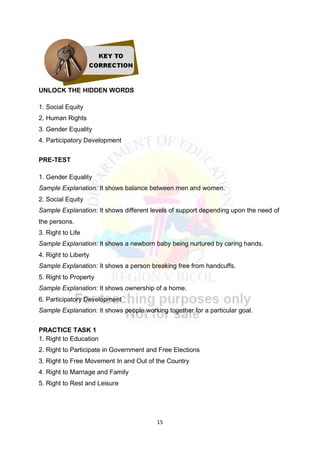
Create a poster showing the importance
of human rights, social equity, gender equality
and participatory development in community
action initiatives.
Use the rubrics below as a guide in
making your poster.
15
UNLOCK THE HIDDEN WORDS
1. Social Equity
2. Human Rights
3. Gender Equality
4. Participatory Development
PRE-TEST
1. Gender Equality
Sample Explanation: It shows balance between men and women.
2. Social Equity
Sample Explanation: It shows different levels of support depending upon the need of
the persons.
3. Right to Life
Sample Explanation: It shows a newborn baby being nurtured by caring hands.
4. Right to Liberty
Sample Explanation: It shows a person breaking free from handcuffs.
5. Right to Property
Sample Explanation: It shows ownership of a home.
6. Participatory Development
Sample Explanation: It shows people working together for a particular goal.
PRACTICE TASK 1
1. Right to Education
2. Right to Participate in Government and Free Elections
3. Right to Free Movement In and Out of the Country
4. Right to Marriage and Family
5. Right to Rest and Leisure
16
PRACTICE TASK 2
A.
1. False
2. True
3. True
4. False
5. True
B.
Sample Explanation: The first illustration shows equality because the same levels of
support were given to the three persons despite the differences in their heights. As a
result, the outcome was not the same to each of them. The second illustration shows
equity because different levels of support were given to the three persons depending
on their needs. As a result, all of them achieved the desired outcomes.
PRACTICE TASK 3
1. Sample Answer: Participatory development is necessary in community initiatives
and projects to ensure that these projects will be sustainable and successful. It also
empowers the marginalized people to handle challenges and influence the direction
of their own lives.
2. Sample Answer: We can encourage participation of different stakeholders in
community initiatives and projects by making them involved in the development
process, giving them recognition and importance, and providing them a chance to be
heard.
POST TEST
1. B
2. C
3. C
4. D
5. C
6. A
7. A
8. D
17
Diffen. (n.d.). Equality vs. Equity. Retrieved on June 26, 2020 from www.diffen.com
MPH@GW. (2018). What’s the Difference Between Equity and Equality? Retrieved on June
25, 2020 from publichealthonline.gwu.edu
Project: Human City. (2017). What is Social Equity? Retrieved on June 25, 2020 from
projecthumancity.com
Rappler. (2017). Things to Know: Human Rights in the Philippines. Retrieved on June 25,
2020 from www.rappler.com
The Advocates for Human Rights. (n.d.). Human Rights Basics. Retrieved on June 26, 2020
from advocatesforhumanrights.org
Tobias, R. (2017). The Centrality of Community Participation for All Community
Development Work. Retrieved on June 27, 2020 from www.grassrootscollective.org
UNFPA. (2005). Frequently Asked Questions About Gender Equality. Retrieved on June 25,
2020 from www.unfpa.org
United Nations. (n.d.). Human Rights. Retrieved on June 25, 2020 from https://www.un.org
/en/sections/issues-depth/human-rights/
University of Minnesota Human Rights Resource Center. (n.d.). The Universal Declaration of
Human Rights. Retrieved on June 26, 2020 from hrlibrary.umn.edu
Wikipedia. (n.d.). Gender Equality. Retrieved on June 25, 2020 from en.m.wikipedia.org
Wikipedia. (n.d.). Participatory Development. Retrieved on June 25, 2020 from en.m.
wikipedia.org
https://www.hiclipart.com/free-transparent-background-png-clipart-jiytq
https://vachristian.org/promoting-the-sanctity-of-human-life-and-the-right-to-life-for-the-baby-
in-the-womb/
https://eachother.org.uk/right-liberty-security-plain-english/
https://www.clipart.email/clipart/community-helping-each-other-clipart-274046.html
https://delta2020.org
www.property24.com
Cover photo credit: Melody D. Legaspi (Rizal Integrated National School, Sorsogon City)

Copy-of-Q2-CESC-Module-1.pdf

  • 1.
    i COMMUNITY ENGAGEMENT, SOLIDARITY ANDCITIZENSHIP Second Quarter – Module 1: Core Values and Principles of Community Action Initiatives SHS
  • 2.
    ii Community Engagement, Solidarity,and Citizenship – Grade 11 Quarter 2 – Module 1: Core Values and Principles of Community Action Initiatives Republic Act 8293, section 176 states that: No copyright shall subsist in any work of the Government of the Philippines. However, prior approval of the government agency or office wherein the work is created shall be necessary for exploitation of such work for profit. Such agency or office may, among other things, impose as a condition the payment of royalties. Borrowed materials (i.e., songs, stories, poems, pictures, photos, brand names, trademarks, etc.) included in this book are owned by their respective copyright holders. Every effort has been exerted to locate and seek permission to use these materials from their respective copyright owners. The publisher and authors do not represent nor claim ownership over them. Regional Director: Gilbert T. Sadsad Assistant Regional Director: Jessie L. Amin Development Team of the Module Writer: Rona A. Despabiladeras Evaluator: Elmer Valenzuela Editor: Divina M. Diaz, Ph.D. Ma. Theresa D. Gacosta Illustrator: Layout Artist: Edsel D. Doctama
  • 3.
    1 INTRODUCTION As a student,your role in nation-building is crucial. This module will help you understand the different core values necessary for implementing community action initiatives. These core values will help you determine the strategies, programs, and policies that would empower your community. OBJECTIVES At the end of this module, you are expected to:  Explain the core values of community action initiatives such as human rights, social equity, gender equality, and participatory development.  Identify the different core values of community action initiatives.  Express the importance of human rights, social equity, gender equality and participatory development in community action initiatives through a poster. VOCABULARY LIST UNLOCK THE HIDDEN WORDS Directions: Each letter in the alphabet from A to Z corresponds to numbers 1 to 26. Determine the words described in each item by identifying the letter that matches up to each number. 1 A 2 B 3 C 4 D 5 E 6 F 7 G 8 H 9 I 10 J 11 K 12 L 13 M 14 N 15 O 16 P 17 Q 18 R 19 S 20 T 21 U 22 V 23 W 24 X 25 Y 26 Z
  • 4.
    2 1. 19 153 9 1 12 5 17 21 9 20 25 It refers to the fair distribution of society’s benefits, advantages and assets, not just bylaw and in the court but in all aspects of the society. 2. 8 21 13 1 14 18 9 7 8 20 19 These are rights inherent to all human beings, regardless of nationality, residence, sex, origin, color, religion, language, or any other status. 3. 7 5 14 4 5 18 5 17 21 1 12 9 20 25 It refers to equal access to goods, services and resources and equal opportunities in all spheres of life for both men and women. 4. 16 1 18 20 9 3 9 16 1 20 15 18 25 4 5 22 5 12 15 16 13 5 14 20 It refers to the process through which stakeholders can influence and share control over development initiatives and over the decisions and resources that affect them. PRE-TEST Identify the concept associated with each illustration. Choose from the options inside the box. Explain briefly why you associated the concept with the illustration. Participatory Development Right to Life Right to Property Right to Liberty Social Equity Gender Equality
  • 5.
    3 1. Concept: _____________________ Explanation:____________________ ______________________________ ______________________________ ______________________________ 2. Concept: _____________________ Explanation: ____________________ ______________________________ ______________________________ ______________________________ 3. Concept: _____________________ Explanation: ____________________ ______________________________ ______________________________ ______________________________ 4. Concept: _____________________ Explanation: ____________________ ______________________________ ______________________________ ______________________________ 5. Concept: _____________________ Explanation: ____________________ ______________________________ ______________________________ ______________________________ 6. Concept: _____________________ Explanation: ____________________ ______________________________ ______________________________ ______________________________ delta2020.com Interactioninstitute.org vachristian.org eachother.org.uk www.property24.com clipart-library.com
  • 6.
    4 LEARNING ACTIVITIES HUMAN RIGHTS Humanrights are rights inherent to all human beings, regardless of race, sex, nationality, ethnicity, language, religion, or any other status. Human rights include the right to life and liberty, freedom from slavery and torture, freedom of opinion and expression, the right to work and education, and many more. Everyone is entitled to these rights, without discrimination. (www.un.org) CHARACTERISTICS OF HUMAN RIGHTS UNIVERSAL Human rights belong to all people. INALIENABLE Human rights cannot be taken away unless specific situations call for it. However, the deprivation of a person’s right is subject to due process. INTERCONNECTED Human rights are dependent on one another. INDIVISIBLE Human rights cannot be treated in isolation. NON-DISCRIMINATORY Human rights should be respected without prejudice. You already have a glimpse of the concepts in this module. To gain a deeper understanding of the core values of community action initiatives, read the succeeding discussions. Then answer the activities prepared for you.
  • 7.
    5 THE UNIVERSAL DECLARATIONOF HUMAN RIGHTS The Universal Declaration of Human Rights (UDHR) is a milestone document in the history of human rights. Drafted by representatives with different legal and cultural backgrounds from all regions of the world, the declaration was proclaimed by the United Nations General Assembly in Paris on December 10, 1948 as a common standard of achievements for all people and all nations. It has 30 articles that set out for the first time the fundamental human rights to be universally protected. (www.un.org) HUMAN RIGHTS ACCORDING TO THE UDHR (hrlibrary.umn.edu) Article 1: Right to Equality Article 2: Freedom from Discrimination Article 3: Right to Life, Liberty, and Personal Security Article 4: Freedom from Slavery Article 5: Freedom from Torture and Degrading Treatment Article 6: Right to Recognition as a Person Before the Law Article 7: Right to Equality Before the Law Article 8: Right to Remedy by Competent Tribunal Article 9: Freedom from Arbitrary Arrest and Exile Article 10: Right to Fair Public Hearing Article 11: Right to be Considered Innocent Until Proven Guilty Article 12: Freedom from Interference with Privacy, Family, Home and Correspondence Article 13: Right to Free Movement in and out of the Country Article 14: Right to Asylum in other Countries from Persecution
  • 8.
    6 Article 15: Rightto a Nationality and the Freedom to Change it Article 16: Right to Marriage and Family Article 17: Right to Own Property Article 18: Freedom of Belief and Religion Article 19: Freedom of Opinion and Information Article 20: Right of Peaceful Assembly and Association Article 21: Right to Participate in Government and in Free Elections Article 22: Right to Social Security Article 23: Right to Desirable Work and to Join Trade Unions Article 24: Right to Rest and Leisure Article 25: Right to Adequate Living Standard Article 26: Right to Education Article 27: Right to Participate in the Cultural Life of Community Article 28: Right to a Social Order that Articulates this Document Article 29: Right to Community Duties Essential to Free and Full Development Article 30: Freedom from State or Personal Interference in the above Rights PRACTICE TASK 1 Identify the human rights associated with the statement in each item. Choose your answer from the different human rights according to the Universal Declaration of Human Rights. _______________________________ 1. The government provides free basic education from Kindergarten to Grade 12 in all public schools.
  • 9.
    7 _______________________________ 2. Thewill of the people is the basis of the authority of the government, which is expressed through periodic elections. _______________________________ 3. Everyone has the right to leave any country, including his own, and to return to his country. _______________________________ 4. Men and women of full age, without any limitation due to race, nationality or religion, have the right to start their own family. _______________________________ 5. Everyone is given reasonable limitation of working hours to rest and relax during their spare time. GENDER EQUALITY Gender equality is the state of equal access to resources and opportunities regardless of gender, including economic participation and decision-making; and the state of valuing different behaviors, aspirations and needs equally, regardless of gender (en.m.wikipedia.org). Gender equality requires equal enjoyment by women and men of socially- valued goods, opportunities, resources, and rewards. Where gender inequality exists, it is generally women who are excluded or disadvantaged in relation to decision- making and access to economic and social resources (www.unfpa.org). But we should not ignore the negative impact that gender inequality can have on men as well. For You have already learned that human rights are granted to everyone without distinction of any kind. Human rights are essential to the full development of individuals and communities. There’s a lot more to learn. Keep moving!
  • 10.
    8 example, societal normsregarding the appropriate behavior for men tend to put them under pressure with regards to the need to provide materially for their family, and also deny them opportunities of being more nurturing towards their children and wife. According to UNICEF, gender equality means that women and men, and girls and boys, enjoy the same rights, resources, opportunities, and protections. It does not require that girls and boys, or women and men, be the same, or that they be treated equally alike. On a global scale, achieving gender equality also requires eliminating harmful practices against women and girls. A critical aspect of promoting gender equality is the empowerment of women, with a focus on identifying and redressing power imbalances and giving women more autonomy to manage their own lives. SOCIAL EQUITY In the context of societal systems, equality and equity refer to similar but slightly different concepts. Equality generally refers to equal opportunity and the same levels of support for all segments of the society. Equity goes a step further and refers to offering varying levels of support depending upon the need to achieve greater fairness of outcomes (www.diffen.com). Equality seeks to make everyone equal; equity, on the other hand, seeks to address the underlying and systemic differences of opportunity and access to social resources. This is more important because we are not all the same and some people need more help than others (projecthumancity.com). One example of striving for social equity is affirmative action. Affirmative action is the policy of explicitly favoring those who tend to suffer from discrimination, especially in relation to employment or education. In some countries, public
  • 11.
    9 universities and governmentagencies set aside a certain number of slots for people from disadvantaged socio-economic backgrounds. Another example of upholding social equity is the progressive tax system that levies higher taxes on higher income brackets because those with higher incomes presumably have a higher ability to pay. Giving preferential treatment to the elderly and to persons with disabilites, as well as women-friendly policies in the workplace are also other ways of promoting social equity. PRACTICE TASK 2 A. Analyze the statements below. Write TRUE if the statement is correct and FALSE if it is incorrect. __________ 1. Men do not suffer from gender inequality. _________ 2. When there is gender inequality, it is women that are more likely to be disadvantaged and marginalized. _________ 3. Gender equality is not just women’s issue but should concern and fully engage men as well. _________ 4. Gender equality means that men and women become the same. _________ 5. Women empowerment is an important aspect of gender equality. B. Analyze the illustrations below. Explain why the first illustration was labeled with equality while the second was labeled with equity.
  • 12.
    10 ___________________________________________________________________ ___________________________________________________________________ ___________________________________________________________________ ___________________________________________________________________ PARTICIPATORY DEVELOPMENT Participatory developmentis a process through which stakeholders can influence and share control over development initiatives, and over the decisions and resources that affect themselves. Participatory development seeks to give the poor a part in initiatives and projects that are designed by outside organizations in the You have understood that upholding social equity is important in community action initiatives. Equity seeks fairness and equality in the outcomes, not just in supports and opportunities. You have learned that gender equality exists when both men and women enjoy the same opportunities, rights and obligations in all spheres of life. It’s time to learn about participatory development. Read further and learn more! Interactioninstitute.org Interactioninstitute.org
  • 13.
    11 hopes that theseprojects will be more sustainable and successful by involving local stakeholders in the project goals (www.thegrassrootscollective.org). Participatory development seeks to engage local populations in development projects. Participation is defined as the mobilization of people to eliminate unjust hierarchies of knowledge, power, and economic distribution. Participation is an empowering process for people to handle challenges and influence the direction of their own lives. The concept of participatory development highlights involvement of the voiceless and those who are marginalized in the development process. It gives recognition and importance to the poor and disadvantaged people and a chance to be heard and get involved in the development process. It encourages community involvement most especially in social issues that affect them. PRACTICE TASK 3 Answer the following questions. 1. Why is it necessary to incorporate participatory development in community initiatives and projects? ___________________________________________________________________ ___________________________________________________________________ ___________________________________________________________________ 2.How can we encourage participation of different stakeholders in community initiatives and projects? _________________________________________________________________________ _________________________________________________________________________
  • 14.
    12 POST TEST Read eachitem carefully and choose the letter of the best answer. Write it in your answer sheet. ______ 1. Which of the following statements best define human rights? A. Human rights can be taken away from a person any time. B. Human rights are inherent to all human beings, regardless of their status. C. Some people are not entitled to human rights. D. A person can be deprived of human rights without due process. ______ 2. Human rights are universal. Which of the following statements explains this characteristic? A. Human rights are dependent on one another. B. Human rights cannot be treated in isolation. C. Human rights belong to all people. D. Human rights cannot be taken away. ______ 3. Which of the following statements best define social equity? A. Equity refers to giving the same levels of support for all segments of the society. B. Equity seeks to make everyone equal by giving equal amount of support. C. Equity refers to giving varying levels of support depending upon the need to achieve greater fairness of outcomes. It is expected that you have already understood the core values of community action initiatives such as human rights, social equity, gender equality, and participatory development. With this new knowledge, you will be able to help empower your community.
  • 15.
    13 D. Equity givesequal support and opportunities and is not concerned with the outcomes. ______ 4. Which of the following situations show social equity? A. Asking the same amount of tax from all people, regardless of their jobs B. Giving more opportunities to people residing in urban areas C. Giving financial assistance to all, regardless of their economic status D. Giving preferential treatment to senior citizens and PWDs ______ 5. Which statement on gender equality is correct? A. Men do not suffer from gender inequality. B. Gender equality means that men and women should be treated in the same way. C. Gender equality requires equal access to resources and opportunities regardless of gender. D. The negative impact of gender inequality on men should be ignored. ______ 6. Which of the following is a critical aspect of gender equality? A. women empowerment B. men empowerment C. giving less opportunities to men D. giving less autonomy to women ______ 7. Which statement best describes participatory development? A. It involves local stakeholders in the in the development projects. B. It does not engage the local population in the project goals. C. It only allows the participation of local government units. D. It does not empower the local population. ______ 8. In participatory development, who are enouraged to get involved in the development process? A. the local government officials
  • 16.
    14 B. the professionalsand businessmen C. the government employees D. the poor and marginalized Criteria Description Points Relevance to the Topic The poster is related to the given topic and makes it easier to understand. 20 Creativity The poster shows an exceptional degree of creativity and originality. 10 Visual Impact The poster is visually appealing in terms of design, layout, and neatness. 10 Total Points 40 Congratulations for finishing this learning module! I am sure you had a wonderful learning journey and you will have the same in the succeeding modules. Keep on learning! Create a poster showing the importance of human rights, social equity, gender equality and participatory development in community action initiatives. Use the rubrics below as a guide in making your poster.
  • 17.
    15 UNLOCK THE HIDDENWORDS 1. Social Equity 2. Human Rights 3. Gender Equality 4. Participatory Development PRE-TEST 1. Gender Equality Sample Explanation: It shows balance between men and women. 2. Social Equity Sample Explanation: It shows different levels of support depending upon the need of the persons. 3. Right to Life Sample Explanation: It shows a newborn baby being nurtured by caring hands. 4. Right to Liberty Sample Explanation: It shows a person breaking free from handcuffs. 5. Right to Property Sample Explanation: It shows ownership of a home. 6. Participatory Development Sample Explanation: It shows people working together for a particular goal. PRACTICE TASK 1 1. Right to Education 2. Right to Participate in Government and Free Elections 3. Right to Free Movement In and Out of the Country 4. Right to Marriage and Family 5. Right to Rest and Leisure
  • 18.
    16 PRACTICE TASK 2 A. 1.False 2. True 3. True 4. False 5. True B. Sample Explanation: The first illustration shows equality because the same levels of support were given to the three persons despite the differences in their heights. As a result, the outcome was not the same to each of them. The second illustration shows equity because different levels of support were given to the three persons depending on their needs. As a result, all of them achieved the desired outcomes. PRACTICE TASK 3 1. Sample Answer: Participatory development is necessary in community initiatives and projects to ensure that these projects will be sustainable and successful. It also empowers the marginalized people to handle challenges and influence the direction of their own lives. 2. Sample Answer: We can encourage participation of different stakeholders in community initiatives and projects by making them involved in the development process, giving them recognition and importance, and providing them a chance to be heard. POST TEST 1. B 2. C 3. C 4. D 5. C 6. A 7. A 8. D
  • 19.
    17 Diffen. (n.d.). Equalityvs. Equity. Retrieved on June 26, 2020 from www.diffen.com MPH@GW. (2018). What’s the Difference Between Equity and Equality? Retrieved on June 25, 2020 from publichealthonline.gwu.edu Project: Human City. (2017). What is Social Equity? Retrieved on June 25, 2020 from projecthumancity.com Rappler. (2017). Things to Know: Human Rights in the Philippines. Retrieved on June 25, 2020 from www.rappler.com The Advocates for Human Rights. (n.d.). Human Rights Basics. Retrieved on June 26, 2020 from advocatesforhumanrights.org Tobias, R. (2017). The Centrality of Community Participation for All Community Development Work. Retrieved on June 27, 2020 from www.grassrootscollective.org UNFPA. (2005). Frequently Asked Questions About Gender Equality. Retrieved on June 25, 2020 from www.unfpa.org United Nations. (n.d.). Human Rights. Retrieved on June 25, 2020 from https://www.un.org /en/sections/issues-depth/human-rights/ University of Minnesota Human Rights Resource Center. (n.d.). The Universal Declaration of Human Rights. Retrieved on June 26, 2020 from hrlibrary.umn.edu Wikipedia. (n.d.). Gender Equality. Retrieved on June 25, 2020 from en.m.wikipedia.org Wikipedia. (n.d.). Participatory Development. Retrieved on June 25, 2020 from en.m. wikipedia.org https://www.hiclipart.com/free-transparent-background-png-clipart-jiytq https://vachristian.org/promoting-the-sanctity-of-human-life-and-the-right-to-life-for-the-baby- in-the-womb/ https://eachother.org.uk/right-liberty-security-plain-english/ https://www.clipart.email/clipart/community-helping-each-other-clipart-274046.html https://delta2020.org www.property24.com Cover photo credit: Melody D. Legaspi (Rizal Integrated National School, Sorsogon City)