Mr.BRIJESH KU.VERMA
B.Sc Nursing First Year
 Become more knowledgeable about stress.
 Understand the process and effects of
stress.
Identify your major sources of stress
situations, people, etc.
Anticipate stressful periods and plan for
them.
Develop successful stress management
techniques and practice them
Coping (Psychology)..
 In psychology, coping is expending
conscious effort to solve personal and
interpersonal problems, and seeking to
master, minimize or tolerate stress or
conflict.
 Psychological coping mechanisms are
commonly termed coping strategies or
coping skills.
1. Emotion-focused:- Directed towards
changing one’s own emotional reaction.
• Involve releasing pent-up emotions,
distracting oneself, managing hostile
feelings, meditating or using systematic
relaxation procedures. Emotion- focused
coping “ is oriented toward managing the
emotions that accompany the perception
of stress.
 Disclaiming
 Escape-avoidance
 Accepting responsibility or blame
 Exercising self-control
 Positive reappraisal
2.Problem-focused:- It includes taking direct
action to solve problems as well as changing
or modifying the stressful problem or the
source of stress. Starting a group study to
improve poor classroom performance is an
example of problem- focused coping.
3. Avoidance coping :- In this coping style
people try to minimize or avoid the
threatening event. People who cope using
avoidance may not make enough cognitive
and emotional efforts to anticipate and
manage long- term problems. Avoidance
strategies are more effective in dealing with
short-term threats.
According to Roger and Nash, the coping
styles are ‘adaptive and maladaptive’.
1. Adaptive styles involve an appropriate
adjustment to the environment and gaining
from the experience. These can be either
detached or rational.
2.Maladaptive styles involve failing to adjust
appropriately to our environment and
experiencing misery and unhappiness as a
result. They can take the form of emotional
and avoidance coping styles.
 Adaptive coping
Detached
• Not seeing the problem or situation as a threat.
• Keeping a sense of humor.
• Taking nothing personally and seeing the problem
as separate from oneself.
• Resolving the issue by dividing things into parts.
Rational
• Using past experience for working out how to
deal with the situation.
• Taking action to change things.
• Taking one step at a time and approacching
the problem with logic.
• Giving the situation full attention and treating
it as a challenge to be met.
 Maladaptive coping
Emotional
• Feeling overpowered and helpless.
• Becoming miserable, depressed, angry.
• Taking frustrations out on other people.
• Preparing for the worst possible outcome and
seeking sympathy from others.
Avoidance
• Sitting tight and hoping it all goes away.
• Pretending there’s nothing the matter if people
ask.
• Thinking about something else and talking
about it as little as possible.
• Trusting in fate and believing things will sort
themselves out.
1.Direct action response:- The individual
tries to directly change or manipulate his/her
relationship to the stressful situation, such as
escaping from/removing it.
2.Information seeking :- The individual
tries to understand the situation better and to
predict future events that are related to the
stressor.
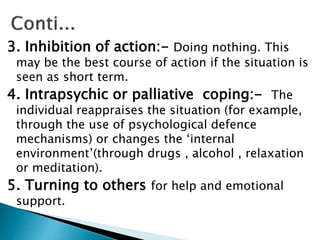
3. Inhibition of action:- Doing nothing. This
may be the best course of action if the situation is
seen as short term.
4. Intrapsychic or palliative coping:- The
individual reappraises the situation (for example,
through the use of psychological defence
mechanisms) or changes the ‘internal
environment’(through drugs , alcohol , relaxation
or meditation).
5. Turning to others for help and emotional
support.
As per the teaching practice requirment
i will teach you regarding the
alteration in psychometric assessment
of “coping with stress.”
It the end of class student will be able to
answer the question regarding the
psychometric assessment to“Coping with
stress.” This knowledge is helpful in
thier future purpose studies.
 “R.Sreevani” in the text book of psychology
of nurses in the publisher “ Jaypee
brother.”
 https://en.m.wikipedia.org>wiki>meni
 https://www.slideshare.net/stress-and-
coping
 https://www.healthline.com
Coping with stress
Coping with stress

Coping with stress

  • 1.
  • 2.
     Become moreknowledgeable about stress.  Understand the process and effects of stress. Identify your major sources of stress situations, people, etc. Anticipate stressful periods and plan for them. Develop successful stress management techniques and practice them
  • 3.
    Coping (Psychology)..  Inpsychology, coping is expending conscious effort to solve personal and interpersonal problems, and seeking to master, minimize or tolerate stress or conflict.  Psychological coping mechanisms are commonly termed coping strategies or coping skills.
  • 4.
    1. Emotion-focused:- Directedtowards changing one’s own emotional reaction. • Involve releasing pent-up emotions, distracting oneself, managing hostile feelings, meditating or using systematic relaxation procedures. Emotion- focused coping “ is oriented toward managing the emotions that accompany the perception of stress.
  • 5.
     Disclaiming  Escape-avoidance Accepting responsibility or blame  Exercising self-control  Positive reappraisal
  • 6.
    2.Problem-focused:- It includestaking direct action to solve problems as well as changing or modifying the stressful problem or the source of stress. Starting a group study to improve poor classroom performance is an example of problem- focused coping.
  • 7.
    3. Avoidance coping:- In this coping style people try to minimize or avoid the threatening event. People who cope using avoidance may not make enough cognitive and emotional efforts to anticipate and manage long- term problems. Avoidance strategies are more effective in dealing with short-term threats.
  • 8.
    According to Rogerand Nash, the coping styles are ‘adaptive and maladaptive’. 1. Adaptive styles involve an appropriate adjustment to the environment and gaining from the experience. These can be either detached or rational. 2.Maladaptive styles involve failing to adjust appropriately to our environment and experiencing misery and unhappiness as a result. They can take the form of emotional and avoidance coping styles.
  • 9.
     Adaptive coping Detached •Not seeing the problem or situation as a threat. • Keeping a sense of humor. • Taking nothing personally and seeing the problem as separate from oneself. • Resolving the issue by dividing things into parts.
  • 10.
    Rational • Using pastexperience for working out how to deal with the situation. • Taking action to change things. • Taking one step at a time and approacching the problem with logic. • Giving the situation full attention and treating it as a challenge to be met.
  • 11.
     Maladaptive coping Emotional •Feeling overpowered and helpless. • Becoming miserable, depressed, angry. • Taking frustrations out on other people. • Preparing for the worst possible outcome and seeking sympathy from others.
  • 12.
    Avoidance • Sitting tightand hoping it all goes away. • Pretending there’s nothing the matter if people ask. • Thinking about something else and talking about it as little as possible. • Trusting in fate and believing things will sort themselves out.
  • 13.
    1.Direct action response:-The individual tries to directly change or manipulate his/her relationship to the stressful situation, such as escaping from/removing it. 2.Information seeking :- The individual tries to understand the situation better and to predict future events that are related to the stressor.
  • 14.
    3. Inhibition ofaction:- Doing nothing. This may be the best course of action if the situation is seen as short term. 4. Intrapsychic or palliative coping:- The individual reappraises the situation (for example, through the use of psychological defence mechanisms) or changes the ‘internal environment’(through drugs , alcohol , relaxation or meditation). 5. Turning to others for help and emotional support.
  • 15.
    As per theteaching practice requirment i will teach you regarding the alteration in psychometric assessment of “coping with stress.”
  • 16.
    It the endof class student will be able to answer the question regarding the psychometric assessment to“Coping with stress.” This knowledge is helpful in thier future purpose studies.
  • 17.
     “R.Sreevani” inthe text book of psychology of nurses in the publisher “ Jaypee brother.”  https://en.m.wikipedia.org>wiki>meni  https://www.slideshare.net/stress-and- coping  https://www.healthline.com