Copepod Life Cycle By: Joseph Aminov
What Are They???? Copepods are microscopic org..    Free-living..
Where does the Name Refer To? The name copepod refers to "oar foot" because some of the planktonic species have tails that flare out like a paddle
Where Are They In The Chain? Crucial link in the food chain and are often assigned the role of "primary consumers."  Generally herbivores,  One of the dominant forms of animal plankton,
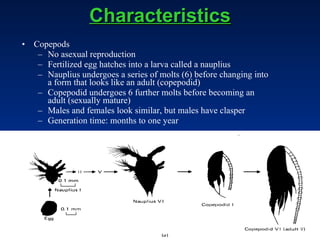
Characteristics Copepods No asexual reproduction Fertilized egg hatches into a larva called a nauplius Nauplius undergoes a series of molts (6) before changing into a form that looks like an adult (copepodid) Copepodid undergoes 6 further molts before becoming an adult (sexually mature) Males and females look similar, but males have clasper Generation time: months to one year
Copepod Life Cycle
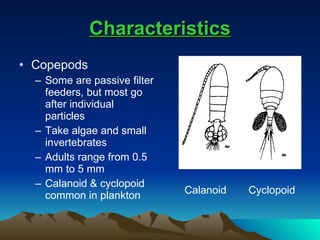
Characteristics Copepods Some are passive filter feeders, but most go after individual particles Take algae and small invertebrates Adults range from 0.5 mm to 5 mm Calanoid & cyclopoid common in plankton Calanoid Cyclopoid
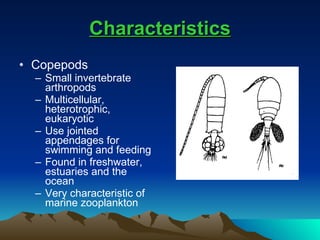
Characteristics Copepods Small invertebrate arthropods Multicellular, heterotrophic, eukaryotic Use jointed appendages for swimming and feeding Found in freshwater, estuaries and the ocean Very characteristic of marine zooplankton
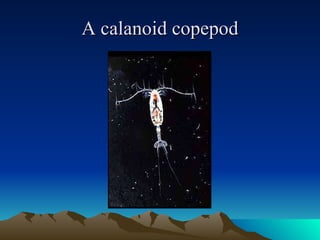
A calanoid copepod
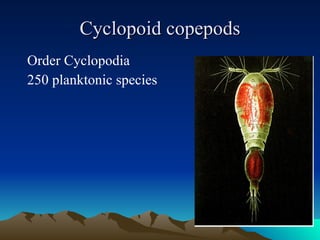
Cyclopoid copepods Order Cyclopodia 250 planktonic species
Difference B/w Calanoid & Cyclopoid Cyclopoids near aquarium… calanoids water surface where they were better visible..
Why are they so Important? They are very important sources of food because of their large numbers and high nutritional value. in marine environments they are the predominant source of food for organisms like jellyfish, basking sharks, and whales (Davis 1955).
Temperatures effect on copepods?? Temperature seems to affect the distribution and activity of copepods. Some species are more apt to be found in colder, deeper lakes whereas some are only found in warmer lakes.
Continuation…. Byron (1982) supported this in his investigation in which he concluded that much of the variation of pigmentation is due to environmental conditions along with metabolic stimulation. However, many of the variations can be explained just by observing the difference in water temperatures. He stated that copepods had the darkest pigmentation in colder water.
Collecting Plankton
Cited webs Plant   http://science.jrank.org/pages/1774/Copepods-Place-in-food-chain.html#ixzz18caOvo1t   http://academics.smcvt. edu /dfacey/AquaticBiology/Freshwater%20Pages/Copepods.html

Copepod life cycle

  • 1.
    Copepod Life CycleBy: Joseph Aminov
  • 2.
    What Are They????Copepods are microscopic org..   Free-living..
  • 3.
    Where does theName Refer To? The name copepod refers to "oar foot" because some of the planktonic species have tails that flare out like a paddle
  • 4.
    Where Are TheyIn The Chain? Crucial link in the food chain and are often assigned the role of "primary consumers." Generally herbivores, One of the dominant forms of animal plankton,
  • 5.
    Characteristics Copepods Noasexual reproduction Fertilized egg hatches into a larva called a nauplius Nauplius undergoes a series of molts (6) before changing into a form that looks like an adult (copepodid) Copepodid undergoes 6 further molts before becoming an adult (sexually mature) Males and females look similar, but males have clasper Generation time: months to one year
  • 6.
  • 7.
    Characteristics Copepods Someare passive filter feeders, but most go after individual particles Take algae and small invertebrates Adults range from 0.5 mm to 5 mm Calanoid & cyclopoid common in plankton Calanoid Cyclopoid
  • 8.
    Characteristics Copepods Smallinvertebrate arthropods Multicellular, heterotrophic, eukaryotic Use jointed appendages for swimming and feeding Found in freshwater, estuaries and the ocean Very characteristic of marine zooplankton
  • 9.
  • 10.
    Cyclopoid copepods OrderCyclopodia 250 planktonic species
  • 11.
    Difference B/w Calanoid& Cyclopoid Cyclopoids near aquarium… calanoids water surface where they were better visible..
  • 12.
    Why are theyso Important? They are very important sources of food because of their large numbers and high nutritional value. in marine environments they are the predominant source of food for organisms like jellyfish, basking sharks, and whales (Davis 1955).
  • 13.
    Temperatures effect oncopepods?? Temperature seems to affect the distribution and activity of copepods. Some species are more apt to be found in colder, deeper lakes whereas some are only found in warmer lakes.
  • 14.
    Continuation…. Byron (1982)supported this in his investigation in which he concluded that much of the variation of pigmentation is due to environmental conditions along with metabolic stimulation. However, many of the variations can be explained just by observing the difference in water temperatures. He stated that copepods had the darkest pigmentation in colder water.
  • 15.
  • 16.
    Cited webs Plant  http://science.jrank.org/pages/1774/Copepods-Place-in-food-chain.html#ixzz18caOvo1t http://academics.smcvt. edu /dfacey/AquaticBiology/Freshwater%20Pages/Copepods.html