The Nervous System
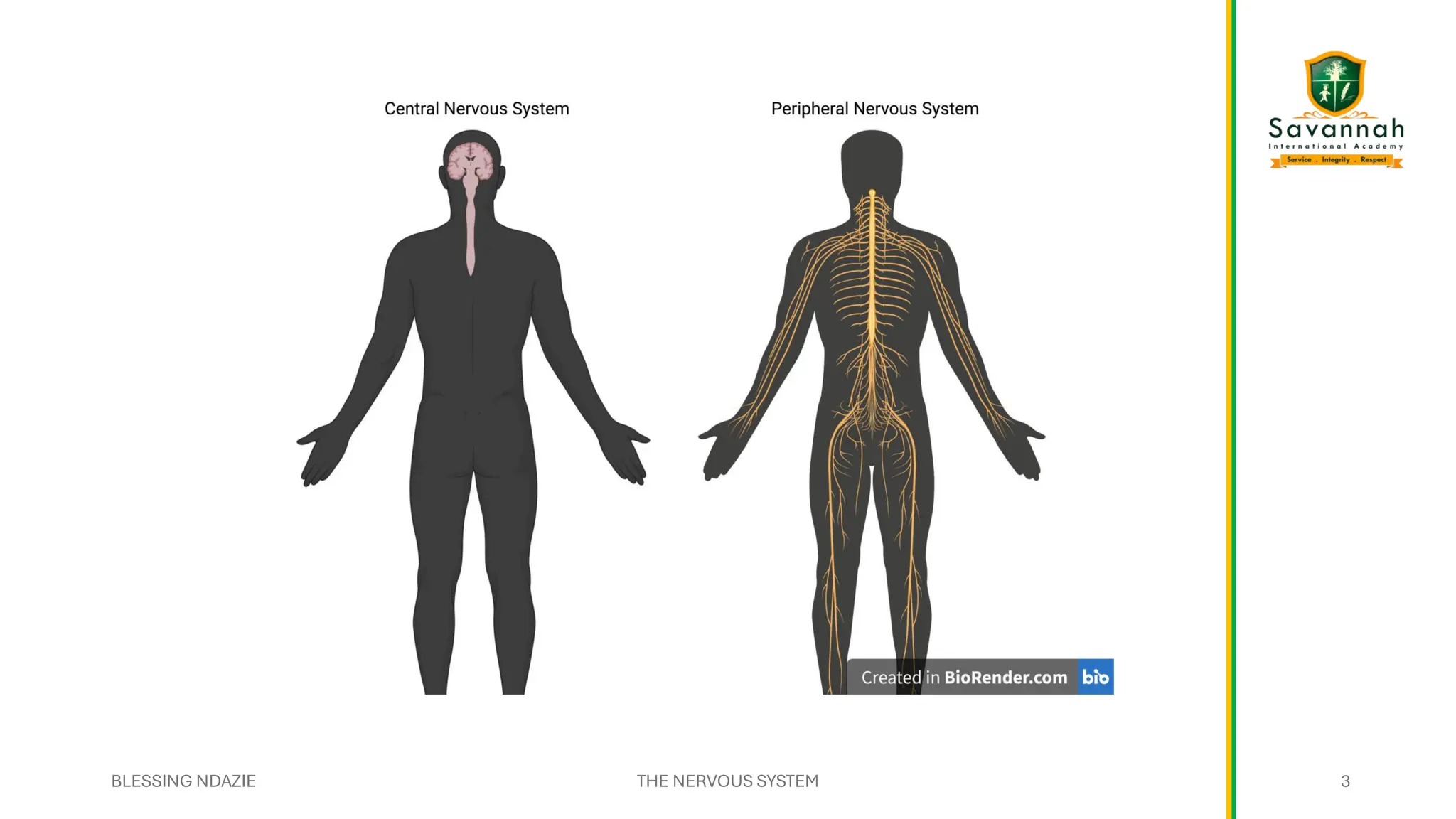
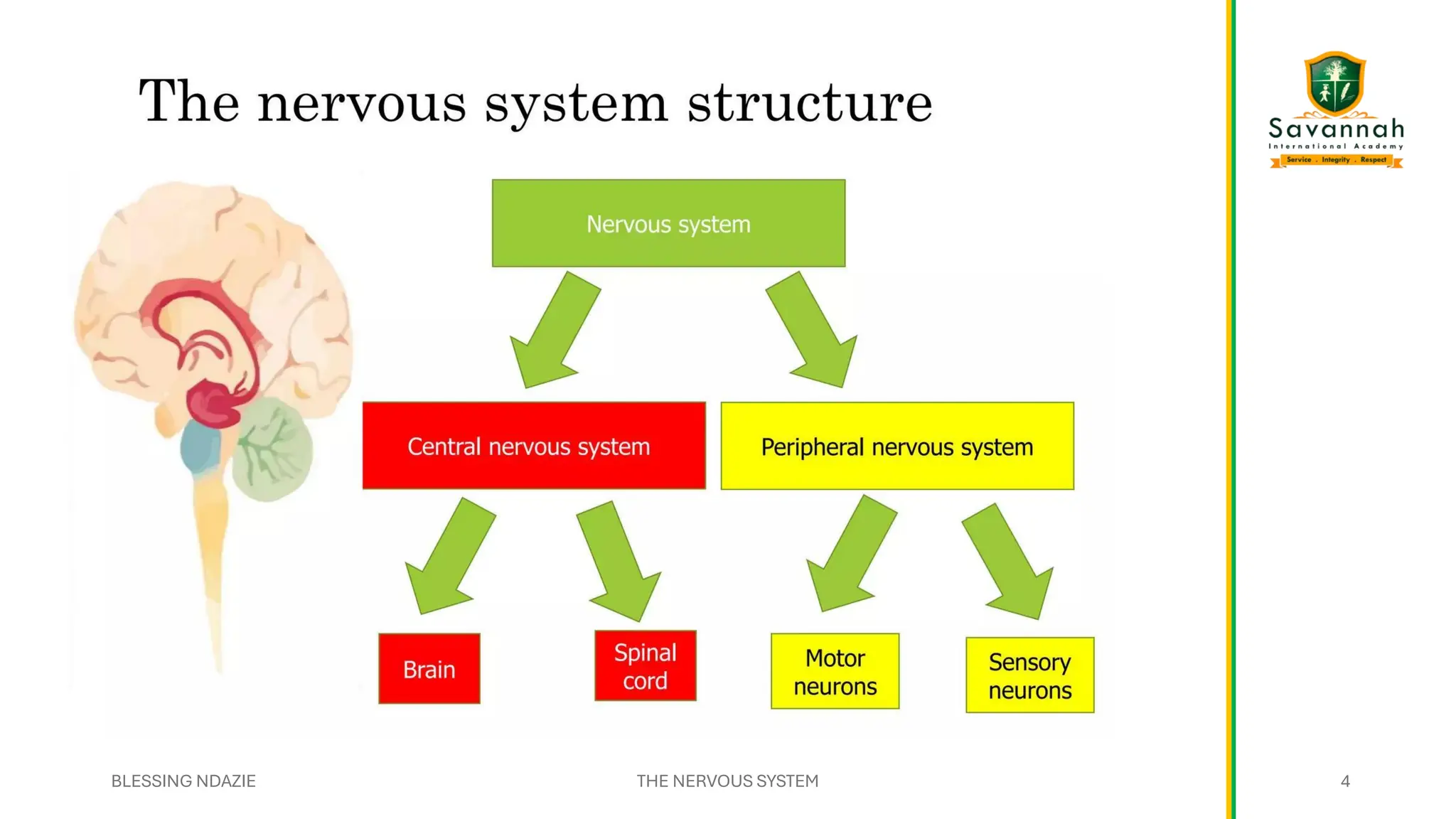
The nervous system in humans consists of 2 parts:
❑Central Nervous System (CNS) – the brain and spinal
cord
❑Peripheral Nervous System (PNS) – all of the nerves in
the body
BLESSING NDAZIE THE NERVOUS SYSTEM 2
BLESSING NDAZIE THE NERVOUS SYSTEM 3
3
BLESSING NDAZIE THE NERVOUS SYSTEM 4
4
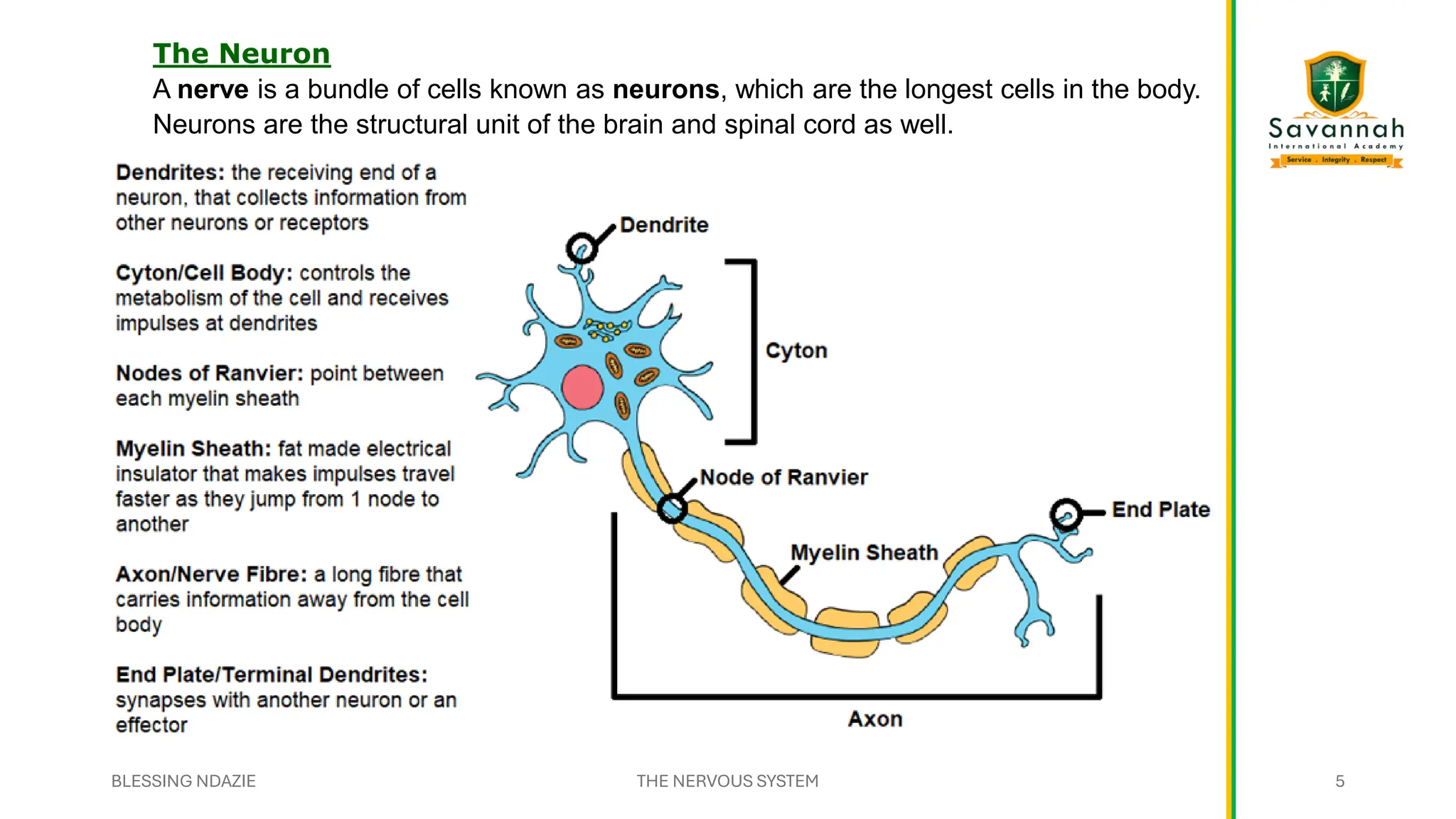
The Neuron
A nerve is a bundle of cells known as neurons, which are the longest cells in the body.
Neurons are the structural unit of the brain and spinal cord as well.
BLESSING NDAZIE THE NERVOUS SYSTEM 5
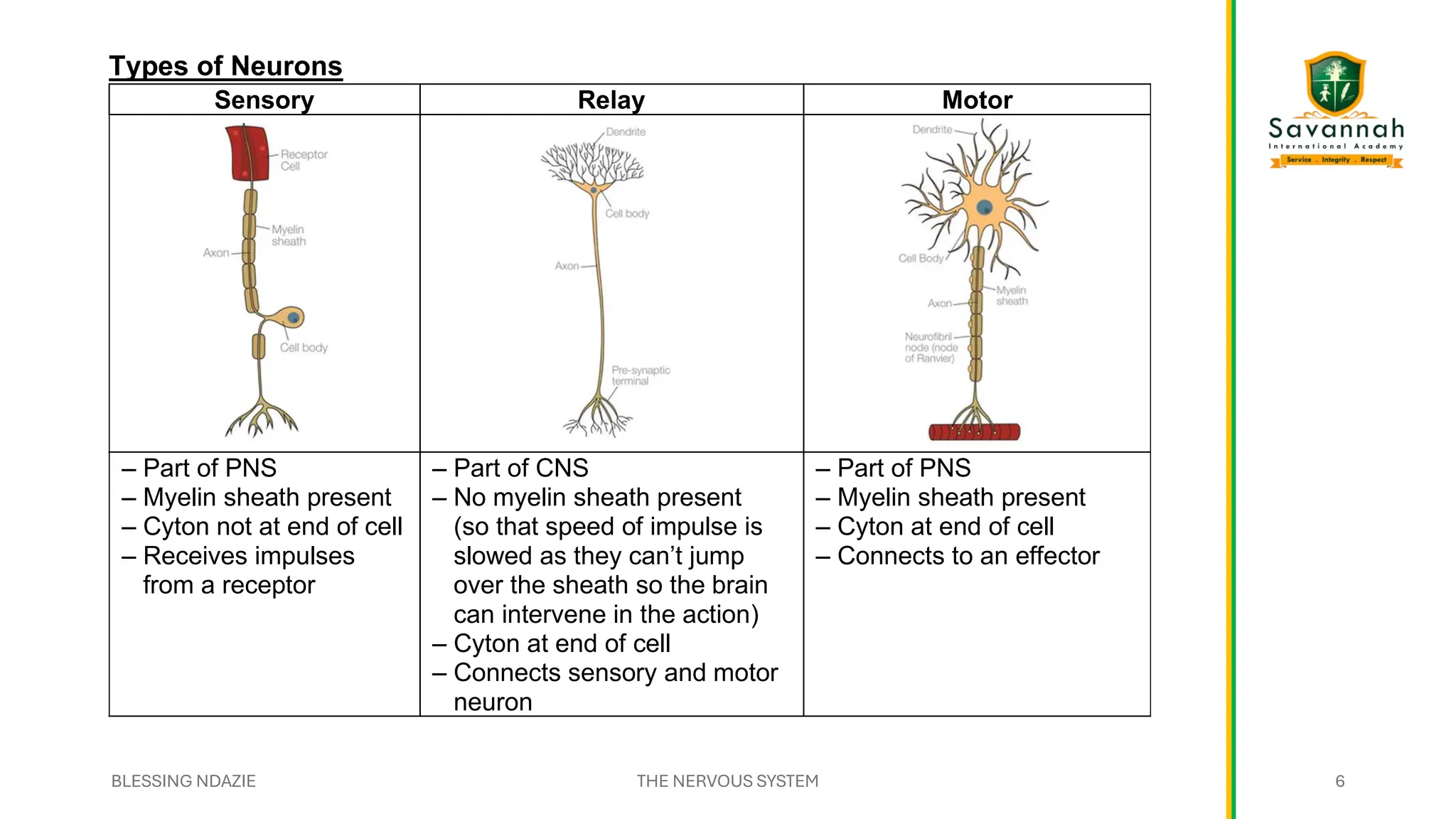
Types of Neurons
Sensory Relay Motor
– Part of PNS
– Myelin sheath present
– Cyton not at end of cell
– Receives impulses
from a receptor
– Part of CNS
– No myelin sheath present
(so that speed of impulse is
slowed as they can’t jump
over the sheath so the brain
can intervene in the action)
– Cyton at end of cell
– Connects sensory and motor
neuron
– Part of PNS
– Myelin sheath present
– Cyton at end of cell
– Connects to an effector
BLESSING NDAZIE THE NERVOUS SYSTEM 6
BLESSING NDAZIE THE NERVOUS SYSTEM 7
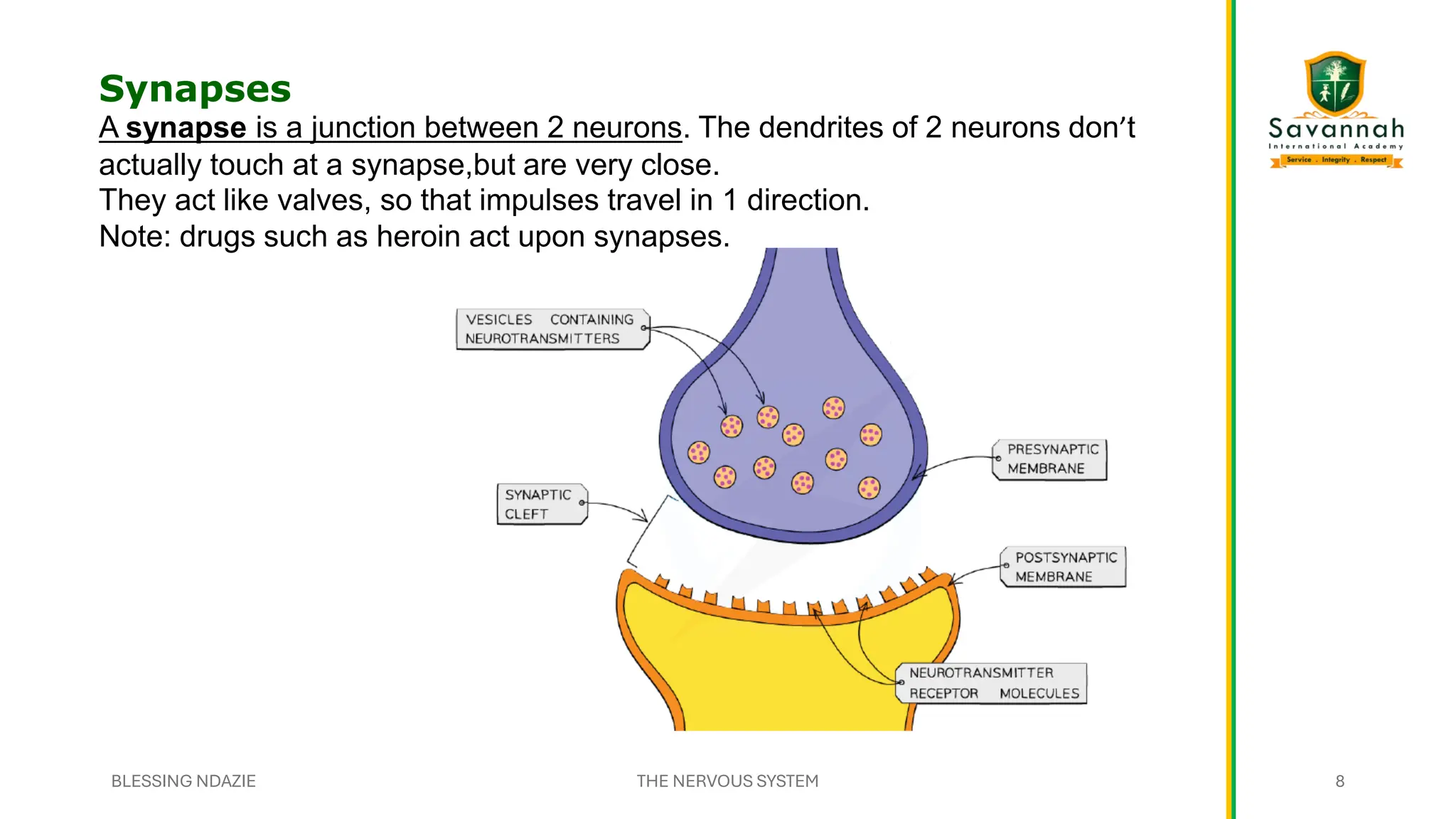
Synapses
A synapse is a junction between 2 neurons. The dendrites of 2 neurons don’t
actually touch at a synapse,but are very close.
They act like valves, so that impulses travel in 1 direction.
Note: drugs such as heroin act upon synapses.
BLESSING NDAZIE THE NERVOUS SYSTEM 8
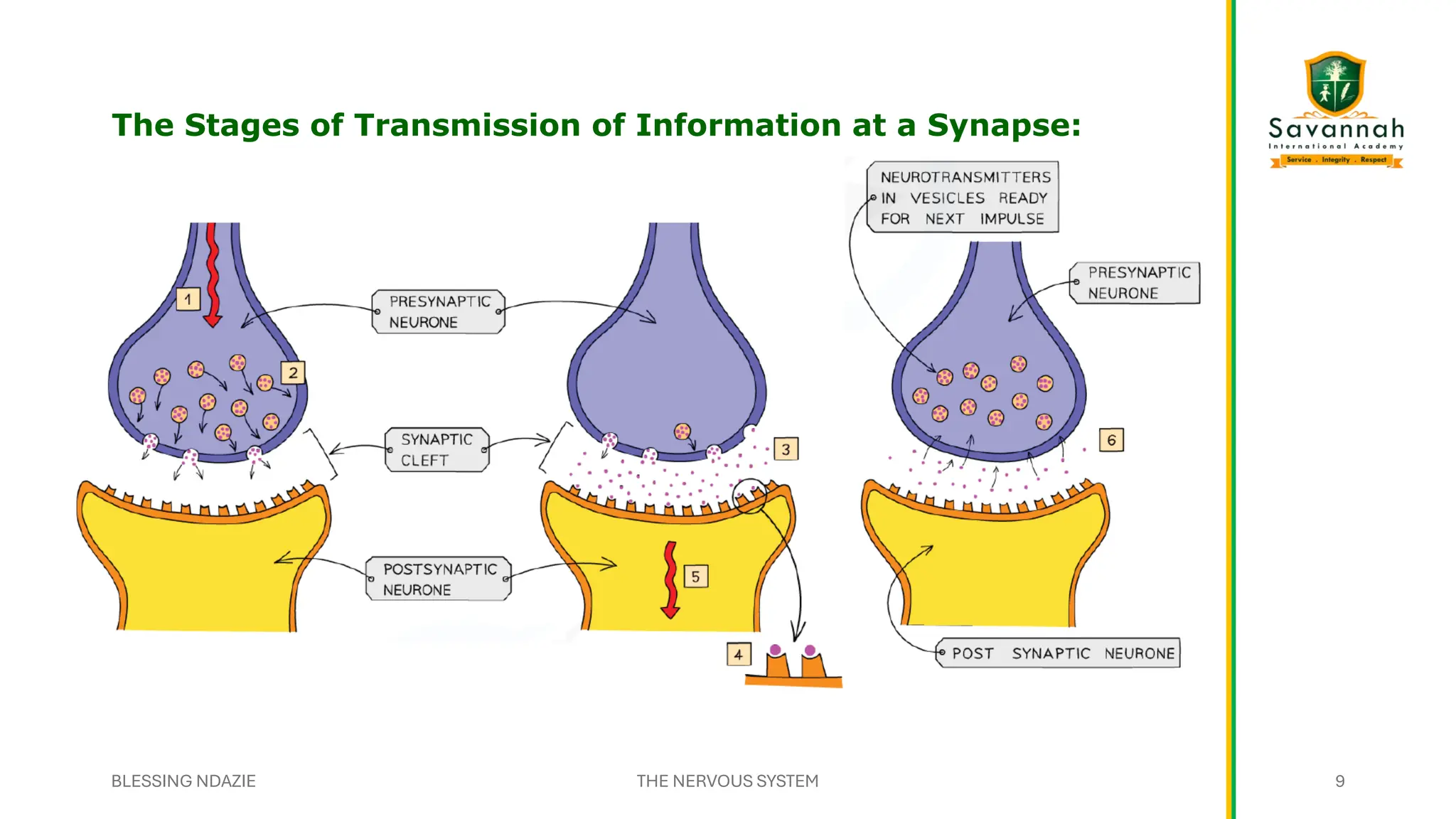
The Stages of Transmission of Information at a Synapse:
BLESSING NDAZIE THE NERVOUS SYSTEM 9
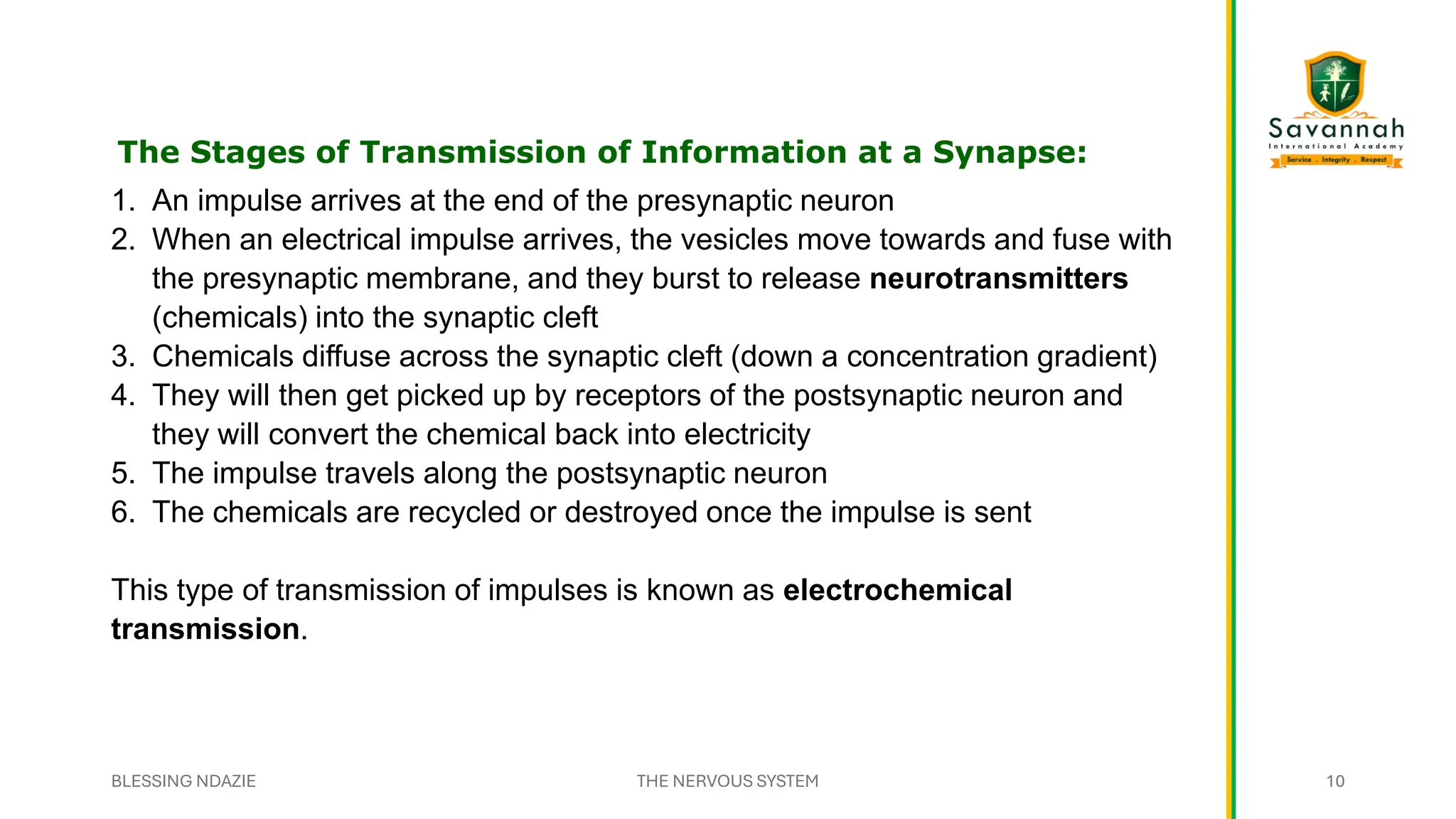
1. An impulse arrives at the end of the presynaptic neuron
2. When an electrical impulse arrives, the vesicles move towards and fuse with
the presynaptic membrane, and they burst to release neurotransmitters
(chemicals) into the synaptic cleft
3. Chemicals diffuse across the synaptic cleft (down a concentration gradient)
4. They will then get picked up by receptors of the postsynaptic neuron and
they will convert the chemical back into electricity
5. The impulse travels along the postsynaptic neuron
6. The chemicals are recycled or destroyed once the impulse is sent
This type of transmission of impulses is known as electrochemical
transmission.
The Stages of Transmission of Information at a Synapse:
BLESSING NDAZIE THE NERVOUS SYSTEM 10
Voluntary and Involuntary Response
A voluntary response is one where you make a conscious
decision to carry out a particular action therefore it starts with your
brain
An involuntary (or reflex) response does not involve the brain
as the coordinator of the reaction and you are not aware you have
completed it until after you have carried it out
Involuntary actions are usually ones which are essential to basic
survival and are rapid, whereas voluntary responses often take
longer as we consider what the response might be before doing it
BLESSING NDAZIE THE NERVOUS SYSTEM 11
Reflex Actions
A reflex action involves rapid and automatic integration of
coordination stimuli with the response of effectors.
Reflex actions are:
•Automatic
•Faster than any other nervous response
•Protective
•Involuntary
BLESSING NDAZIE THE NERVOUS SYSTEM 12
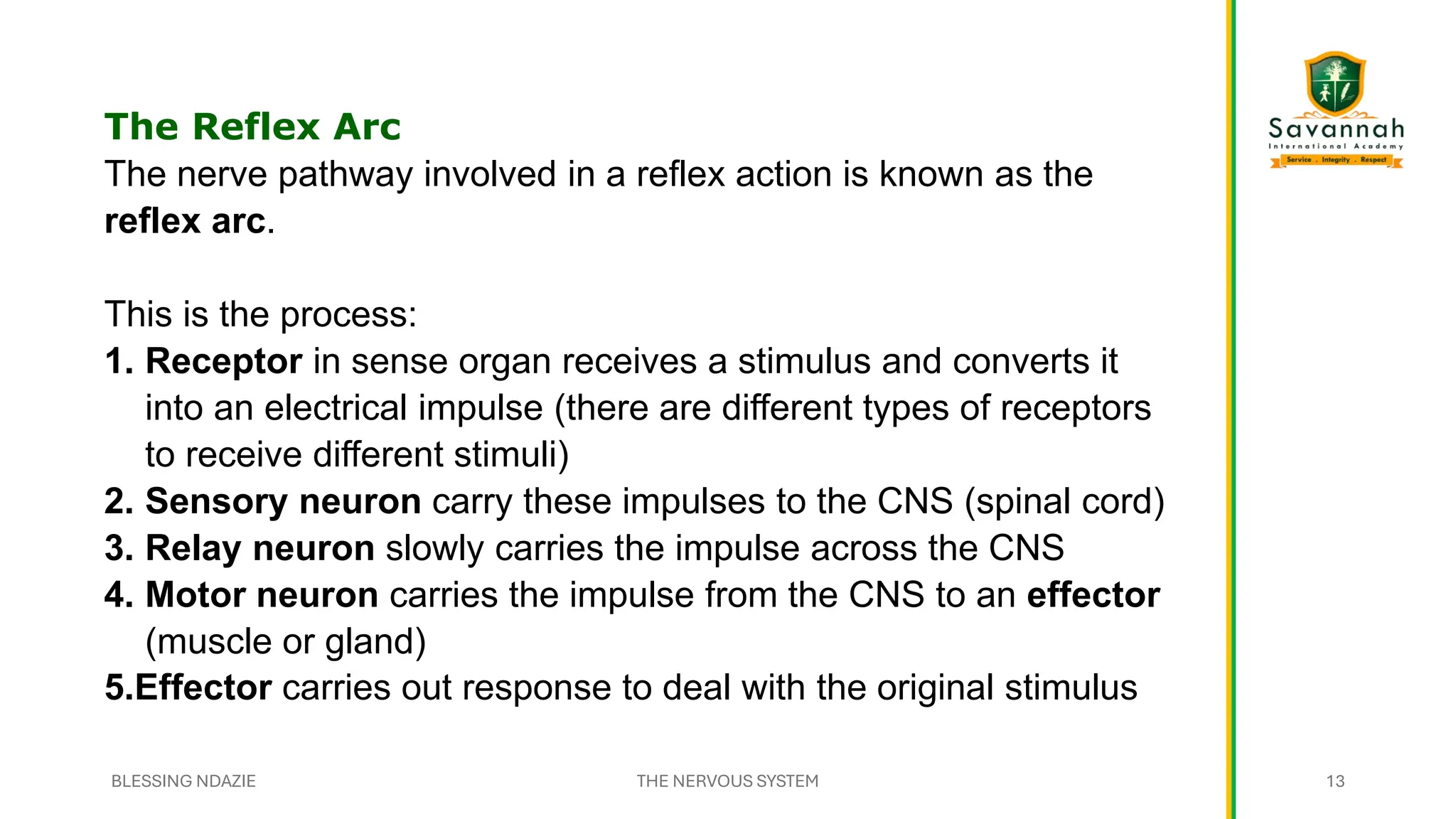
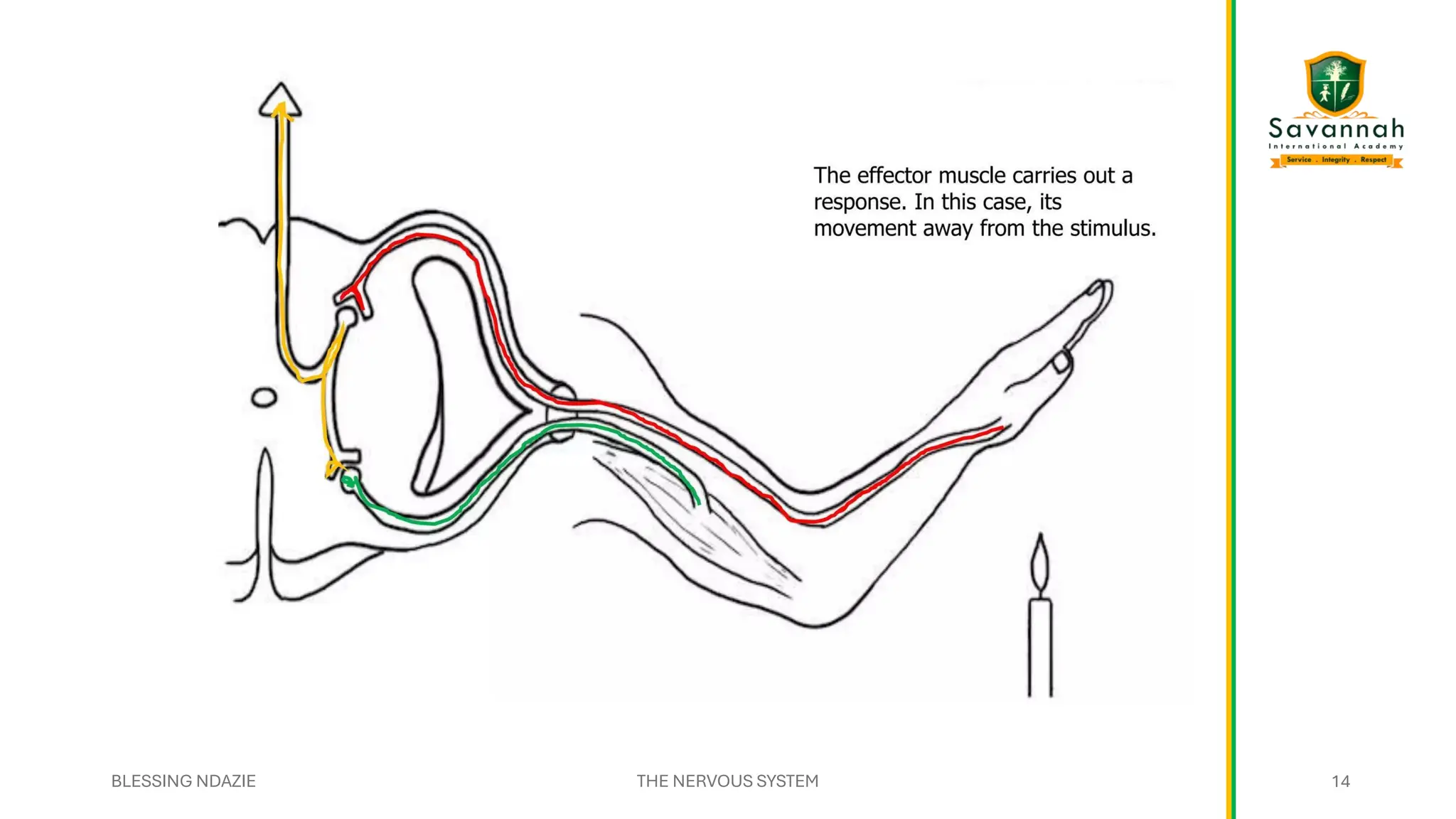
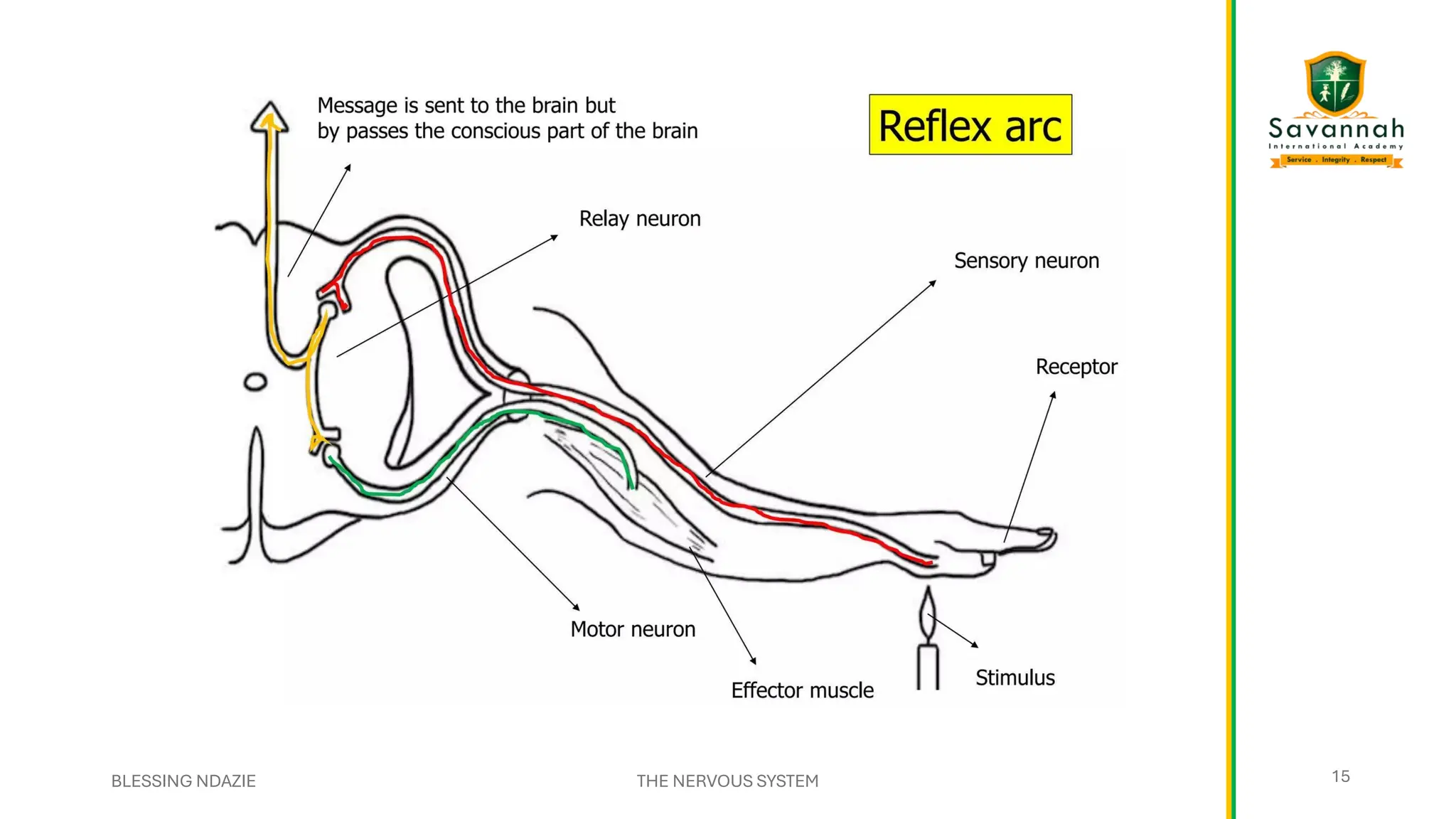
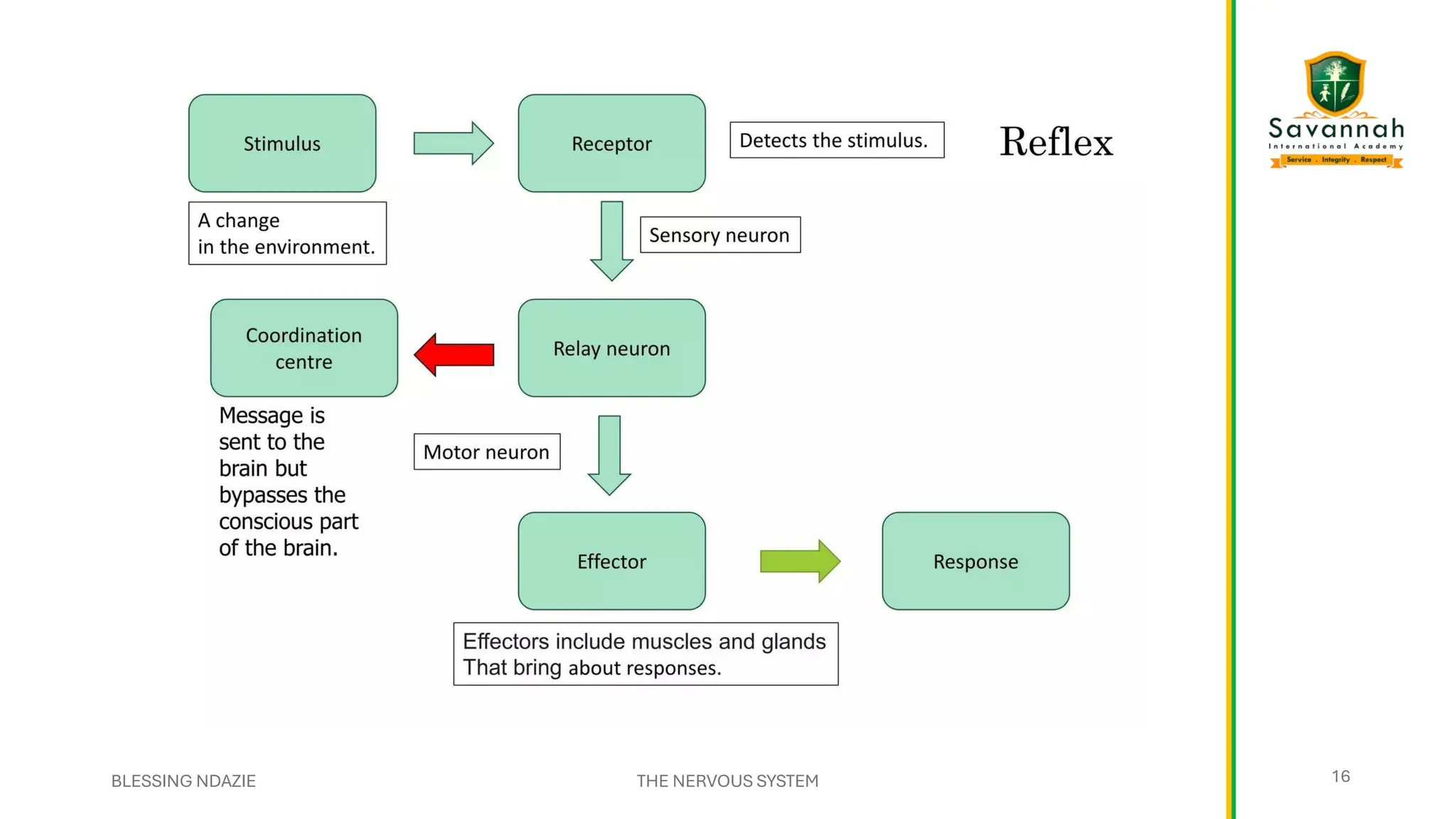
The Reflex Arc
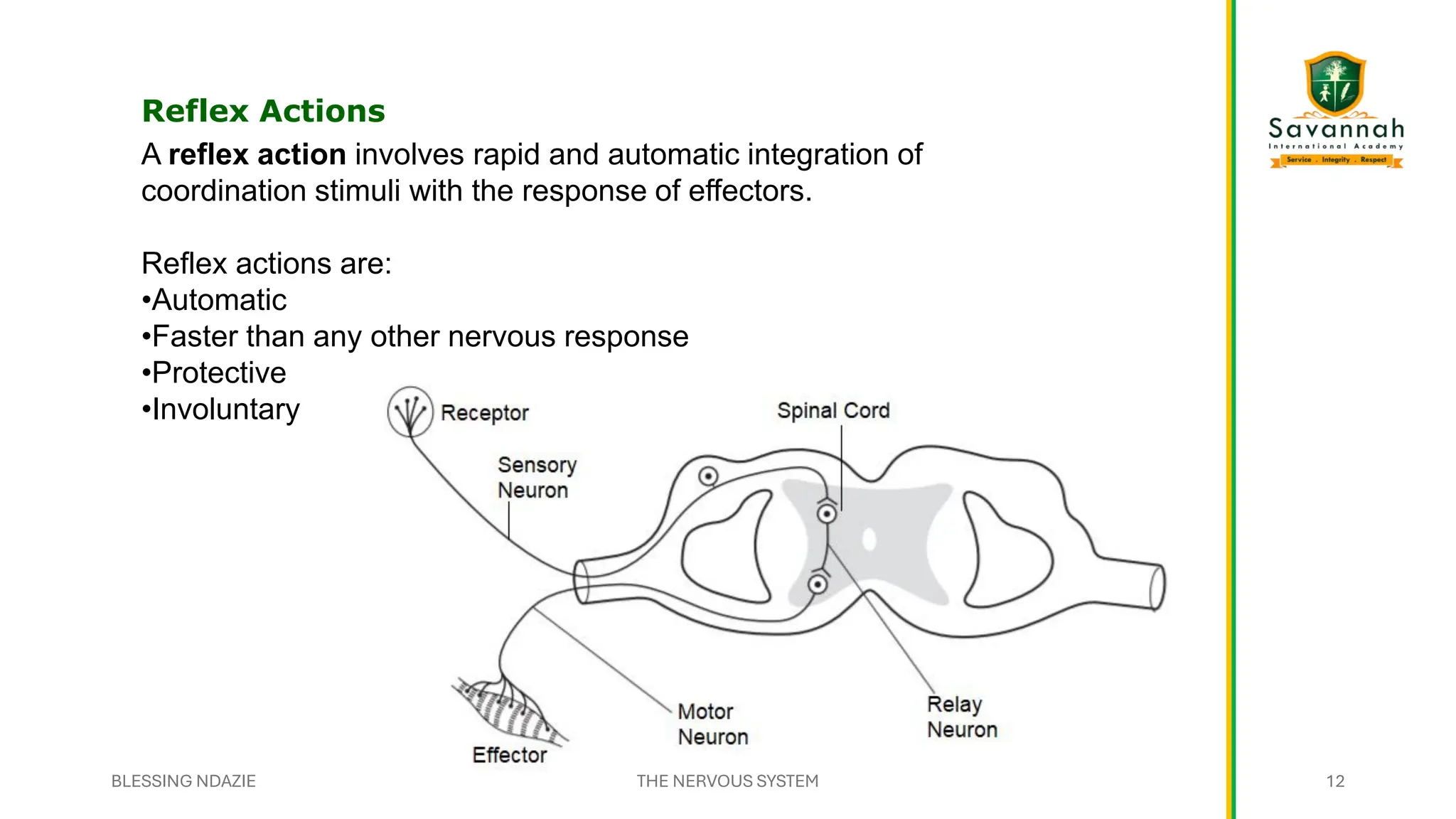
The nerve pathway involved in a reflex action is known as the
reflex arc.
This is the process:
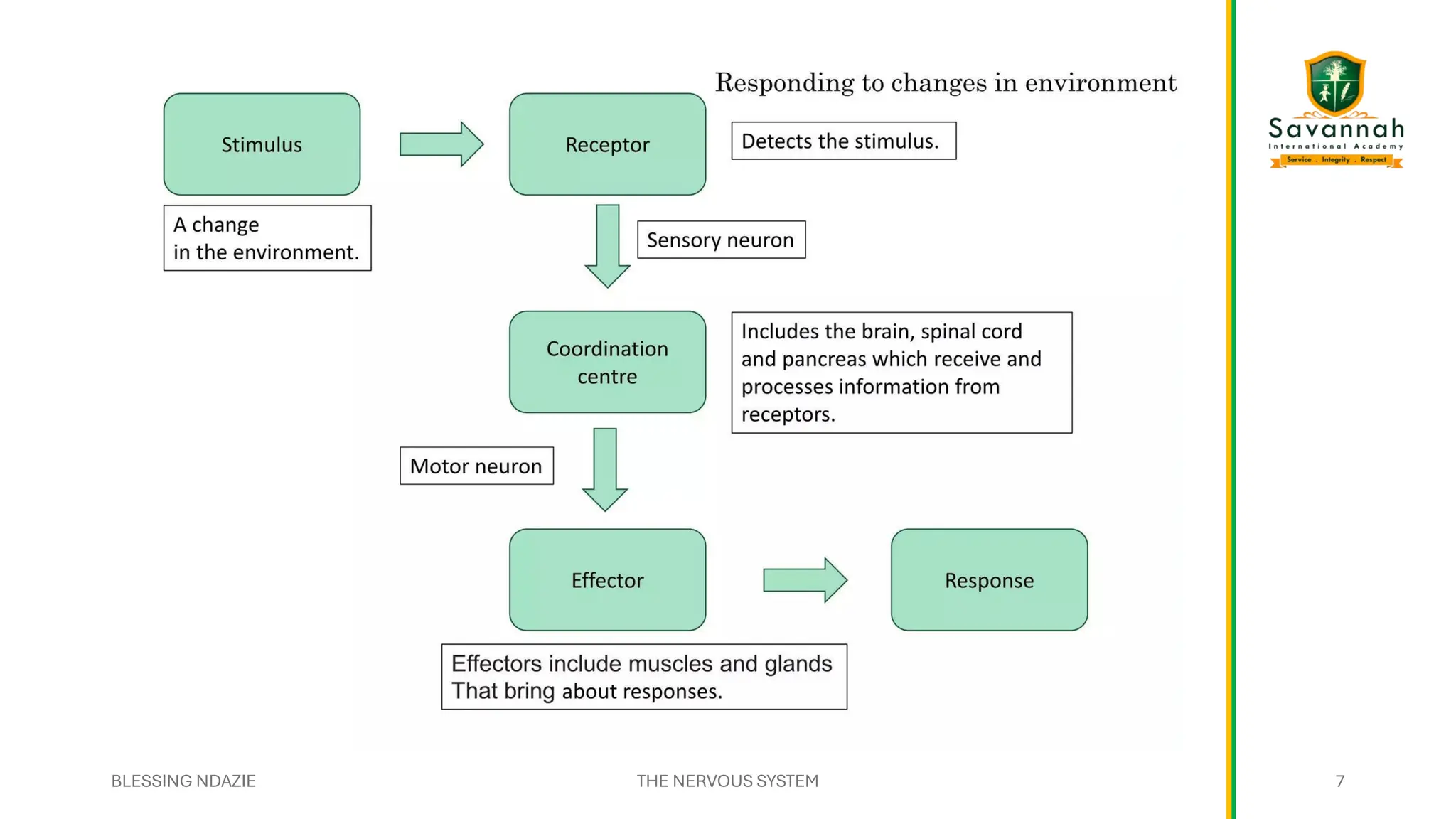
1. Receptor in sense organ receives a stimulus and converts it
into an electrical impulse (there are different types of receptors
to receive different stimuli)
2. Sensory neuron carry these impulses to the CNS (spinal cord)
3. Relay neuron slowly carries the impulse across the CNS
4. Motor neuron carries the impulse from the CNS to an effector
(muscle or gland)
5.Effector carries out response to deal with the original stimulus
BLESSING NDAZIE THE NERVOUS SYSTEM 13
BLESSING NDAZIE THE NERVOUS SYSTEM 14
14
BLESSING NDAZIE THE NERVOUS SYSTEM 15
15
BLESSING NDAZIE THE NERVOUS SYSTEM 16
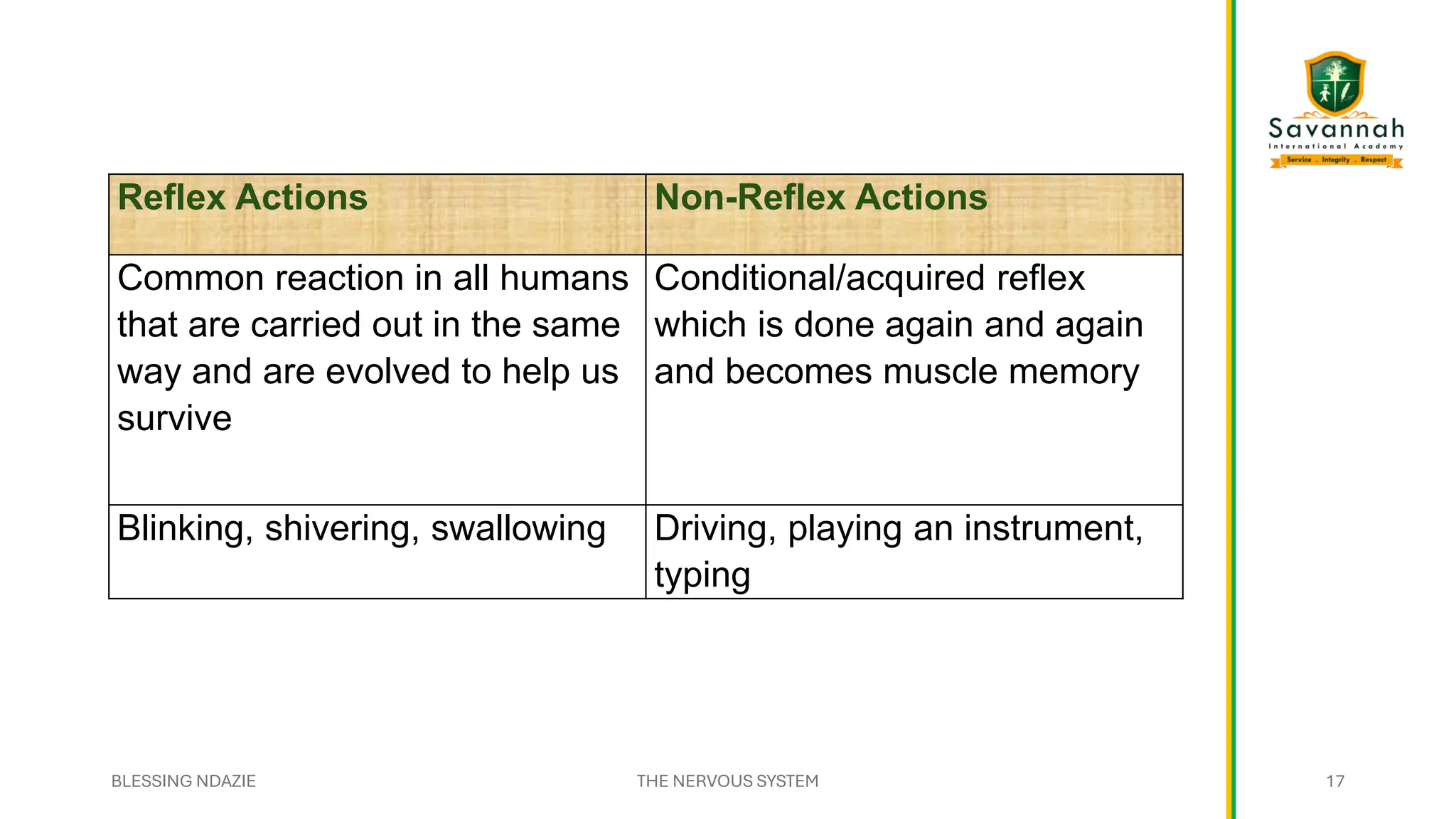
Reflex Actions Non-Reflex Actions
Common reaction in all humans
that are carried out in the same
way and are evolved to help us
survive
Conditional/acquired reflex
which is done again and again
and becomes muscle memory
Blinking, shivering, swallowing Driving, playing an instrument,
typing
BLESSING NDAZIE THE NERVOUS SYSTEM 17
BLESSING NDAZIE THE NERVOUS SYSTEM 18

Coordination and Response: The Nervous System | IGCSE Biology

  • 2.
    The Nervous System Thenervous system in humans consists of 2 parts: ❑Central Nervous System (CNS) – the brain and spinal cord ❑Peripheral Nervous System (PNS) – all of the nerves in the body BLESSING NDAZIE THE NERVOUS SYSTEM 2
  • 3.
    BLESSING NDAZIE THENERVOUS SYSTEM 3 3
  • 4.
    BLESSING NDAZIE THENERVOUS SYSTEM 4 4
  • 5.
    The Neuron A nerveis a bundle of cells known as neurons, which are the longest cells in the body. Neurons are the structural unit of the brain and spinal cord as well. BLESSING NDAZIE THE NERVOUS SYSTEM 5
  • 6.
    Types of Neurons SensoryRelay Motor – Part of PNS – Myelin sheath present – Cyton not at end of cell – Receives impulses from a receptor – Part of CNS – No myelin sheath present (so that speed of impulse is slowed as they can’t jump over the sheath so the brain can intervene in the action) – Cyton at end of cell – Connects sensory and motor neuron – Part of PNS – Myelin sheath present – Cyton at end of cell – Connects to an effector BLESSING NDAZIE THE NERVOUS SYSTEM 6
  • 7.
    BLESSING NDAZIE THENERVOUS SYSTEM 7
  • 8.
    Synapses A synapse isa junction between 2 neurons. The dendrites of 2 neurons don’t actually touch at a synapse,but are very close. They act like valves, so that impulses travel in 1 direction. Note: drugs such as heroin act upon synapses. BLESSING NDAZIE THE NERVOUS SYSTEM 8
  • 9.
    The Stages ofTransmission of Information at a Synapse: BLESSING NDAZIE THE NERVOUS SYSTEM 9
  • 10.
    1. An impulsearrives at the end of the presynaptic neuron 2. When an electrical impulse arrives, the vesicles move towards and fuse with the presynaptic membrane, and they burst to release neurotransmitters (chemicals) into the synaptic cleft 3. Chemicals diffuse across the synaptic cleft (down a concentration gradient) 4. They will then get picked up by receptors of the postsynaptic neuron and they will convert the chemical back into electricity 5. The impulse travels along the postsynaptic neuron 6. The chemicals are recycled or destroyed once the impulse is sent This type of transmission of impulses is known as electrochemical transmission. The Stages of Transmission of Information at a Synapse: BLESSING NDAZIE THE NERVOUS SYSTEM 10
  • 11.
    Voluntary and InvoluntaryResponse A voluntary response is one where you make a conscious decision to carry out a particular action therefore it starts with your brain An involuntary (or reflex) response does not involve the brain as the coordinator of the reaction and you are not aware you have completed it until after you have carried it out Involuntary actions are usually ones which are essential to basic survival and are rapid, whereas voluntary responses often take longer as we consider what the response might be before doing it BLESSING NDAZIE THE NERVOUS SYSTEM 11
  • 12.
    Reflex Actions A reflexaction involves rapid and automatic integration of coordination stimuli with the response of effectors. Reflex actions are: •Automatic •Faster than any other nervous response •Protective •Involuntary BLESSING NDAZIE THE NERVOUS SYSTEM 12
  • 13.
    The Reflex Arc Thenerve pathway involved in a reflex action is known as the reflex arc. This is the process: 1. Receptor in sense organ receives a stimulus and converts it into an electrical impulse (there are different types of receptors to receive different stimuli) 2. Sensory neuron carry these impulses to the CNS (spinal cord) 3. Relay neuron slowly carries the impulse across the CNS 4. Motor neuron carries the impulse from the CNS to an effector (muscle or gland) 5.Effector carries out response to deal with the original stimulus BLESSING NDAZIE THE NERVOUS SYSTEM 13
  • 14.
    BLESSING NDAZIE THENERVOUS SYSTEM 14 14
  • 15.
    BLESSING NDAZIE THENERVOUS SYSTEM 15 15
  • 16.
    BLESSING NDAZIE THENERVOUS SYSTEM 16
  • 17.
    Reflex Actions Non-ReflexActions Common reaction in all humans that are carried out in the same way and are evolved to help us survive Conditional/acquired reflex which is done again and again and becomes muscle memory Blinking, shivering, swallowing Driving, playing an instrument, typing BLESSING NDAZIE THE NERVOUS SYSTEM 17
  • 18.
    BLESSING NDAZIE THENERVOUS SYSTEM 18