Coordination and
Embedded Question
OBJECTIVES:
 At the end of the lesson, students should be able to:
 identify what Coordination and Embedded questions are;
 enumerate the processes involved in the Deep Structure of coordination and
embedded question(s); and,
 apply the rules in the Deep Structure of Coordination as well as Embedded
question(s).
Coordination
Coordination involves the linking of structures of equal
grammatical rank.
The words: but,yet,so,for,or and nor.
 but and yet
indicate contrast, opposition or negation;
 so and for
show several relationships, among them, purpose, cause, result,
or inference;
 or and nor
indicate what might be described as alteration, choice or
opposition
It is overtly simple to describe the conjunctions as
coordinators without certain qualifications. Even ‘and’ is not
purely a coordinator. Whatever the units it combines, and
usually indicates an additive relationship, and sometimes it
intensifies, or indicates continuous and repeated action, as
in:
She waited and waited.
She talked and talked and talked.
They went around and around.
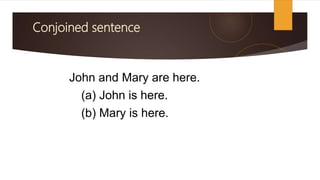
Conjoined sentence
John and Mary are here.
(a) John is here.
(b) Mary is here.
# ##
#S
and S
S
NP NPVP VP
beJohn Mary
PRED. be PRED.
herehere
John and Mary are here.
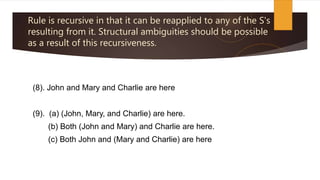
Rule is recursive in that it can be reapplied to any of the S's
resulting from it. Structural ambiguities should be possible
as a result of this recursiveness.
(8). John and Mary and Charlie are here
(9). (a) (John, Mary, and Charlie) are here.
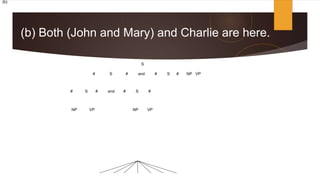
(b) Both (John and Mary) and Charlie are here.
(c) Both John and (Mary and Charlie) are here
S
SS #
#
# ###
VP
VP
VPNP
NP
NP .
.
.
.
.
.
.
.
.
.
.
.
.
.
.
.
.
.
S
(a) (John, Mary, and Charlie) are here.
(b) Both (John and Mary) and Charlie are here.
.
.
.
.
.
.
.
.
.
.
.
.
.
.
.
.
.
.
(b)
S
# S # and # S #
# S # and # S # NP VP
NP VP NP VP
(c) Both John and (Mary and Charlie) are here
.
.
.
.
.
.
.
.
.
.
.
.
.
.
.
.
.
.
(c)
S
# S # and # S #
NP VP # S # and # S #NP VP NP VP
Coordinate Structure Constraint (Ross 1967)
This constraint states that coordination does not allow for asymmetrical
constructions.
This is the man whom Kim likes and Sandy hates Pat.
This is the man whom Kim likes and Sandy hates
unacceptable, because only the first conjunct is relativized
acceptable, because both conjuncts are relativized
Example:
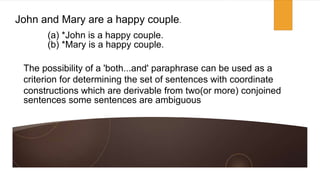
John and Mary are a happy couple.
The possibility of a 'both...and' paraphrase can be used as a
criterion for determining the set of sentences with coordinate
constructions which are derivable from two(or more) conjoined
sentences some sentences are ambiguous
(a) *John is a happy couple.
(b) *Mary is a happy couple.
Ambiguous coordinating sentence
John and Helen are married.
(a) John and Helen are each married.
(b) John and Helen are married to each other.
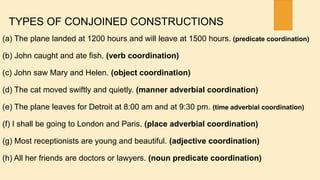
TYPES OF CONJOINED CONSTRUCTIONS
(a) The plane landed at 1200 hours and will leave at 1500 hours. (predicate coordination)
(b) John caught and ate fish. (verb coordination)
(c) John saw Mary and Helen. (object coordination)
(d) The cat moved swiftly and quietly. (manner adverbial coordination)
(e) The plane leaves for Detroit at 8:00 am and at 9:30 pm. (time adverbial coordination)
(f) I shall be going to London and Paris. (place adverbial coordination)
(g) Most receptionists are young and beautiful. (adjective coordination)
(h) All her friends are doctors or lawyers. (noun predicate coordination)
Forming embedded questions
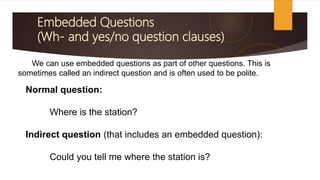
Embedded Questions
(Wh- and yes/no question clauses)
We can use embedded questions as part of other questions. This is
sometimes called an indirect question and is often used to be polite.
Normal question:
Where is the station?
Indirect question (that includes an embedded question):
Could you tell me where the station is?
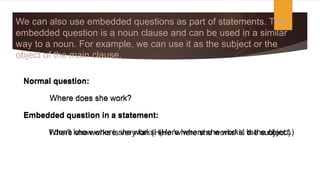
We can also use embedded questions as part of statements. The
embedded question is a noun clause and can be used in a similar
way to a noun. For example, we can use it as the subject or the
object of the main clause.
Normal question:
Where does she work?
Embedded question in a statement:
I don't know where she works. (Here 'where she works' is the object.)
Normal question:
Where does she work?
Embedded question in a statement:
Where she works is very far. (Here 'where she works' is the subject.)
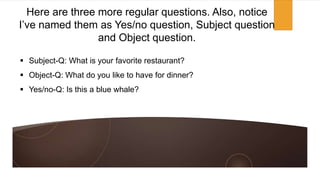
 Subject-Q: What is your favorite restaurant?
 Object-Q: What do you like to have for dinner?
 Yes/no-Q: Is this a blue whale?
Here are three more regular questions. Also, notice
I’ve named them as Yes/no question, Subject question
and Object question.
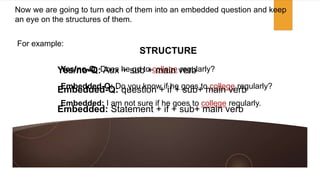
Yes/no-Q: Does he go to college regularly?
Embedded-Q: Do you know if he goes to college regularly?
Embedded: I am not sure if he goes to college regularly.
Now we are going to turn each of them into an embedded question and keep
an eye on the structures of them.
For example:
STRUCTURE
Yes/no-Q: Aux + sub + main verb
Embedded-Q: question + if + sub+ main verb
Embedded: Statement + if + sub+ main verb
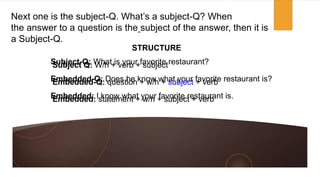
Next one is the subject-Q. What’s a subject-Q? When
the answer to a question is the subject of the answer, then it is
a Subject-Q.
Subject-Q: What is your favorite restaurant?
Embedded-Q: Does he know what your favorite restaurant is?
Embedded: I know what your favorite restaurant is.
STRUCTURE
Subject Q: W/h + verb + subject
Embedded-Q: question + w/h + subject + verb
Embedded: statement + w/h + subject + verb
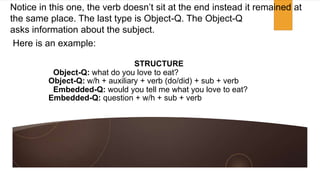
Notice in this one, the verb doesn’t sit at the end instead it remained at
the same place. The last type is Object-Q. The Object-Q
asks information about the subject.
Here is an example:
Object-Q: what do you love to eat?
Embedded-Q: would you tell me what you love to eat?
STRUCTURE
Object-Q: w/h + auxiliary + verb (do/did) + sub + verb
Embedded-Q: question + w/h + sub + verb
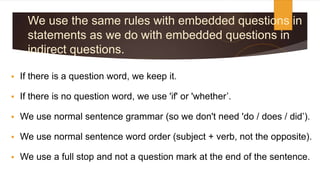
We use the same rules with embedded questions in
statements as we do with embedded questions in
indirect questions.
 If there is a question word, we keep it.
 If there is no question word, we use 'if' or 'whether’.
 We use normal sentence grammar (so we don't need 'do / does / did’).
 We use normal sentence word order (subject + verb, not the opposite).
 We use a full stop and not a question mark at the end of the sentence.
Coordination and embedded question

Coordination and embedded question

  • 1.
  • 2.
    OBJECTIVES:  At theend of the lesson, students should be able to:  identify what Coordination and Embedded questions are;  enumerate the processes involved in the Deep Structure of coordination and embedded question(s); and,  apply the rules in the Deep Structure of Coordination as well as Embedded question(s).
  • 3.
    Coordination Coordination involves thelinking of structures of equal grammatical rank.
  • 4.
    The words: but,yet,so,for,orand nor.  but and yet indicate contrast, opposition or negation;  so and for show several relationships, among them, purpose, cause, result, or inference;  or and nor indicate what might be described as alteration, choice or opposition
  • 5.
    It is overtlysimple to describe the conjunctions as coordinators without certain qualifications. Even ‘and’ is not purely a coordinator. Whatever the units it combines, and usually indicates an additive relationship, and sometimes it intensifies, or indicates continuous and repeated action, as in: She waited and waited. She talked and talked and talked. They went around and around.
  • 6.
    Conjoined sentence John andMary are here. (a) John is here. (b) Mary is here.
  • 7.
    # ## #S and S S NPNPVP VP beJohn Mary PRED. be PRED. herehere John and Mary are here.
  • 8.
    Rule is recursivein that it can be reapplied to any of the S's resulting from it. Structural ambiguities should be possible as a result of this recursiveness. (8). John and Mary and Charlie are here (9). (a) (John, Mary, and Charlie) are here. (b) Both (John and Mary) and Charlie are here. (c) Both John and (Mary and Charlie) are here
  • 9.
    S SS # # # ### VP VP VPNP NP NP. . . . . . . . . . . . . . . . . . S (a) (John, Mary, and Charlie) are here.
  • 10.
    (b) Both (Johnand Mary) and Charlie are here. . . . . . . . . . . . . . . . . . . (b) S # S # and # S # # S # and # S # NP VP NP VP NP VP
  • 11.
    (c) Both Johnand (Mary and Charlie) are here . . . . . . . . . . . . . . . . . . (c) S # S # and # S # NP VP # S # and # S #NP VP NP VP
  • 12.
    Coordinate Structure Constraint(Ross 1967) This constraint states that coordination does not allow for asymmetrical constructions. This is the man whom Kim likes and Sandy hates Pat. This is the man whom Kim likes and Sandy hates unacceptable, because only the first conjunct is relativized acceptable, because both conjuncts are relativized Example:
  • 13.
    John and Maryare a happy couple. The possibility of a 'both...and' paraphrase can be used as a criterion for determining the set of sentences with coordinate constructions which are derivable from two(or more) conjoined sentences some sentences are ambiguous (a) *John is a happy couple. (b) *Mary is a happy couple.
  • 14.
    Ambiguous coordinating sentence Johnand Helen are married. (a) John and Helen are each married. (b) John and Helen are married to each other.
  • 15.
    TYPES OF CONJOINEDCONSTRUCTIONS (a) The plane landed at 1200 hours and will leave at 1500 hours. (predicate coordination) (b) John caught and ate fish. (verb coordination) (c) John saw Mary and Helen. (object coordination) (d) The cat moved swiftly and quietly. (manner adverbial coordination) (e) The plane leaves for Detroit at 8:00 am and at 9:30 pm. (time adverbial coordination) (f) I shall be going to London and Paris. (place adverbial coordination) (g) Most receptionists are young and beautiful. (adjective coordination) (h) All her friends are doctors or lawyers. (noun predicate coordination)
  • 16.
  • 17.
    Embedded Questions (Wh- andyes/no question clauses) We can use embedded questions as part of other questions. This is sometimes called an indirect question and is often used to be polite. Normal question: Where is the station? Indirect question (that includes an embedded question): Could you tell me where the station is?
  • 18.
    We can alsouse embedded questions as part of statements. The embedded question is a noun clause and can be used in a similar way to a noun. For example, we can use it as the subject or the object of the main clause. Normal question: Where does she work? Embedded question in a statement: I don't know where she works. (Here 'where she works' is the object.) Normal question: Where does she work? Embedded question in a statement: Where she works is very far. (Here 'where she works' is the subject.)
  • 19.
     Subject-Q: Whatis your favorite restaurant?  Object-Q: What do you like to have for dinner?  Yes/no-Q: Is this a blue whale? Here are three more regular questions. Also, notice I’ve named them as Yes/no question, Subject question and Object question.
  • 20.
    Yes/no-Q: Does hego to college regularly? Embedded-Q: Do you know if he goes to college regularly? Embedded: I am not sure if he goes to college regularly. Now we are going to turn each of them into an embedded question and keep an eye on the structures of them. For example: STRUCTURE Yes/no-Q: Aux + sub + main verb Embedded-Q: question + if + sub+ main verb Embedded: Statement + if + sub+ main verb
  • 21.
    Next one isthe subject-Q. What’s a subject-Q? When the answer to a question is the subject of the answer, then it is a Subject-Q. Subject-Q: What is your favorite restaurant? Embedded-Q: Does he know what your favorite restaurant is? Embedded: I know what your favorite restaurant is. STRUCTURE Subject Q: W/h + verb + subject Embedded-Q: question + w/h + subject + verb Embedded: statement + w/h + subject + verb
  • 22.
    Notice in thisone, the verb doesn’t sit at the end instead it remained at the same place. The last type is Object-Q. The Object-Q asks information about the subject. Here is an example: Object-Q: what do you love to eat? Embedded-Q: would you tell me what you love to eat? STRUCTURE Object-Q: w/h + auxiliary + verb (do/did) + sub + verb Embedded-Q: question + w/h + sub + verb
  • 23.
    We use thesame rules with embedded questions in statements as we do with embedded questions in indirect questions.  If there is a question word, we keep it.  If there is no question word, we use 'if' or 'whether’.  We use normal sentence grammar (so we don't need 'do / does / did’).  We use normal sentence word order (subject + verb, not the opposite).  We use a full stop and not a question mark at the end of the sentence.