PROUTIST ECONOMIC
DEVELOPMENT
COOPERATIVES
BY:- DALJEET AND AJAY
CLASS:-XI-C
Cooperative Industries
 All people have the right to be
guaranteed minimum requirements
such as food (including water),
clothing, housing, education and
medical care.
 These basic requirements should be
cooperatively produced because
they are essential collective
requirements.
COOPERATIVES AS A FORM OF ECONOMIC
ENTERPRISE
• Co-ops help people work together and move forward in
a collective way.
• They are capable of seeking a balanced adjustment
between collective spirit and individual rights.
• Getting things done with collective effort.
Combines the wealth and resources of many
individuals and harnesses them in a united way.
Structured so that individual interest
does not dominate collective interests.
Individual dominance can adversely effect the
welfare of different social groups. 
BENEFITS
 Involves getting things done between free human
beings with:
(i) equal rights;
(ii) equal human prestige (and mutual respect for each
other);
(iii) equal locus standi (eg, legal standing);
so that everyone's welfare is considered.
This is called "coordinated cooperation".
Coordinated CooperationCoordinated Cooperation
Needed for equilibrium and equipoise in social
life.
A socio-economic system should be based on
coordinated cooperation not subordinated
cooperation.
"Subordinated cooperation" involves people
doing something individually or collectively, but
keeping themselves under other peoples'
supervision or control.
This can degenerate the moral fabric of
an enterprise and should be avoided when
structuring cooperative business enterprises.
 All groups in the cooperative workforce will benefit
from the cooperative's profits.
 They will be entitled to draw dividends and salaries
including bonuses on the basis of their membership in,
and services they render to, the cooperative.
 Labourers or workers also include those who are
engaged in cooperative management.
 The members of a cooperative can be composed of:
(i) shareholders - who receive salaries for their work
plus a return on their shares;
(ii) non-shareholders or labourers - who enjoy stable
employment and favourable wages or incomes.
OWNERSHIP
 Without a sense of personal ownership people do
not work hard or care for property.
 Suppression of personal ownership sentiments
results in sluggish production and psychic
oppression.
 In cooperatives, there is personal ownership,
subject to:
social limitations on concentration of wealth;
and
a mechanism to ensure progressive increase in
everyone's living standards.
Membership requirement
 Worker's or shareholder's longer term
commitment to the cooperative.
 Cooperative members have to be local people
who, by virtue of their established residence,
can make a commitment to the cooperative and
the region it services.
 Local is a relative concept and expands over
time.
 Anyone who wishes to be part of the socio-
economic life of a region can settle there and
become a member of a local cooperatives.
SHAREHOLDER COMPOSITION
 Members who purchase shares in a cooperative should have
no power or right to transfer their shares without the
permission of the cooperative.
 Such a pre-emptive right allows existing shareholders to
determine the basis of membership, and prevents capitalist
entrepreneurs from purchasing large numbers of shares in a
cooperative and speculating in the market.
Share transfer
 Shares can however be inherited.
 Generally, the shares of cooperative members without
descendants simply pass on to their legally authorised
successors, who become members of the cooperative if they
are not already members.
 Different countries have different systems of inheritance,
so the right of inheritance should be decided according to the
system in vogue.
 In Western common law countries if someone inherits shares
in a business enterprise and does not want to become a
member of that enterprise, existing shareholders simply buy
that person out.
 The same reasoning can be applied to cooperatives -
following this arrangement will help cooperative members
avoid litigation.
New shareholders
ecause cooperative members will be from the
same vicinity they will all know each other, so
there should be no difficulty in deciding who
should be able to buy shares due to ignorance
about potential shareholders.
Dividend distribution 
 In a cooperative system there is no need for
preference shares.
 Today preference shares are used by some
financial institutions as a substitute
for debt investments (ie loans to businesses).
 Preference shares really mean that a lender in the
guise of a shareholder has first grab at co-op
dividends and therefore co-op profits.
 Such investors should become ordinary
shareholders like other co-op members and share
proportionately in the success (or perhaps
otherwise) of the co-op.
Non-shareholder
Non-shareholderworkers
workers
 Non-shareholding workers
Non-shareholding workers
are possible and can be
categorized into those who
are:are:
(i)(i) permanent labourers - who
permanent labourers - who
get bonuses and premiums
(‘dividends’) as incentives
besides their wages; and 
besides their wages; and (ii)(ii) casual or contract labourers
casual or contract labourers
- who only get wages for
their labour. 
their labour. 
Bonus distributions
Workers (or worker/shareholders)
who give the greatest service to the
cooperative should get the greatest
bonuses.
Bonuses should be paid in
proportion to wage rates and should
reflect both the skill and productivity
of the worker.
 Cooperatives are to develop a proper incentive system so that
individual initiative by talented people is encouraged.
 An incentive system should ensure that intelligent people are
not forced to do work which is unsuitable for them, or be paid
the same wages as ordinary workers.
 If skilled workers get paid more than unskilled workers there
will be an incentive for all to become skilled and work harder.
 In this way the cooperative will encourage the educational
and skill upgrading of its members. 
Whoelsebenefits?Whoelsebenefits? • Disadvantaged persons can also benefit from the
cooperative system.
• A widow, orphaned minor or disabled worker can
own shares and derive an income based on the
number of shares they own.
• Therefore even if as cooperative members they
are unable to work or are retired, they will can still
be entitled to an income from special funds
deriving cooperative profits, eg pension funds.
• Establishing such a structure on a large
scale should be able to do away with the welfare
state mentality prevalent in capitalist societies.
 Encourage individual initiative by talented
people.
 Organisational behaviour and outlook to be
cultivated is one that is non-materialistic.
 Leadership is subtle and sophisticated.
Cooperative
management
 Cooperative members
should elect a board
of directors from
amongst
the cooperative
members.
 The position of
director should not be
honorary or
hereditary.
 Directors must be
moralists.
Board of Directors
The board decides the amount of profit to be divided amongst
members, ie the dividends or bonuses to be paid to each
shareholder and/or worker.
However, not all profit should be distributed in the form of
dividends. Some should be kept or used for:
(i) reinvestment, purchasing capital items or repair and
maintenance;
(ii) increasing the authorised capital of existing shareholders;
(iii) deposit into a reserve fund to be used to increase the value
or rate of dividends in years when production is low.
This also ensures that shareholder capital is not adversely affected.
Farmer cooperatives
 The importance of food means there has to be maximum and
safe utilisation of agricultural land.
 The best way to achieve proper organisation of agriculture is on
a cooperative basis.
 Land is very important in the psychology of farmers so a proper
cooperative system has to be built up to give farmers a sense of
ownership of their land and permanent usufructuary rights to the
land 
while it is managed cooperatively.
 This will also give a better outturn. 
 The cooperative system has to be psychological and subtle so
that farmers do not feel adversely affected or insecure. 
 Farming cooperatives can be achieved by farmers
pooling their land in cooperatives and keeping records
of their shares based on the size of their individual land
holdings.
 In this way many small plots can be merged and
boundaries for adjoining lands broken down, removing
needless division of land into small individual holdings.
 This allows for an increase in the area of land available
for cultivation, benefiting farmers collectively.
In the cooperative system there is also
great scope for agricultural research
and development into new ways to
better utilize and prolong the vitality of
land.
The ill effects of chemical fertilizers,
which are common in individual
farming and relatively unavoidable
because of lack
of individual capital, could be
minimized or eliminated.
Research and development
• Cooperatives which are agricultural should sell their produce to
producer cooperatives, which in turn can manufacture a wide
variety of consumer goods.
• Raw materials which are of non-farming origin, such as
limestone for the production of cement, can also be processed
by producer cooperatives. 
• Producer cooperatives need to be formed for agro industries,
agrico industries and non-agricultural industries.
• The total profit of such cooperatives should be distributed
amongst the workers and members of the cooperative according
to their individual capital investment (shares) in the cooperative
and the service (labour) they render to the production and
management of the cooperative.
Farmer-producer cooperatives
 Farmers in agricultural cooperatives
may also create producer cooperatives
to produce items for various
industries.
 Some cooperatives may function as
both farmer and producer
cooperatives.
 Farmer cooperatives which also
function as producer cooperatives have
the opportunity of increasing their
profitability in various ways.
 For example, producer cooperatives
functioning with agricultural
cooperatives could produce rice as well
as oil from the husks.
Consumer cooperatives will distribute consumer goods to
members of the public at reasonable rates.
These cooperatives should be formed by persons having an
interest in selling goods to the public (ie not hoarding), and
will share profits according to the standard criteria
of individual labour and capital investment (shares).
Consumer cooperatives will be supplied by both agricultural
and producer cooperatives.
For example, agricultural or producer cooperatives which
produce cotton or silk thread will sell the thread to weaver
cooperatives, which can produce cloth using the appropriate
or latest technology.
Weaver cooperatives will in turn supply consumer
cooperatives that sell the cloth to the public.
 These are special cooperatives which should be
formed by people involved in service-type industries,
such as doctors.
 Professional cooperatives for dentists, accountants,
etc can also be formed.
 Small business may remain privately owned.
 An economy can advocate the formation of many small satellite
cooperatives to supply various items to large producer cooperatives.
 Eg, different parts of a motor car can be locally manufactured in small
cooperatives (and even carried out as cottage industries).
 The main function of the producer cooperative will then be assembly.
 This has two benefits: 
(i) large cooperatives will not require many labourers, minimizing labour
unrest; and 
(ii) labour costs can be reduced, keeping the cost of commodities low.
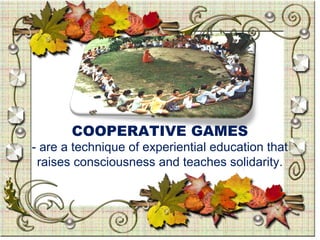
COOPERATIVE GAMES
- are a technique of experiential education that
raises consciousness and teaches solidarity.
Cooperative society

Cooperative society

  • 1.
  • 2.
    Cooperative Industries  Allpeople have the right to be guaranteed minimum requirements such as food (including water), clothing, housing, education and medical care.  These basic requirements should be cooperatively produced because they are essential collective requirements.
  • 3.
    COOPERATIVES AS AFORM OF ECONOMIC ENTERPRISE • Co-ops help people work together and move forward in a collective way. • They are capable of seeking a balanced adjustment between collective spirit and individual rights. • Getting things done with collective effort.
  • 4.
    Combines the wealthand resources of many individuals and harnesses them in a united way. Structured so that individual interest does not dominate collective interests. Individual dominance can adversely effect the welfare of different social groups.  BENEFITS
  • 5.
     Involves gettingthings done between free human beings with: (i) equal rights; (ii) equal human prestige (and mutual respect for each other); (iii) equal locus standi (eg, legal standing); so that everyone's welfare is considered. This is called "coordinated cooperation".
  • 6.
    Coordinated CooperationCoordinated Cooperation Neededfor equilibrium and equipoise in social life. A socio-economic system should be based on coordinated cooperation not subordinated cooperation. "Subordinated cooperation" involves people doing something individually or collectively, but keeping themselves under other peoples' supervision or control. This can degenerate the moral fabric of an enterprise and should be avoided when structuring cooperative business enterprises.
  • 7.
     All groupsin the cooperative workforce will benefit from the cooperative's profits.  They will be entitled to draw dividends and salaries including bonuses on the basis of their membership in, and services they render to, the cooperative.  Labourers or workers also include those who are engaged in cooperative management.  The members of a cooperative can be composed of: (i) shareholders - who receive salaries for their work plus a return on their shares; (ii) non-shareholders or labourers - who enjoy stable employment and favourable wages or incomes.
  • 8.
    OWNERSHIP  Without asense of personal ownership people do not work hard or care for property.  Suppression of personal ownership sentiments results in sluggish production and psychic oppression.  In cooperatives, there is personal ownership, subject to: social limitations on concentration of wealth; and a mechanism to ensure progressive increase in everyone's living standards.
  • 9.
    Membership requirement  Worker'sor shareholder's longer term commitment to the cooperative.  Cooperative members have to be local people who, by virtue of their established residence, can make a commitment to the cooperative and the region it services.  Local is a relative concept and expands over time.  Anyone who wishes to be part of the socio- economic life of a region can settle there and become a member of a local cooperatives.
  • 10.
    SHAREHOLDER COMPOSITION  Memberswho purchase shares in a cooperative should have no power or right to transfer their shares without the permission of the cooperative.  Such a pre-emptive right allows existing shareholders to determine the basis of membership, and prevents capitalist entrepreneurs from purchasing large numbers of shares in a cooperative and speculating in the market.
  • 11.
    Share transfer  Sharescan however be inherited.  Generally, the shares of cooperative members without descendants simply pass on to their legally authorised successors, who become members of the cooperative if they are not already members.  Different countries have different systems of inheritance, so the right of inheritance should be decided according to the system in vogue.  In Western common law countries if someone inherits shares in a business enterprise and does not want to become a member of that enterprise, existing shareholders simply buy that person out.  The same reasoning can be applied to cooperatives - following this arrangement will help cooperative members avoid litigation.
  • 12.
    New shareholders ecause cooperativemembers will be from the same vicinity they will all know each other, so there should be no difficulty in deciding who should be able to buy shares due to ignorance about potential shareholders.
  • 13.
    Dividend distribution   Ina cooperative system there is no need for preference shares.  Today preference shares are used by some financial institutions as a substitute for debt investments (ie loans to businesses).  Preference shares really mean that a lender in the guise of a shareholder has first grab at co-op dividends and therefore co-op profits.  Such investors should become ordinary shareholders like other co-op members and share proportionately in the success (or perhaps otherwise) of the co-op.
  • 14.
    Non-shareholder Non-shareholderworkers workers  Non-shareholding workers Non-shareholdingworkers are possible and can be are possible and can be categorized into those who categorized into those who are:are: (i)(i) permanent labourers - who permanent labourers - who get bonuses and premiums get bonuses and premiums (‘dividends’) as incentives (‘dividends’) as incentives besides their wages; and  besides their wages; and (ii)(ii) casual or contract labourers casual or contract labourers - who only get wages for - who only get wages for their labour.  their labour. 
  • 15.
    Bonus distributions Workers (orworker/shareholders) who give the greatest service to the cooperative should get the greatest bonuses. Bonuses should be paid in proportion to wage rates and should reflect both the skill and productivity of the worker.
  • 16.
     Cooperatives areto develop a proper incentive system so that individual initiative by talented people is encouraged.  An incentive system should ensure that intelligent people are not forced to do work which is unsuitable for them, or be paid the same wages as ordinary workers.  If skilled workers get paid more than unskilled workers there will be an incentive for all to become skilled and work harder.  In this way the cooperative will encourage the educational and skill upgrading of its members. 
  • 17.
    Whoelsebenefits?Whoelsebenefits? • Disadvantagedpersons can also benefit from the cooperative system. • A widow, orphaned minor or disabled worker can own shares and derive an income based on the number of shares they own. • Therefore even if as cooperative members they are unable to work or are retired, they will can still be entitled to an income from special funds deriving cooperative profits, eg pension funds. • Establishing such a structure on a large scale should be able to do away with the welfare state mentality prevalent in capitalist societies.
  • 18.
     Encourage individualinitiative by talented people.  Organisational behaviour and outlook to be cultivated is one that is non-materialistic.  Leadership is subtle and sophisticated.
  • 19.
    Cooperative management  Cooperative members shouldelect a board of directors from amongst the cooperative members.  The position of director should not be honorary or hereditary.  Directors must be moralists.
  • 20.
    Board of Directors Theboard decides the amount of profit to be divided amongst members, ie the dividends or bonuses to be paid to each shareholder and/or worker. However, not all profit should be distributed in the form of dividends. Some should be kept or used for: (i) reinvestment, purchasing capital items or repair and maintenance; (ii) increasing the authorised capital of existing shareholders; (iii) deposit into a reserve fund to be used to increase the value or rate of dividends in years when production is low. This also ensures that shareholder capital is not adversely affected.
  • 21.
    Farmer cooperatives  Theimportance of food means there has to be maximum and safe utilisation of agricultural land.  The best way to achieve proper organisation of agriculture is on a cooperative basis.  Land is very important in the psychology of farmers so a proper cooperative system has to be built up to give farmers a sense of ownership of their land and permanent usufructuary rights to the land  while it is managed cooperatively.  This will also give a better outturn.   The cooperative system has to be psychological and subtle so that farmers do not feel adversely affected or insecure. 
  • 22.
     Farming cooperativescan be achieved by farmers pooling their land in cooperatives and keeping records of their shares based on the size of their individual land holdings.  In this way many small plots can be merged and boundaries for adjoining lands broken down, removing needless division of land into small individual holdings.  This allows for an increase in the area of land available for cultivation, benefiting farmers collectively.
  • 23.
    In the cooperativesystem there is also great scope for agricultural research and development into new ways to better utilize and prolong the vitality of land. The ill effects of chemical fertilizers, which are common in individual farming and relatively unavoidable because of lack of individual capital, could be minimized or eliminated. Research and development
  • 24.
    • Cooperatives whichare agricultural should sell their produce to producer cooperatives, which in turn can manufacture a wide variety of consumer goods. • Raw materials which are of non-farming origin, such as limestone for the production of cement, can also be processed by producer cooperatives.  • Producer cooperatives need to be formed for agro industries, agrico industries and non-agricultural industries. • The total profit of such cooperatives should be distributed amongst the workers and members of the cooperative according to their individual capital investment (shares) in the cooperative and the service (labour) they render to the production and management of the cooperative.
  • 25.
    Farmer-producer cooperatives  Farmersin agricultural cooperatives may also create producer cooperatives to produce items for various industries.  Some cooperatives may function as both farmer and producer cooperatives.  Farmer cooperatives which also function as producer cooperatives have the opportunity of increasing their profitability in various ways.  For example, producer cooperatives functioning with agricultural cooperatives could produce rice as well as oil from the husks.
  • 26.
    Consumer cooperatives willdistribute consumer goods to members of the public at reasonable rates. These cooperatives should be formed by persons having an interest in selling goods to the public (ie not hoarding), and will share profits according to the standard criteria of individual labour and capital investment (shares). Consumer cooperatives will be supplied by both agricultural and producer cooperatives. For example, agricultural or producer cooperatives which produce cotton or silk thread will sell the thread to weaver cooperatives, which can produce cloth using the appropriate or latest technology. Weaver cooperatives will in turn supply consumer cooperatives that sell the cloth to the public.
  • 27.
     These arespecial cooperatives which should be formed by people involved in service-type industries, such as doctors.  Professional cooperatives for dentists, accountants, etc can also be formed.  Small business may remain privately owned.
  • 28.
     An economycan advocate the formation of many small satellite cooperatives to supply various items to large producer cooperatives.  Eg, different parts of a motor car can be locally manufactured in small cooperatives (and even carried out as cottage industries).  The main function of the producer cooperative will then be assembly.  This has two benefits:  (i) large cooperatives will not require many labourers, minimizing labour unrest; and  (ii) labour costs can be reduced, keeping the cost of commodities low.
  • 29.
    COOPERATIVE GAMES - area technique of experiential education that raises consciousness and teaches solidarity.

Editor's Notes

  • #2 There are other kinds of money besides the traditional note and coin with which we are all familiar. This presentation introduces some new kinds of currency that may be useful for communities under certain circumstances.
  • #30 The dominant message today in the educational system, the mass media and advertising is individualistic and competitive. This selfish, materialistic attitude is expressed as, “I win, you lose,” or more correctly, “I win, and it doesn’t matter to me what happens to you.” This individualistic outlook divides communities and harms human relations. Cooperative games are a technique of popular experiential education that help to change this consciousness and teach solidarity. In this photo for example, everyone is giving a back massage to the person in front of him or her.
  • #31 Cooperative games promote kindness, honesty, trust and teamwork. They are fun, full of surprises and require creative problem solving. These experiences help people to realize the difference between a cooperative paradigm and the traditional competitive one.