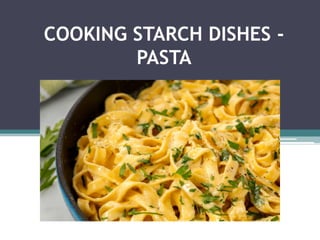
COOKING STARCH DISHES -
PASTA
Introduction
• There are so many reasons to eat pasta it is
delicious, easy to cook and affordable. It’s
also versatile because it makes a great base
for a wide array of other healthy ingredients
like lean proteins, vegetables, legumes and
fruits. One of the most important things to
keep in mind when cooking pasta is that you
should always aim to cook it until it is firm,
or “al dente,” which means “to the tooth” in
Italian.
Let’s have a recap
• What are the uses of starch and cereals in
culinary?
Functions of starch in preparing
food and its application to various
recipes.
Functions of
Starch
Type of Food
Preparation
Recipes
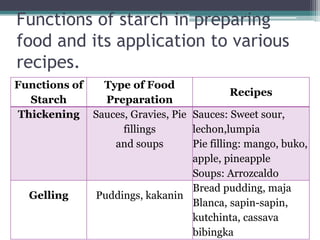
Thickening Sauces, Gravies, Pie
fillings
and soups
Sauces: Sweet sour,
lechon,lumpia
Pie filling: mango, buko,
apple, pineapple
Soups: Arrozcaldo
Gelling Puddings, kakanin
Bread pudding, maja
Blanca, sapin-sapin,
kutchinta, cassava
bibingka
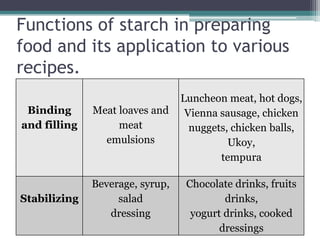
Functions of starch in preparing
food and its application to various
recipes.
Binding
and filling
Meat loaves and
meat
emulsions
Luncheon meat, hot dogs,
Vienna sausage, chicken
nuggets, chicken balls,
Ukoy,
tempura
Stabilizing
Beverage, syrup,
salad
dressing
Chocolate drinks, fruits
drinks,
yogurt drinks, cooked
dressings
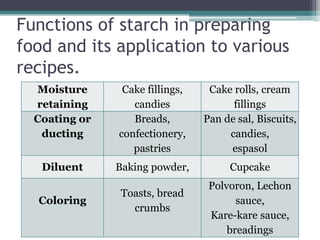
Functions of starch in preparing
food and its application to various
recipes.
Moisture
retaining
Cake fillings,
candies
Cake rolls, cream
fillings
Coating or
ducting
Breads,
confectionery,
pastries
Pan de sal, Biscuits,
candies,
espasol
Diluent Baking powder, Cupcake
Coloring
Toasts, bread
crumbs
Polvoron, Lechon
sauce,
Kare-kare sauce,
breadings
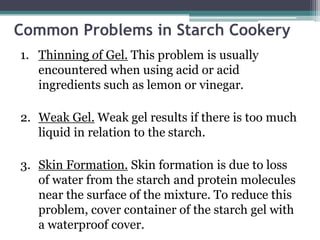
Common Problems in Starch Cookery
1. Thinning of Gel. This problem is usually
encountered when using acid or acid
ingredients such as lemon or vinegar.
2. Weak Gel. Weak gel results if there is too much
liquid in relation to the starch.
3. Skin Formation. Skin formation is due to loss
of water from the starch and protein molecules
near the surface of the mixture. To reduce this
problem, cover container of the starch gel with
a waterproof cover.
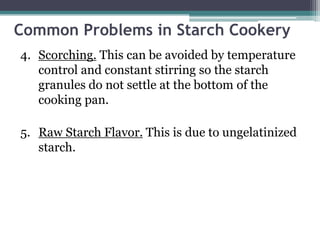
Common Problems in Starch Cookery
4. Scorching. This can be avoided by temperature
control and constant stirring so the starch
granules do not settle at the bottom of the
cooking pan.
5. Raw Starch Flavor. This is due to ungelatinized
starch.
Principles in Cooking Cereals
In cooking all cereal products, the following points
should be observed:
• Use a double boiler.
• Observe carefully the correct proportions of
cereal, water and salt.
• Cook at boiling temperature (212° F.).
• Watch the time by the clock, and always cook the
full time prescribed, preferably longer.
• Serve attractively.
• Improper cooking and poor serving are largely
responsible for unpopularity of cereal foods.
COOKING PASTA
Pasta should be cooked al dente, or ”to
the tooth”. This means the cooking should
be stopped when the pasta still feels firm to
the bite, not soft and mushy. The pleasure
of cooking pasta is its texture, and this is
lost if it is overcooked. To test for doneness,
break pasta into small piece and taste it. As
soon as pasta is al dente, cooking must be
stopped at once. Half a minute extra is
enough to overcook it.
COOKING PASTA
Cooking time differs for every shape
and size of pasta. Timing also depends on
the kind of flour used, and the moisture
content.
Fresh egg pasta, if it has not been
allowed to dry, takes only 1 to 1 ½ minutes
to cook after the water has returned to a
boil.
COOKING PASTA
Italian practice is to toss the pasta with
the sauce the minute it is drained, the sauce
immediately coats all surfaces of the pasta,
and the cheese, melts in the heat of the
boiling hot noodles.
BASIC PRINCIPLES IN PREPARING
PASTA
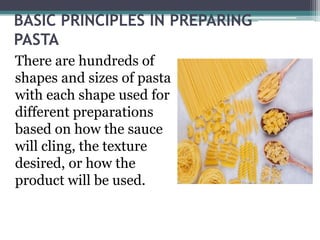
There are hundreds of
shapes and sizes of pasta
with each shape used for
different preparations
based on how the sauce
will cling, the texture
desired, or how the
product will be used.
BASIC PRINCIPLES IN PREPARING
PASTA
For example:
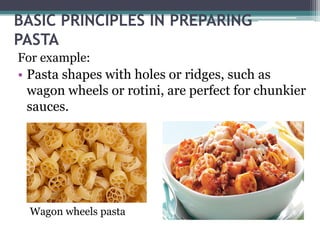
• Pasta shapes with holes or ridges, such as
wagon wheels or rotini, are perfect for chunkier
sauces.
Wagon wheels pasta
BASIC PRINCIPLES IN PREPARING
PASTA
For example:
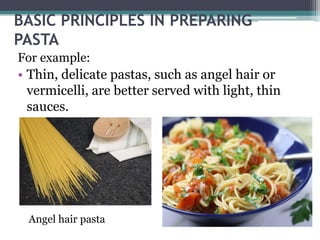
• Thin, delicate pastas, such as angel hair or
vermicelli, are better served with light, thin
sauces.
Angel hair pasta
BASIC PRINCIPLES IN PREPARING
PASTA
For example:
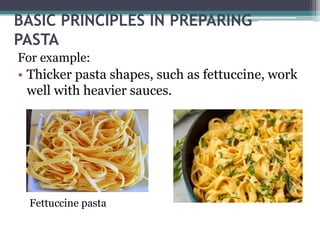
• Thicker pasta shapes, such as fettuccine, work
well with heavier sauces.
Fettuccine pasta
BASIC PRINCIPLES IN PREPARING
PASTA
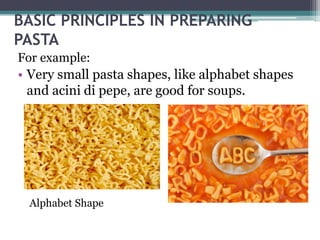
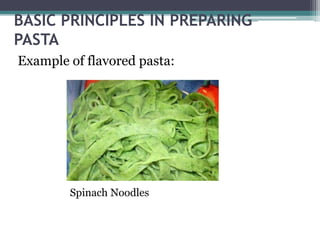
For example:
• Very small pasta shapes, like alphabet shapes
and acini di pepe, are good for soups.
Alphabet Shape
BASIC PRINCIPLES IN PREPARING
PASTA
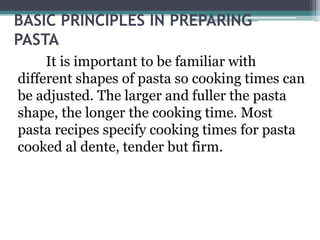
Example of flavored pasta:
Spinach Noodles
BASIC PRINCIPLES IN PREPARING
PASTA
It is important to be familiar with
different shapes of pasta so cooking times can
be adjusted. The larger and fuller the pasta
shape, the longer the cooking time. Most
pasta recipes specify cooking times for pasta
cooked al dente, tender but firm.
BASIC PRINCIPLES IN PREPARING
PASTA
Pasta Gets Bigger and Heavier when Cooked
Generally, pasta doubles or triples in
weight when it is cooked. Likewise, the
volume increases 2 to 2 ½ times during
cooking
BASIC PRINCIPLES IN PREPARING
PASTA
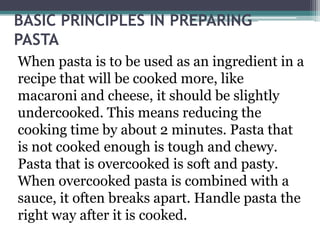
When pasta is to be used as an ingredient in a
recipe that will be cooked more, like
macaroni and cheese, it should be slightly
undercooked. This means reducing the
cooking time by about 2 minutes. Pasta that
is not cooked enough is tough and chewy.
Pasta that is overcooked is soft and pasty.
When overcooked pasta is combined with a
sauce, it often breaks apart. Handle pasta the
right way after it is cooked.
BASIC PRINCIPLES IN PREPARING
PASTA
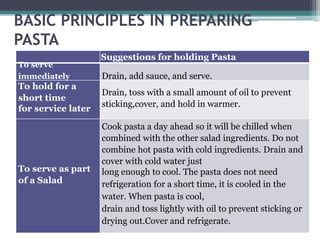
Suggestions for holding Pasta
To serve
immediately Drain, add sauce, and serve.
To hold for a
short time
for service later
Drain, toss with a small amount of oil to prevent
sticking,cover, and hold in warmer.
To serve as part
of a Salad
Cook pasta a day ahead so it will be chilled when
combined with the other salad ingredients. Do not
combine hot pasta with cold ingredients. Drain and
cover with cold water just
long enough to cool. The pasta does not need
refrigeration for a short time, it is cooled in the
water. When pasta is cool,
drain and toss lightly with oil to prevent sticking or
drying out.Cover and refrigerate.
BASIC PRINCIPLES IN PREPARING
PASTA
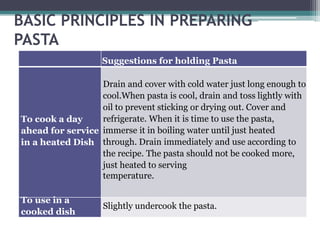
Suggestions for holding Pasta
To cook a day
ahead for service
in a heated Dish
Drain and cover with cold water just long enough to
cool.When pasta is cool, drain and toss lightly with
oil to prevent sticking or drying out. Cover and
refrigerate. When it is time to use the pasta,
immerse it in boiling water until just heated
through. Drain immediately and use according to
the recipe. The pasta should not be cooked more,
just heated to serving
temperature.
To use in a
cooked dish
Slightly undercook the pasta.
BASIC PRINCIPLES IN PREPARING
PASTA
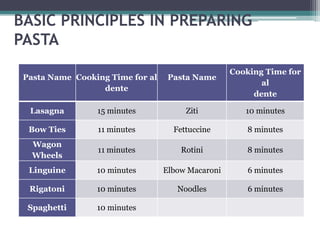
Pasta Name Cooking Time for al
dente
Pasta Name
Cooking Time for
al
dente
Lasagna 15 minutes Ziti 10 minutes
Bow Ties 11 minutes Fettuccine 8 minutes
Wagon
Wheels
11 minutes Rotini 8 minutes
Linguine 10 minutes Elbow Macaroni 6 minutes
Rigatoni 10 minutes Noodles 6 minutes
Spaghetti 10 minutes
Any questions?

Cooking-Pasta.pdf

  • 1.
  • 2.
    Introduction • There areso many reasons to eat pasta it is delicious, easy to cook and affordable. It’s also versatile because it makes a great base for a wide array of other healthy ingredients like lean proteins, vegetables, legumes and fruits. One of the most important things to keep in mind when cooking pasta is that you should always aim to cook it until it is firm, or “al dente,” which means “to the tooth” in Italian.
  • 3.
    Let’s have arecap • What are the uses of starch and cereals in culinary?
  • 4.
    Functions of starchin preparing food and its application to various recipes. Functions of Starch Type of Food Preparation Recipes Thickening Sauces, Gravies, Pie fillings and soups Sauces: Sweet sour, lechon,lumpia Pie filling: mango, buko, apple, pineapple Soups: Arrozcaldo Gelling Puddings, kakanin Bread pudding, maja Blanca, sapin-sapin, kutchinta, cassava bibingka
  • 5.
    Functions of starchin preparing food and its application to various recipes. Binding and filling Meat loaves and meat emulsions Luncheon meat, hot dogs, Vienna sausage, chicken nuggets, chicken balls, Ukoy, tempura Stabilizing Beverage, syrup, salad dressing Chocolate drinks, fruits drinks, yogurt drinks, cooked dressings
  • 6.
    Functions of starchin preparing food and its application to various recipes. Moisture retaining Cake fillings, candies Cake rolls, cream fillings Coating or ducting Breads, confectionery, pastries Pan de sal, Biscuits, candies, espasol Diluent Baking powder, Cupcake Coloring Toasts, bread crumbs Polvoron, Lechon sauce, Kare-kare sauce, breadings
  • 7.
    Common Problems inStarch Cookery 1. Thinning of Gel. This problem is usually encountered when using acid or acid ingredients such as lemon or vinegar. 2. Weak Gel. Weak gel results if there is too much liquid in relation to the starch. 3. Skin Formation. Skin formation is due to loss of water from the starch and protein molecules near the surface of the mixture. To reduce this problem, cover container of the starch gel with a waterproof cover.
  • 8.
    Common Problems inStarch Cookery 4. Scorching. This can be avoided by temperature control and constant stirring so the starch granules do not settle at the bottom of the cooking pan. 5. Raw Starch Flavor. This is due to ungelatinized starch.
  • 9.
    Principles in CookingCereals In cooking all cereal products, the following points should be observed: • Use a double boiler. • Observe carefully the correct proportions of cereal, water and salt. • Cook at boiling temperature (212° F.). • Watch the time by the clock, and always cook the full time prescribed, preferably longer. • Serve attractively. • Improper cooking and poor serving are largely responsible for unpopularity of cereal foods.
  • 10.
    COOKING PASTA Pasta shouldbe cooked al dente, or ”to the tooth”. This means the cooking should be stopped when the pasta still feels firm to the bite, not soft and mushy. The pleasure of cooking pasta is its texture, and this is lost if it is overcooked. To test for doneness, break pasta into small piece and taste it. As soon as pasta is al dente, cooking must be stopped at once. Half a minute extra is enough to overcook it.
  • 11.
    COOKING PASTA Cooking timediffers for every shape and size of pasta. Timing also depends on the kind of flour used, and the moisture content. Fresh egg pasta, if it has not been allowed to dry, takes only 1 to 1 ½ minutes to cook after the water has returned to a boil.
  • 12.
    COOKING PASTA Italian practiceis to toss the pasta with the sauce the minute it is drained, the sauce immediately coats all surfaces of the pasta, and the cheese, melts in the heat of the boiling hot noodles.
  • 13.
    BASIC PRINCIPLES INPREPARING PASTA There are hundreds of shapes and sizes of pasta with each shape used for different preparations based on how the sauce will cling, the texture desired, or how the product will be used.
  • 14.
    BASIC PRINCIPLES INPREPARING PASTA For example: • Pasta shapes with holes or ridges, such as wagon wheels or rotini, are perfect for chunkier sauces. Wagon wheels pasta
  • 15.
    BASIC PRINCIPLES INPREPARING PASTA For example: • Thin, delicate pastas, such as angel hair or vermicelli, are better served with light, thin sauces. Angel hair pasta
  • 16.
    BASIC PRINCIPLES INPREPARING PASTA For example: • Thicker pasta shapes, such as fettuccine, work well with heavier sauces. Fettuccine pasta
  • 17.
    BASIC PRINCIPLES INPREPARING PASTA For example: • Very small pasta shapes, like alphabet shapes and acini di pepe, are good for soups. Alphabet Shape
  • 18.
    BASIC PRINCIPLES INPREPARING PASTA Example of flavored pasta: Spinach Noodles
  • 19.
    BASIC PRINCIPLES INPREPARING PASTA It is important to be familiar with different shapes of pasta so cooking times can be adjusted. The larger and fuller the pasta shape, the longer the cooking time. Most pasta recipes specify cooking times for pasta cooked al dente, tender but firm.
  • 20.
    BASIC PRINCIPLES INPREPARING PASTA Pasta Gets Bigger and Heavier when Cooked Generally, pasta doubles or triples in weight when it is cooked. Likewise, the volume increases 2 to 2 ½ times during cooking
  • 21.
    BASIC PRINCIPLES INPREPARING PASTA When pasta is to be used as an ingredient in a recipe that will be cooked more, like macaroni and cheese, it should be slightly undercooked. This means reducing the cooking time by about 2 minutes. Pasta that is not cooked enough is tough and chewy. Pasta that is overcooked is soft and pasty. When overcooked pasta is combined with a sauce, it often breaks apart. Handle pasta the right way after it is cooked.
  • 22.
    BASIC PRINCIPLES INPREPARING PASTA Suggestions for holding Pasta To serve immediately Drain, add sauce, and serve. To hold for a short time for service later Drain, toss with a small amount of oil to prevent sticking,cover, and hold in warmer. To serve as part of a Salad Cook pasta a day ahead so it will be chilled when combined with the other salad ingredients. Do not combine hot pasta with cold ingredients. Drain and cover with cold water just long enough to cool. The pasta does not need refrigeration for a short time, it is cooled in the water. When pasta is cool, drain and toss lightly with oil to prevent sticking or drying out.Cover and refrigerate.
  • 23.
    BASIC PRINCIPLES INPREPARING PASTA Suggestions for holding Pasta To cook a day ahead for service in a heated Dish Drain and cover with cold water just long enough to cool.When pasta is cool, drain and toss lightly with oil to prevent sticking or drying out. Cover and refrigerate. When it is time to use the pasta, immerse it in boiling water until just heated through. Drain immediately and use according to the recipe. The pasta should not be cooked more, just heated to serving temperature. To use in a cooked dish Slightly undercook the pasta.
  • 24.
    BASIC PRINCIPLES INPREPARING PASTA Pasta Name Cooking Time for al dente Pasta Name Cooking Time for al dente Lasagna 15 minutes Ziti 10 minutes Bow Ties 11 minutes Fettuccine 8 minutes Wagon Wheels 11 minutes Rotini 8 minutes Linguine 10 minutes Elbow Macaroni 6 minutes Rigatoni 10 minutes Noodles 6 minutes Spaghetti 10 minutes
  • 25.