By: LWANGA HERBERT FELIX
UWERA BENITAH
Tutor: Dr. Kalubi Peters
10/18/2023
1
 Definitions
 Neuro-anatomy & physiology of normal consciousness Vs
Coma
 Conditions that mimic Coma
 Coma Etiologies
 Coma Assessment scales (GCS, BCS, AVPU)
 Approach to a convulsing/ Comatose child i.e Hx and P/E
 Investigations
 Management of a convulsing child & Status epilepticus
10/18/2023 2
1. Seizure: Abnormal excessive electrical firing, or neuronal
activity in the brain which may result into
motor(contraction of muscles) or non motor(such as loss of
awareness, incontinence, drooling, yawning among others)
results
10/18/2023 3
 It can either be epileptic OR non-epileptic
 Epileptic: manifestation due to abnormal synchronous
neuronal activity in the brain
 Non-epileptic seizure: mimics seizures but have nothing to do
with the brain, e.g. Shivering
10/18/2023 4
2. Fit: Abnormal electrical activities in the brain that occur quickly
and can go almost unnoticed.
3.Spasm: A sudden involuntary muscle contraction.
4.Convulsions: Motor manifestation of a seizure.
Can be classified into
a) Generalized:
Tonic: Extension
Clonic: Flexion
Tonic-clonic: Both extension and flexion
Myoclonic: Localised to muscle
Atonic: Loss of tone, can lead to sudden falls
10/18/2023 5
b) Focal
Either motor, or non-motor
5. Coma: Prolonged state of unconsciousness in which a person
cant be awakened and is unresponsive to stimuli (e.g light,
pain, sound) and lacks a normal sleep-wake cycle, and doesn’t
initiate voluntary actions.
6. Epilepsy: A neurological disorder marked by sudden recurrent
episodes of sensory disturbance, loss of consciousness/
convulsions due to abnormal electrical activity in the brain.
It needs at-least 2 unprovoked seizures occurring more than
24hrs apart.
10/18/2023 6
7. Status epilepticus: An afebrile seizure lasting more than 15
minutes, or Recurrent seizures lasting in total more than 30
minutes without return to consciousness in between.
8. Febrile Convulsions: A seizure of infancy/ childhood (1 month-
5yrs) associated with fevers but without evidence of
intracranial infection or a defined cause (such as trauma)
10/18/2023 7
Febrile Convulsions: convulsions precipitated by fever, not due to an
intracranial infection or other definable CNS.
Features:
 Fevers >38℃
 No neurological abnormality in the period between episodes
 Usually brief convulsions and benign
 Age dependent and occur between 6months and 5years of age.
Types
a. Simple Febrile convulsions (85%):
Brief Generalized tonic-clonic seizure lasting a few seconds to a
few minutes, usually <5mins followed by full recovery, and don’t go
beyond 15mins. Don’t recur within 24hrs.
a. Complex/Atypical Febrile Convulsions(15%): prolonged
(>15mins)repeated convulsions occur within the same day
(reccur more than once within 24 hours), when the seizure is
focal(confined to one side of the body) or post-ictal focal deficit
noted.
10/18/2023 8
Simple Febrile Convulsions:
low risk of epilepsy(1%), no adverse effects on
behavior/ neurocognition
Complex febrile convulsions:
Increased risk of epilepsy and this may also
be associated with other risk factors such as a
positive family history of epilepsy, an initial
febrile seizure before 9months of age, delayed
developmental milestones or a preexisting
neurological disorder.
10/18/2023 9
 Coma : The patient cannot be aroused, and the eyes are closed
and do not open in response to any stimulation.
 Maintaining alertness requires intact function of the cerebral
hemispheres and arousal mechanisms in reticular activating
system(RAS-also known as the ascending arousal system)- an
extensive network of nuclei and interconnecting fibers in
upper pons, mid brain and posterior diencephalon. Therefore,
the mechanism of impaired consciousness must involve both
cerebral hemispheres or dysfunction of the RAS
10/18/2023 10
 To impair consciousness, cerebral dysfunction must be bilateral;
unilateral cerebral hemisphere disorders are not sufficient,
although they may cause severe neurologic deficits. However,
rarely, a unilateral massive hemispheric focal lesion(e.g left middle
cerebral artery stroke) impairs consciousness if the contralateral
hemisphere is already compromised or if it results in compression
of the contralateral hemisphere(such as by causing oedema.)
10/18/2023 11
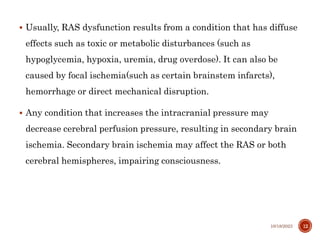
 Usually, RAS dysfunction results from a condition that has diffuse
effects such as toxic or metabolic disturbances (such as
hypoglycemia, hypoxia, uremia, drug overdose). It can also be
caused by focal ischemia(such as certain brainstem infarcts),
hemorrhage or direct mechanical disruption.
 Any condition that increases the intracranial pressure may
decrease cerebral perfusion pressure, resulting in secondary brain
ischemia. Secondary brain ischemia may affect the RAS or both
cerebral hemispheres, impairing consciousness.
10/18/2023 12
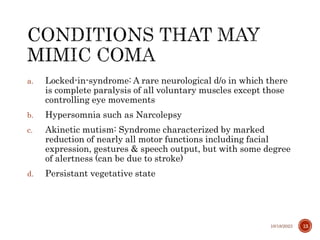
a. Locked-in-syndrome: A rare neurological d/o in which there
is complete paralysis of all voluntary muscles except those
controlling eye movements
b. Hypersomnia such as Narcolepsy
c. Akinetic mutism: Syndrome characterized by marked
reduction of nearly all motor functions including facial
expression, gestures & speech output, but with some degree
of alertness (can be due to stroke)
d. Persistant vegetative state
10/18/2023 13
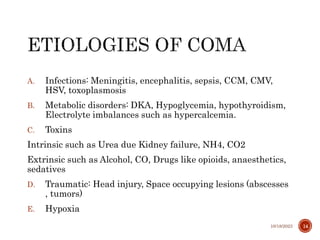
A. Infections: Meningitis, encephalitis, sepsis, CCM, CMV,
HSV, toxoplasmosis
B. Metabolic disorders: DKA, Hypoglycemia, hypothyroidism,
Electrolyte imbalances such as hypercalcemia.
C. Toxins
Intrinsic such as Urea due Kidney failure, NH4, CO2
Extrinsic such as Alcohol, CO, Drugs like opioids, anaesthetics,
sedatives
D. Traumatic: Head injury, Space occupying lesions (abscesses
, tumors)
E. Hypoxia
10/18/2023 14
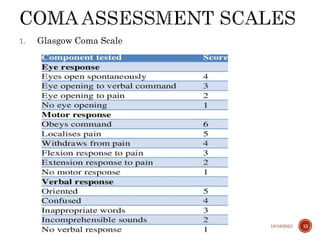
1. Glasgow Coma Scale
10/18/2023 15
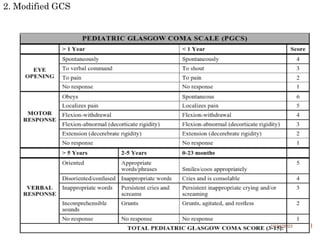
2. Modified GCS
10/18/2023 16
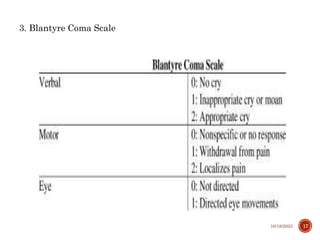
3. Blantyre Coma Scale
10/18/2023 17
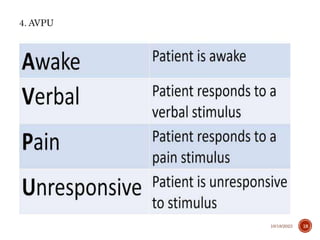
4. AVPU
10/18/2023 18
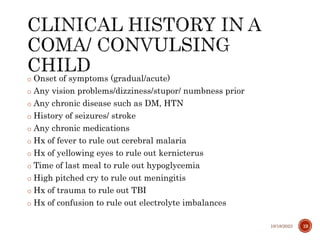
o Onset of symptoms (gradual/acute)
o Any vision problems/dizziness/stupor/ numbness prior
o Any chronic disease such as DM, HTN
o History of seizures/ stroke
o Any chronic medications
o Hx of fever to rule out cerebral malaria
o Hx of yellowing eyes to rule out kernicterus
o Time of last meal to rule out hypoglycemia
o High pitched cry to rule out meningitis
o Hx of trauma to rule out TBI
o Hx of confusion to rule out electrolyte imbalances
10/18/2023 19
For a convulsing child, do a detailed general exam, and systemic
exams
a) General exams
Vitals: Temp, RR, SPO2, PR, GCS/BCS/AVPU
Note: BP & HR very crucial in syncopy
Febrile, jaundice, pallor, etc + pigmentation e.g in neuro-
cutaneous syndromes, etc
b) Systemic exams, e.g GIT, RS, CVS, and a Focused
Neurological Exam (Cranial nerves & Motor and Brainstem
reflexes e.g Corneal, Dolls reflex, oculovescular reflex)
10/18/2023 20
 Absence of:
Pupils: no response to light
Cornea: no corneal reflexes
Oculocephalic testing (head turning) and oculovestibular
(caloric) testing
Motor response to adequate somatic stimulation within
distribution of cranial nerve
Gag reflex( pharyngeal and tracheal reflexes)
NB: Brainstem reflexes are usually used in assessing brainstem
death(if they are absent)
10/18/2023 21
Based on patient’s presentation.
Note: commonest cause of coma and convulsions in children is
Cerebral Malaria
Investigations include, but not limited to:
 RBS
 Blood smear for malaria/ mRDT
 CSF Analysis/ culture, Blood culture, Serum electrolytes
 EEG
 Neuroimaging e.g CT/ MRI
 CBC
10/18/2023 22
 Random Blood Sugar.
 Blood smear
 Lumbar puncture for CSF analysis/ Blood culture
 Metabolic screen
 Imaging such as Cranial ultrasound on the anterior fontanelle,
CT scan.
10/18/2023 23
Seizures in children usually <3mins, however if
>5mins=Prolonged seizures, and these have more likelihood to
injure brain.
Status epilepticus is an Emergency
10/18/2023 24
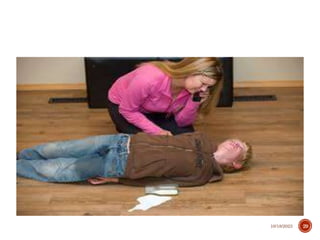
- Ensure safety (patient and co.) space,remove tight clothes
- Left lateral (recovery)position
- ABC(Airway patency, Breathing, & Circulation)
AVOID
Restraining patient,
putting anything in the mouth, even feeds during an episode
Arousing convulsing child
Leaving convulsing pt unattended to before recovery
Time episodes where possible
10/18/2023 25
Initiate active pharmacological mgt
First line: Benzodiazepines (Diazepam/Midazolam) IV, or rectal.
IV Diazepam 0.3mg/kg (S.Es Resp arrest)
If 1st dose doesn’t work in 10 mins, give 2nd dose of diazepam.
If it doesn’t work, switch to 2nd line
10/18/2023 26
Second line:
These are longer acting anti-epileptics e.g Phenobarbital &
Phenytoin
Phenobarbital (10-15mg/kg slowly and monitor
vitals)
If this doesn’t work, inform ICU who’ll do general anaesthesia and
mechanical ventilation (3rd Line)
10/18/2023 27
 Uganda Clinical Guidelines 2016
 WHO Pocket handbook of paediatrics
 ILAE
10/18/2023 28
10/18/2023 29

CONVULSIONS AND STATUS EPILEPTICUS.pptx

  • 1.
    By: LWANGA HERBERTFELIX UWERA BENITAH Tutor: Dr. Kalubi Peters 10/18/2023 1
  • 2.
     Definitions  Neuro-anatomy& physiology of normal consciousness Vs Coma  Conditions that mimic Coma  Coma Etiologies  Coma Assessment scales (GCS, BCS, AVPU)  Approach to a convulsing/ Comatose child i.e Hx and P/E  Investigations  Management of a convulsing child & Status epilepticus 10/18/2023 2
  • 3.
    1. Seizure: Abnormalexcessive electrical firing, or neuronal activity in the brain which may result into motor(contraction of muscles) or non motor(such as loss of awareness, incontinence, drooling, yawning among others) results 10/18/2023 3
  • 4.
     It caneither be epileptic OR non-epileptic  Epileptic: manifestation due to abnormal synchronous neuronal activity in the brain  Non-epileptic seizure: mimics seizures but have nothing to do with the brain, e.g. Shivering 10/18/2023 4
  • 5.
    2. Fit: Abnormalelectrical activities in the brain that occur quickly and can go almost unnoticed. 3.Spasm: A sudden involuntary muscle contraction. 4.Convulsions: Motor manifestation of a seizure. Can be classified into a) Generalized: Tonic: Extension Clonic: Flexion Tonic-clonic: Both extension and flexion Myoclonic: Localised to muscle Atonic: Loss of tone, can lead to sudden falls 10/18/2023 5
  • 6.
    b) Focal Either motor,or non-motor 5. Coma: Prolonged state of unconsciousness in which a person cant be awakened and is unresponsive to stimuli (e.g light, pain, sound) and lacks a normal sleep-wake cycle, and doesn’t initiate voluntary actions. 6. Epilepsy: A neurological disorder marked by sudden recurrent episodes of sensory disturbance, loss of consciousness/ convulsions due to abnormal electrical activity in the brain. It needs at-least 2 unprovoked seizures occurring more than 24hrs apart. 10/18/2023 6
  • 7.
    7. Status epilepticus:An afebrile seizure lasting more than 15 minutes, or Recurrent seizures lasting in total more than 30 minutes without return to consciousness in between. 8. Febrile Convulsions: A seizure of infancy/ childhood (1 month- 5yrs) associated with fevers but without evidence of intracranial infection or a defined cause (such as trauma) 10/18/2023 7
  • 8.
    Febrile Convulsions: convulsionsprecipitated by fever, not due to an intracranial infection or other definable CNS. Features:  Fevers >38℃  No neurological abnormality in the period between episodes  Usually brief convulsions and benign  Age dependent and occur between 6months and 5years of age. Types a. Simple Febrile convulsions (85%): Brief Generalized tonic-clonic seizure lasting a few seconds to a few minutes, usually <5mins followed by full recovery, and don’t go beyond 15mins. Don’t recur within 24hrs. a. Complex/Atypical Febrile Convulsions(15%): prolonged (>15mins)repeated convulsions occur within the same day (reccur more than once within 24 hours), when the seizure is focal(confined to one side of the body) or post-ictal focal deficit noted. 10/18/2023 8
  • 9.
    Simple Febrile Convulsions: lowrisk of epilepsy(1%), no adverse effects on behavior/ neurocognition Complex febrile convulsions: Increased risk of epilepsy and this may also be associated with other risk factors such as a positive family history of epilepsy, an initial febrile seizure before 9months of age, delayed developmental milestones or a preexisting neurological disorder. 10/18/2023 9
  • 10.
     Coma :The patient cannot be aroused, and the eyes are closed and do not open in response to any stimulation.  Maintaining alertness requires intact function of the cerebral hemispheres and arousal mechanisms in reticular activating system(RAS-also known as the ascending arousal system)- an extensive network of nuclei and interconnecting fibers in upper pons, mid brain and posterior diencephalon. Therefore, the mechanism of impaired consciousness must involve both cerebral hemispheres or dysfunction of the RAS 10/18/2023 10
  • 11.
     To impairconsciousness, cerebral dysfunction must be bilateral; unilateral cerebral hemisphere disorders are not sufficient, although they may cause severe neurologic deficits. However, rarely, a unilateral massive hemispheric focal lesion(e.g left middle cerebral artery stroke) impairs consciousness if the contralateral hemisphere is already compromised or if it results in compression of the contralateral hemisphere(such as by causing oedema.) 10/18/2023 11
  • 12.
     Usually, RASdysfunction results from a condition that has diffuse effects such as toxic or metabolic disturbances (such as hypoglycemia, hypoxia, uremia, drug overdose). It can also be caused by focal ischemia(such as certain brainstem infarcts), hemorrhage or direct mechanical disruption.  Any condition that increases the intracranial pressure may decrease cerebral perfusion pressure, resulting in secondary brain ischemia. Secondary brain ischemia may affect the RAS or both cerebral hemispheres, impairing consciousness. 10/18/2023 12
  • 13.
    a. Locked-in-syndrome: Arare neurological d/o in which there is complete paralysis of all voluntary muscles except those controlling eye movements b. Hypersomnia such as Narcolepsy c. Akinetic mutism: Syndrome characterized by marked reduction of nearly all motor functions including facial expression, gestures & speech output, but with some degree of alertness (can be due to stroke) d. Persistant vegetative state 10/18/2023 13
  • 14.
    A. Infections: Meningitis,encephalitis, sepsis, CCM, CMV, HSV, toxoplasmosis B. Metabolic disorders: DKA, Hypoglycemia, hypothyroidism, Electrolyte imbalances such as hypercalcemia. C. Toxins Intrinsic such as Urea due Kidney failure, NH4, CO2 Extrinsic such as Alcohol, CO, Drugs like opioids, anaesthetics, sedatives D. Traumatic: Head injury, Space occupying lesions (abscesses , tumors) E. Hypoxia 10/18/2023 14
  • 15.
    1. Glasgow ComaScale 10/18/2023 15
  • 16.
  • 17.
    3. Blantyre ComaScale 10/18/2023 17
  • 18.
  • 19.
    o Onset ofsymptoms (gradual/acute) o Any vision problems/dizziness/stupor/ numbness prior o Any chronic disease such as DM, HTN o History of seizures/ stroke o Any chronic medications o Hx of fever to rule out cerebral malaria o Hx of yellowing eyes to rule out kernicterus o Time of last meal to rule out hypoglycemia o High pitched cry to rule out meningitis o Hx of trauma to rule out TBI o Hx of confusion to rule out electrolyte imbalances 10/18/2023 19
  • 20.
    For a convulsingchild, do a detailed general exam, and systemic exams a) General exams Vitals: Temp, RR, SPO2, PR, GCS/BCS/AVPU Note: BP & HR very crucial in syncopy Febrile, jaundice, pallor, etc + pigmentation e.g in neuro- cutaneous syndromes, etc b) Systemic exams, e.g GIT, RS, CVS, and a Focused Neurological Exam (Cranial nerves & Motor and Brainstem reflexes e.g Corneal, Dolls reflex, oculovescular reflex) 10/18/2023 20
  • 21.
     Absence of: Pupils:no response to light Cornea: no corneal reflexes Oculocephalic testing (head turning) and oculovestibular (caloric) testing Motor response to adequate somatic stimulation within distribution of cranial nerve Gag reflex( pharyngeal and tracheal reflexes) NB: Brainstem reflexes are usually used in assessing brainstem death(if they are absent) 10/18/2023 21
  • 22.
    Based on patient’spresentation. Note: commonest cause of coma and convulsions in children is Cerebral Malaria Investigations include, but not limited to:  RBS  Blood smear for malaria/ mRDT  CSF Analysis/ culture, Blood culture, Serum electrolytes  EEG  Neuroimaging e.g CT/ MRI  CBC 10/18/2023 22
  • 23.
     Random BloodSugar.  Blood smear  Lumbar puncture for CSF analysis/ Blood culture  Metabolic screen  Imaging such as Cranial ultrasound on the anterior fontanelle, CT scan. 10/18/2023 23
  • 24.
    Seizures in childrenusually <3mins, however if >5mins=Prolonged seizures, and these have more likelihood to injure brain. Status epilepticus is an Emergency 10/18/2023 24
  • 25.
    - Ensure safety(patient and co.) space,remove tight clothes - Left lateral (recovery)position - ABC(Airway patency, Breathing, & Circulation) AVOID Restraining patient, putting anything in the mouth, even feeds during an episode Arousing convulsing child Leaving convulsing pt unattended to before recovery Time episodes where possible 10/18/2023 25
  • 26.
    Initiate active pharmacologicalmgt First line: Benzodiazepines (Diazepam/Midazolam) IV, or rectal. IV Diazepam 0.3mg/kg (S.Es Resp arrest) If 1st dose doesn’t work in 10 mins, give 2nd dose of diazepam. If it doesn’t work, switch to 2nd line 10/18/2023 26
  • 27.
    Second line: These arelonger acting anti-epileptics e.g Phenobarbital & Phenytoin Phenobarbital (10-15mg/kg slowly and monitor vitals) If this doesn’t work, inform ICU who’ll do general anaesthesia and mechanical ventilation (3rd Line) 10/18/2023 27
  • 28.
     Uganda ClinicalGuidelines 2016  WHO Pocket handbook of paediatrics  ILAE 10/18/2023 28
  • 29.