Convolution and Residue Method
in Inverse Z- Transform
• Contents
i. Crux of IZT
ii. Convolution Theorem (With examples)
iii. Residue Method Integral Inversion
(With examples)
General Form for finding through Residue
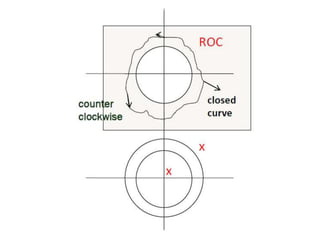
Contour: ƶ = r.ejƜ
Contour Integration C is a counterclockwise closed contour in the ROC of X(z)
encircling the origin
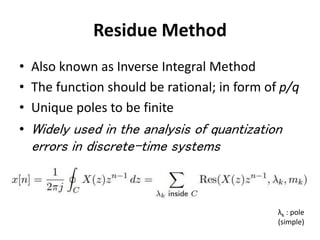
Residue Method
• Also known as Inverse Integral Method
• The function should be rational; in form of p/q
• Unique poles to be finite
• Widely used in the analysis of quantization
errors in discrete-time systems
λk : pole
(simple)
• The poles {pn} are the roots of the denominator polynomial = 0.
• The poles {pn} are assumed to be distinct (no two are equal);
• Repeated roots of polynomials don’t occur in real life unless forced to.
• If X(z) is real, both poles and residues occur in complex conjugate pairs
• In case of non-simple poles; (in order of >1)
λk : pole
OR
Convolution Theorem/Method
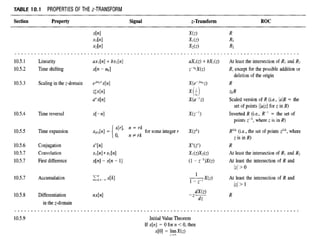
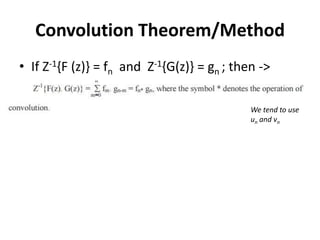
• If Z-1{F (z)} = fn and Z-1{G(z)} = gn ; then ->
We tend to use
un and vn
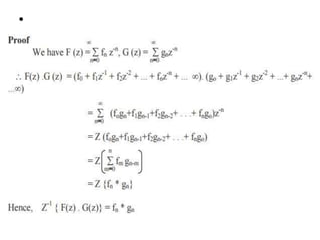
•
• Special Thanks to Shri Shri Shri Alan
Oppenheim

Convolution and Residue Method in Inverse Z Transform

  • 1.
    Convolution and ResidueMethod in Inverse Z- Transform • Contents i. Crux of IZT ii. Convolution Theorem (With examples) iii. Residue Method Integral Inversion (With examples)
  • 3.
    General Form forfinding through Residue Contour: ƶ = r.ejƜ Contour Integration C is a counterclockwise closed contour in the ROC of X(z) encircling the origin
  • 5.
    Residue Method • Alsoknown as Inverse Integral Method • The function should be rational; in form of p/q • Unique poles to be finite • Widely used in the analysis of quantization errors in discrete-time systems λk : pole (simple)
  • 6.
    • The poles{pn} are the roots of the denominator polynomial = 0. • The poles {pn} are assumed to be distinct (no two are equal); • Repeated roots of polynomials don’t occur in real life unless forced to. • If X(z) is real, both poles and residues occur in complex conjugate pairs • In case of non-simple poles; (in order of >1) λk : pole OR
  • 7.
    Convolution Theorem/Method • IfZ-1{F (z)} = fn and Z-1{G(z)} = gn ; then -> We tend to use un and vn
  • 8.
  • 9.
    • Special Thanksto Shri Shri Shri Alan Oppenheim