Downloaded 149 times
![Example:
#include<stdio.h>
int main(void)
{
int a=5,b=8;
float c = 0, d = 0;
c = a/b;
printf("n [%f] n",c);
d = (float)a/(float)b;
printf("n [%f] n",d);
return 0;
}](https://image.slidesharecdn.com/typecastinginc-140227113153-phpapp02/85/Typecasting-in-c-2-320.jpg)
![In the above example, first we divide 'a' by 'b' without
typecasting. While in the second attempt we typecast both 'a'
and 'b' to float and then divide them.
So, what happens is, in the first attempt, the compiler
knows both 'a' and 'b' are integers so it ignores the floating
part of the result and stores the result of a/b in a temporary
integer variable and then assign the value of this temporary
integer variable to 'c'. So despite of 'c' being a float, the final
value that 'c' gets is an integer ie '0' in this case.
While in the second attempt, as both 'a' and 'b' are
individually typecasted as 'float', so this typecasting makes
compiler think as if both 'a' and 'b' are floats, so the compiler
retains the floating part of the result and assigns the float
value to 'c'.
The output of the above program :
[0.000000]
[0.625000]](https://image.slidesharecdn.com/typecastinginc-140227113153-phpapp02/85/Typecasting-in-c-3-320.jpg)
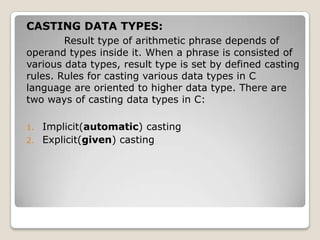
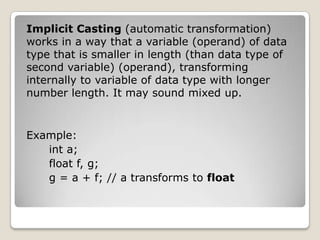
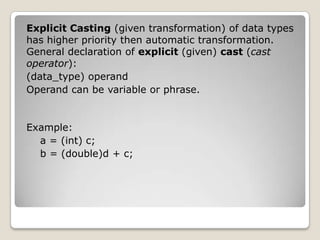
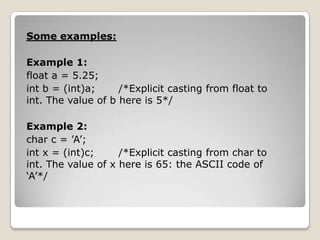
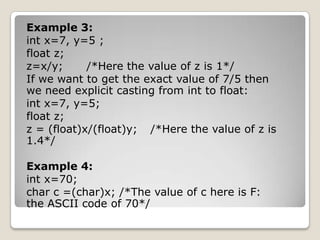


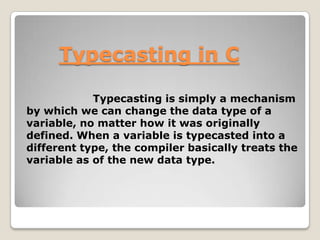
Typecasting in C allows changing the data type of a variable, regardless of its original definition. When a variable is typecast to a new type, the compiler treats it as the new type. In the example, dividing two integers results in 0, but casting them to floats first results in the actual quotient of 0.625. Typecasting can be implicit, letting smaller types automatically cast to larger ones in expressions, or explicit using cast operators like (int) or (float). Explicit casts have higher priority and force a specific conversion.


