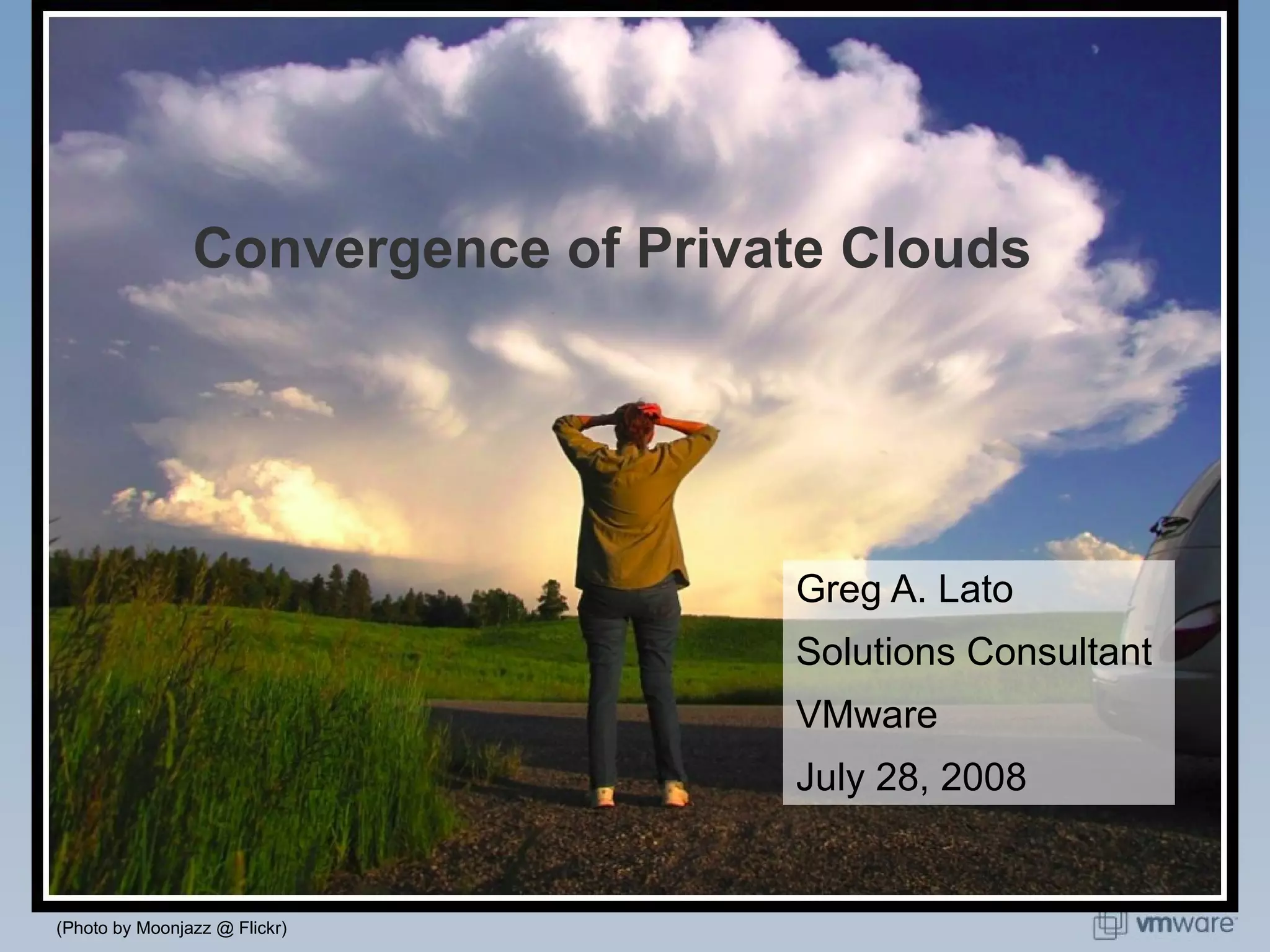
Convergence of Private Clouds Greg A. Lato Solutions Consultant VMware July 28, 2008 (Photo by Moonjazz @ Flickr)
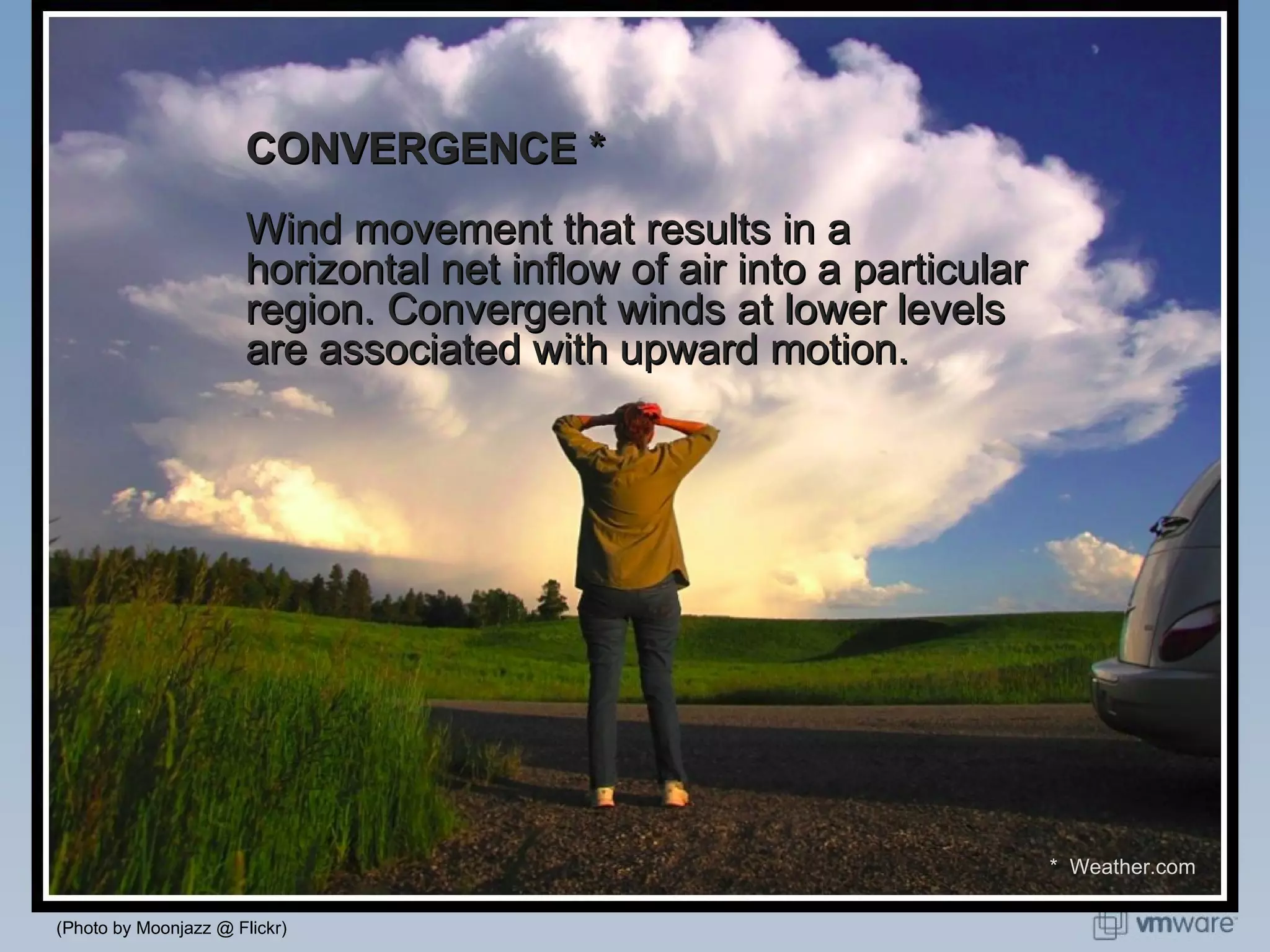
CONVERGENCE * Wind movement that results in a horizontal net inflow of air into a particular region. Convergent winds at lower levels are associated with upward motion. (Photo by Moonjazz @ Flickr) *  Weather.com
Agenda Introduction W-W-H of Private Clouds VMware Private Clouds Discussion…
Introduction Who am I?  …  Greg A. Lato Global Accounts Solution Consultant, VMware Work with largest VMW customers, Global Fortune 500 Aggregate snapshot of my clients:  25,000+ VMs 450,000+ Employees $370B in yearly revenues Clients deploying Private Clouds now… Blog:  www.latogalabs.com Twitter: latoga
What are Private Clouds? Who Should Care  About  Private Clouds? How are Private  Clouds Built? (Photo by Nicholas_T @ Flickr)
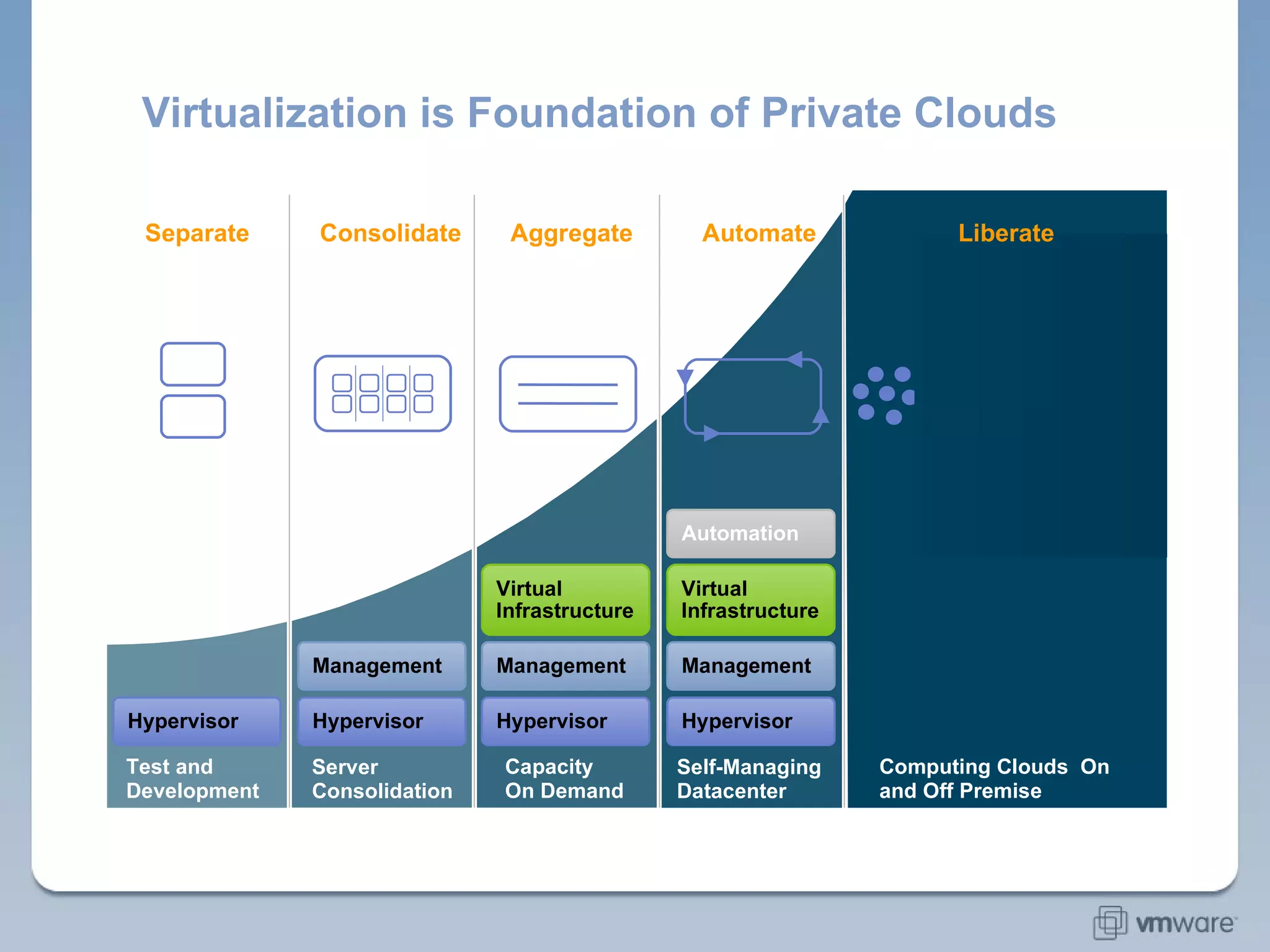
Virtualization is Foundation of Private Clouds Capacity On Demand Hypervisor Management Virtual Infrastructure Automate Separate Consolidate Aggregate Self-Managing Datacenter Server Consolidation Test and Development Computing Clouds  On and Off Premise Hypervisor Hypervisor Management Hypervisor Management Virtual Infrastructure Automation Liberate
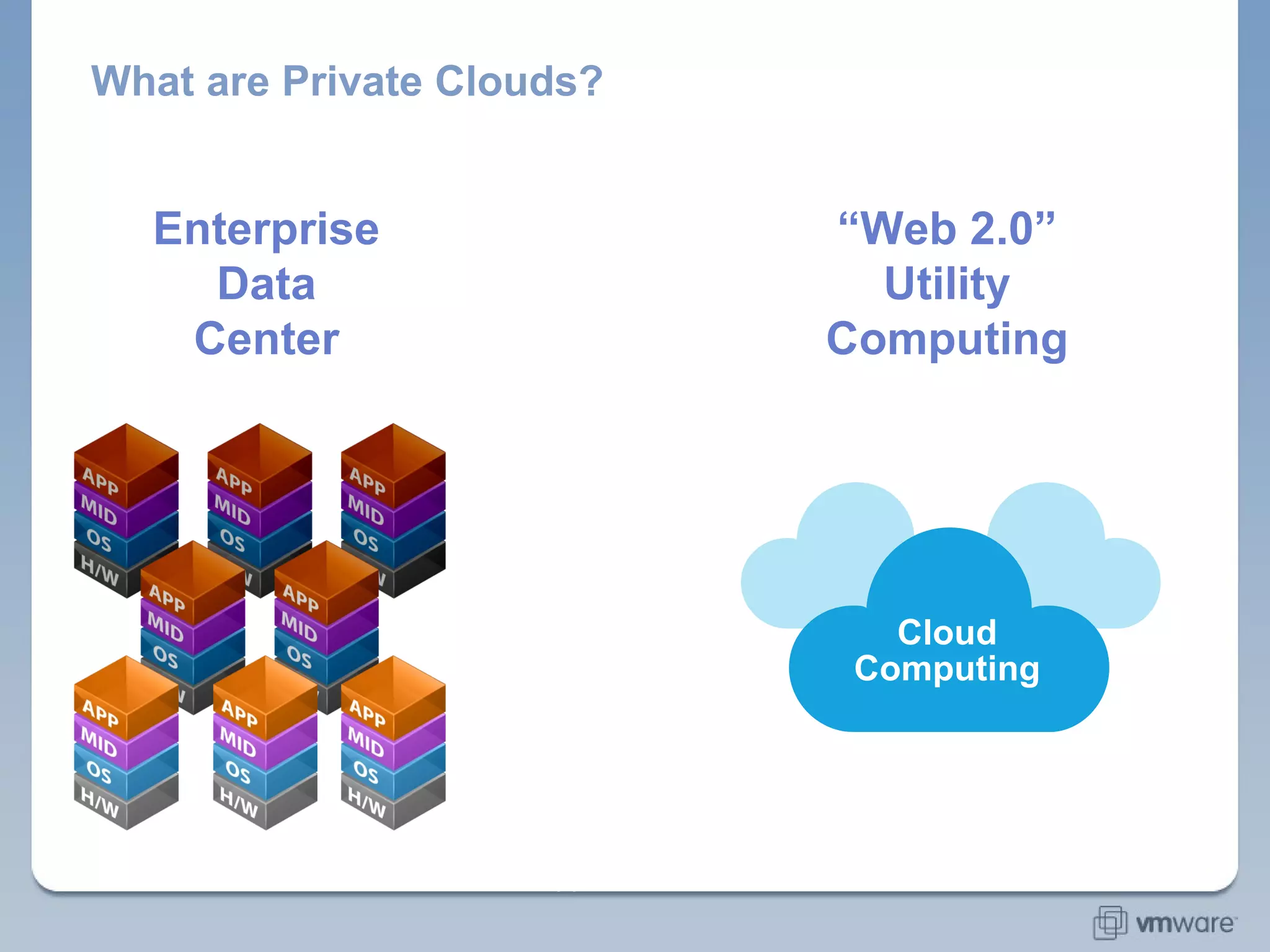
What are Private Clouds? 11 Replaced slide, notes remain the same Cloud Computing “ Web 2.0” Utility Computing Enterprise Data Center
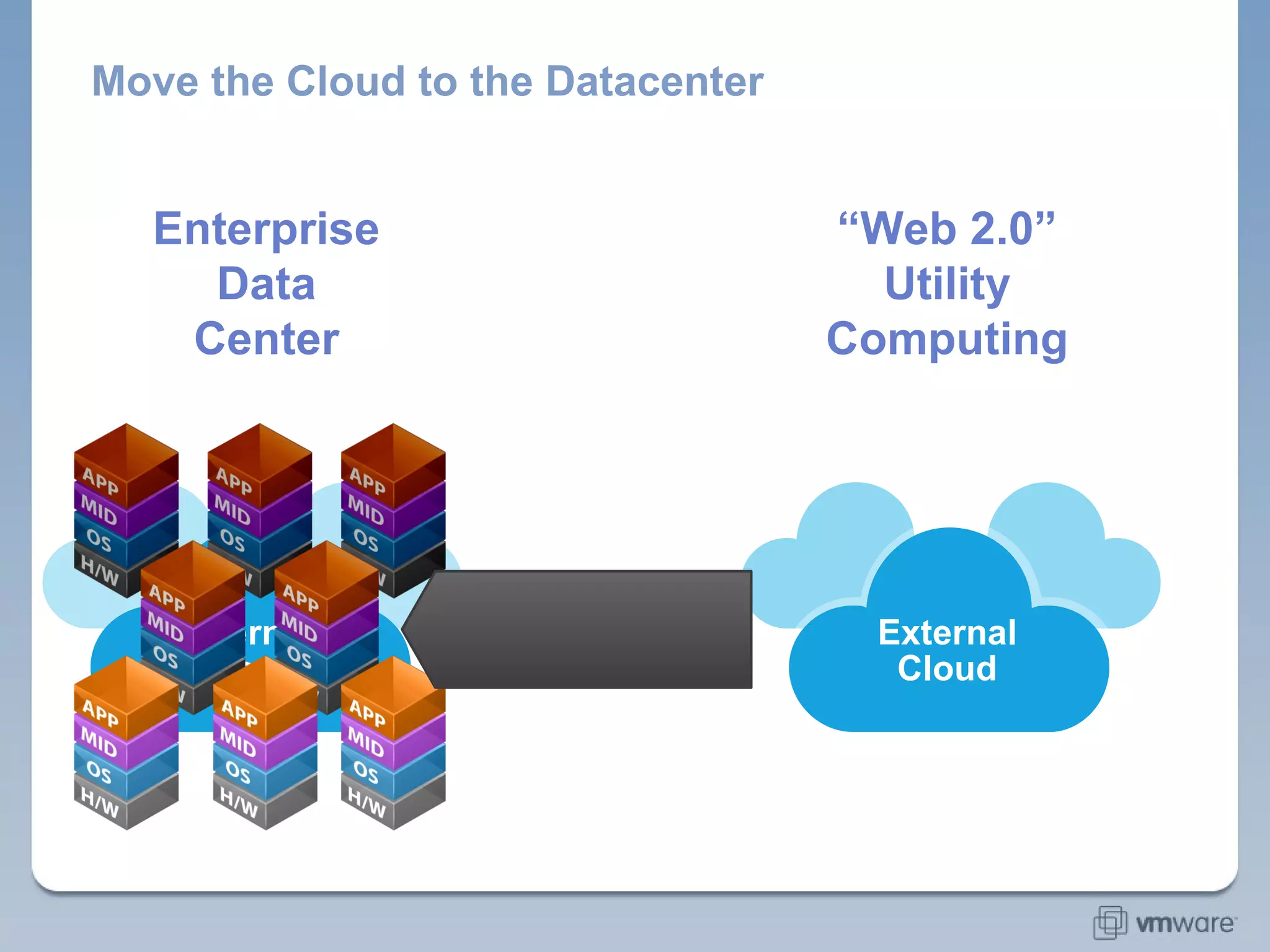
Move the Cloud to the Datacenter Replaced slide, notes remain the same Cloud Computing “ Web 2.0” Utility Computing Enterprise Data Center External Cloud Internal Cloud
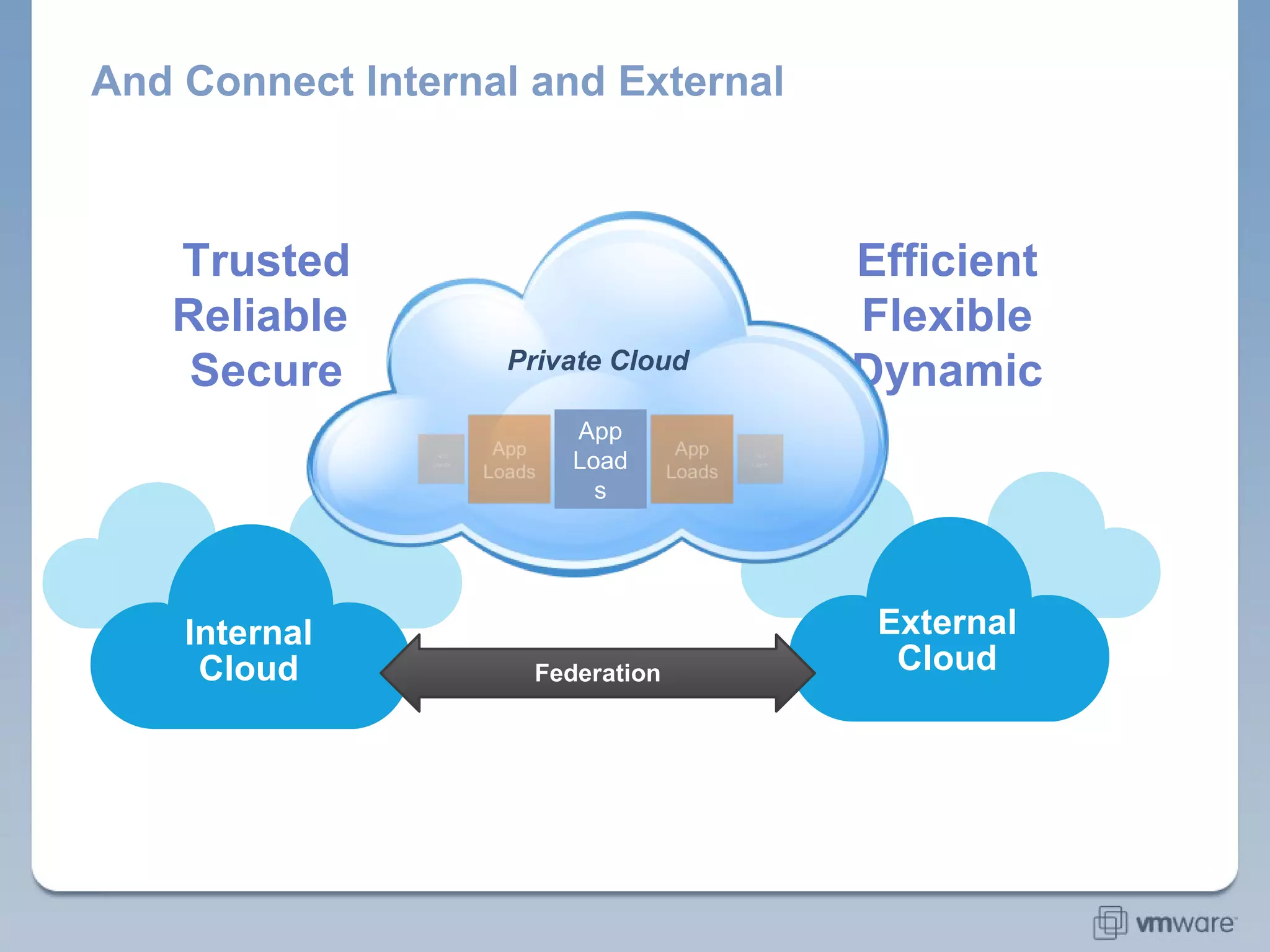
And Connect Internal and External Replaced slide, notes remain the same External Cloud Efficient Flexible Dynamic Trusted Reliable  Secure Internal Cloud Private Cloud App Loads Federation
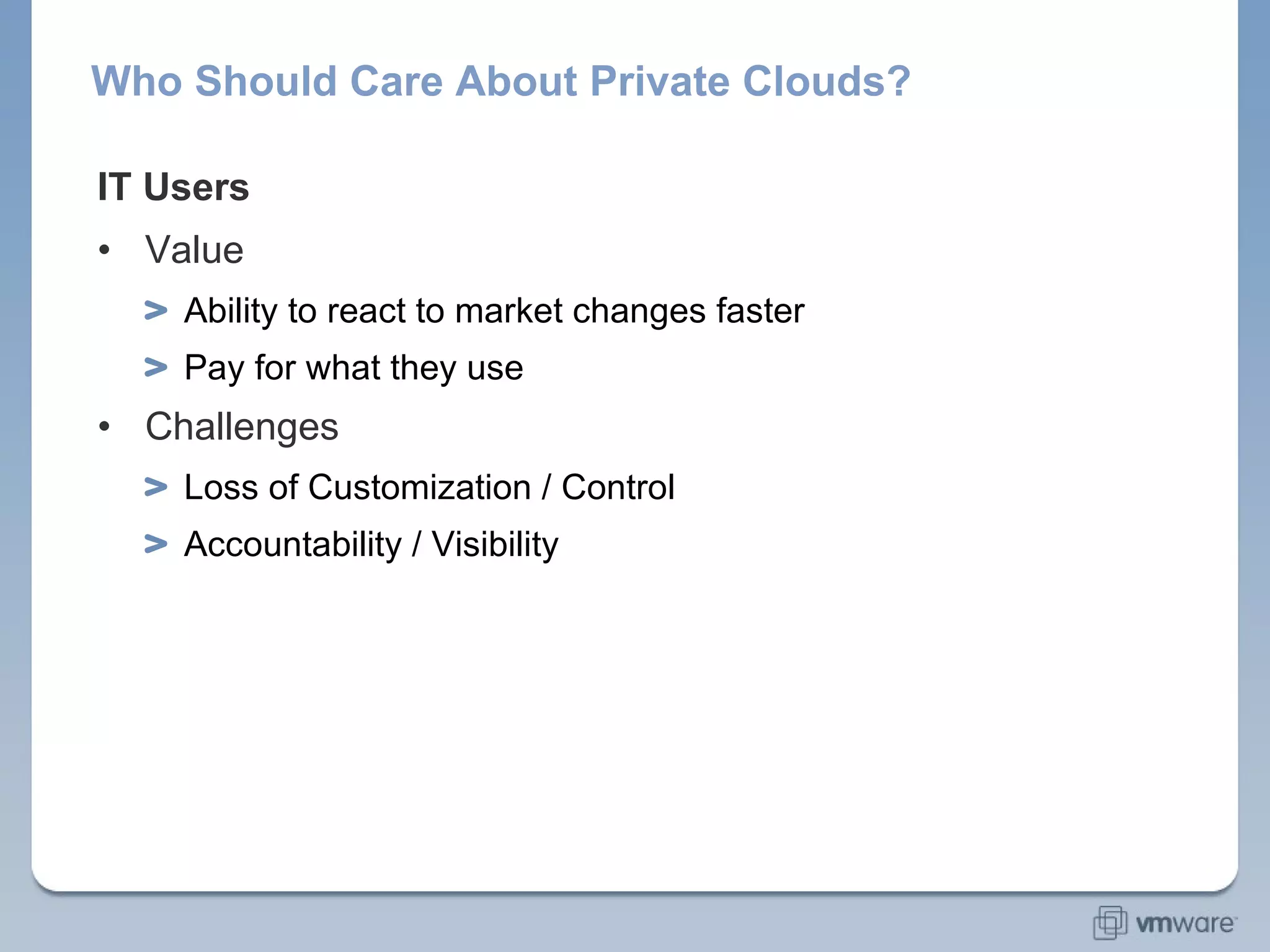
Who Should Care About Private Clouds? IT Users Value Ability to react to market changes faster Pay for what they use Challenges Loss of “My Server is Special / Custom” attitude Accountability / Visibility for resource utilization
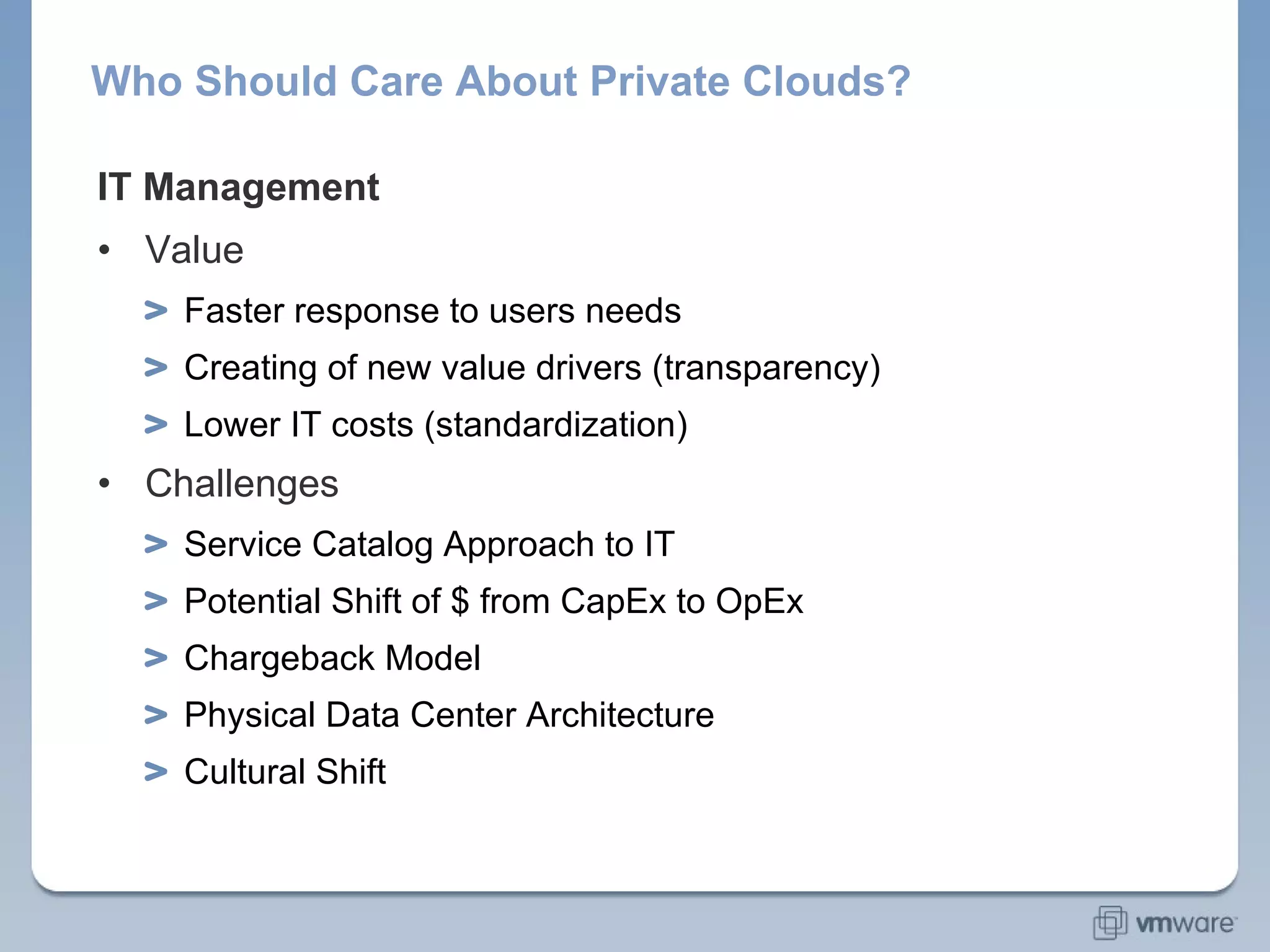
Who Should Care About Private Clouds? IT Management Value Faster response to users needs Creating of new value drivers (transparency) Lower IT costs (standardization) Challenges Service Catalog Approach to IT Potential Shift of $ from CapEx to OpEx Chargeback Model Physical Data Center Architecture Cultural Shift
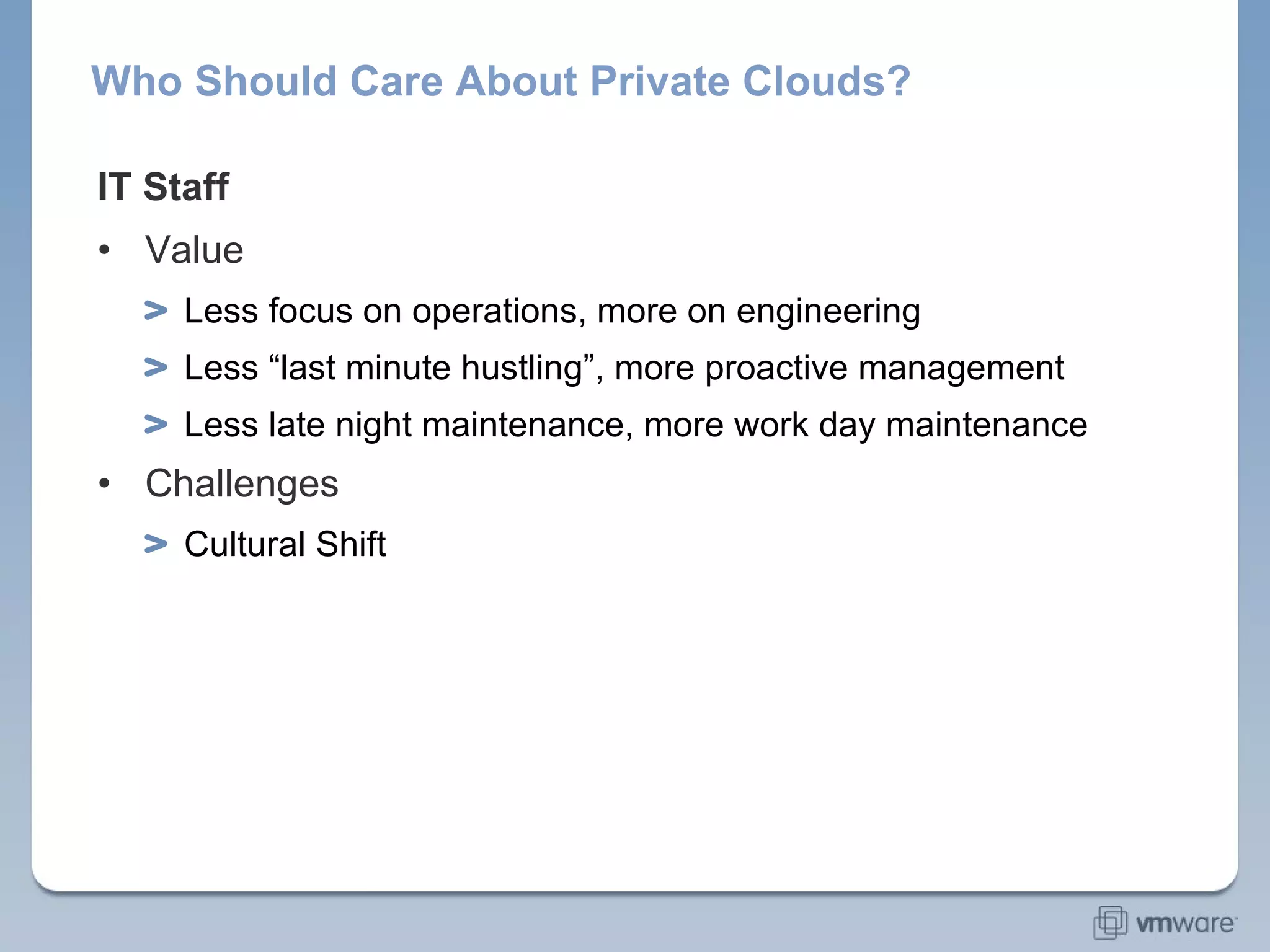
Who Should Care About Private Clouds? IT Staff Value Less focus on operations, more on engineering Less “last minute hustling”, more proactive management Less late night maintenance, more work day maintenance Challenges Cultural Shift
Who Should Care About Private Clouds? Application Developers Value Build apps the same way you do now No custom app frameworks No cloud specific app design paradigm Internal development clouds speed dev cycle and frees up “system administrator”  New Delivery Option: Virtual Appliance Challenges Culture Shift Prying fingers from the Server…
How are Private Clouds Built? 6 Step Process Virtualization Tier the Infrastructure in QoS Resource Pools Create a Standardized Service Catalogue Make it Available Through Self-Service Fully Automate App Hosting Leverage External Clouds
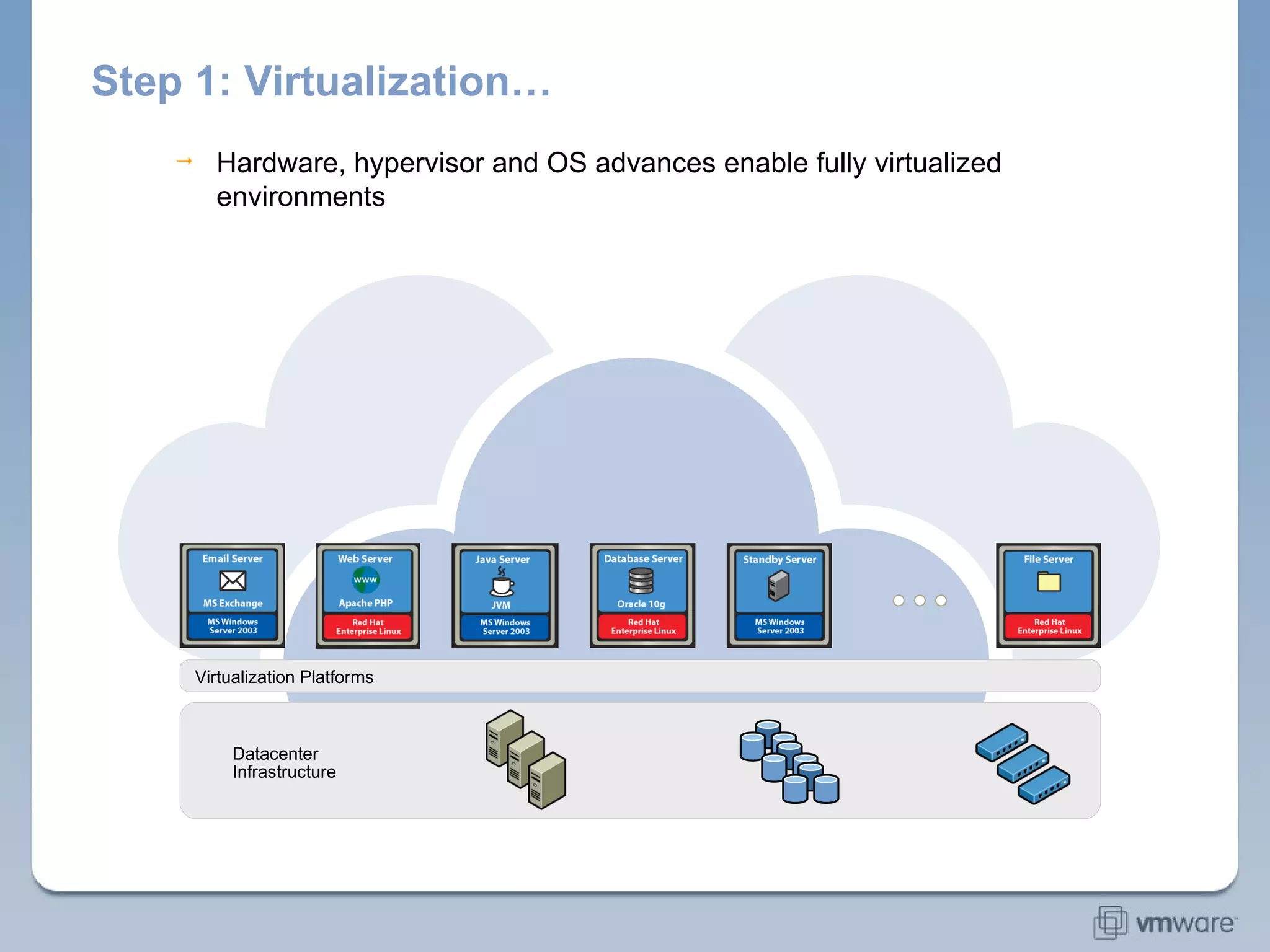
Step 1: Virtualization… Datacenter Infrastructure Virtualization Platforms Hardware, hypervisor and OS advances enable fully virtualized environments
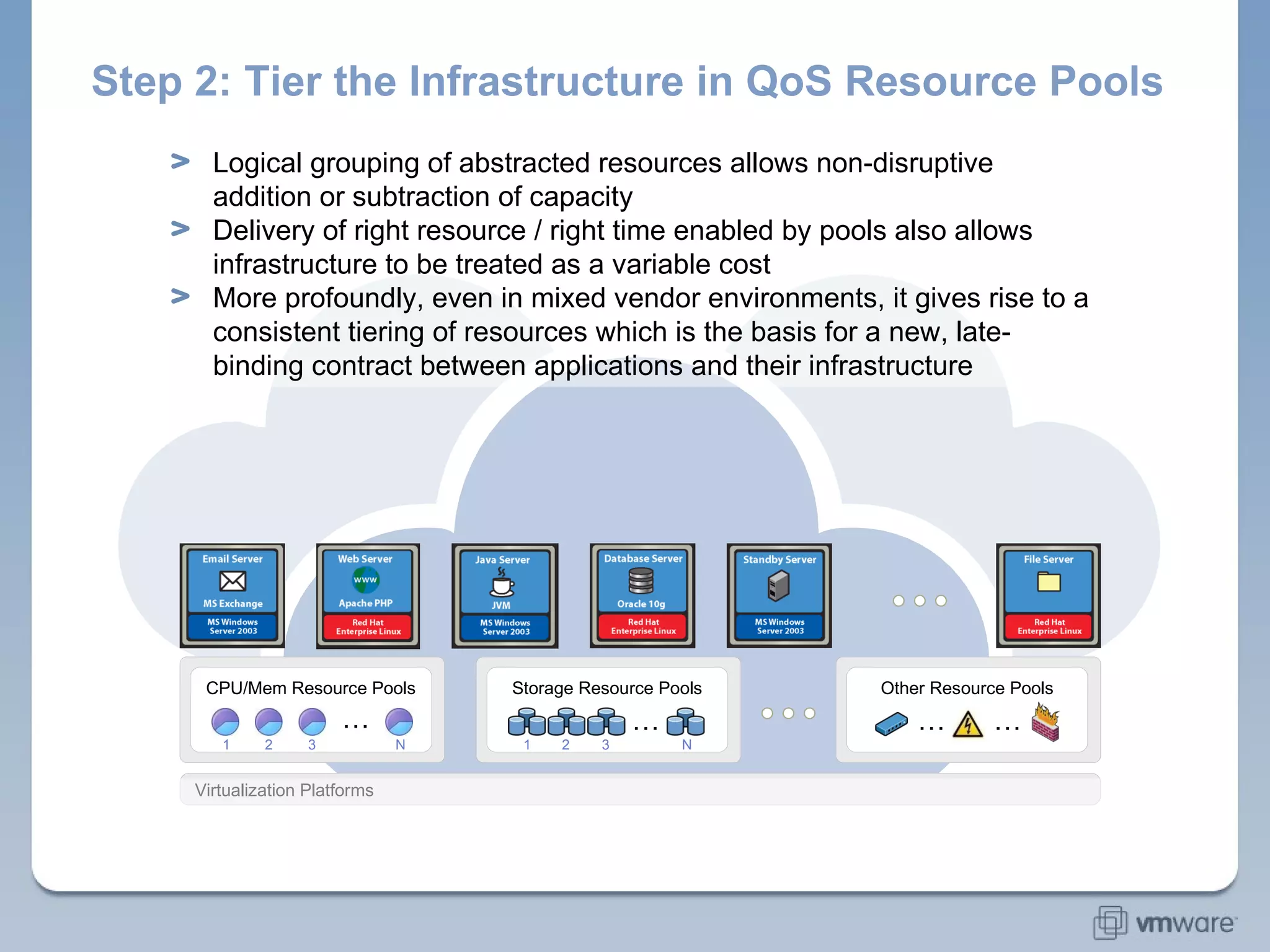
Step 2: Tier the Infrastructure in QoS Resource Pools CPU/Mem Resource Pools Other Resource Pools Storage Resource Pools Virtualization Platforms … 1 N 2 3 … 1 N 2 3 … … Logical grouping of abstracted resources allows non-disruptive addition or subtraction of capacity Delivery of right resource / right time enabled by pools also allows infrastructure to be treated as a variable cost More profoundly, even in mixed vendor environments, it gives rise to a consistent tiering of resources which is the basis for a new, late-binding contract between applications and their infrastructure
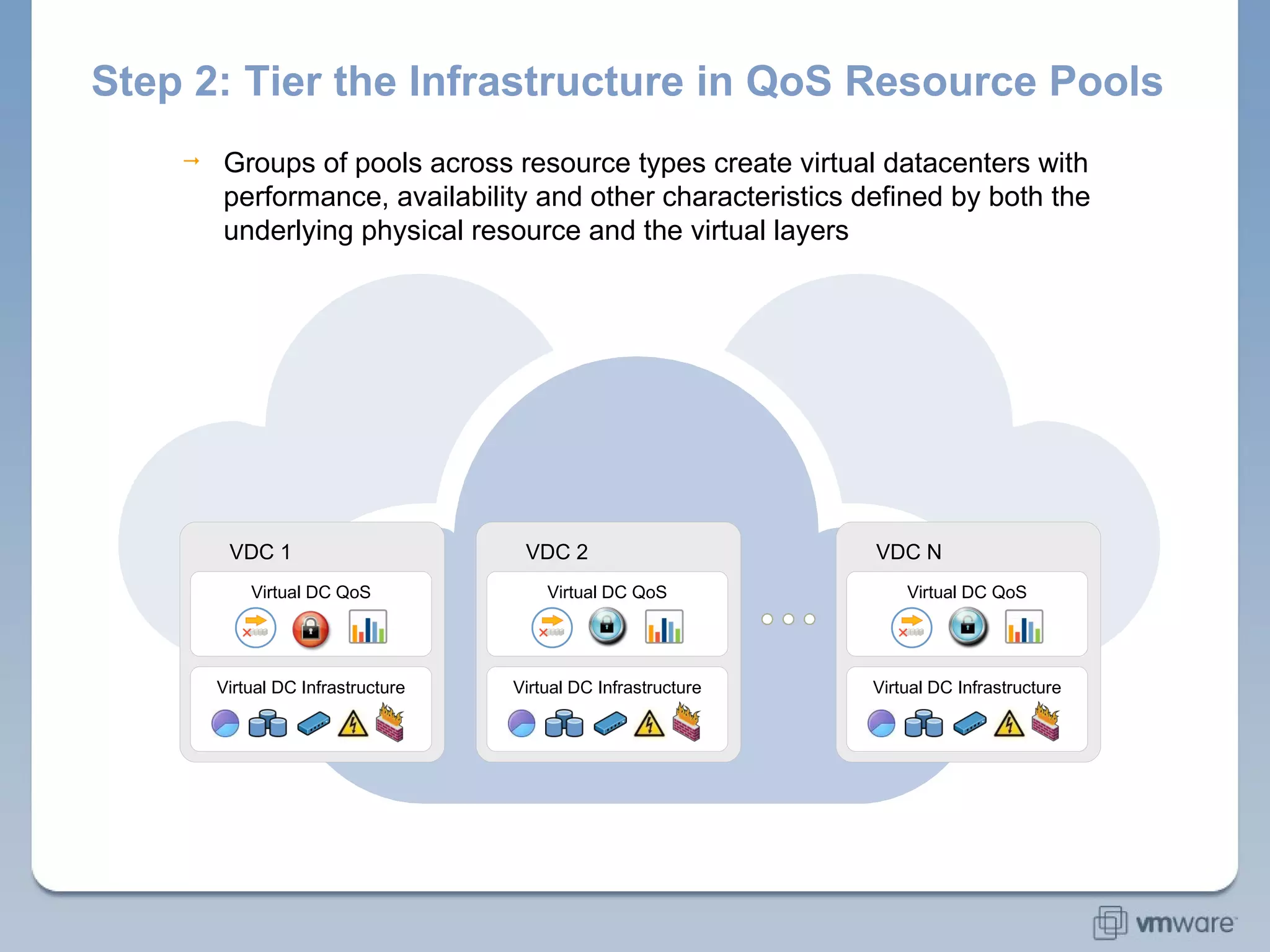
Step 2: Tier the Infrastructure in QoS Resource Pools Virtual DC Infrastructure Virtual DC Infrastructure Virtual DC Infrastructure VDC 1 VDC N VDC 2 Groups of pools across resource types create virtual datacenters with performance, availability and other characteristics defined by both the underlying physical resource and the virtual layers Virtual DC QoS Virtual DC QoS Virtual DC QoS
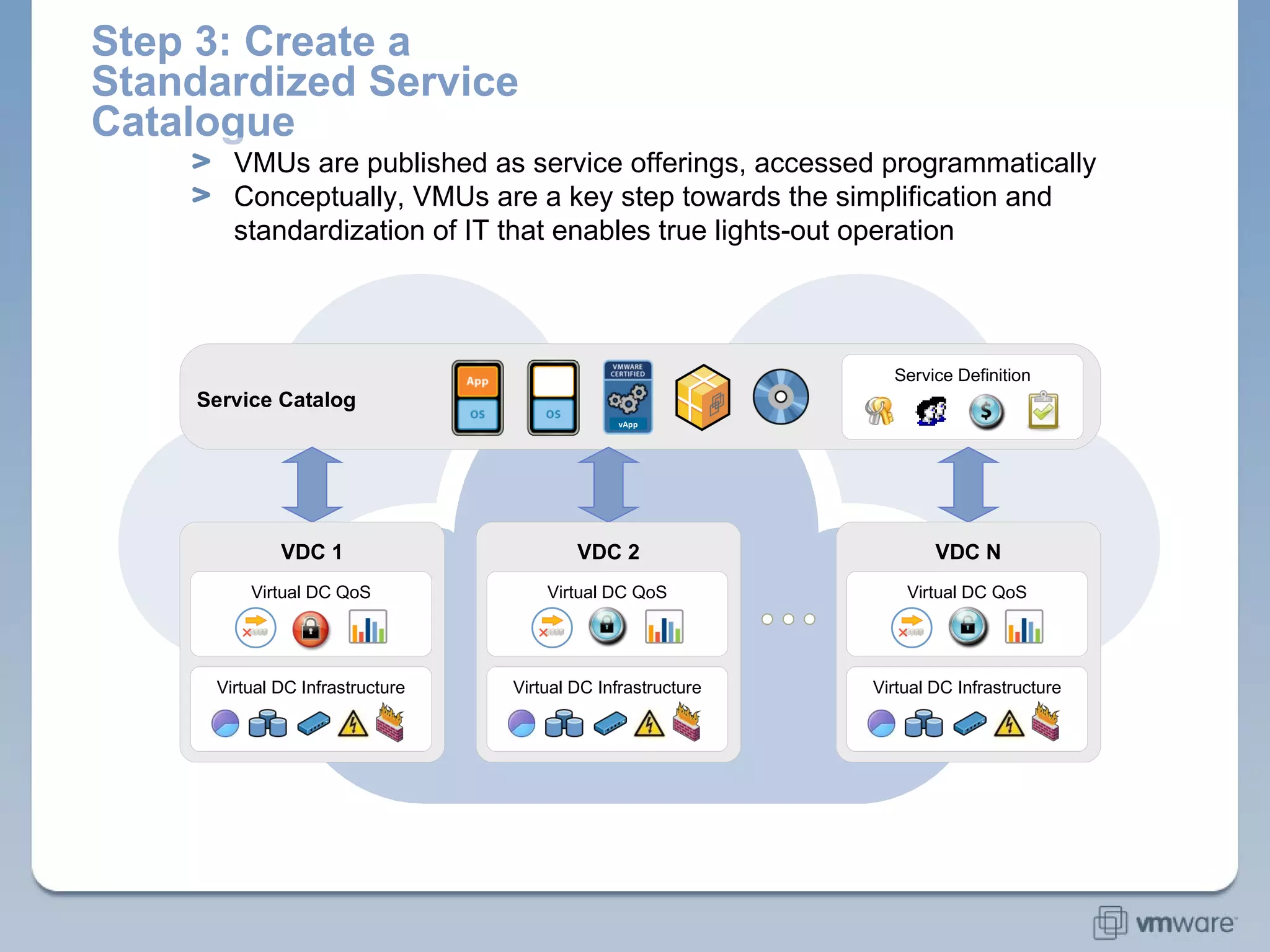
Step 3: Create a Standardized Service Catalogue Virtual DC Infrastructure Virtual DC Infrastructure Virtual DC Infrastructure VDC 1 VDC N VDC 2 Service Catalog VMUs are published as service offerings, accessed programmatically Conceptually, VMUs are a key step towards the simplification and standardization of IT that enables true lights-out operation Service Definition Virtual DC QoS Virtual DC QoS Virtual DC QoS vApp
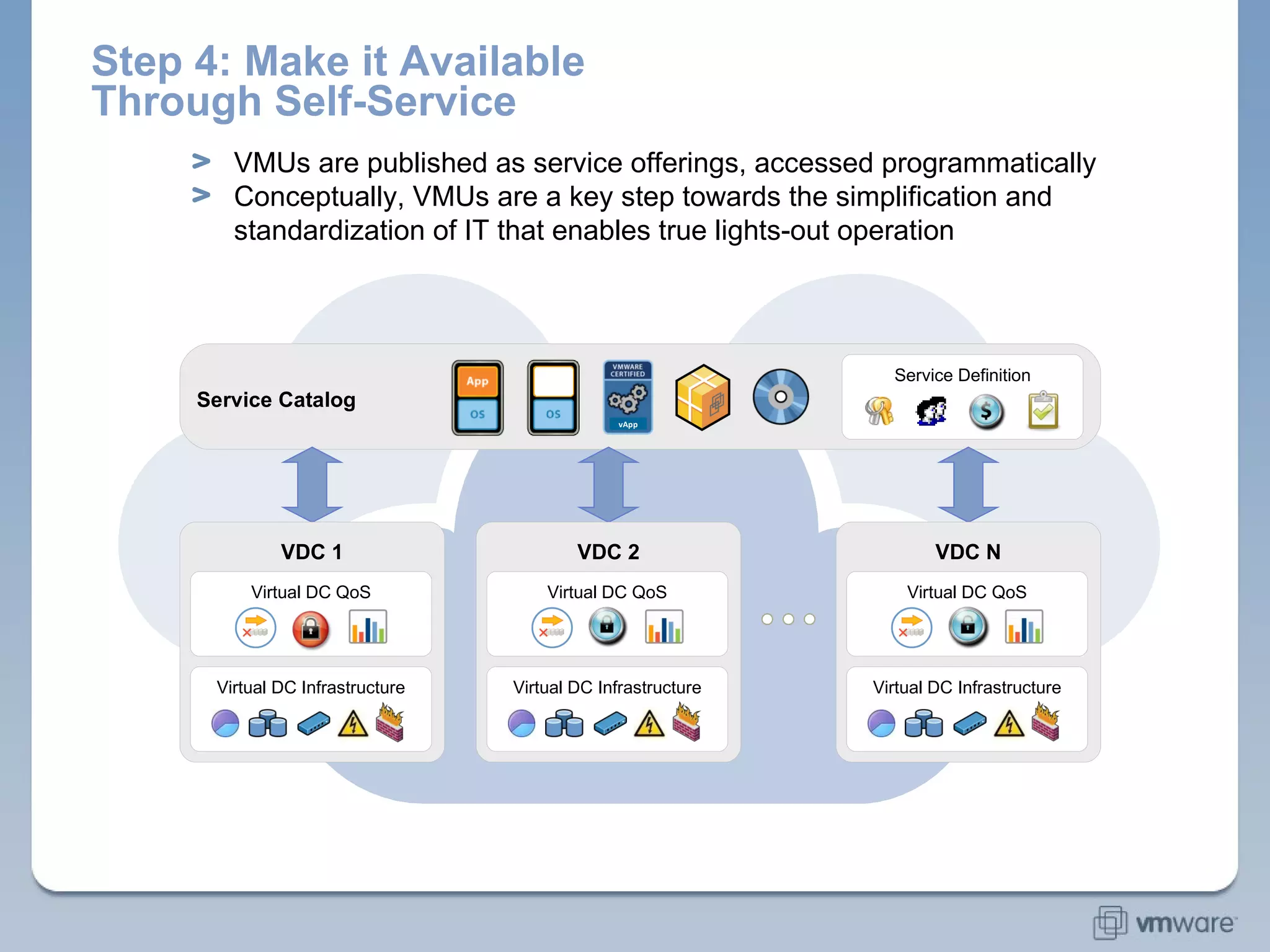
Step 4: Make it Available Through Self-Service Virtual DC Infrastructure Virtual DC Infrastructure Virtual DC Infrastructure VDC 1 VDC N VDC 2 Service Catalog VMUs are published as service offerings, accessed programmatically Conceptually, VMUs are a key step towards the simplification and standardization of IT that enables true lights-out operation Service Definition Virtual DC QoS Virtual DC QoS Virtual DC QoS vApp
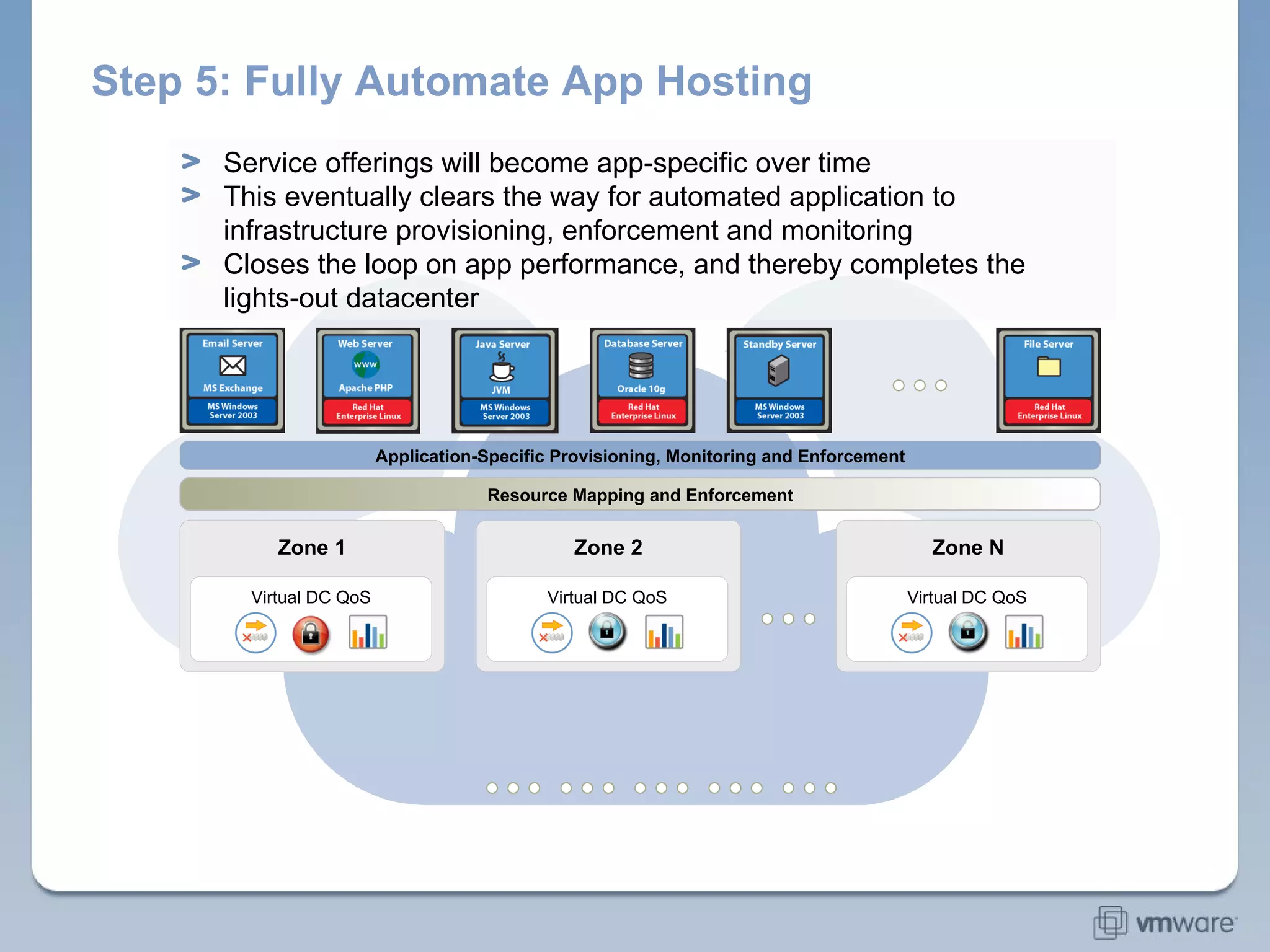
Step 5: Fully Automate App Hosting Application-Specific Provisioning, Monitoring and Enforcement Service offerings will become app-specific over time  This eventually clears the way for automated application to infrastructure provisioning, enforcement and monitoring  Closes the loop on app performance, and thereby completes the lights-out datacenter  Zone 1 Zone N Zone 2 Resource Mapping and Enforcement Virtual DC QoS Virtual DC QoS Virtual DC QoS
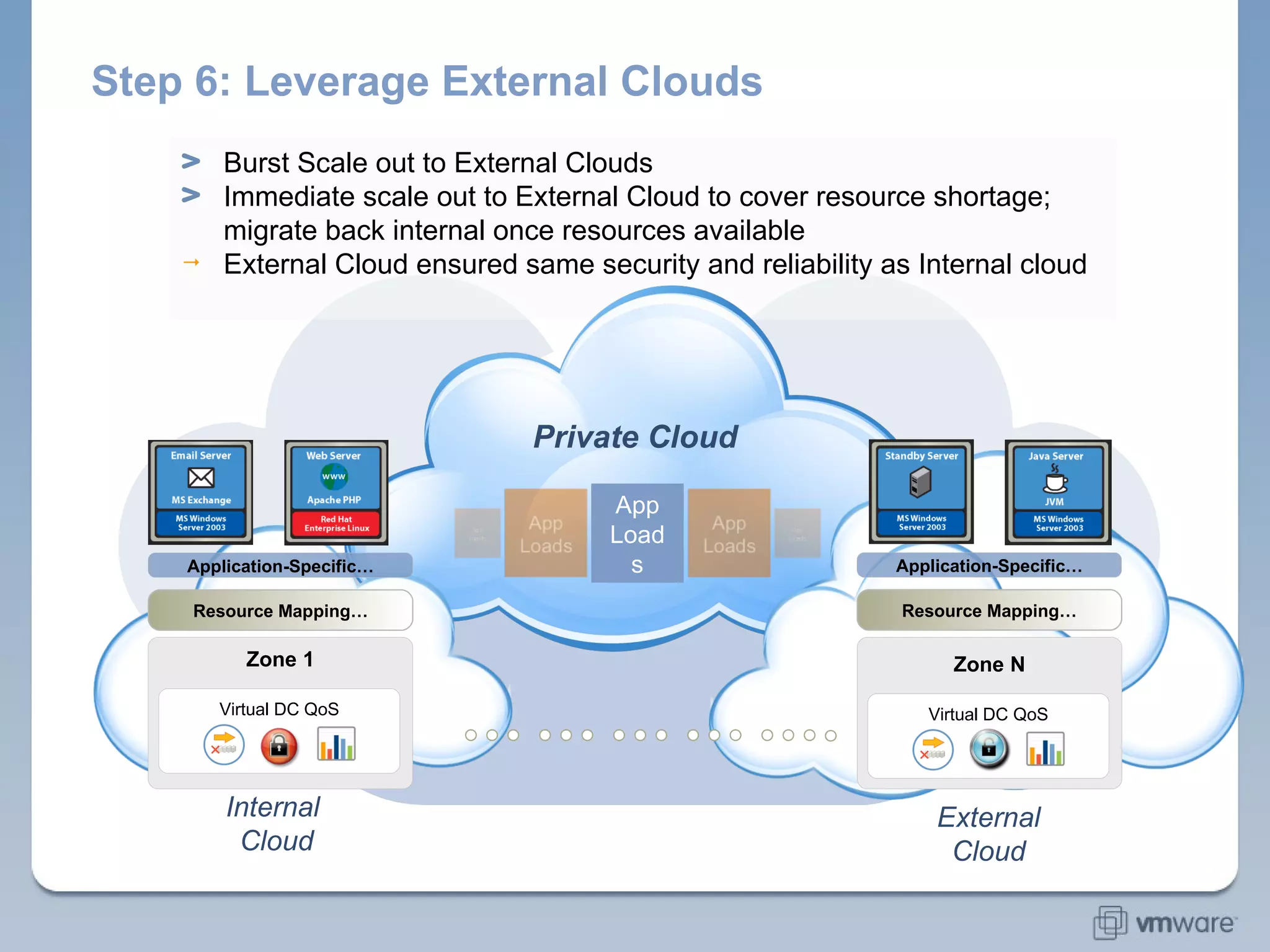
Step 6: Leverage External Clouds Burst Scale out to External Clouds Immediate scale out to External Cloud to cover resource shortage; migrate back internal once resources available External Cloud ensured same security and reliability as Internal cloud Private Cloud Internal  Cloud App Loads External Cloud Virtual DC QoS Zone 1 Virtual DC QoS Zone N Application-Specific… Resource Mapping… Application-Specific… Resource Mapping…
VMware Private Clouds VMware Private Clouds (Photo by Nicholas_T @ Flickr)
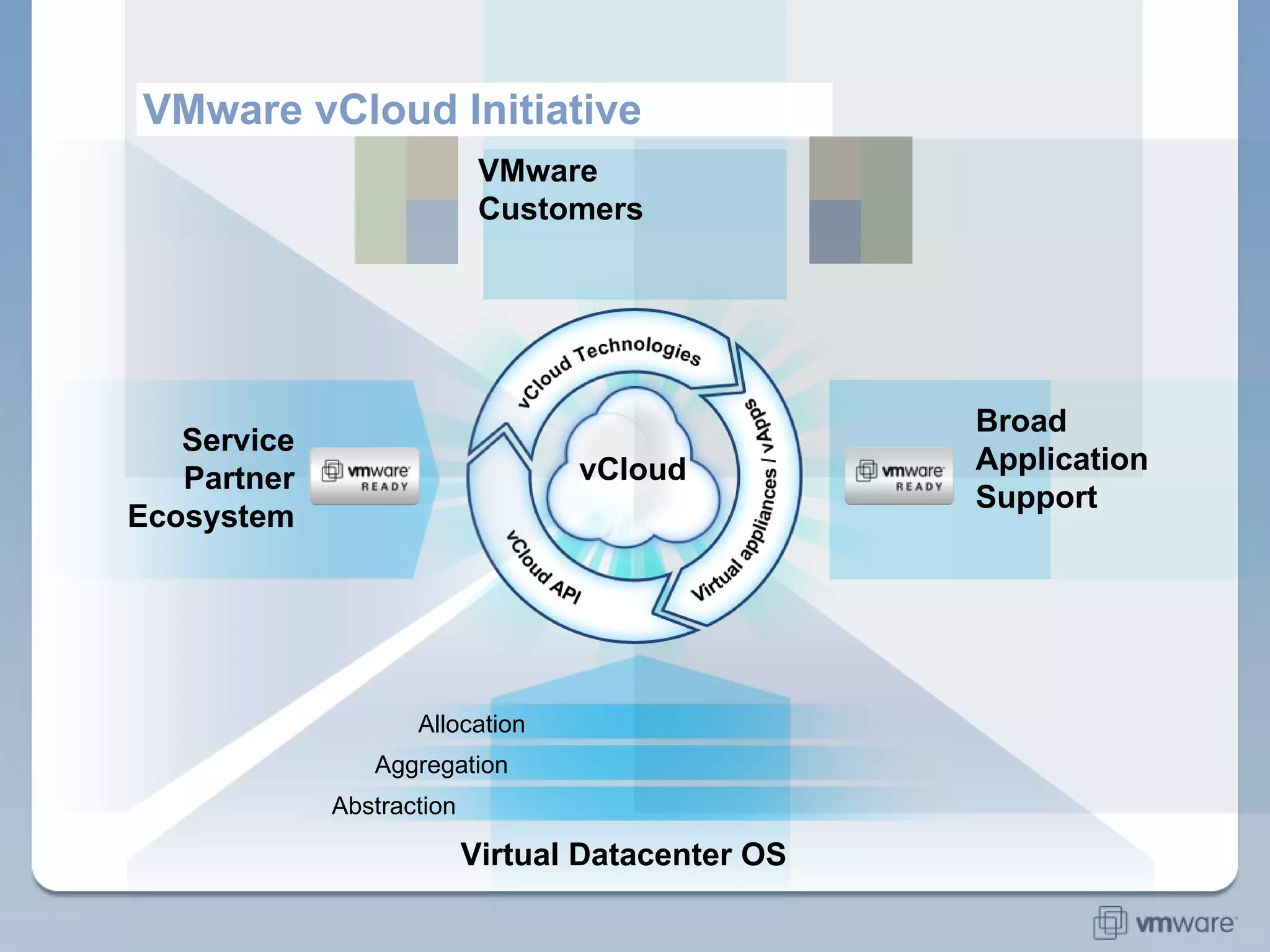
VMware vCloud Initiative vCloud Virtual Datacenter OS Abstraction Aggregation Allocation Broad Application Support VMware  Customers Service Partner Ecosystem
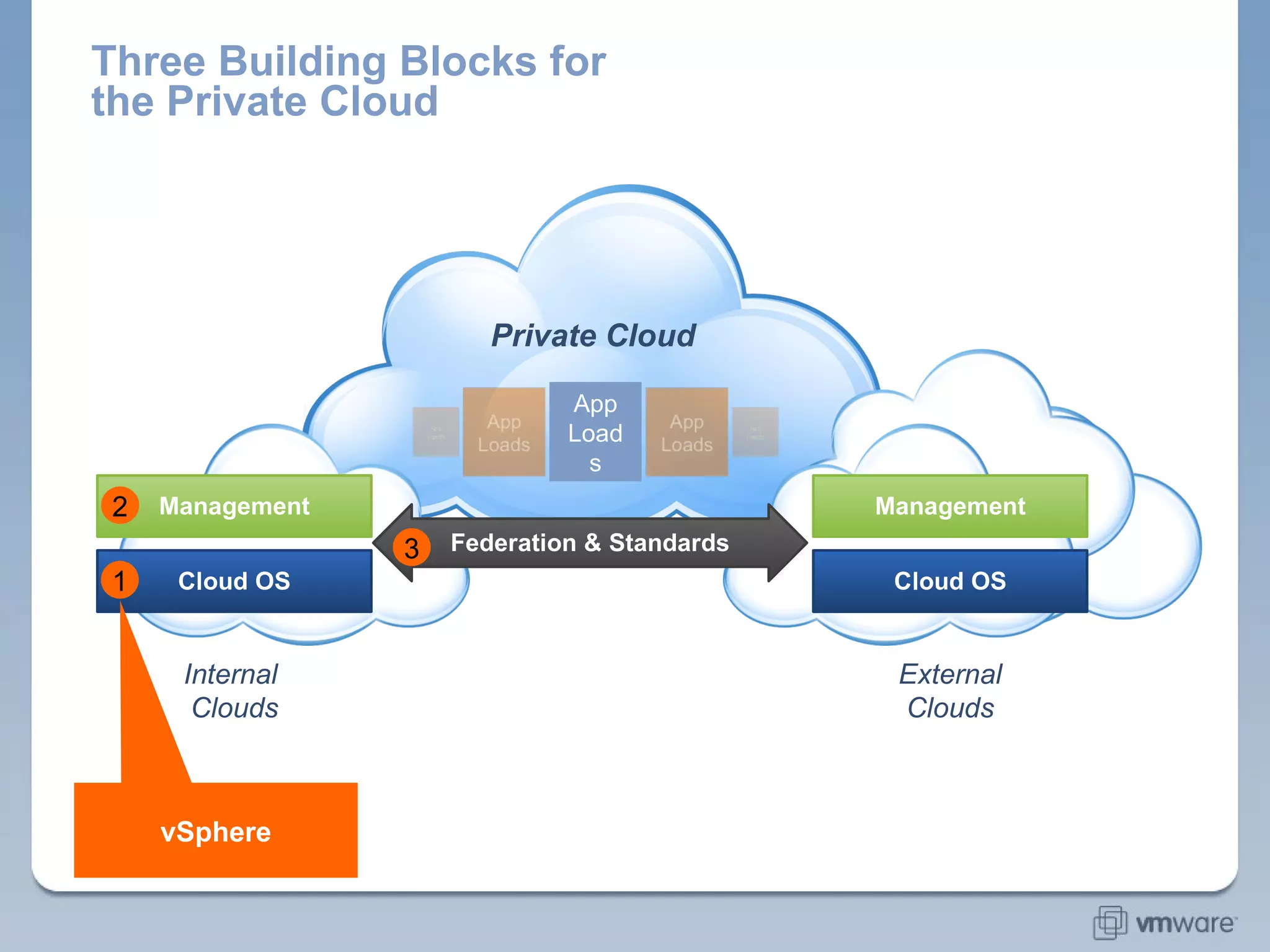
Three Building Blocks for the Private Cloud Private Cloud Internal  Clouds Cloud OS Management Federation & Standards External Clouds Cloud OS Management vSphere App Loads 2 3 1
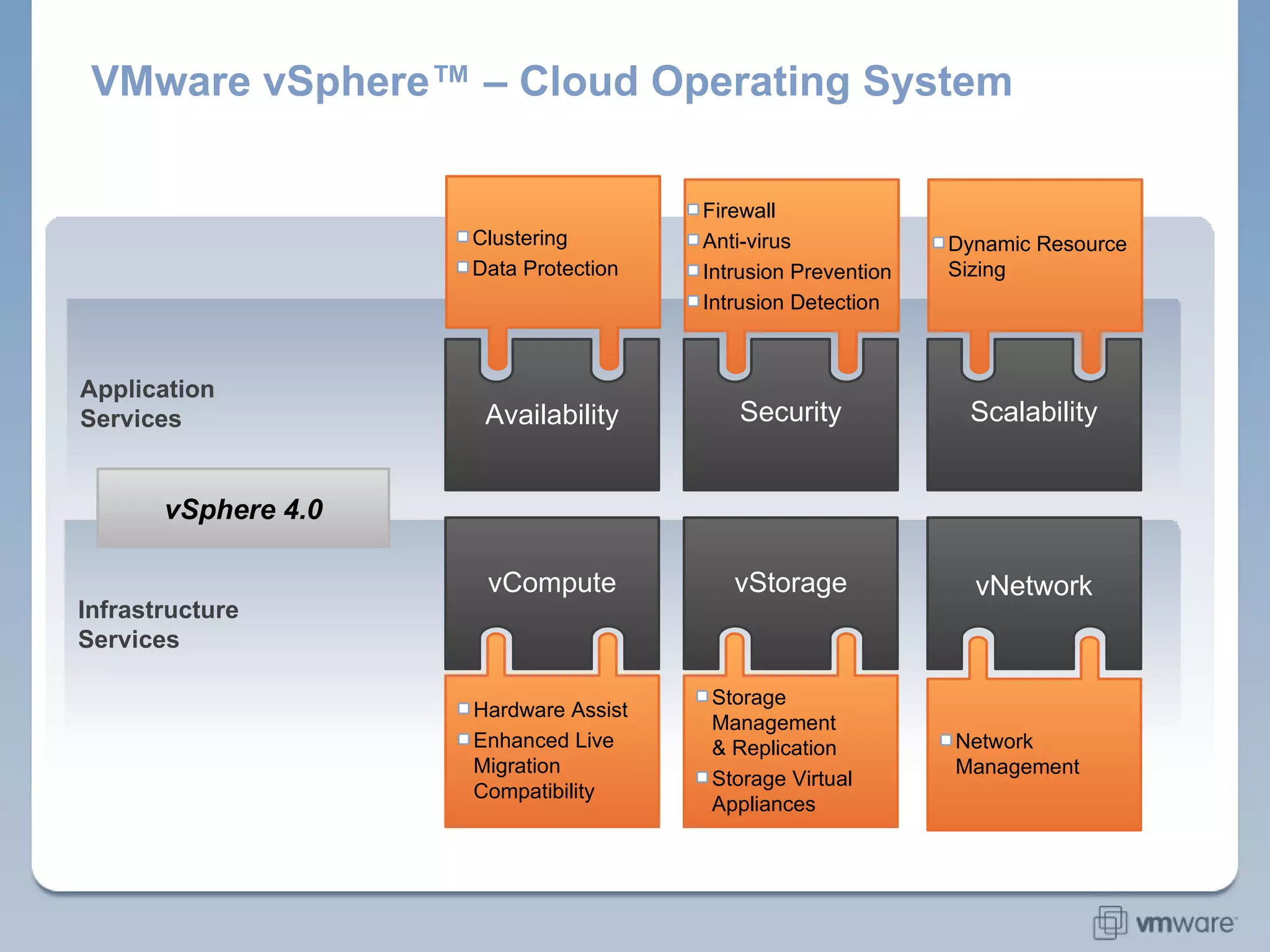
VMware vSphere™ – Cloud Operating System Application  Services Infrastructure  Services Scalability vSphere 4.0 Security Availability vNetwork vStorage vCompute Dynamic Resource  Sizing Network  Management Firewall Anti-virus Intrusion Prevention Intrusion Detection Clustering Data Protection Storage Management  & Replication Storage Virtual  Appliances Hardware Assist Enhanced Live  Migration Compatibility
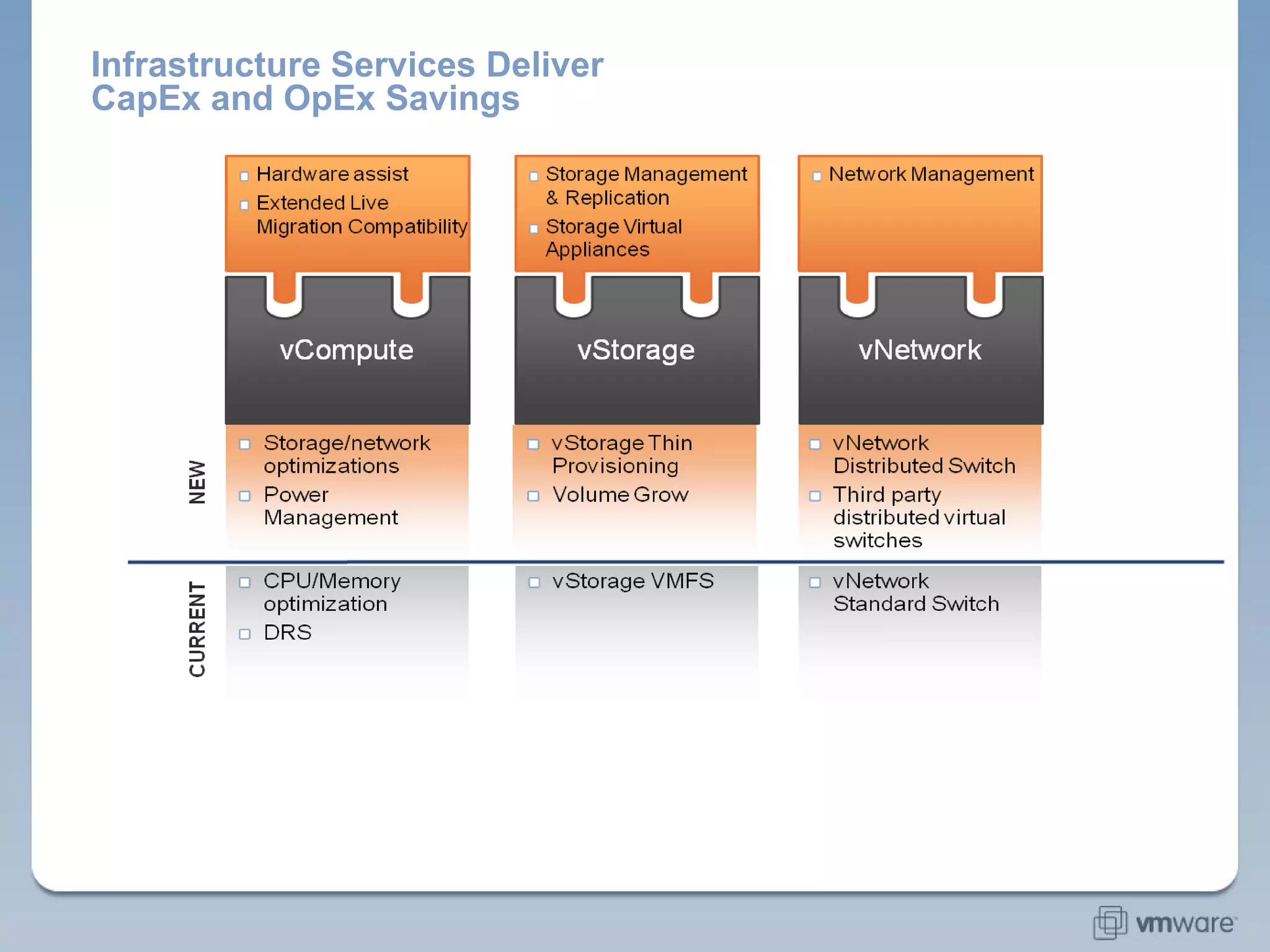
Infrastructure Services Deliver CapEx and OpEx Savings Highest consolidation ratios in the industry Most efficient use of hardware resources Low operational overhead
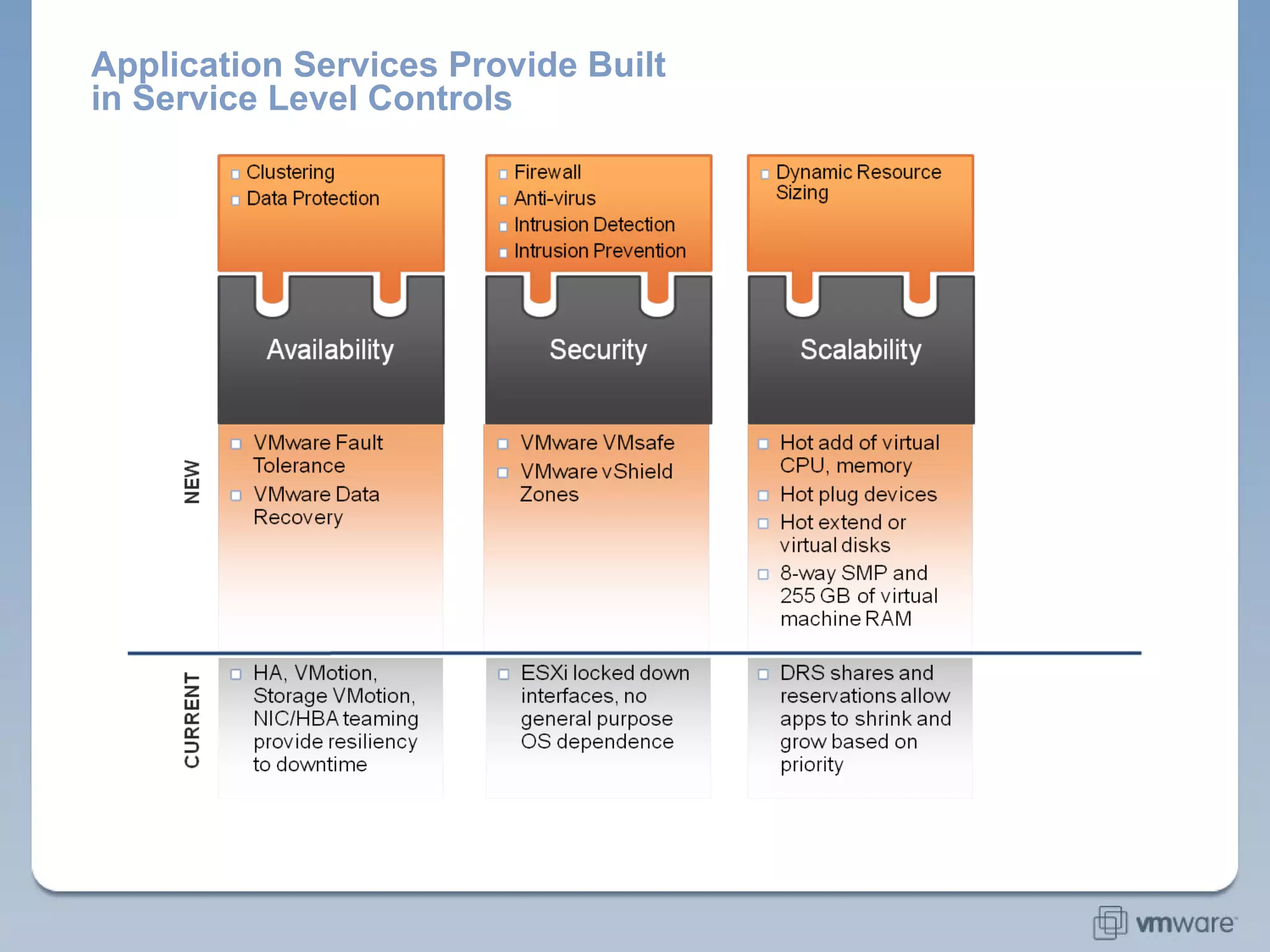
Application Services Provide Built in Service Level Controls
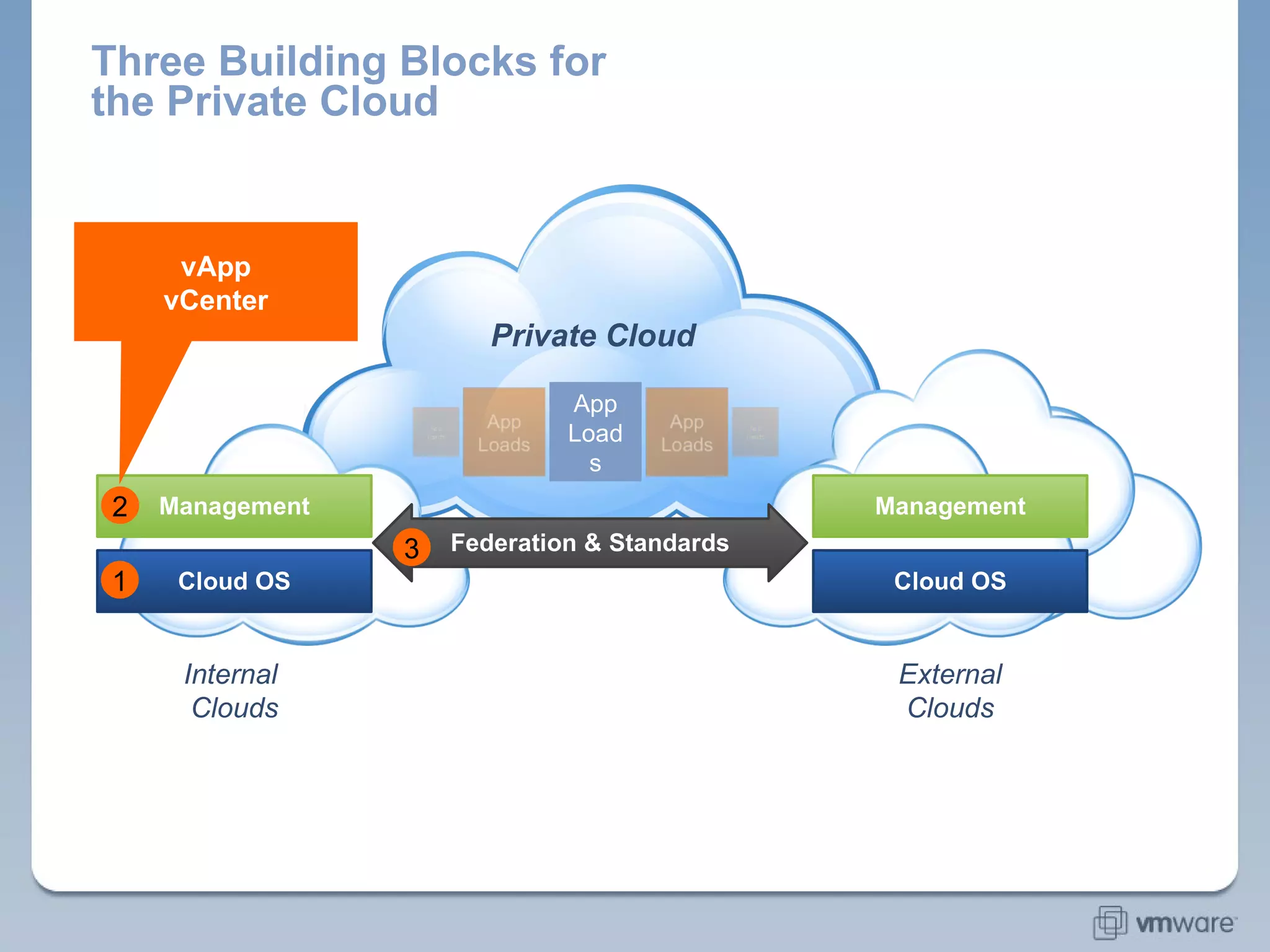
Three Building Blocks for the Private Cloud Private Cloud Internal  Clouds Cloud OS Management Federation & Standards External Clouds Cloud OS Management vApp vCenter App Loads 2 3 1
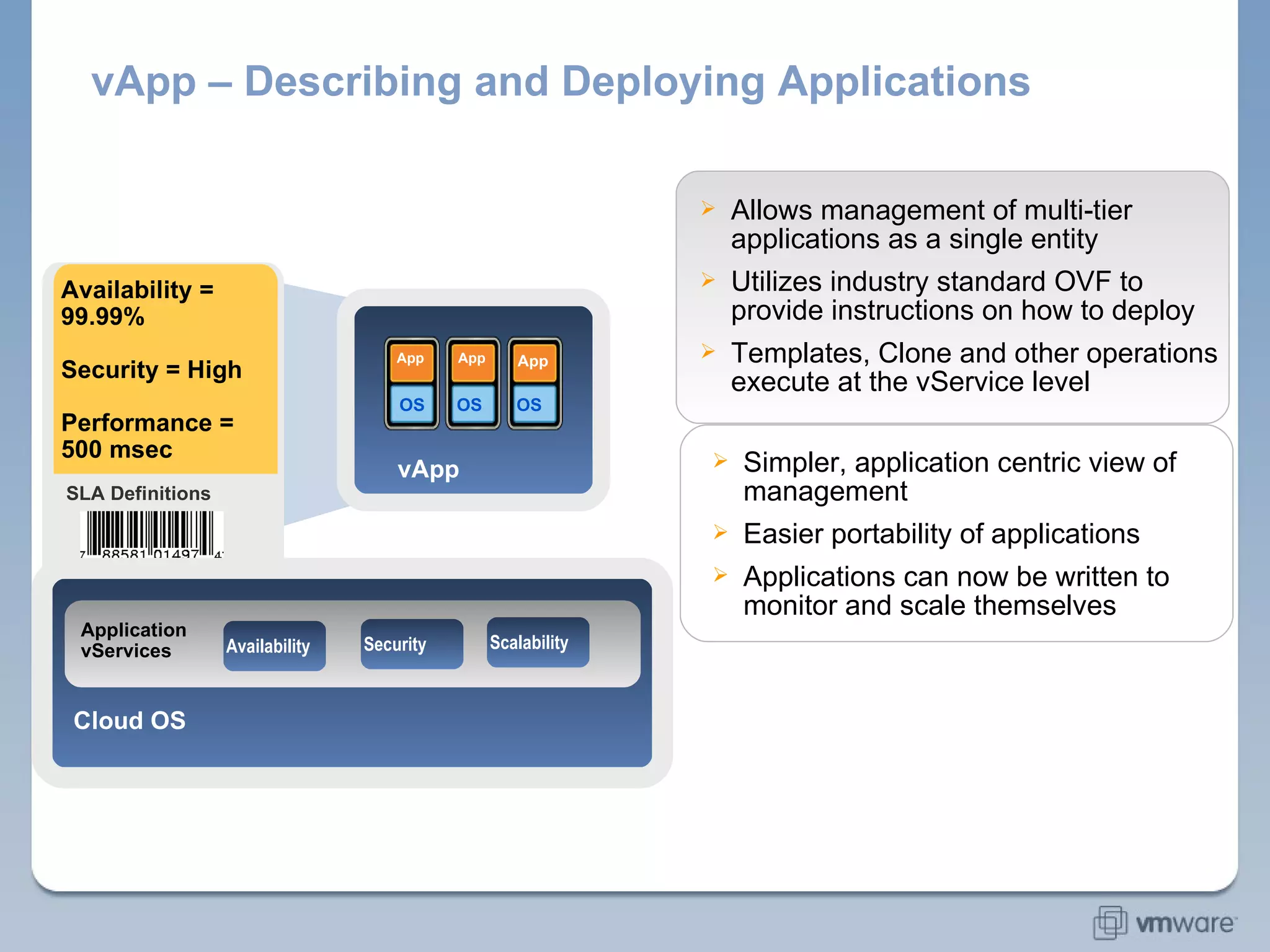
vApp – Describing and Deploying Applications Availability = 99.99% Security = High Performance = 500 msec SLA Definitions Cloud OS Application  vServices Scalability Security Availability Allows management of multi-tier applications as a single entity  Utilizes industry standard OVF to provide instructions on how to deploy Templates, Clone and other operations execute at the vService level Simpler, application centric view of management Easier portability of applications Applications can now be written to monitor and scale themselves vApp App OS App OS App OS
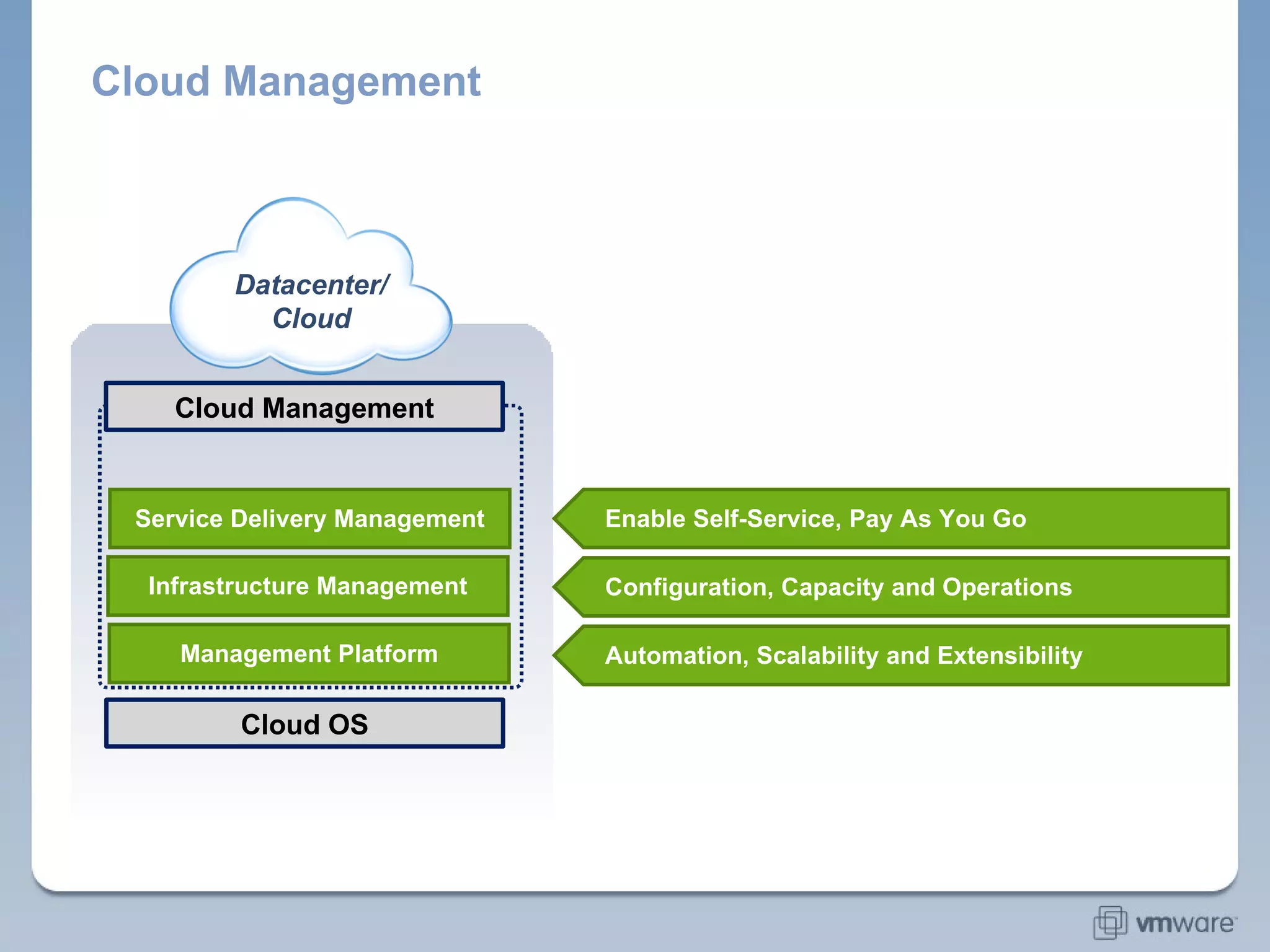
Cloud Management Management Platform Cloud OS Infrastructure Management Service Delivery Management Automation, Scalability and Extensibility Configuration, Capacity and Operations Enable Self-Service, Pay As You Go Cloud Management Datacenter/ Cloud
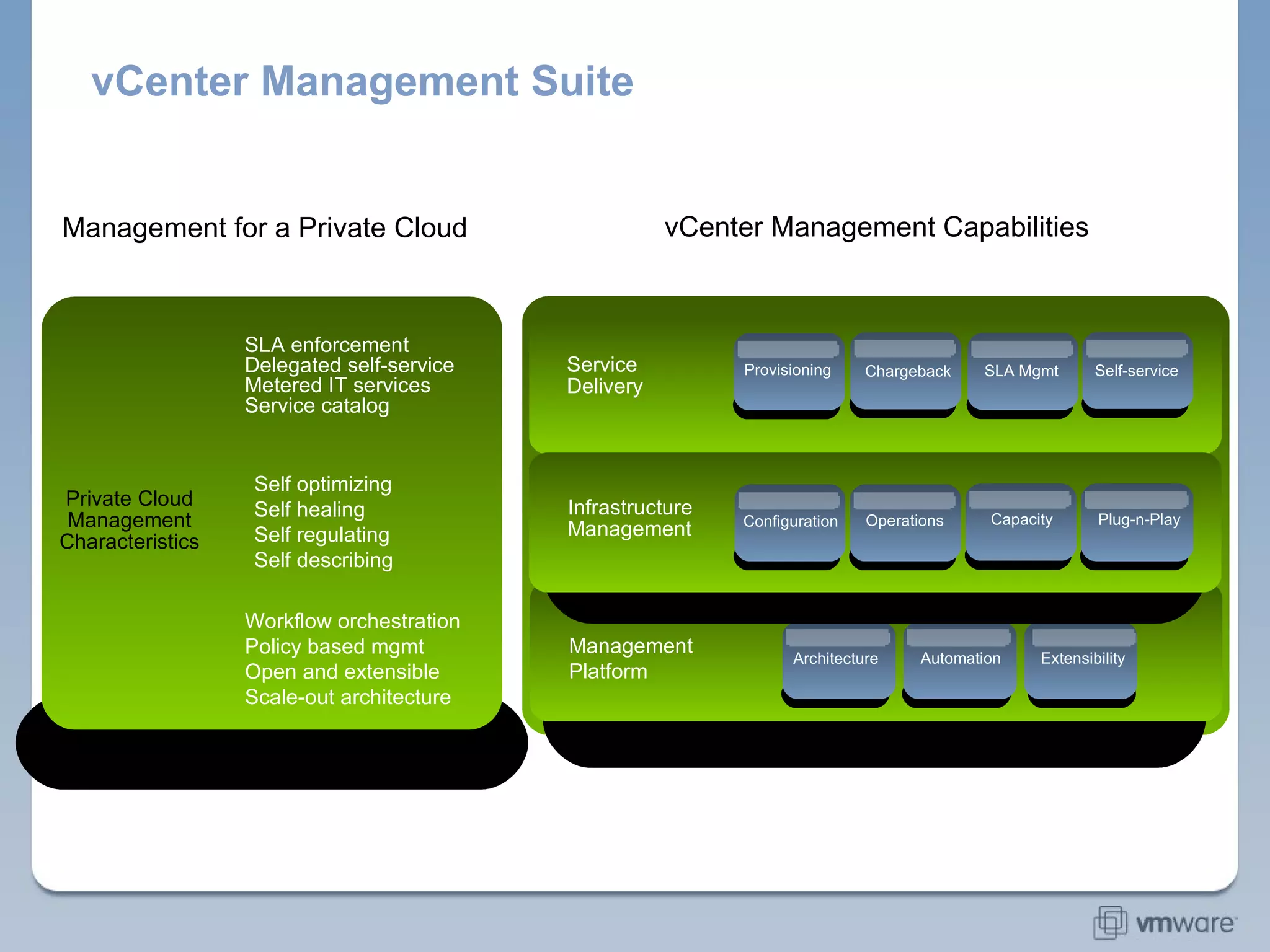
vCenter Management Suite Infrastructure Management Infrastructure Management Workflow orchestration  Policy based mgmt Open and extensible Scale-out architecture SLA enforcement Delegated self-service Metered IT services Service catalog Private Cloud Management Characteristics Self optimizing Self healing Self regulating Self describing Management for a Private Cloud vCenter Management Capabilities Management Platform Automation Extensibility Infrastructure Management Infrastructure Management Capacity Chargeback Configuration Operations Architecture Service  Delivery SLA Mgmt Self-service Plug-n-Play Provisioning
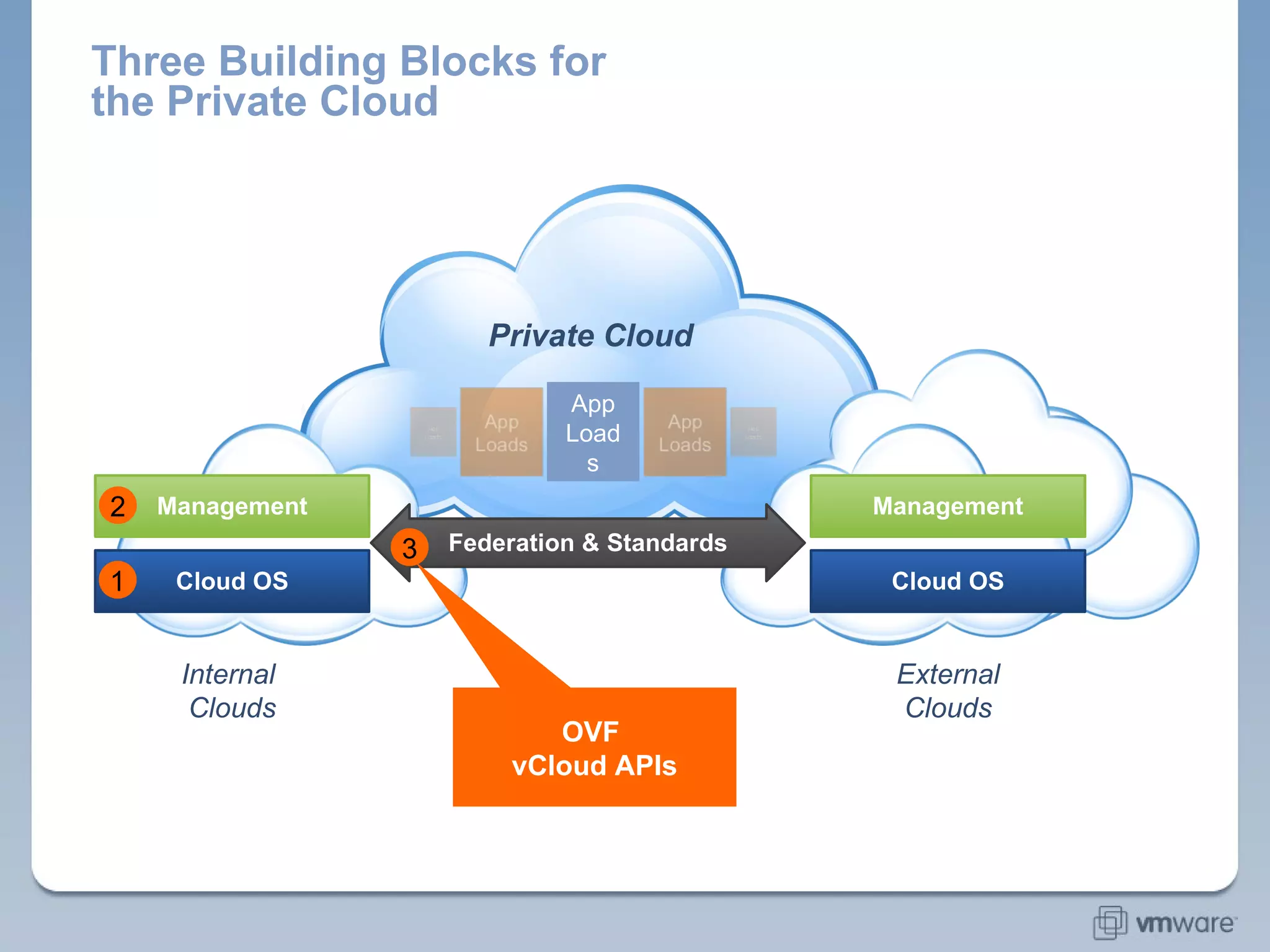
Three Building Blocks for the Private Cloud Private Cloud Internal  Clouds Cloud OS Management Federation & Standards External Clouds Cloud OS Management OVF  vCloud APIs App Loads 2 3 1
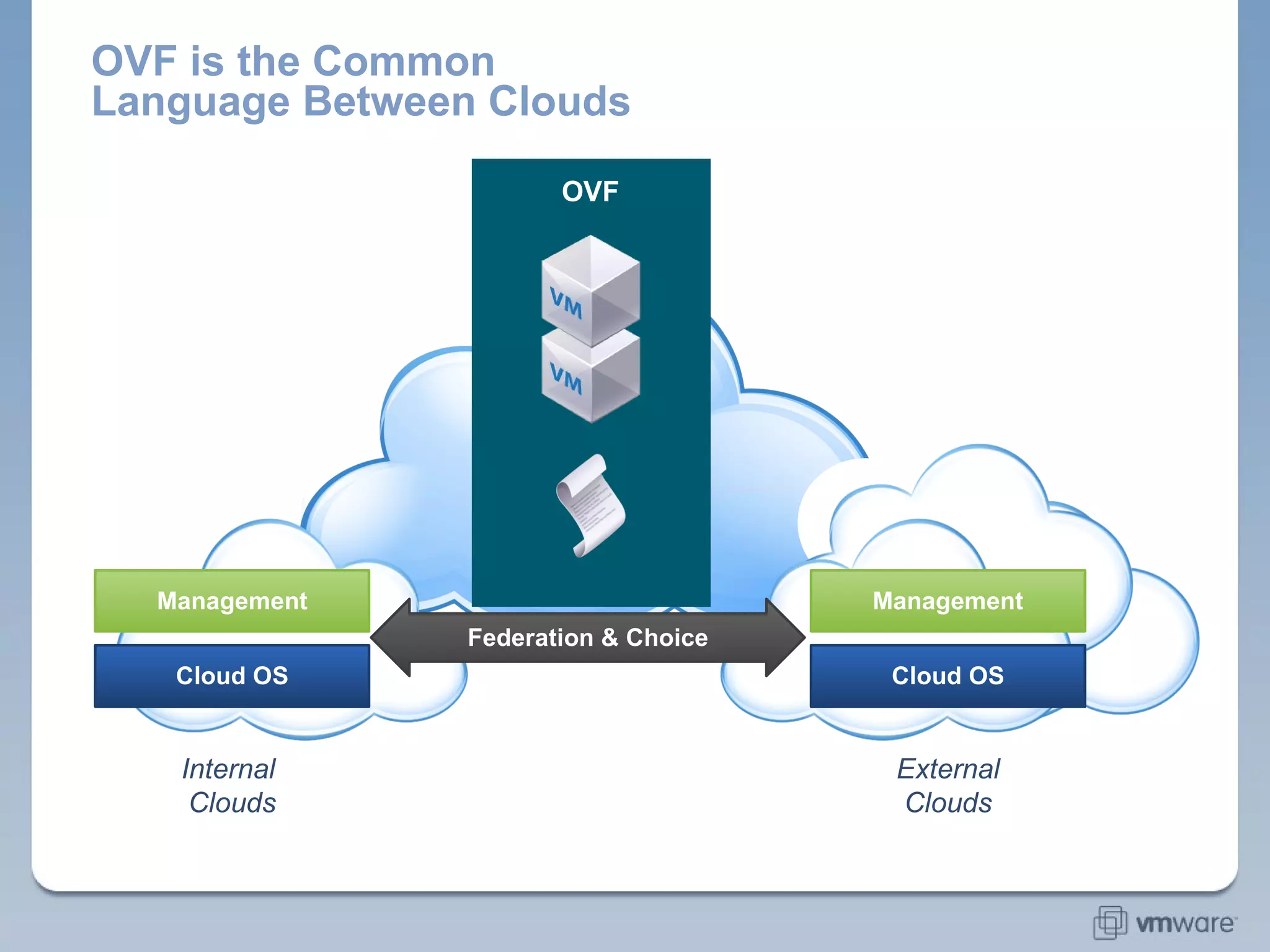
OVF is the Common Language Between Clouds Internal  Clouds Cloud OS Management External Clouds Cloud OS Management Federation & Choice OVF
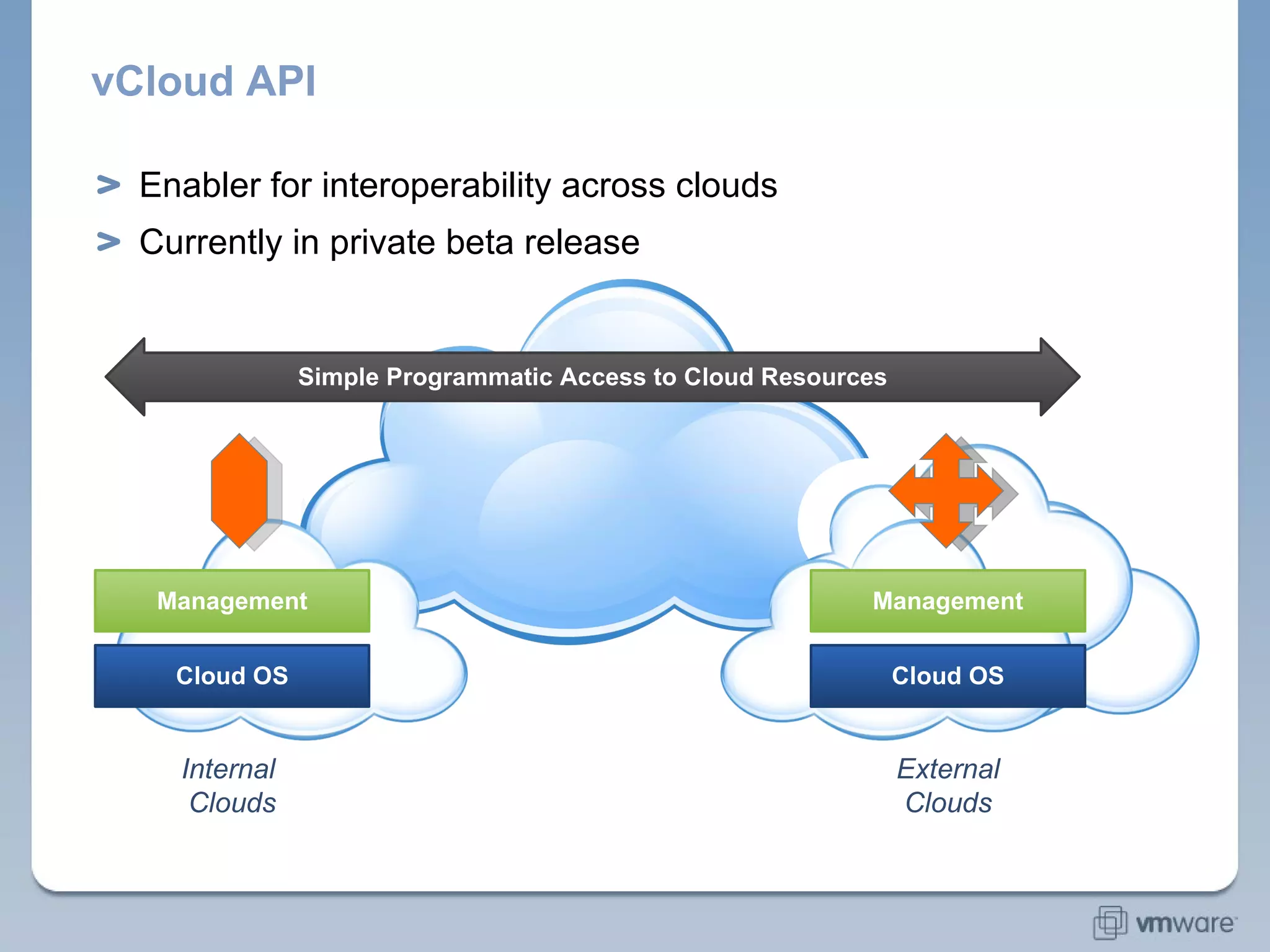
Enabler for interoperability across clouds Currently in private beta release vCloud API Internal  Clouds Cloud OS Management External Clouds Cloud OS Management Simple Programmatic Access to Cloud Resources
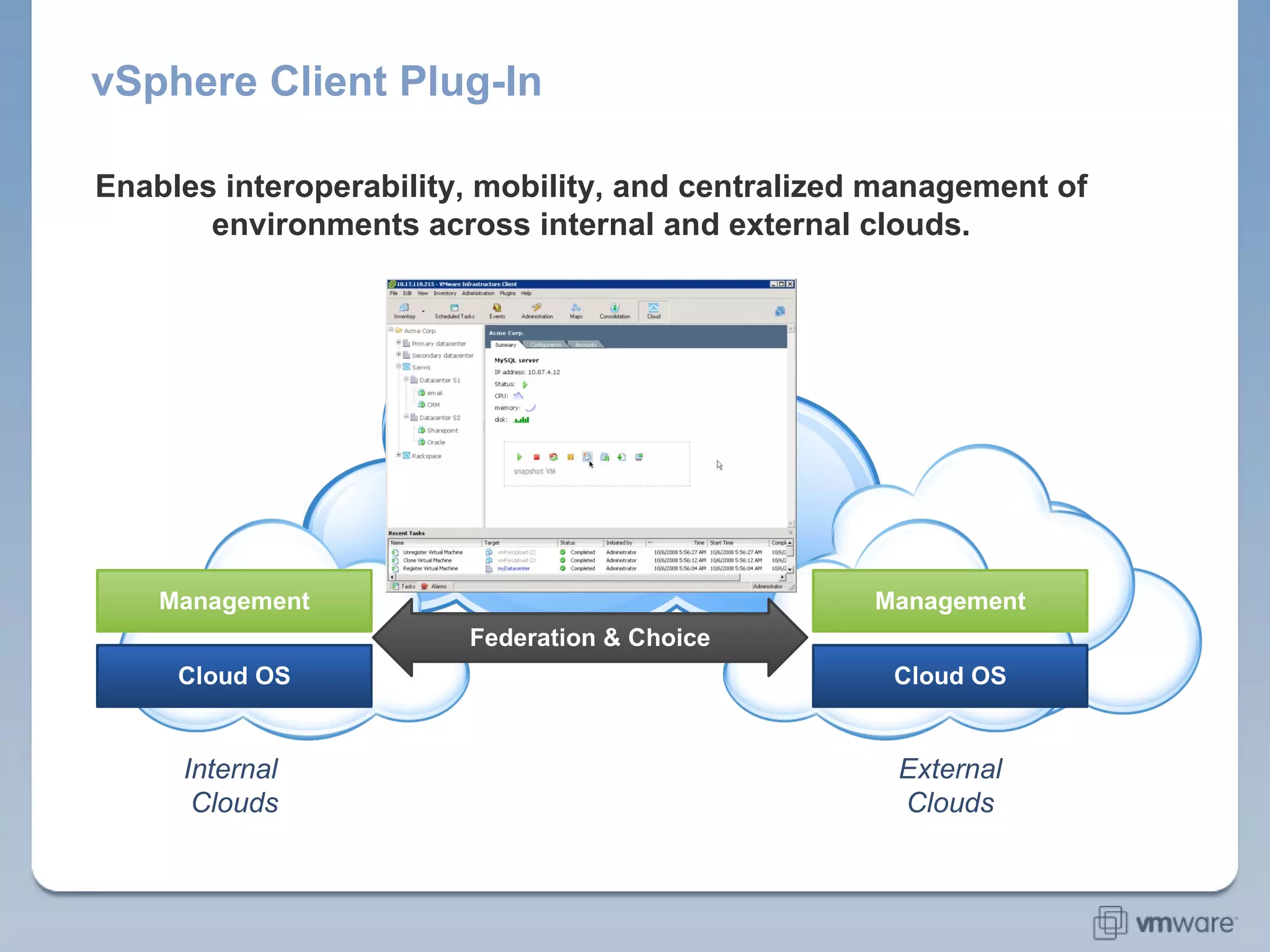
vSphere Client Plug-In Private Cloud Internal  Clouds Cloud OS Management Federation & Choice External Clouds Cloud OS Management Enables interoperability, mobility, and centralized management of environments across internal and external clouds. App Loads
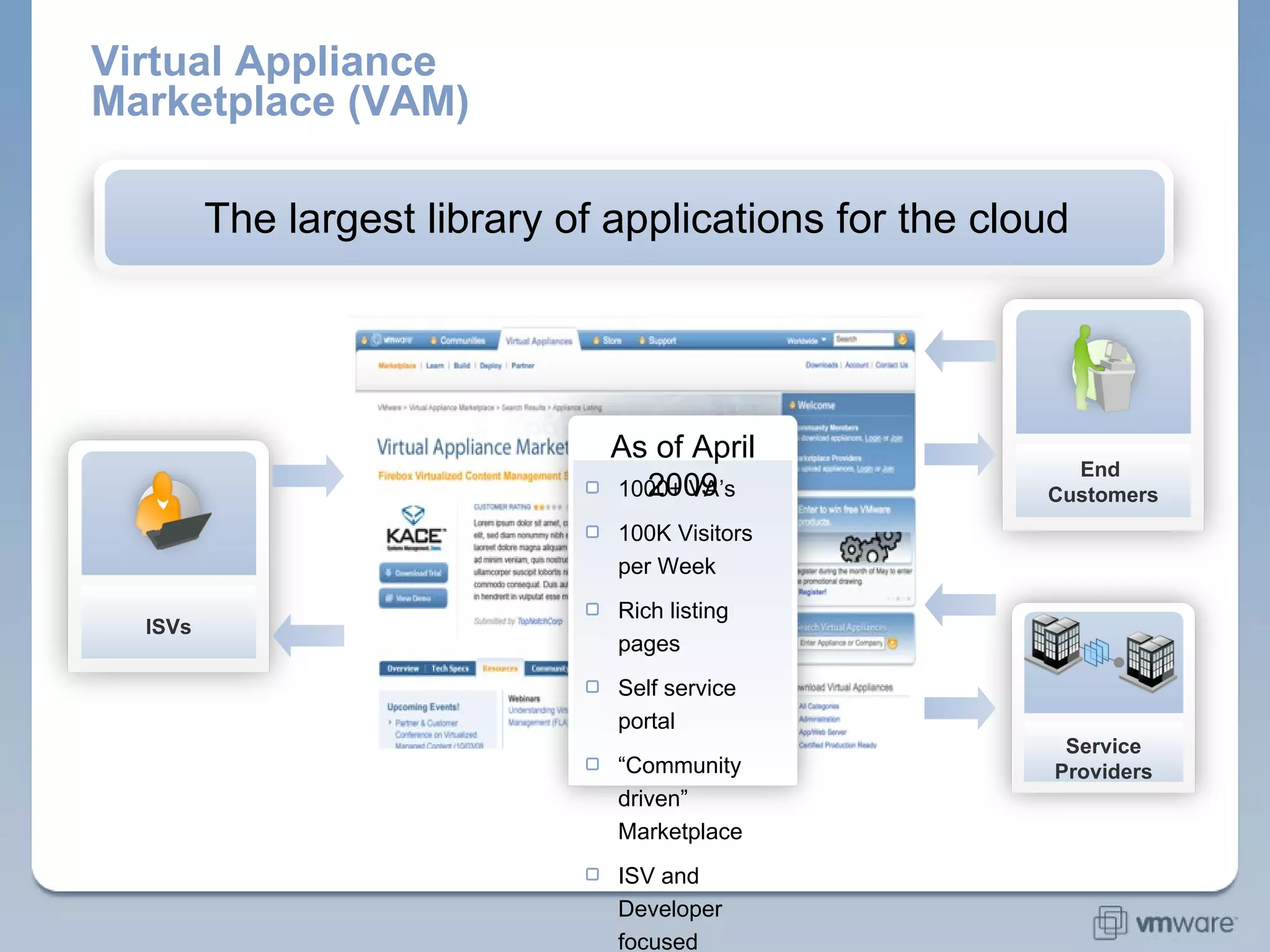
Virtual Appliance Marketplace (VAM) The largest library of applications for the cloud End  Customers ISVs Service Providers 1000+ VA’s 100K Visitors per Week Rich listing pages Self service portal “ Community driven” Marketplace ISV and Developer focused As of April 2009
VMworld 2009 Sessions DE-03 - Introduction to vCloud APIs TA3326 - Building an Internal Cloud-the Journey and the Details TA3901 - Security and the Cloud TA4100 - Internal Clouds: Customer perspective and implementations TA4101 - Buying the Cloud: Customer perspective and considerations on what you should send to an external cloud TA4103 - Engineering the Cloud-The Future of Cloud TA4102 - Unveiling New Cloud Technologies VM2706 - Improved cloud interoperability using virtualization management standards
Discussion… (Photo by Moonjazz @ Flickr)

Convergence of Private Clouds

  • 1.
    Convergence of PrivateClouds Greg A. Lato Solutions Consultant VMware July 28, 2008 (Photo by Moonjazz @ Flickr)
  • 2.
    CONVERGENCE * Windmovement that results in a horizontal net inflow of air into a particular region. Convergent winds at lower levels are associated with upward motion. (Photo by Moonjazz @ Flickr) * Weather.com
  • 3.
    Agenda Introduction W-W-Hof Private Clouds VMware Private Clouds Discussion…
  • 4.
    Introduction Who amI? … Greg A. Lato Global Accounts Solution Consultant, VMware Work with largest VMW customers, Global Fortune 500 Aggregate snapshot of my clients: 25,000+ VMs 450,000+ Employees $370B in yearly revenues Clients deploying Private Clouds now… Blog: www.latogalabs.com Twitter: latoga
  • 5.
    What are PrivateClouds? Who Should Care About Private Clouds? How are Private Clouds Built? (Photo by Nicholas_T @ Flickr)
  • 6.
    Virtualization is Foundationof Private Clouds Capacity On Demand Hypervisor Management Virtual Infrastructure Automate Separate Consolidate Aggregate Self-Managing Datacenter Server Consolidation Test and Development Computing Clouds On and Off Premise Hypervisor Hypervisor Management Hypervisor Management Virtual Infrastructure Automation Liberate
  • 7.
    What are PrivateClouds? 11 Replaced slide, notes remain the same Cloud Computing “ Web 2.0” Utility Computing Enterprise Data Center
  • 8.
    Move the Cloudto the Datacenter Replaced slide, notes remain the same Cloud Computing “ Web 2.0” Utility Computing Enterprise Data Center External Cloud Internal Cloud
  • 9.
    And Connect Internaland External Replaced slide, notes remain the same External Cloud Efficient Flexible Dynamic Trusted Reliable Secure Internal Cloud Private Cloud App Loads Federation
  • 10.
    Who Should CareAbout Private Clouds? IT Users Value Ability to react to market changes faster Pay for what they use Challenges Loss of “My Server is Special / Custom” attitude Accountability / Visibility for resource utilization
  • 11.
    Who Should CareAbout Private Clouds? IT Management Value Faster response to users needs Creating of new value drivers (transparency) Lower IT costs (standardization) Challenges Service Catalog Approach to IT Potential Shift of $ from CapEx to OpEx Chargeback Model Physical Data Center Architecture Cultural Shift
  • 12.
    Who Should CareAbout Private Clouds? IT Staff Value Less focus on operations, more on engineering Less “last minute hustling”, more proactive management Less late night maintenance, more work day maintenance Challenges Cultural Shift
  • 13.
    Who Should CareAbout Private Clouds? Application Developers Value Build apps the same way you do now No custom app frameworks No cloud specific app design paradigm Internal development clouds speed dev cycle and frees up “system administrator” New Delivery Option: Virtual Appliance Challenges Culture Shift Prying fingers from the Server…
  • 14.
    How are PrivateClouds Built? 6 Step Process Virtualization Tier the Infrastructure in QoS Resource Pools Create a Standardized Service Catalogue Make it Available Through Self-Service Fully Automate App Hosting Leverage External Clouds
  • 15.
    Step 1: Virtualization…Datacenter Infrastructure Virtualization Platforms Hardware, hypervisor and OS advances enable fully virtualized environments
  • 16.
    Step 2: Tierthe Infrastructure in QoS Resource Pools CPU/Mem Resource Pools Other Resource Pools Storage Resource Pools Virtualization Platforms … 1 N 2 3 … 1 N 2 3 … … Logical grouping of abstracted resources allows non-disruptive addition or subtraction of capacity Delivery of right resource / right time enabled by pools also allows infrastructure to be treated as a variable cost More profoundly, even in mixed vendor environments, it gives rise to a consistent tiering of resources which is the basis for a new, late-binding contract between applications and their infrastructure
  • 17.
    Step 2: Tierthe Infrastructure in QoS Resource Pools Virtual DC Infrastructure Virtual DC Infrastructure Virtual DC Infrastructure VDC 1 VDC N VDC 2 Groups of pools across resource types create virtual datacenters with performance, availability and other characteristics defined by both the underlying physical resource and the virtual layers Virtual DC QoS Virtual DC QoS Virtual DC QoS
  • 18.
    Step 3: Createa Standardized Service Catalogue Virtual DC Infrastructure Virtual DC Infrastructure Virtual DC Infrastructure VDC 1 VDC N VDC 2 Service Catalog VMUs are published as service offerings, accessed programmatically Conceptually, VMUs are a key step towards the simplification and standardization of IT that enables true lights-out operation Service Definition Virtual DC QoS Virtual DC QoS Virtual DC QoS vApp
  • 19.
    Step 4: Makeit Available Through Self-Service Virtual DC Infrastructure Virtual DC Infrastructure Virtual DC Infrastructure VDC 1 VDC N VDC 2 Service Catalog VMUs are published as service offerings, accessed programmatically Conceptually, VMUs are a key step towards the simplification and standardization of IT that enables true lights-out operation Service Definition Virtual DC QoS Virtual DC QoS Virtual DC QoS vApp
  • 20.
    Step 5: FullyAutomate App Hosting Application-Specific Provisioning, Monitoring and Enforcement Service offerings will become app-specific over time This eventually clears the way for automated application to infrastructure provisioning, enforcement and monitoring Closes the loop on app performance, and thereby completes the lights-out datacenter Zone 1 Zone N Zone 2 Resource Mapping and Enforcement Virtual DC QoS Virtual DC QoS Virtual DC QoS
  • 21.
    Step 6: LeverageExternal Clouds Burst Scale out to External Clouds Immediate scale out to External Cloud to cover resource shortage; migrate back internal once resources available External Cloud ensured same security and reliability as Internal cloud Private Cloud Internal Cloud App Loads External Cloud Virtual DC QoS Zone 1 Virtual DC QoS Zone N Application-Specific… Resource Mapping… Application-Specific… Resource Mapping…
  • 22.
    VMware Private CloudsVMware Private Clouds (Photo by Nicholas_T @ Flickr)
  • 23.
    VMware vCloud InitiativevCloud Virtual Datacenter OS Abstraction Aggregation Allocation Broad Application Support VMware Customers Service Partner Ecosystem
  • 24.
    Three Building Blocksfor the Private Cloud Private Cloud Internal Clouds Cloud OS Management Federation & Standards External Clouds Cloud OS Management vSphere App Loads 2 3 1
  • 25.
    VMware vSphere™ –Cloud Operating System Application Services Infrastructure Services Scalability vSphere 4.0 Security Availability vNetwork vStorage vCompute Dynamic Resource Sizing Network Management Firewall Anti-virus Intrusion Prevention Intrusion Detection Clustering Data Protection Storage Management & Replication Storage Virtual Appliances Hardware Assist Enhanced Live Migration Compatibility
  • 26.
    Infrastructure Services DeliverCapEx and OpEx Savings Highest consolidation ratios in the industry Most efficient use of hardware resources Low operational overhead
  • 27.
    Application Services ProvideBuilt in Service Level Controls
  • 28.
    Three Building Blocksfor the Private Cloud Private Cloud Internal Clouds Cloud OS Management Federation & Standards External Clouds Cloud OS Management vApp vCenter App Loads 2 3 1
  • 29.
    vApp – Describingand Deploying Applications Availability = 99.99% Security = High Performance = 500 msec SLA Definitions Cloud OS Application vServices Scalability Security Availability Allows management of multi-tier applications as a single entity Utilizes industry standard OVF to provide instructions on how to deploy Templates, Clone and other operations execute at the vService level Simpler, application centric view of management Easier portability of applications Applications can now be written to monitor and scale themselves vApp App OS App OS App OS
  • 30.
    Cloud Management ManagementPlatform Cloud OS Infrastructure Management Service Delivery Management Automation, Scalability and Extensibility Configuration, Capacity and Operations Enable Self-Service, Pay As You Go Cloud Management Datacenter/ Cloud
  • 31.
    vCenter Management SuiteInfrastructure Management Infrastructure Management Workflow orchestration Policy based mgmt Open and extensible Scale-out architecture SLA enforcement Delegated self-service Metered IT services Service catalog Private Cloud Management Characteristics Self optimizing Self healing Self regulating Self describing Management for a Private Cloud vCenter Management Capabilities Management Platform Automation Extensibility Infrastructure Management Infrastructure Management Capacity Chargeback Configuration Operations Architecture Service Delivery SLA Mgmt Self-service Plug-n-Play Provisioning
  • 32.
    Three Building Blocksfor the Private Cloud Private Cloud Internal Clouds Cloud OS Management Federation & Standards External Clouds Cloud OS Management OVF vCloud APIs App Loads 2 3 1
  • 33.
    OVF is theCommon Language Between Clouds Internal Clouds Cloud OS Management External Clouds Cloud OS Management Federation & Choice OVF
  • 34.
    Enabler for interoperabilityacross clouds Currently in private beta release vCloud API Internal Clouds Cloud OS Management External Clouds Cloud OS Management Simple Programmatic Access to Cloud Resources
  • 35.
    vSphere Client Plug-InPrivate Cloud Internal Clouds Cloud OS Management Federation & Choice External Clouds Cloud OS Management Enables interoperability, mobility, and centralized management of environments across internal and external clouds. App Loads
  • 36.
    Virtual Appliance Marketplace(VAM) The largest library of applications for the cloud End Customers ISVs Service Providers 1000+ VA’s 100K Visitors per Week Rich listing pages Self service portal “ Community driven” Marketplace ISV and Developer focused As of April 2009
  • 37.
    VMworld 2009 SessionsDE-03 - Introduction to vCloud APIs TA3326 - Building an Internal Cloud-the Journey and the Details TA3901 - Security and the Cloud TA4100 - Internal Clouds: Customer perspective and implementations TA4101 - Buying the Cloud: Customer perspective and considerations on what you should send to an external cloud TA4103 - Engineering the Cloud-The Future of Cloud TA4102 - Unveiling New Cloud Technologies VM2706 - Improved cloud interoperability using virtualization management standards
  • 38.
    Discussion… (Photo byMoonjazz @ Flickr)

Editor's Notes

  • #3 When two air masses meet, the air rises Air masses Virtualization in the Enterprise Data Center Cloud Computing Private Cloud computing is rising out of that convergence. What you see here is a Cumulonimbus cloud – the visual affect of meteorological convergence
  • #6 The W-W-H of Private Clouds
  • #7 It should come as no surprise to anyone here that Virtualization is the foundation for cloud computing.
  • #8 You have virtualization within your Enterprise Data Center. You have web 2.0 style utility computing available over the internet, classic Cloud Computing
  • #9 The classic cloud computing is what we refer to as the external cloud. Utility computing run outside of the IT organization. When we move the cloud into the data center we have the internal cloud.
  • #10 The Internal Cloud The External Cloud The Internal Cloud is your data center, trusted, reliable, secure The external cloud is someone elses data center which you can access: efficient, flexible, dynamic The private cloud is your internal cloud with can be extended (federated) into the external cloud. The private cloud may exist only internally but can also extend outside the enterprise walls for short or long periods of time.
  • #16 As stated earlier, step 1 is to virtualize your data center.
  • #17 Step two is group your data center resources into pools of similar resources
  • #18 Furthermore, you can add QOS and sub-divide your resource pools for greater control and flexibility.
  • #19 As mentioned previously as one of the challenges, creating a standardized service catalog is key to the private cloud. Services are sized and priced and made available via the catalogue: small, medium, large sized computer workloads. Software media centrally available for all to access.
  • #20 Once the service catalog is established, allow self-service access to the environment to the end users. Business needs can be meet at the IT User’s scheduled, without the need to interact with IT directly.
  • #21 Over time, the notion of self-service gives way to increasingly automated deployment. Tools for self-service access morph to include tools for defining application QoS and other parameters, which are interpreted and enforced by the infrastructure’s own provisioning management layer. Jumping off point for: vApps, Studio
  • #22 Additionally , The Cloud OS provides a common platform for datacenters and service providers, linked through federation and standards based interaction allowing the creation of private clouds leveraging common management services This allows datacenters to retain the choice of how they provide computing…without getting locked out of external clouds at a later date
  • #24 The VMware vCloud initiative, which is supported by over 100 service providers worldwide, including BT, Savvis, Verizon Business, and other leaders, delivers an enterprise-class cloud computing platform with broad support for existing and new applications, to enable federation between on and off premise clouds. The core technology underpinning the VMware vCloud Initiative is a set of Cloud vServices that provide the APIs and technologies to enable this federation to facilitate business needs such as flex capacity, disaster recovery or test and development. There are 4 core pillars to the vCloud: Most Efficient and Flexible Technology Platform for Cloud Computing A highly efficient, flexible and automated infrastructure is critical to enabling cloud computing both in the enterprise and on the public internet. vCloud services leverage unique capabilities of VMware Infrastructure to enable optimal delivery of cloud computing: Best in class hypervisor that provides highest single server efficiency: The ability to aggregate cost-effective x86 servers, storage and network into a single platform to achieve the highest cluster efficiency: Highly scalable infrastructure management via fully automated datacenter: Utility, pay-for-what-you-use infrastructure Further development with API’s enable users and cloud providers to build services. Broad Application Support vCloud services give enterprises choice and flexibility by enabling any application from legacy Windows NT to modern day Ruby-on-Rails to be deployed on-premise or off-premise—without disruption. Unlike other compute clouds that require applications to be built specifically to a single cloud computing platform and require complete rewrites of existing applications, millions of existing applications currently running on VMware Infrastructure can run on vCloud services without modification. For any size of organization, this application compatibility provides the flexibility to run applications where it makes the most sense, on premise or off with vCloud. Today VMware virtual appliances enable service providers to serve applications to users or help businesses deploy applications where they want, simply. vApps enable multiple virtual machines to be grouped with policies that follow them, making it simpler and more reliable to put your applications where you need to. Industry Leading Service Providers vCloud enables all kinds of customers and use cases to leverage cloud services by enabling an extensive and diverse ecosystem of services. With over 100 partners worldwide, the VMware Service Provider Program (VSPP) extends the vCloud platform and creates mobility and interoperability across common services built by VMware, service providers and customers themselves. vCloud Technologies ( Cloud vServices ) vCloud technologies will connect internal datacenters and external service provider offerings, enabling enterprises to move between on-premise and cloud-based services, to scale the infrastructure needed for peak load, service level management, and disaster recovery without expanding datacenter capacity.
  • #25 Additionally , The Cloud OS provides a common platform for datacenters and service providers, linked through federation and standards based interaction allowing the creation of private clouds leveraging common management services This allows datacenters to retain the choice of how they provide computing…without getting locked out of external clouds at a later date
  • #26 VMware vSphere™ is a cloud operating system - A cloud operating system is a new category of software that is specifically designed to holistically manage large collections of infrastructure – CPUs, storage, networking – as a seamless, flexible and dynamic operating environment. Analogous to the operating system that manages the complexity of an individual machine, the cloud operating system manages the complexity of a datacenter. Although alternative approaches may be pursued, VMware believes that virtualization is the key underpinning technology to enable the cloud. The cloud OS comprises infrastructure services that transform server, storage and network hardware into a shared resource and application services that are built in and available to all applications that run on it. Also equally important for an OS is the vibrant ecosystem that builds and complements it providing plug and play services to users Note: vCompute, vStorage and vNetwork represent categories of functionality provided by vSphere that abstract and aggregate server, storage and network hardware and allocate it precisely and efficiently to applications. Availability, Security and Scalability represent the categories of services that are provided by vSphere to all virtual machines that run on it.
  • #27 This is a quick summary of current and new infrastructure Services that deliver greater capital and operational savings than any other virtualization solution. Infrastructure services are components of the cloud OS that abstract away from the underlying server, storage and networking hardware; aggregate them and deliver them precisely as needed to applications At the highest level – vCompute services deliver the most efficient way to virtualize single servers and maximize utilization across and group of servers increasing capital and operational savings. vStorage services deliver abstraction from the type of storage and the most efficient use of storage in virtual environments vNetwok services deliver the most optimal way to integrate networking in virtual environments
  • #28 Application Services are components of the cloud OS that provide built in controls for service levels –these are usable with any application running on any OS inside a virtual machine – and can be turned on or off easily. This is a summary of all the new and existing application services that VMware vSphere™.
  • #29 Additionally , The Cloud OS provides a common platform for datacenters and service providers, linked through federation and standards based interaction allowing the creation of private clouds leveraging common management services This allows datacenters to retain the choice of how they provide computing…without getting locked out of external clouds at a later date
  • #30 vApp is the UPC barcode that specifies policies for applications running on the VDC OS Anyone using VMware Infrastructure can use the vApp to encapsulate a multi-virtual machine application ISVs can use VMware Studio to create vApps that can be automatically updated and maintained by VMware Infrastructure   vApp turns new and existing application into self-describing and self-managing entities. vApp leverages OVF, an open industry standard, to specify and encapsulate all components of a multi-tier application as well the operational the policies and service levels associated with it. Just like the UPC bar code contains all information about a product, the vApp gives application owners a standard way to describe operational policies for an application which the VDC-OS can automatically interpret and execute.
  • #33 Additionally , The Cloud OS provides a common platform for datacenters and service providers, linked through federation and standards based interaction allowing the creation of private clouds leveraging common management services This allows datacenters to retain the choice of how they provide computing…without getting locked out of external clouds at a later date
  • #36 Additionally , The Cloud OS provides a common platform for datacenters and service providers, linked through federation and standards based interaction allowing the creation of private clouds leveraging common management services This allows datacenters to retain the choice of how they provide computing…without getting locked out of external clouds at a later date